From Reality to Fabrication

From Reality to Fabrication: Engineering-Led 3D Modelling, Structural Verification and Build-Ready Documentation

In industrial and infrastructure projects, success is rarely determined by intent alone. It is determined by how accurately existing conditions are understood, how rigorously designs are validated, and how clearly fabrication information is communicated. At Hamilton By Design, we bridge the gap between site reality and fabrication by combining engineering-led 3D modelling, structural engineering, finite element analysis (FEA), and fabrication-ready documentation into a single, accountable workflow.

This integrated approach ensures that what is designed can be built, fits the first time, and performs as intended in service.

3D Modelling for Fabrication: Designing What Can Actually Be Built

3D modelling for fabrication is not simply about producing visually accurate geometry. It is about creating models that reflect real-world constraints, manufacturing tolerances, installation access, and structural behaviour. Hamilton By Design develops fabrication-grade 3D CAD models that are built around how components will be cut, welded, machined, lifted, and installed.

Our models are typically informed by site measurements, laser scanning, and as-built data to ensure alignment with existing structures and equipment. This is particularly critical in brownfield environments such as processing plants, material handling facilities, and industrial upgrades where assumptions based on legacy drawings are unreliable.

Each model is developed with downstream use in mind. Hole sizes, weld preparations, plate thicknesses, member sizes, and connection details are defined so fabricators can confidently transition from model to manufacture without reinterpretation or rework.

Structural Engineering Embedded in the Modelling Process

Structural engineering at Hamilton By Design is not a separate, downstream exercise. It is embedded directly within the 3D modelling process. Structural load paths, support conditions, connection behaviour, and serviceability requirements are considered as the model evolves, not after geometry is frozen.

This integrated method allows structural considerations to inform design decisions early, reducing late-stage redesigns and cost escalation. It also ensures compliance with relevant Australian Standards and industry-specific requirements, whether the project involves steel structures, plant support frames, access platforms, equipment foundations, or retrofit works.

By developing the structural model in parallel with the fabrication model, we maintain alignment between engineering intent and physical deliverables.

Finite Element Analysis: Verifying Performance, Not Guessing

Finite Element Analysis (FEA) plays a critical role in validating that a design will perform safely and efficiently under real operating conditions. Hamilton By Design applies FEA to assess stresses, deflections, load sharing, vibration response, and fatigue risk across a wide range of industrial applications.

FEA is particularly valuable where traditional hand calculations are insufficient or overly conservative. Complex geometries, dynamic loading, eccentric supports, impact forces, and non-uniform load distributions can all be assessed with greater confidence using simulation-based analysis.

Our FEA workflows are directly linked to the 3D CAD models used for fabrication. This ensures consistency between the analysed geometry and the manufactured outcome. Where analysis identifies areas of concern, design modifications are implemented directly in the model, creating a closed-loop engineering process that improves both safety and constructability.

As-Built Documentation: Capturing What Exists, Not What Was Assumed

Accurate as-built documentation is fundamental to effective engineering decision-making. In many facilities, original drawings are outdated, incomplete, or no longer representative of the installed condition. Hamilton By Design produces engineering-grade as-built documentation that reflects the true geometry and configuration of existing assets.

As-built documentation may include 3D models, general arrangement drawings, sectional views, and measured dimensions that form a reliable baseline for future upgrades, maintenance planning, and compliance assessments. This information reduces uncertainty, supports safer design decisions, and enables more efficient project planning.

For clients managing long-life assets, high-quality as-built data becomes a strategic resource rather than a one-off deliverable.

Fabrication Drawings That Reduce Risk on the Workshop Floor

Fabrication drawings are the point where engineering intent meets manufacturing reality. Poorly defined drawings lead to RFIs, delays, rework, and disputes. Hamilton By Design produces clear, unambiguous fabrication drawings that fabricators can trust.

Our drawings typically include detailed part drawings, assembly drawings, weld symbols, material specifications, tolerances, and notes aligned with the approved engineering model. Because these drawings are derived directly from fabrication-ready 3D models that have been structurally verified, inconsistencies between design and manufacture are minimised.

This approach supports faster fabrication turnaround, improved quality control, and smoother installation on site.

A Single, Accountable Engineering Workflow

One of the key advantages of Hamilton By Designโ€™s approach is single-source accountability. By delivering 3D modelling for fabrication, structural engineering, FEA, as-built documentation, and fabrication drawings within a unified workflow, we remove the handover gaps that often exist between consultants, designers, and fabricators.

Clients benefit from clearer communication, reduced coordination risk, and designs that are technically sound, buildable, and aligned with operational requirements. Fabricators benefit from models and drawings that reflect real conditions and engineering intent. Asset owners benefit from safer, more reliable outcomes delivered with fewer surprises.

Hamilton By Design logo displayed on a blue tilted rectangle with a grey gradient background

Engineering That Stands Up in the Real World

At Hamilton By Design, engineering is not about producing documents in isolation. It is about delivering outcomes that work in the real worldโ€”on site, in fabrication workshops, and over the life of an asset. By integrating 3D modelling for fabrication with structural engineering, finite element analysis, as-built documentation, and fabrication drawings, we provide a robust foundation for successful industrial projects.

This engineer-led, fabrication-focused approach ensures that designs are not only accurate on screen, but reliable, buildable, and fit for purpose in operation.

Our clients:


Name
Would you like us to arrange a phone consultation for you?
Address

3D CAD Modelling | 3D Scanning

Hamilton By Design

3D LiDAR Scanning Solutions Australia: Capturing Engineering-Grade Accuracy for Mining, Industrial & Infrastructure Projects

3D LiDAR scanning has rapidly become one of Australiaโ€™s most valuable engineering tools โ€” and for good reason. From mining CHPPs to power stations, manufacturing plants, processing facilities, marine infrastructure, and complex brownfield upgrades, LiDAR delivers accuracy, clarity, and reliability that traditional measurement methods simply canโ€™t match.

Across Australiaโ€™s most demanding industrial regions โ€” the Hunter Valley, Bowen Basin, Pilbara, Mount Isa, Central Coast, Sydney, Adelaide, and beyond โ€” Hamilton By Design provides engineering-grade 3D LiDAR scanning, mechanical design, and full digital-engineering workflows that help clients minimise shutdown duration, eliminate rework, and make better decisions.

This page explains what 3D LiDAR scanning is, why it matters, and how it delivers real, measurable benefits to Australian mining, industrial, and manufacturing operations.


What Is 3D LiDAR Scanning?

LiDAR (Light Detection and Ranging) uses laser pulses to measure millions of points per second, capturing the exact geometry of equipment, structures, and environments. The result is a high-resolution point cloud that serves as a digital replica of the asset โ€” precise down to the millimetre.

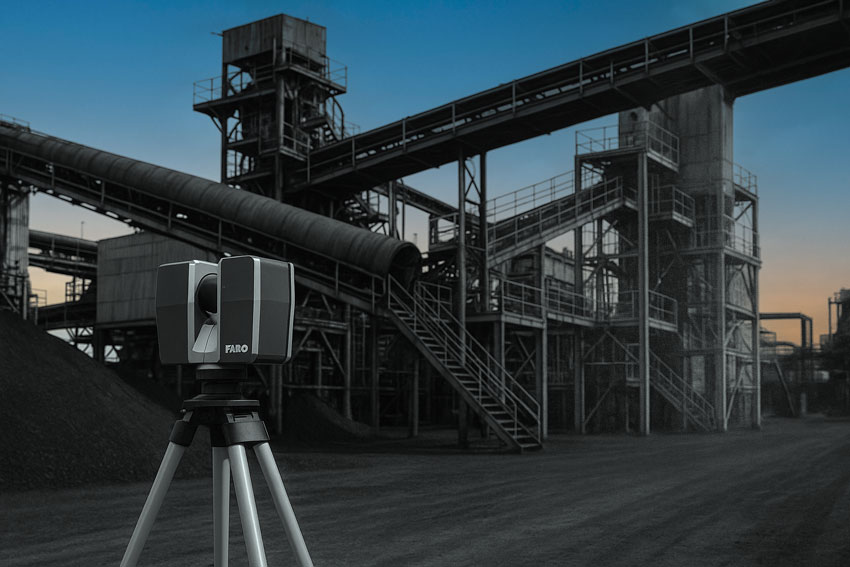
Hamilton By Design uses FARO engineering-grade scanners delivering:

  • ยฑ1โ€“2 mm accuracy
  • Full-colour point clouds
  • Safe, fast external and internal scanning
  • High-resolution data suitable for mechanical design and fabrication

This accuracy allows us to model steelwork, chutes, conveyors, piping, tanks, equipment frames, building interiors, structural interfaces, and entire wash plants with confidence.


Why Australian Industries Are Turning to LiDAR

Australiaโ€™s mining, energy, and industrial sectors face unique pressures:
tight shutdown windows, ageing infrastructure, safety constraints, limited access, and the constant demand for more accurate data.

LiDAR scanning solves these challenges by offering:

1. Fast, Safe, Non-Contact Measurement

No climbing into hazardous areas.
No lengthy tape measurements.
No assumptions.

LiDAR captures everything from a safe distance โ€” ideal for CHPPs, crushing circuits, transfer towers, power stations, and restricted plant rooms.


2. Zero Guesswork in Brownfield Engineering

Brownfield sites are messy. Nothing is straight, square, or built to the original drawing anymore.

With LiDAR:

  • Misalignment is captured
  • Deformation is visible
  • Corrosion and sag are measurable
  • Legacy drawings can be validated or corrected

This drastically reduces design error across upgrades, fabrication, and shutdown works.


3. Millimetre-Accurate 3D Models for Fabrication

After scanning, Hamilton By Design converts the point cloud into:

  • SolidWorks 3D models
  • GA drawings
  • Fabrication drawings
  • DXF profiles
  • Shop-ready detail packs

Fabricators love it because parts fit the first time, and rework is almost eliminated.


4. Better Shutdown Planning

LiDAR scanning provides clear digital visibility of:

  • Access routes
  • Lifting paths
  • Structural constraints
  • Tie-in locations
  • Clash points

This leads to safer, faster, more predictable shutdown execution.


5. Digital Twins for Long-Term Asset Management

A structured point cloud becomes a digital baseline for future planning.
Clients use it for:

  • Condition monitoring
  • Deviation tracking
  • Long-term upgrade planning
  • Documentation for compliance

It builds engineering resilience into the asset lifecycle.


Industries We Support Across Australia

Hamilton By Design delivers LiDAR scanning and mechanical engineering solutions nationwide, supporting:

Mining & Heavy Industry

  • CHPPs
  • Coal handling plants
  • Hard-rock processing facilities
  • Underground & surface operations
  • Conveyors, chutes, crushers, screen houses

Energy & Utilities

  • Power stations
  • Turbine halls
  • Boiler houses
  • Substations
  • Cooling water systems

Manufacturing & Industrial

  • Plants and factories
  • Production lines
  • Warehouses
  • Material-handling systems

Data Centres & Infrastructure

  • Fit-out scans
  • MEP coordination
  • Expansion planning
  • Brownfield integration

Wherever precision and clarity are required, LiDAR scanning adds value.


Our Digital Engineering Workflow

Hamilton By Design integrates LiDAR scanning into a full project lifecycle:

  1. On-site LiDAR scan using FARO engineering-grade equipment
  2. Processing in FARO Scene to create a clean, structured point cloud
  3. Import into SolidWorks for modelling of required geometry
  4. 3D modelling & mechanical design
  5. Clash detection & feasibility checks
  6. 3DEXPERIENCE reviews with clients
  7. Fabrication drawings, DXF files, and shop packs
  8. Handover + digital twin for future works

This ensures absolute clarity from the first scan to the final signed-off drawing.


Benefits for Australian Projects

โœ” Parts fit first time

โœ” Shutdown durations reduced

โœ” Fabricators receive complete, accurate information

โœ” Safer site access with fewer high-risk activities

โœ” Eliminates rework, delays, and measurement errors

โœ” Enhances engineering collaboration

โœ” Reduces total project cost

LiDAR scanning isnโ€™t just a measurement method โ€” itโ€™s a competitive advantage.


Why Choose Hamilton By Design

  • Over a decade of experience in heavy industry
  • Extensive CHPP and mining plant expertise
  • SolidWorks Simulation, FEA, and advanced modelling capability
  • Fast mobilisation across Australia
  • Detailed, fabrication-ready deliverables
  • LinkedIn-trusted and industry-proven
  • Engineering accuracy at every step

For clients across the Hunter Valley, Bowen Basin, Pilbara, NSW, QLD, WA, and SA โ€” we offer scalable, high-precision digital engineering that delivers reliability and confidence.


Hamilton By Design logo displayed on a blue tilted rectangle with a grey gradient background

Ready to Start Your Project?

Hamilton By Design offers 3D LiDAR scanning anywhere in Australia, from mine sites to manufacturing plants to data centres.

If youโ€™re planning:

  • an upgrade
  • a shutdown
  • a brownfield expansion
  • a feasibility study
  • or an equipment replacement

โ€ฆLiDAR scanning is the smartest starting point.

Contact us today to book a site scan or request a proposal.

Name
Address
You would like to:

3D Point Clouds Are a Game-Changer for Your Projects

Your Experts in 3D Laser Scanning & Mechanical Design

3D CAD Modelling | 3D Scanning

3D Experience Platform Login

Why Shutdown Parts Donโ€™t Fit โ€” And How 2 mm LiDAR Scanning Stops the Rework

When Parts Donโ€™t Fit, Shutdowns Fail

Every shutdown fitter, maintenance crew member, and supervisor has lived the same nightmare:

A critical part arrives during shutdown.
The old part is removed.
Everyone gathers, ready to install the new one.
Production is waiting.
The pressure is on.

And thenโ€”
the part doesnโ€™t fit.

Not 2 mm out.
Not 10 mm out.
Sometimes 30โ€“50 mm out, wrong angle, wrong bolt pattern, wrong centreline, or wrong geometry altogether.

The job stops.
People get frustrated.
Supervisors argue.
Fitters cop the blame.
The plant misses production.
And someone eventually says the words everyone hates:

โ€œPut the old worn-out chute back on.โ€

This blog is about why shutdowns fall apart like thisโ€ฆ and how 2 mm LiDAR scanning finally gives fitters a system that gets it right the first time.


The Real Reason Parts Donโ€™t Fit

Most shutdown failures have nothing to do with the fitter, nothing to do with the workshop, and nothing to do with the installation crew.

Parts donโ€™t fit because:

  • Wrong measurements
  • Bad drawings
  • Outdated as-builts
  • Guesswork
  • Fabricators โ€œeyeballingโ€ dimensions
  • Cheap non-OEM parts purchased without geometry verification
  • Designers who have never seen the site
  • High staff turnover with no engineering history
  • Wear profiles not checked
  • Intersection points impossible to measure manually

Fitters are then expected to make magic happen with a tape measure and a grinder.

Itโ€™s not fair. Itโ€™s not professional. And itโ€™s completely avoidable.


Shutdown Pressures Make It Even Worse

When a part doesnโ€™t fit during a shutdown:

  • The entire job stalls
  • Crews stand around waiting
  • The supervisor gets hammered
  • The fitter gets the blame
  • Other shutdown tasks cannot start
  • The clock ticks
  • Production loses thousands per hour
  • Everyone becomes stressed and angry

And the worst part?

You were only replacing the part because the existing one was worn out.
Now youโ€™re bolting the worn-out one back on.

This isnโ€™t good enough.
Not in 2025.
Not in heavy industry.
Not when there is technology that eliminates this problem completely.


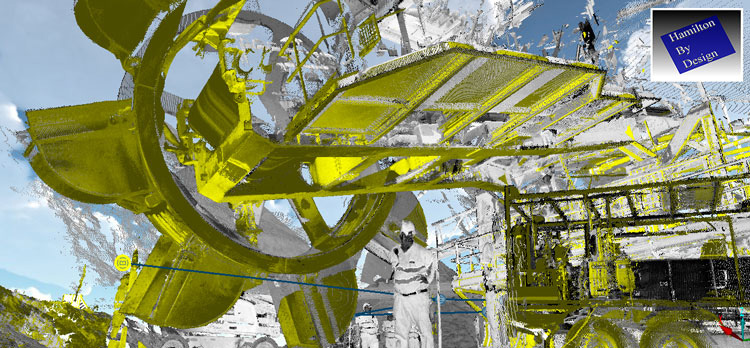
Coloured 3D LiDAR point-cloud scan of industrial CHPP machinery, including a large rotating component and surrounding structures. A worker stands beside the equipment for scale, with the Hamilton By Design logo displayed in the top-right corner.

Why Manual Measurement Fails Every Time

Fitters often get asked to measure:

  • Inside chutes
  • Wear sections
  • Pipe spools with intersection points
  • Tanks too large to measure from one position
  • Walkways too long for tape accuracy
  • Geometry with no records
  • Components 10+ metres above ground
  • Hard-to-reach bolt patterns
  • Angles and centrelines distorted by wear

But some measurements simply cannot be taken safely or accurately by hand.

You canโ€™t hang off an EWP 20 metres up measuring a worn flange angle.
You canโ€™t crawl deep inside a chute trying to measure intersecting surfaces.
You canโ€™t take a 20-metre walkway measurement with a tape measure and hope for precision.

This is not a measurement problem.
This is a method problem.

Manual measurement has hit its limit.
Shutdowns have outgrown tape measures.


This Is Where 2 mm LiDAR Scanning Changes Everything

Hamilton By Design uses 2 mm precision LiDAR scanning to capture the exact geometry of a site โ€” even in areas that are:

  • Too high
  • Too big
  • Too unsafe
  • Too worn
  • Too complex
  • Too tight
  • Too distorted to measure manually

From the ground, up to 30 metres away, we can capture:

  • Wear profiles
  • Flange positions
  • Bolt patterns
  • Pipe centrelines
  • Chute geometry
  • Conveyor interfaces
  • Complex intersections
  • Ductwork transitions
  • Mill inlet/outlet shapes
  • Tank dimensions
  • Walkway alignment
  • Structural deflection
  • Existing inaccuracies

No tape measure. No guesswork. No EWP. No risk.

The result is a perfect 3D point cloud accurate within 2 mm โ€” a digital version of real life.


2 mm Scanning + Fitter-informed Design = Parts That Fit First Time

This is where Hamilton By Design is different.

We donโ€™t just scan and hand the files to a drafter whoโ€™s never set foot on-site.

We scan and your parts are modelled by someone who:

  • Has been a fitter
  • Understands how parts are installed
  • Knows what goes wrong
  • Knows how to design parts that actually fit
  • Knows where shutdowns fail
  • Knows what to check
  • Knows what NOT to trust
  • And most importantly โ€” knows where the real-world problems are hidden

This fitter-informed engineering approach is why our parts fit the first time.

And why shutdown crews trust us.


Digital QA Ensures Fabrication Is Correct Before It Leaves the Workshop

Once the new chute, spool, or component is modelled, we run digital QA:

  • Fit-up simulation
  • Clash detection
  • Tolerance analysis
  • Wear profile compensation
  • Reverse engineering comparison
  • Bolt alignment verification
  • Centreline matching
  • Flange rotation accuracy
  • Structural interface checks

If something is out by even 2โ€“3 mm, we know.

We fix it digitally โ€” before the workshop cuts steel.

This stops rework.
This stops shutdown delays.
This stops blame.
This stops stress.

This is the future of shutdown preparation.


Accuracy of 3D LiDAR Scanning With FARO


When the Part Fits, Everything Runs Smooth

Hereโ€™s what actually happens when a chute or spool fits perfectly the first time:

  • The plant is back online faster
  • No rework
  • No reinstalling old worn-out parts
  • No arguing between fitters and supervisors
  • No unexpected surprises
  • No extra access equipment
  • No late-night stress
  • No grinding or โ€œmaking it fitโ€
  • Other shutdown tasks stay on schedule
  • Everyone looks good
  • Production trusts the maintenance team again

Shutdowns become predictable.
Fitters become heroes, not last-minute problem-solvers.


Shutdown Example (Anonymous but Real)

A major processing plant needed a large chute replaced during a short shutdown window.
Access was limited.
The geometry was distorted.
Measurements were impossible to take safely.
The workshop needed exact dimensions, fast.

Hamilton By Design scanned the entire area from the ground โ€” no EWP, no risk.

We produced:

  • Full 2 mm point cloud
  • As-built 3D model
  • New chute design
  • Digital fit-up validation
  • Workshop-ready drawings

The new chute arrived on site.
The old chute came out.
The new chute went straight in.
Zero rework.
Zero stress.
Plant online early.

The supervisor called it the smoothest shutdown theyโ€™d had in 10 years.


Why Fitters Should Reach Out Directly

Sometimes fitters know more about whatโ€™s really happening on-site than anyone in the office.

Fitters see the problems.
Fitters carry the blame.
Fitters deal with the rework.
Fitters just want parts that fit.

So weโ€™re making this simple:

If youโ€™re tired of fitting parts that donโ€™t fit โ€”
If youโ€™re tired of fixing other peopleโ€™s mistakes โ€”
If youโ€™re tired of shutdown stress โ€”

Call Hamilton By Design.

We scan it.
We model it.
We get it right.
Every time.


Services Featured

Hamilton By Design offers:

  • 3D LiDAR laser scanning (2 mm precision)
  • 3D modelling by a fitter-engineer who understands real-world installation
  • Digital QA before fabrication
  • Reverse engineering of worn components
  • Shutdown planning support
  • Fabrication-ready drawings
  • Fit-up simulation
  • Clash detection between old and new parts

This is how shutdowns run smooth.

Hamilton By Design logo displayed on a blue tilted rectangle with a grey gradient background

Call to Action

Are you a Fitter: tired of parts that donโ€™t fit?

Email or Call Hamilton By Design.

Email โ€“ info@hamiltonbydesign.com.au

Phone – 0477002249


Would you Like to Know more?

Name
Would you like us to arrange a phone consultation for you?
Address

Our clients:

Accuracy of 3D LiDAR Scanning With FARO

Why Shutdown Parts Donโ€™t Fit

Engineering Services

Coal Chute Design

Chute Design

3D CAD Modelling | 3D Scanning