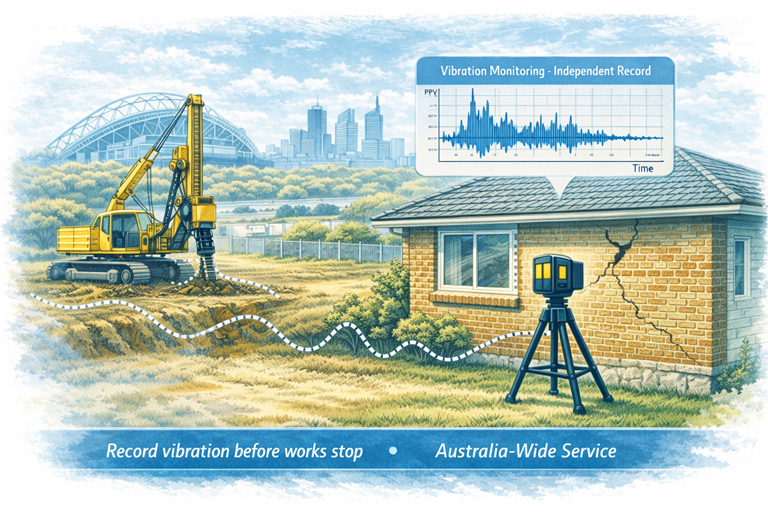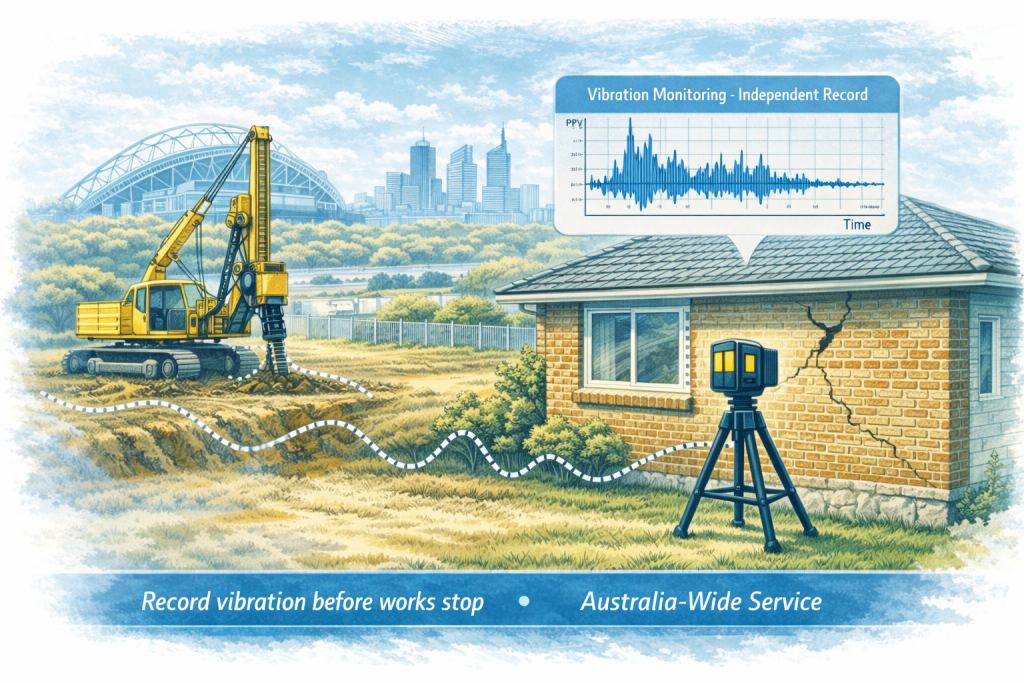
Read This Before Cracks Appear
Construction in Australia is getting closer to existing homes than ever before. Subdivisions, duplex developments, basement garages and boundary wall construction now routinely occur only metres from established houses.
One of the most misunderstood risks during nearby construction is ground vibration — particularly from piling, sheet piling, rock breaking and compaction equipment.
Most homeowners only notice the issue once cracks appear.
By that point, proving the cause becomes significantly harder.
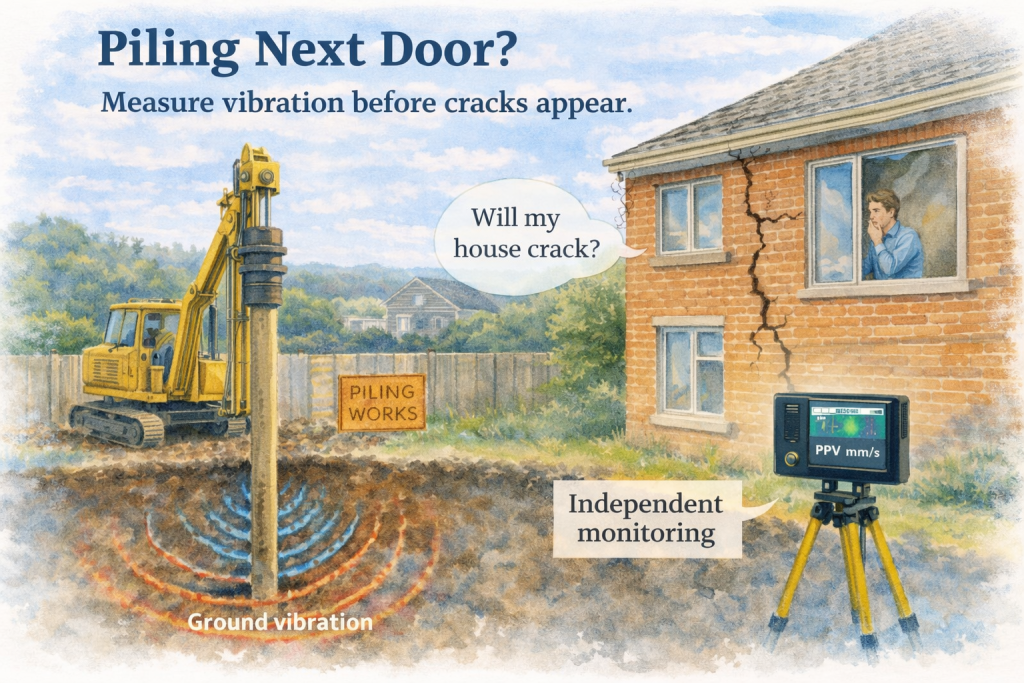
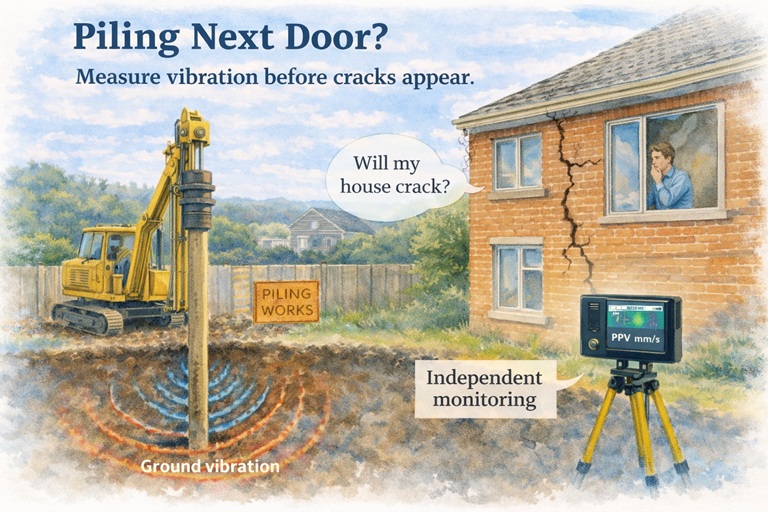
What Is Actually Happening During Piling?
When a neighbouring builder installs piles, the ground does not simply “shake” — it transmits energy waves through the soil.
These waves travel through the foundation system of your home and can interact with the structure in very specific ways.
Depending on soil type and building construction, vibration can:
- Amplify inside brick veneer cavities
- Transfer through footings into slab edges
- Excite steel lintels above windows
- Cause differential movement between materials
- Open previously dormant shrinkage cracks
- Break brittle materials like grout and plasterboard joints
Many owners describe it as feeling like a truck hitting the house repeatedly — and structurally, that is not far from reality.
The Critical Problem — Evidence
Here is the reality:
If you do not measure vibration before damage occurs, proving responsibility later becomes extremely difficult.
Once construction finishes:
- The vibration source is gone
- Monitoring cannot be retroactively installed
- Engineers must rely on assumptions
- Insurance claims are often rejected
- Builders argue pre-existing damage
This is why most vibration disputes fail — not because damage didn’t happen, but because it wasn’t recorded at the time.
Why Cracks Appear Days or Weeks Later
Damage does not always occur instantly.
Vibration commonly causes:
- Micro-movement in mortar joints
- Loosening of interfaces between materials
- Progressive settlement in reactive soils
Then later:
- A hot day
- Rain event
- Door closing
- Minor thermal expansion
…and the crack becomes visible.
The construction activity triggered the mechanism — but the visible damage appears later.
Without monitoring, causation becomes nearly impossible to demonstrate.
Australian Standards — The Legal Threshold
Australian and international building damage criteria are based on Peak Particle Velocity (PPV), not how strong vibration feels.
Typical residential guidance limits:
| Frequency | Cosmetic Damage Threshold |
|---|---|
| < 10 Hz | ~5 mm/s |
| 10–50 Hz | 5–15 mm/s |
| > 50 Hz | up to 20 mm/s |
Important:
Human perception is NOT a reliable indicator of structural damage risk.
Some damaging vibrations feel mild.
Some strong sensations cause no damage.
Only instrumentation determines the difference.
What You Should Do — Before Work Starts
If you have received a notice of:
- Piling
- Rock breaking
- Basement excavation
- Sheet piling
- Compaction works
- Demolition close to boundary
You should arrange:
1. Pre-Construction Condition Survey
Photographic and measured documentation of existing condition.
2. Vibration Monitoring Installation
Sensors installed before the first machine arrives.
3. Continuous Logging During Construction
Provides legal evidence if thresholds are exceeded.
Why Timing Matters
The most valuable data occurs during the first day of piling.
After that:
- Cracks may already initiate
- You have no baseline
- Arguments become opinion-based
Early measurement protects everyone — homeowner and builder alike.
Who Is Responsible?
In Australia, responsibility is generally determined by measurable physical impact, not perception.
Courts consistently require:
- Recorded vibration data
- Engineering interpretation
- Demonstrated building response
Without measurement, claims rely on visual opinion — which rarely succeeds.
Peace of Mind Is the Real Outcome
Many monitored projects show vibration stays within acceptable limits.
In those cases, owners gain certainty their home is safe.
Monitoring is not about creating conflict — it is about removing uncertainty.
We Travel Australia-Wide
Hamilton By Design provides independent vibration recording across Australia, including regional and remote locations.
We install monitoring equipment prior to construction and provide documented records suitable for engineering or legal use if required.
If Construction Is About To Start Next Door
Do not wait for cracks.
Once visible damage appears, the opportunity to capture critical evidence has often already passed.
👉 Arrange vibration monitoring before works commence:
https://www.hamiltonbydesign.com.au/construction-vibration-monitoring-home-australia/
Final Thought
You insure your house against fire and storm — events that may never happen.
Nearby construction is different.
It will happen, and it will introduce measurable forces into your home.
The question is not whether vibration occurs.
The question is whether it will be recorded.
Hamilton By Design
Engineering Measurement & 3D Spatial Documentation
Australia Wide