Surface Mine 3D LiDAR Scanning for Brownfield Mine Sites

Surface mines across the Hunter Valley and Upper Hunter are constantly changing. Coal handling plants, conveyors, transfer stations, pump stations, workshops, access platforms, pipework, chutes, bins and rail load-out areas are regularly modified to keep production moving. Some changes are part of planned capital upgrades. Others happen during shutdowns, maintenance windows or urgent repair work.
After years of brownfield modifications, the problem becomes simple: the plant on site no longer matches the drawings.
For surface mine operators, outdated drawings create real engineering and shutdown risk. Engineers may design around old information. Fabricators may manufacture parts that do not fit. Shutdown planners may miss access restrictions, clashes or tie-in issues. Installation crews may arrive on site only to discover that pipework, steelwork, guards, walkways or equipment are not where the drawings say they are.
This is where 3D laser scanning provides real value. By capturing accurate existing-condition data of the installed plant, mine operators and engineering teams can make decisions based on what is actually on site, not what was originally drawn years ago.
Hamilton By Design provides engineering-grade 3D LiDAR scanning, point cloud processing, scan-to-CAD modelling and as-built verification for Hunter Valley surface mines and brownfield industrial sites.
Locations Supported Across the Hunter Valley and Upper Hunter
Hamilton By Design supports surface mine and heavy industrial projects across the Hunter Valley, Upper Hunter and surrounding mining support regions, including:
Singleton, Muswellbrook, Ravensworth, Lemington, Warkworth, Mount Thorley, Broke, Bulga, Camberwell, Hebden, Jerrys Plains, Rixs Creek, Glennies Creek, Maison Dieu, Whittingham, Liddell, Bayswater, Aberdeen, Denman, Scone, Maitland, Cessnock, Lake Macquarie, Newcastle and the Port of Newcastle corridor.
These locations are affected by the same brownfield engineering problem. Mine plant is modified over time, but the drawing register does not always keep up. A conveyor transfer station may have extra guarding. A pump station may have replacement pipework. A CHPP may have modified chutes, platforms, cable trays and access stairs. A rail load-out area may have structural or mechanical changes that are not fully documented.
Hamilton By Design also supports industrial and mining clients beyond the Hunter Valley through 3D laser scanning across Australia, helping project teams capture reliable as-built data for plant upgrades, shutdown planning, fabrication checks and engineering verification.
Why Existing Surface Mine Drawings Become Outdated
Surface mine infrastructure rarely stays the same for long. Production requirements change. Maintenance teams improve access. Process engineers adjust layouts. Shutdown crews replace equipment. Fabricators install revised steelwork. Emergency repairs become permanent. Over time, these small changes create a large difference between the original drawings and the actual plant.
Common causes of outdated drawings include:
| Brownfield Change | Resulting Risk |
|---|---|
| Conveyor upgrades | New chutes, guards or drives may not match old layouts |
| CHPP modifications | Pipework, platforms and equipment positions may change |
| Pump station changes | Flanges, valves and pipe supports may not be in the documented location |
| Structural access upgrades | Stairs, ladders, handrails and platforms may have been added or replaced |
| Shutdown repairs | Temporary supports or modifications may become permanent |
| Replacement equipment | New motors, pumps, screens or gearboxes may have different footprints |
| Rail load-out changes | Structural and mechanical interfaces may no longer match original drawings |
| Site services modifications | Cable trays, water lines, air lines and drainage may be undocumented |
When drawings are unreliable, engineering design becomes slower and riskier. More time is spent checking dimensions, confirming interfaces and resolving clashes. In a shutdown environment, that uncertainty can become expensive very quickly.
What 3D LiDAR Scanning Captures
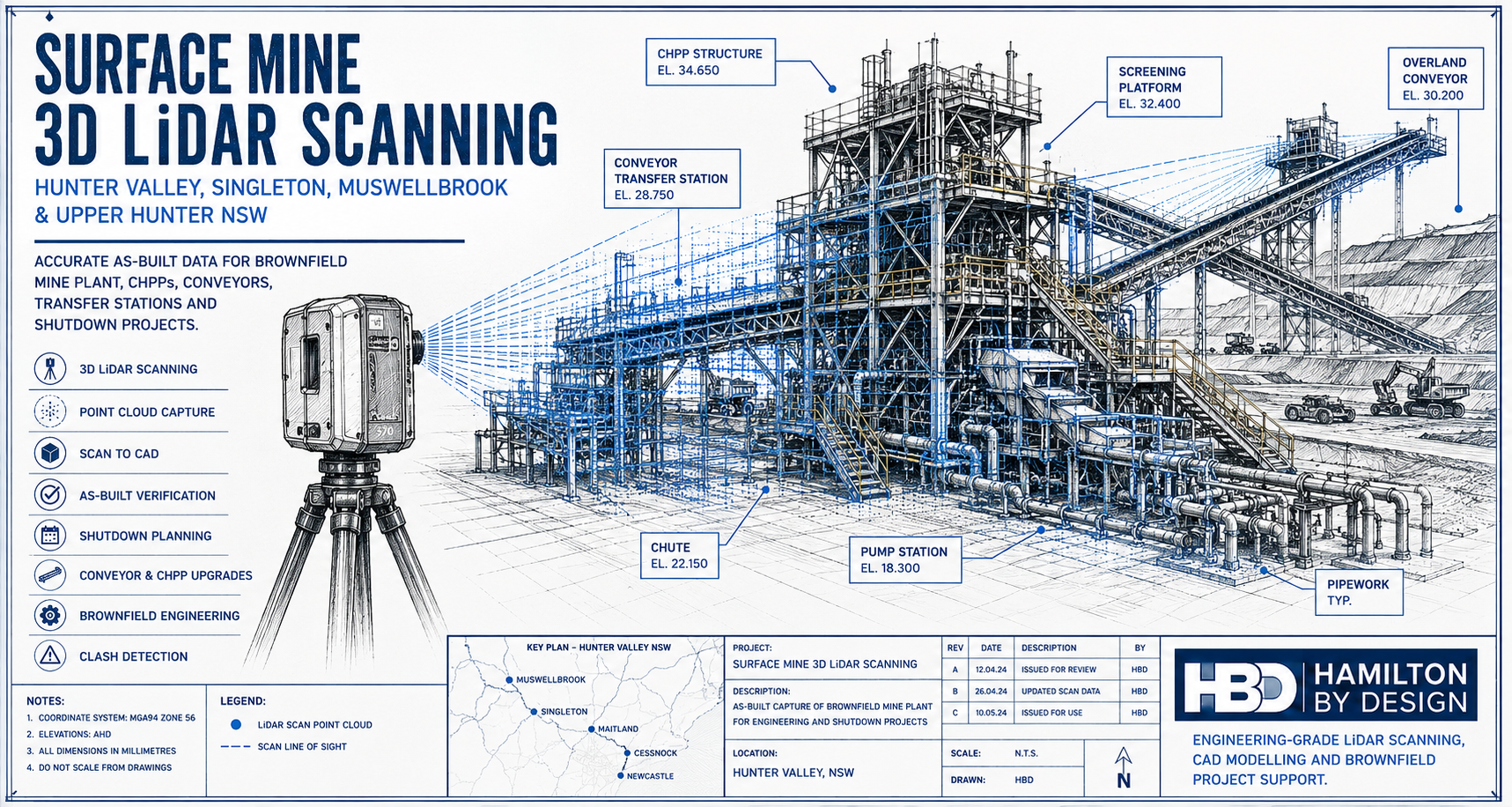
3D LiDAR scanning captures the existing mine plant as a measured 3D point cloud. The scanner records millions of points from multiple positions, creating a detailed digital record of the installed site condition.
For surface mining projects, LiDAR scanning can capture:
- Conveyor transfer stations
- CHPP areas
- Crusher stations
- Screens and bins
- Chutes and hoppers
- Pump stations
- Pipework and valve stations
- Structural steelwork
- Platforms, stairs, ladders and handrails
- Workshops and maintenance bays
- Rail load-out structures
- Stockpile conveyor systems
- Water management infrastructure
- Electrical rooms and cable tray support areas
- Brownfield tie-in zones
The point cloud can then be used for engineering review, CAD modelling, clash detection, as-built documentation, shutdown planning and fabrication support.
Turning Scan Data into Engineering Information
The scan is only the first step. The real value comes from turning point cloud data into information engineers, fabricators and project teams can use.
Hamilton By Design can convert captured site data into 3D CAD modelling outputs suitable for mechanical layouts, plant upgrades, fabrication planning, clash checking and as-built documentation.
For example, if a mine is planning to replace a chute, the scan can capture the surrounding steelwork, conveyor geometry, access platforms, guards and nearby equipment. The design team can then model the new chute around the actual site conditions. This reduces the chance of a clash during installation.
If a pump station is being modified, LiDAR scanning can confirm the true location of pipework, flanges, valves, supports and access clearances. This helps fabricators produce more accurate spools and reduces the need for site rework.
If a CHPP area has been modified many times, scanning can provide an updated as-built record that engineers can use for future upgrades.
For shutdown projects, the value is even greater. Shutdown windows are limited. Mistakes are costly. If parts do not fit, access is blocked or tie-in points are wrong, the project can lose valuable time. 3D LiDAR scanning helps reduce those unknowns before the shutdown begins.
Typical Deliverables
Hamilton By Design can support surface mine scanning projects with practical engineering deliverables, including:
| Deliverable | Purpose |
|---|---|
| Registered point cloud | Accurate 3D record of the existing plant |
| E57 / RCP / RCS / LAS files | Point cloud formats for CAD and review workflows |
| 3D CAD model | Engineering model of selected plant, equipment or structure |
| 2D GA drawings | Plans, elevations and sections for design and review |
| Scan-to-CAD model | Converts point cloud data into usable CAD geometry |
| Clash review | Checks proposed equipment against existing site conditions |
| Tie-in verification | Confirms exact positions before fabrication |
| Shutdown work pack support | Helps planners, engineers and installers understand the site |
| As-built documentation | Updates records after years of brownfield change |
The deliverable should match the engineering problem. Some projects only need a point cloud. Others need a detailed CAD model, fabrication drawings or clash detection review.
Example Project Applications
Surface mine 3D LiDAR scanning is useful for many common Hunter Valley mining projects, including:
- Conveyor transfer station upgrades
- Chute replacement and redesign
- CHPP brownfield modifications
- Pump station upgrades
- Pipework replacement and spool verification
- Access platform and stair upgrades
- Structural steel verification
- Crusher and screen area modifications
- Rail load-out upgrades
- Workshop and maintenance bay layout changes
- Shutdown planning and installation checks
- Reverse engineering of obsolete components
- As-built documentation for undocumented plant
For worn, modified or undocumented mining equipment, Hamilton By Design can also support reverse engineering for mining and industrial equipment. This is useful where existing parts, structures or assemblies need to be captured, modelled and converted into practical engineering documentation.
Why Use an Engineering-Led Scanning Approach?
Not all scanning is the same. For surface mine projects, the scan needs to support engineering decisions. That means the scanner operator must understand what matters to the design team: tie-in points, access clearances, structural interfaces, equipment footprints, maintenance envelopes, lifting paths and shutdown constraints.
An engineering-led scanning approach focuses on the areas that affect design, fabrication and installation. It is not just about capturing a large point cloud. It is about capturing the right information so the project team can reduce risk.
Hamilton By Design combines 3D LiDAR scanning with mechanical engineering, CAD modelling, drafting and brownfield project experience. This allows the scan data to be turned into practical engineering outputs that support real site work.

Conclusion
Surface mines across the Hunter Valley, Singleton, Muswellbrook and Upper Hunter region often operate with plant that has changed significantly over many years. Drawings may be incomplete, outdated or inconsistent with what is installed on site.
For brownfield mining projects, this creates risk. New equipment can clash with existing plant. Fabricated parts may not fit. Shutdown work can be delayed. Engineering teams may spend too much time checking dimensions manually.
Surface Mine 3D LiDAR Scanning helps solve this problem by capturing accurate as-built data of the existing plant. The point cloud can then be used for CAD modelling, clash checking, shutdown planning, fabrication support and engineering verification.
For Hunter Valley surface mine operators, the message is clear:
If the drawings are no longer reliable, scan the plant before designing, fabricating or installing the next modification.
Talk to Us – Contact Us
Our clients: