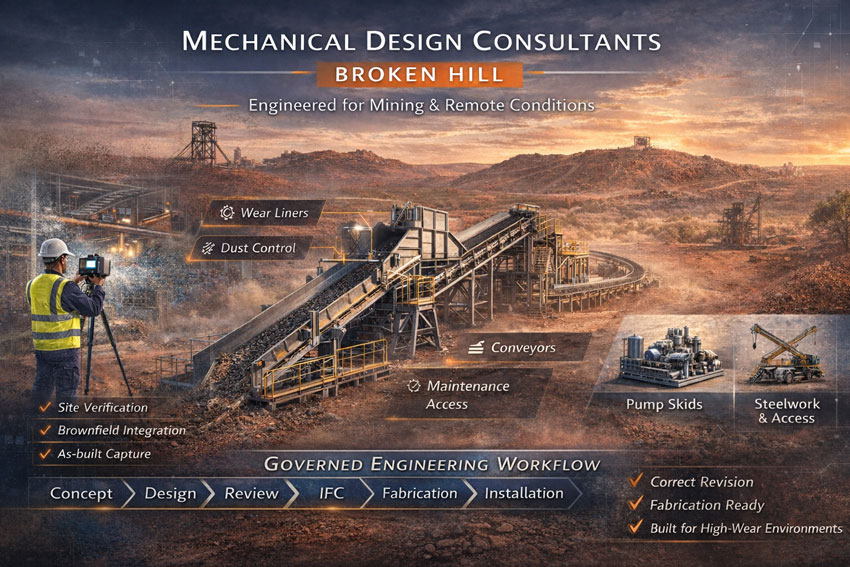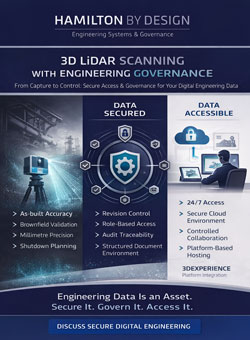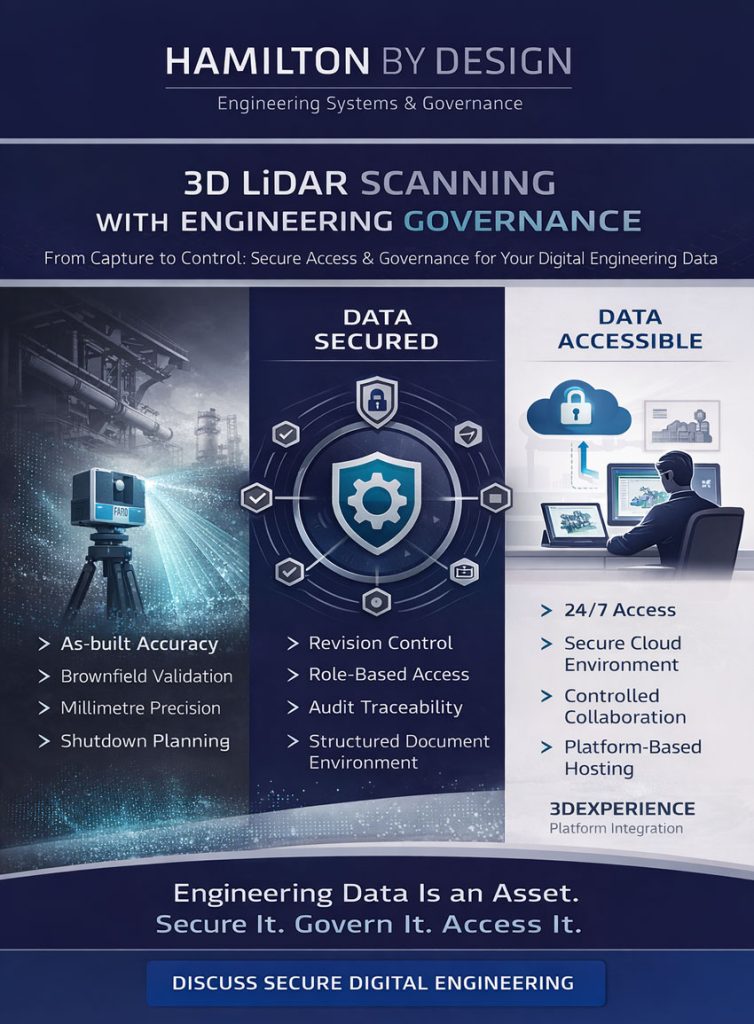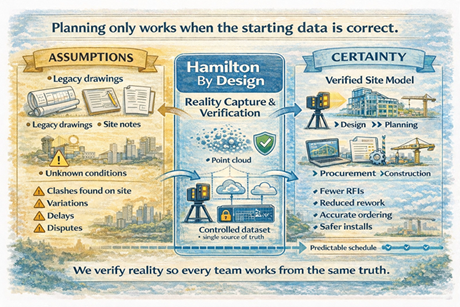
Mechanical Engineering | 3D Scanning | 3D Modelling
Tag: Brownfield Engineering
Brownfield engineering covers engineering work carried out on existing assets, facilities, and infrastructure where constraints, legacy conditions, and operational requirements must be carefully managed. This tag brings together content showing how brownfield engineering uses accurate site data, 3D scanning, coordinated CAD modelling, and engineering verification to safely design, modify, and upgrade operating facilities.
They Donโt Just Scan โ They Take Responsibility
Engineering-grade LiDAR scanning is not about collecting point clouds. It is about taking responsibility for the data that engineering, fabrication, and shutdown decisions are made from.
At Hamilton By Design, engineering-grade LiDAR scanning means the scan is:
Planned by engineers
Verified by engineers
Used directly for design and fabrication
Owned by engineers when it matters
If a scan cannot be confidently designed from, fabricated from, and installed from, it is not engineering grade.
โWeโve seen too many projects fail because everyone assumed the scan was โgood enoughโ. At Hamilton By Design, we donโt just deliver LiDAR data โ we take responsibility for whether it can actually be designed and built from. If weโre involved, someone owns the outcome.โ
โ General Manager, Hamilton By Design
Why Most LiDAR Scans Fail Engineering Projects
We regularly encounter projects where:
โWe trusted the data and got burned.โ
โThe drawings didnโt match reality.โ
โNo one wanted to own it when it went wrong.โ
In most cases, the issue isnโt the scanner.
The issue is that the scan was treated as a data product, not an engineering input.
Scan-only services deliver point clouds. Engineering-grade LiDAR delivers confidence, accountability, and defensible outcomes.
What Makes LiDAR โEngineering-Gradeโ
Engineering-grade LiDAR scanning is defined by how the scan is controlled, interpreted, and used, not by scan density or marketing claims.
1. Engineering-Led Scan Planning
Before scanning begins, engineers define:
What must fit together
What tolerances actually matter
What will be fabricated, replaced, or installed
Where shutdown or safety risk exists
This ensures the scan is fit-for-purpose, not just visually impressive.
2. Accuracy Is Verified โ Not Assumed
Engineering-grade scanning includes:
Controlled scan resolution and overlap
Registration reviewed using engineering judgement
Scale and geometry checked against known site features
Accuracy assessed relative to design intent
A dense point cloud does not guarantee engineering reliability.
3. Engineering Interpretation of Brownfield Reality
Real industrial assets are rarely perfect. They are:
Worn
Modified
Repaired
Out of square
Engineering-grade LiDAR scanning includes:
Interpretation of deformation and wear
Identification of unreliable geometry
Clear documentation of assumptions and exclusions
This is where engineering experience prevents downstream rework.
4. Data That Works Directly in CAD & Fabrication
Engineering-grade LiDAR data is:
Structured for SolidWorks and Inventor
Used directly for fabrication-ready models and drawings
Suitable for interference checks and constructability reviews
If a scan cannot be confidently used in CAD, it is not engineering-grade.
Point Clouds – 3D Scans – Engineering Quality – Past Projects
5. Ownership When It Matters Most
Engineering-grade LiDAR scanning means:
One party owns the scan-to-design interface
Assumptions are explicit and traceable
Engineering judgement is applied โ not avoided
This is critical when:
Shutdown windows are tight
Fabrication is off-site
Parts must fit together first time
Designs must be defensible in audits or reviews
Our clients:
Why Fabricators and Shutdown Teams Value This Approach
Engineering-grade LiDAR scanning enables:
Seamless delivery where parts fit together
Reduced RFIs and site rework
Predictable shutdown execution
Fit-first-time fabrication
We design with fabrication and installation in mind, because that is where projects succeed โ or fail.
Where Engineering-Grade LiDAR Is Essential
Mining and minerals processing facilities
Power generation and utilities
Manufacturing and process plants
Brownfield upgrades and tie-ins
Shutdown-critical replacement works
Reverse engineering of undocumented assets
Safety-critical access platforms and structures
Engineering-Grade LiDAR Is Risk Management
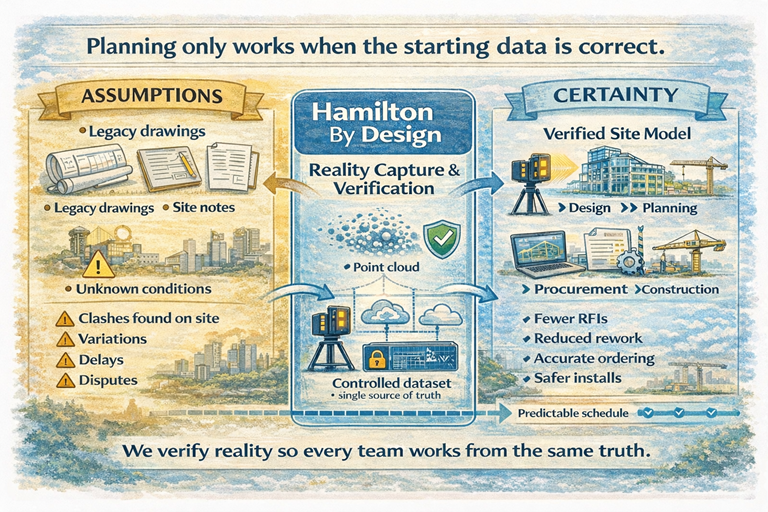
At Hamilton By Design, LiDAR scanning is not sold as a standalone service.
It is part of an engineering-led delivery model that connects:
Reality capture
Mechanical and structural design
Fabrication documentation
Installation confidence
We do not compete on lowest scan cost. We compete on ownership, accountability, and outcome.
The Australian Standard AS 3990, “Mechanical Equipment โ Steelwork,” is critical for ensuring the design and construction of safe, reliable, and durable steel structures in mechanical systems. It establishes guidelines for materials, construction practices, and stress analysis to meet the demanding requirements of industrial and mechanical applications. Failing to consult AS 3990 can lead to significant challenges for companies and individuals involved in engineering projects. Additionally, an engineering company like Hamilton By Design, with extensive experience in mechanical design and steelwork, can address these challenges effectively by leveraging its expertise and adherence to industry standards.
Our clients:
1. Structural Failures
One of the most severe consequences of not consulting AS 3990 is the risk of structural failures. Steelwork used in mechanical equipment must withstand specific stresses, loads, and environmental conditions. If these factors are not carefully calculated according to the standard, the structure may fail under operational stress, leading to catastrophic consequences.
Hamilton By Designโs Approach: Hamilton By Design ensures structural integrity through rigorous design analysis, leveraging advanced modeling tools and AS 3990 guidelines to predict and mitigate potential failure points. Their experience in various industries allows them to create robust steelwork designs that perform reliably under operational conditions.
2. Compliance and Legal Issues
Regulatory compliance is a cornerstone of modern engineering practices. Many industries, including mining, manufacturing, and construction, mandate adherence to AS 3990 for safety and operational approvals. Ignoring the standard can result in penalties, project delays, or even legal liabilities due to non-compliance.
Hamilton By Designโs Approach: The company prioritizes compliance by integrating AS 3990 requirements into every stage of the project. Their team stays updated with the latest revisions of the standard and ensures all designs meet regulatory expectations, providing clients with peace of mind and streamlined approval processes.
3. Reduced Equipment Longevity
Steel structures that do not conform to AS 3990 may suffer from premature wear, fatigue, or failure. This can lead to frequent repairs, replacements, or unplanned downtime, significantly reducing the lifespan of mechanical equipment.
Hamilton By Designโs Approach: Hamilton By Design employs precise material selection and stress analysis techniques, as prescribed by AS 3990, to optimize the durability and performance of their designs. Their focus on quality engineering ensures long-lasting equipment that minimizes maintenance requirements.
4. Safety Hazards
Non-compliance with AS 3990 poses serious safety risks. Equipment that fails unexpectedly can cause injuries or fatalities, creating an unsafe work environment and potential legal repercussions.
Hamilton By Designโs Approach: Safety is a core value for Hamilton By Design. The company conducts thorough risk assessments and designs steelwork that adheres to AS 3990โs stringent safety standards. Their commitment to safety reduces risks to operators and protects the overall workforce.
5. Increased Maintenance Costs
Improperly designed steelwork often requires frequent maintenance due to unforeseen stress points, material fatigue, or environmental damage. This not only increases operational costs but also disrupts productivity.
Hamilton By Designโs Approach: Hamilton By Designโs adherence to AS 3990 minimizes maintenance needs by delivering designs that perform reliably over extended periods. Their proactive approach to material selection and stress management ensures reduced long-term operational costs for their clients.
6. Loss of Reputation
Companies delivering substandard designs risk damaging their reputation and losing client trust. Poor performance or failure of mechanical equipment reflects negatively on both the engineers and the organization.
Hamilton By Designโs Approach: Hamilton By Design has built a solid reputation by consistently delivering high-quality, compliant designs. Their focus on excellence and attention to detail ensures that their clients receive reliable solutions, strengthening relationships and fostering repeat business.
Advantages of Working with Engineers Who Refer to AS 3990
1. Enhanced Structural Reliability
Engineers who follow AS 3990 guidelines ensure that steel structures are designed to handle expected loads and stresses safely. This enhances the overall reliability and performance of mechanical equipment.
Hamilton By Designโs Advantage: Hamilton By Designโs expertise in applying AS 3990 results in robust designs that exceed client expectations. Their thorough understanding of structural dynamics ensures optimal performance and safety.
2. Regulatory Compliance
Adhering to AS 3990 simplifies the process of meeting industry regulations, reducing risks of audits, fines, or project delays.
Hamilton By Designโs Advantage: Hamilton By Designโs commitment to compliance ensures that their projects pass inspections and meet all regulatory requirements, helping clients avoid costly delays and legal issues.
3. Optimized Design
Following AS 3990 enables engineers to create designs that balance safety, functionality, and cost-efficiency.
Hamilton By Designโs Advantage: The company uses advanced engineering tools and methodologies to develop optimized designs that align with clientsโ operational goals while maintaining compliance with AS 3990.
4. Improved Safety
AS 3990 includes comprehensive guidelines for minimizing risks, ensuring a safer working environment.
Hamilton By Designโs Advantage: Hamilton By Designโs safety-first approach incorporates AS 3990โs recommendations to deliver solutions that prioritize the well-being of workers and operators.
5. Cost Savings
Properly designed steelwork reduces maintenance, repair, and replacement costs over the equipmentโs lifecycle.
Hamilton By Designโs Advantage: By adhering to AS 3990, Hamilton By Design delivers cost-effective solutions that reduce long-term expenses, helping clients maximize their return on investment.
6. Increased Equipment Lifespan
AS 3990-compliant designs are engineered to withstand operational stresses, enhancing the durability of mechanical systems.
Hamilton By Designโs Advantage: Hamilton By Designโs focus on durability and reliability ensures that their designs deliver long-term performance, minimizing disruptions and extending equipment lifespan.
7. Competitive Advantage
Delivering high-quality, compliant systems provides a competitive edge, improving marketability and client trust.
Hamilton By Designโs Advantage: Hamilton By Designโs track record of excellence and adherence to AS 3990 positions them as a trusted partner for engineering projects, helping clients achieve their goals efficiently and effectively.
8. Risk Mitigation
Following AS 3990 minimizes the risk of unexpected failures, accidents, or operational delays.
Hamilton By Designโs Advantage: The companyโs comprehensive approach to risk management ensures that their designs perform reliably under real-world conditions, reducing risks for their clients.
Hamilton By Design: Addressing Challenges with Expertise
Hamilton By Design is an engineering firm renowned for its dedication to excellence and adherence to industry standards. Their extensive experience in mechanical equipment and steelwork enables them to address the challenges of non-compliance with AS 3990 effectively. Here are some examples of how Hamilton By Design applies its expertise to deliver superior outcomes:
Case Study 1: Mining Equipment Steelwork
In a project involving heavy mining equipment, Hamilton By Design was tasked with designing a support structure for a conveyor system. By consulting AS 3990, they identified critical stress points and optimized the design to handle dynamic loads. The result was a durable and reliable structure that exceeded client expectations and minimized maintenance costs.
Case Study 2: Industrial Manufacturing Facility
Hamilton By Design worked on a manufacturing facility requiring custom steelwork for robotic assembly lines. By adhering to AS 3990, they ensured the steel structures could withstand repetitive stress and environmental factors, enhancing the safety and efficiency of the facility.
Case Study 3: Renewable Energy Project
In a renewable energy project, Hamilton By Design designed steel frameworks for wind turbine foundations. By following AS 3990, they accounted for wind loads, fatigue stresses, and environmental conditions, delivering a solution that met stringent safety and performance requirements.
Conclusion
Failing to consult AS 3990 can lead to significant challenges, including structural failures, compliance issues, reduced equipment lifespan, safety hazards, increased maintenance costs, and reputational damage. However, working with experienced engineers who prioritize adherence to AS 3990, such as those at Hamilton By Design, provides numerous advantages, including enhanced reliability, regulatory compliance, optimized design, improved safety, cost savings, increased equipment lifespan, and risk mitigation.
Hamilton By Designโs proven track record demonstrates their ability to navigate these challenges effectively, leveraging their expertise and commitment to quality to deliver exceptional results for their clients. By choosing Hamilton By Design, companies can ensure that their mechanical equipment steelwork projects are completed to the highest standards of safety, reliability, and performance.
For more information on the Hamilton By Design Consulting approach, feel free to email info@hamiltonbydesign.com.au
To provide the best experiences, we use technologies like cookies to store and/or access device information. Consenting to these technologies will allow us to process data such as browsing behaviour or unique IDs on this site. Not consenting or withdrawing consent, may adversely affect certain features and functions.
Functional
Always active
The technical storage or access is strictly necessary for the legitimate purpose of enabling the use of a specific service explicitly requested by the subscriber or user, or for the sole purpose of carrying out the transmission of a communication over an electronic communications network.
Preferences
The technical storage or access is necessary for the legitimate purpose of storing preferences that are not requested by the subscriber or user.
Statistics
The technical storage or access that is used exclusively for statistical purposes.The technical storage or access that is used exclusively for anonymous statistical purposes. Without a subpoena, voluntary compliance on the part of your Internet Service Provider, or additional records from a third party, information stored or retrieved for this purpose alone cannot usually be used to identify you.
Marketing
The technical storage or access is required to create user profiles to send advertising, or to track the user on a website or across several websites for similar marketing purposes.