

3D Scanning Brisbane | Engineering-Led LiDAR & Risk Management
We are engineers. Let us manage your risk.
3D scanning is often treated as a visual exercise. In engineering, it is a measurement task. The difference matters.
At Hamilton By Design, 3D scanning in Brisbane is approached as an engineering activity, not just data capture. Our role is to ensure the information collected on site can be safely relied upon for design, fabrication, and installation — without rework, uncertainty, or guesswork.
What People Mean When They Say “3D Scanning”
When someone searches for 3D scanning Brisbane, they are usually trying to answer one question:
“How do I measure what already exists?”
That might be to:
- Capture existing site conditions
- Reduce uncertainty before fabrication
- Avoid clashes or rework on site
The challenge is that not all scanning methods actually measure geometry.
3D Scanning in Brisbane – Typical Use Cases
Across Brisbane and South-East Queensland, 3D scanning is commonly used for:
- Industrial plant upgrades and brownfield sites
- As-built capture of steel, services, and structures
- Fabrication completed off-site
- Retrofit works with limited access
- Shutdown and tie-in planning
For projects like these, scanning is typically carried out using engineering-grade laser scanning, not visual or consumer-grade tools.
3D Laser Scanning
Scanning Is Not the Same as Measuring
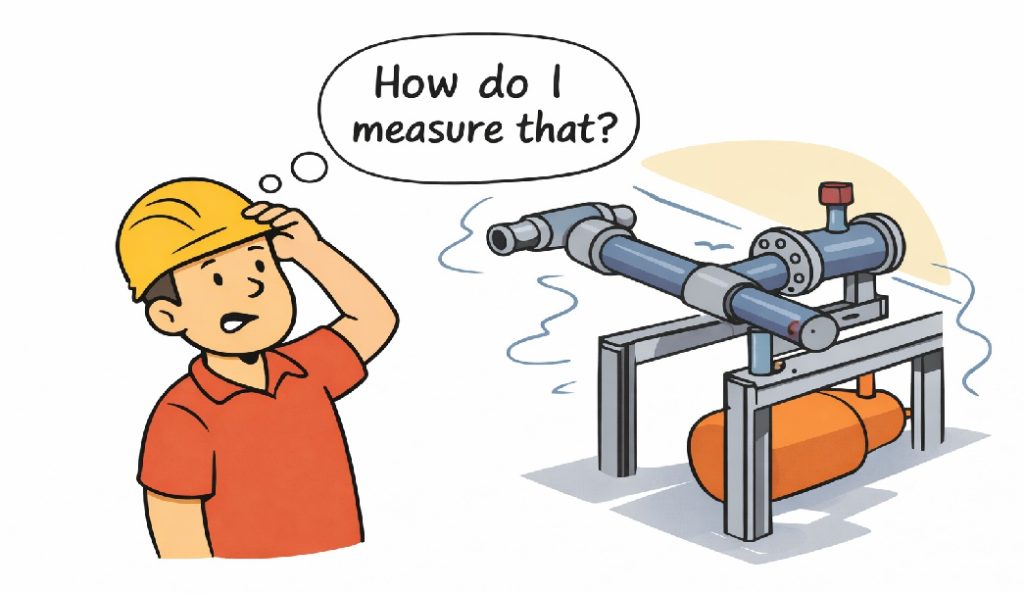
(Simple cartoon here: character looking at an object asking “How do I measure that?”)
Scanning is not the same as measuring.
In fabrication, we measure twice and cut once.
With the right scanner, you only need to scan once.
Many scanning tools create models that look right but are based on inferred or smoothed geometry. For engineering, appearance is not enough — the data must be measurable and accurate.
Not All 3D Scanning Is the Same
There are different ways to “scan” a site, each producing very different outcomes:
- Phone and visual scans
Useful for reference and visualisation, but not suitable for engineering. - Photogrammetry
Good for context and large areas, but geometry is inferred rather than directly measured. - Engineering-grade LiDAR scanning
Uses direct distance measurement to generate a true 3D point cloud.
Measured scan data can then be converted into usable engineering information through point cloud modelling workflows.
3D Point Cloud Modelling Brisbane
When Engineering-Grade Scanning Is Required
Engineering-grade scanning is required when:
- Steelwork must fit first time
- Pipework or spools are fabricated off-site
- Structural members must be verified
- Clearances and clashes carry cost or safety risk
- There is only one opportunity to access the site
In these cases, scan data is typically followed by a Scan-to-CAD process, where point clouds are converted into accurate 3D models and drawings.
Scan to CAD Brisbane
Our Approach to 3D Scanning
Hamilton By Design treats scanning as part of a complete engineering workflow, not a standalone service.
Our approach includes:
- Engineer-led scanning
- Measurement-first mindset
- Engineering-grade LiDAR equipment
- Clear understanding of downstream use
By integrating scanning with mechanical engineering services, we maintain single-source accountability from site capture through to fabrication-ready deliverables.
Mechanical Engineering Services
What Happens After the Scan
3D scanning is the starting point, not the end.
Accurate scan data supports:
- 3D CAD modelling
- Fabrication and shop drawings
- Structural verification
- Clash detection and layout validation
Every downstream decision depends on the quality of the measurement captured at the start.
Talk to an Engineer Before You Scan
Many project issues begin with the wrong question:
“Can you scan this?”
The better question is:
“How do I measure this so it can be engineered?”
If you need 3D scanning in Brisbane that can safely support engineering and fabrication decisions, Hamilton By Design can help you get it right the first time.
We are engineers. Let us manage your risk.

Our clients:
























