

AS 1657 – Fixed Platforms, Walkways, Stairways & Ladders
One of the Most Enforced Standards on Mine Sites
Safe access is fundamental to operating plant. If people are required to inspect, operate, isolate, maintain, or repair equipment, they must be able to access it safely. This is why AS 1657 – Fixed platforms, walkways, stairways & ladders is one of the most actively enforced Australian Standards across mine sites, processing plants, and heavy industry.
Unlike many structural standards, AS 1657 compliance is highly visible, directly linked to injury risk, and simple for regulators to assess during inspections. As a result, access systems are often one of the first areas reviewed following incidents, audits, or site modifications.
Hamilton By Design supports asset owners by converting real as-built access steelwork into verified, engineering-grade digital records that can be assessed, upgraded, and documented with confidence.
Why AS 1657 Is Enforced So Frequently
AS 1657 governs how people physically move around plant. Regulators do not need detailed calculations to identify non-compliance — they can see it immediately.
AS 1657 enforcement is commonly driven by:
- Slips, trips and falls remaining a leading cause of mine-site injuries
- Direct links to working-at-heights risk
- Clear dimensional and geometric requirements
- Strong alignment with WHS duty-of-care obligations
In practice, AS 1657 is enforced not because it is complex, but because non-compliance is visible and consequential.
Where AS 1657 Compliance Breaks Down in Operating Plant
Most access systems are originally designed with good intent. Problems develop over time as plant is modified, upgraded, or repurposed — while access arrangements are not re-verified.
Common real-world scenarios include:
- Walkways designed for inspection now used for routine maintenance
- Increased personnel traffic driven by reliability or production demands
- Temporary access becoming permanent
- New guarding, chutes, pipework or services reducing clearances
- Access steelwork modified during shutdowns with no formal review
The standard did not change — the way the plant is used did.
Common AS 1657 Non-Conformances on Mine Sites
Across brownfield assets, the same access issues appear repeatedly:
- Walkways narrower than required for the task being performed
- Missing, incomplete, or inconsistent handrails and toe boards
- Stairways outside allowable pitch or geometry limits
- Inconsistent riser heights and tread depths
- Ladders used where stairs should be provided
- Unsafe access around conveyors, tanks, hoppers, and transfer stations
- Ad-hoc access steelwork added without drawings or verification
Individually these issues may appear minor. Collectively, they represent a significant safety, compliance, and governance risk.
“Looks Safe” Is Not the Same as Compliant
A common industry assumption is that if access appears safe, it must be compliant. In reality:
- Dimensional non-compliance is often subtle
- Incremental changes hide cumulative risk
- Visual acceptability does not equal compliance
- Documentation is frequently missing or outdated
Most access systems do not fail catastrophically.
They fail audits, inspections, and incident reviews.
AS 1657 Interfaces with Other Standards
AS 1657 rarely exists in isolation on mine sites. It typically interfaces with:
- AS 3990 – Mechanical equipment steelwork supporting access systems
- AS 1755 – Conveyors and associated access and guarding
- AS 4100 – Steel structures
- WHS legislation – Enforcement and duty-holder accountability
Many compliance gaps occur at the interfaces between standards rather than within a single document.
The Documentation Gap in Access Compliance
A recurring challenge on older or modified sites is not necessarily unsafe access — it is unverified access.
Common documentation gaps include:
- Missing or obsolete access drawings
- Handrails, stairs, and platforms never updated in CAD
- Legacy drawings that no longer reflect site conditions
- Inability to demonstrate compliance during audits
If you cannot prove what exists, it becomes difficult to prove compliance, fitness-for-purpose, or due diligence.
The Role of LiDAR Scanning in AS 1657 Compliance
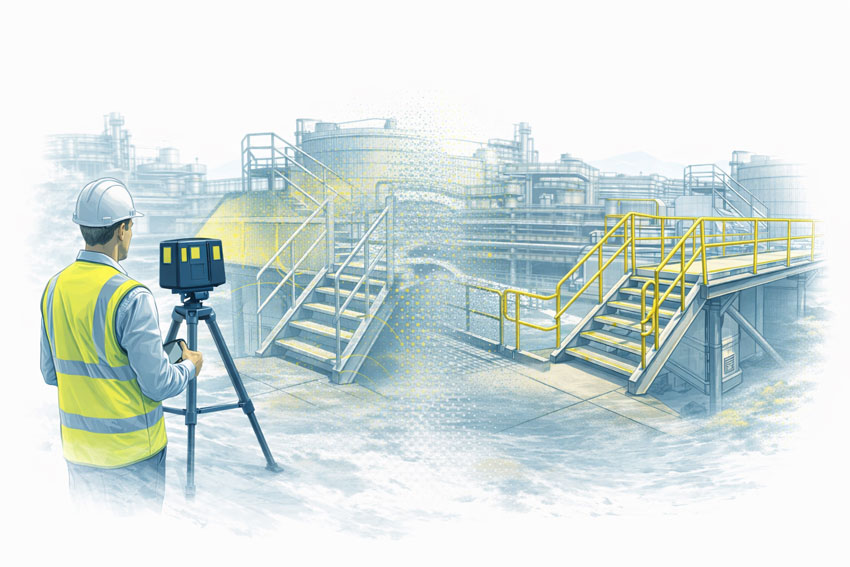
Engineering-grade 3D LiDAR scanning provides a practical solution to access compliance challenges by capturing accurate as-built geometry.
LiDAR scanning allows asset owners to:
- Measure real walkway widths, clearances, stair geometry and ladder access
- Verify existing access systems against AS 1657 requirements
- Identify non-compliances before audits or incidents
- Design access upgrades that fit existing plant first time
- Create reliable digital records for governance and lifecycle management
This approach replaces assumptions with measured reality.
Related service:
https://www.hamiltonbydesign.com.au/3d-laser-scanning/
AS 1657 in Brownfield Upgrades and Shutdowns
Access compliance is most commonly compromised during:
- Tight shutdown windows
- Conveyor and guarding upgrades
- Debottlenecking and plant modifications
- “Like-for-like” replacements that repeat legacy issues
Without accurate as-built data, access upgrades risk fabrication rework, site clashes, and reinstating non-compliant geometry. Digital verification prior to fabrication significantly reduces these risks.
Our clients:















AS 1657 as a Due Diligence Issue for Asset Owners
For officers and senior leaders, AS 1657 compliance is not just an engineering detail — it is a governance and due-diligence issue.
Demonstrating due diligence increasingly requires:
- Evidence-based decision making
- Documented verification of access systems
- Clear linkage between identified risks and controls
- Audit-ready engineering records
AS 1657 compliance is often one of the most visible indicators of how seriously an organisation treats safety and asset stewardship.
Practical Triggers to Review AS 1657 Compliance
An AS 1657 review should be considered when:
- A near-miss or fall incident occurs
- Maintenance frequency increases
- New guarding or conveyors are installed
- Access is modified during shutdowns
- An audit or regulator inspection is upcoming
- Assets are being sold, leased, or handed over
Early verification is significantly more cost-effective than reactive remediation.

How Hamilton By Design Supports AS 1657 Compliance
Hamilton By Design supports access compliance by combining:
- Engineering-grade LiDAR scanning
- Accurate as-built CAD models
- Practical upgrade and retrofit design
- Fabrication-ready documentation
This enables asset owners to move from assumed compliance to verified compliance, with confidence in safety, constructability, and governance.