

BIM Documentation & Defensible Building Records
Sydney property and building projects live or die on what is documented—and how confidently that documentation can be relied upon. In a market defined by tight plant rooms, vertical services, constrained access, staged upgrades, and high holding costs, “close enough” drawings can become a legal, commercial, and program risk.
Hamilton By Design provides engineer-led 3D scanning and 3D engineering services in Sydney, focused on producing BIM-ready documentation and defensible building records to support:
- Sale and purchase due diligence
- Leasing and refurbishment planning
- Services upgrades (HVAC, piping, mechanical plant, fire coordination interfaces)
- Fit-first-time fabrication and constructability
- Evidence-quality as-built records
If you’re looking for a Sydney scanning service that goes beyond “pretty point clouds” and delivers engineering-grade outputs, start here:
3D Scanning Sydney: https://www.hamiltonbydesign.com.au/3d-scanning-sydney/
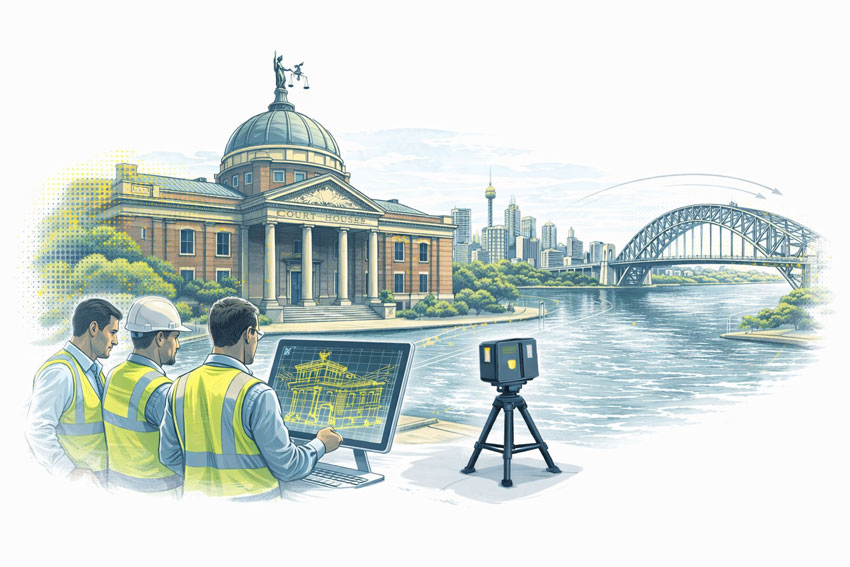
Why Documentation Matters for Property Sale in Sydney
When a commercial or industrial property changes hands, the documentation pack often becomes a key part of:
- Pre-purchase due diligence
- Capex forecasting
- Compliance planning
- Tenant fit-out feasibility
- Valuation and defect risk assessment
In practice, the biggest issues arise when the “as-builts” are:
- Outdated (multiple refurbishments since issue)
- Incomplete (plant rooms, risers, roof plant never updated)
- Uncoordinated (services don’t match structure or architecture)
- Non-dimensional or ambiguous (typical details reused across floors)
- Inconsistent with reality (especially in brownfield assets)
A reality-captured, engineering-led approach reduces uncertainty by establishing a reliable baseline: what exists, where it is, and what can fit.
Is BIM a Legal Requirement — or a “Nice to Have”?
BIM is not typically mandated by law for private property transactions. However, the legal and commercial requirement is not “BIM” — it is adequate, accurate, and defensible documentation.
On modern Sydney assets, BIM-style coordination is often the most practical way to:
- Demonstrate reasonable verification of existing conditions
- Reduce foreseeable clashes and rework
- Provide traceable design intent and change control
- Support compliance pathways and certification workflows
For property sale and acquisition, BIM and 3D documentation increasingly function as risk controls. They help owners, buyers, and project teams make decisions using verifiable geometry instead of assumptions.
Note: This page is general information, not legal advice. Documentation obligations depend on building type, scope of work, and the relevant approval pathway.
What We Deliver: Documentation Packs That Stand Up to Scrutiny
Our Sydney workflow is designed to create outputs that are useful across multiple stakeholders: owners, facilities teams, designers, contractors, and project managers.
1) Reality Capture and Registered Outputs
- Engineering-grade LiDAR / laser scanning
- Site constraints captured in high detail (plant rooms, risers, mezzanines, service corridors)
- Deliverables structured so they can be used for BIM modelling and coordination
2) BIM-Ready As-Built Models
We produce or support the production of:
- Coordinated 3D models suitable for engineering design workflows
- Mechanical service zones and clearance envelopes
- Plant layout validation (lift paths, maintenance access, removable panels)
3) Drawing Sets for Sale, Leasing, and Upgrades
Depending on the asset and use case, documentation can include:
- General arrangement drawings
- Plant-room and rooftop plant layouts
- Service routing diagrams (where required)
- Key dimensions, levels, and coordination references
4) Evidence-Quality Record Packs
When the purpose is due diligence, risk reduction, or dispute avoidance, we can structure outputs with:
- Traceable references back to the scan dataset
- Clear assumptions and tolerances
- Version control and change notes for future updates
Where This Helps Most in Sydney
Commercial Buildings and CBD Refurbishments
Sydney’s CBD and inner suburbs often involve:
- Occupied buildings
- After-hours access
- Tight risers and low ceiling voids
- Multiple generations of undocumented services
Reality capture + BIM documentation improves planning for:
- HVAC replacement
- Plant upgrades
- Tenant fit-outs
- Services reroutes
- Staged works and shutdowns
Industrial and Processing Facilities
For industrial assets, “document confidence” is directly tied to:
- Fit-first-time fabrication
- Shutdown windows
- Safety and access planning
3D engineering outputs support:
- Pipe spools and mechanical upgrades
- Structural interfaces
- Skid and equipment placement validation
Property Sale and Acquisition Due Diligence
For buyers and owners, BIM-ready records can help:
- Confirm plant capacity and spatial constraints
- Validate feasibility for intended refurbishments
- Identify unknowns that should be priced into capex planning
- Reduce “latent defect” surprises caused by unknown geometry
Engineer-Led Scanning vs. Generic Capture
Not all scans are equal. The difference is not just the scanner — it’s the workflow and the engineering intent.
Engineer-led reality capture focuses on:
- What must be measured for mechanical design
- Clearances, access paths, and maintenance envelopes
- Interfaces between structure and services
- Deliverables that reduce fabrication and installation risk
If the goal is property documentation, the key question is:
“Can this documentation be trusted to make decisions that cost money?”
Typical Deliverables (Choose What You Need)
A Sydney documentation package may include:
- Point cloud dataset (registered and organised)
- BIM-ready model (scope defined by asset type and use case)
- Drawing set (GA layouts and key sections)
- Plant and services spatial verification notes (where requested)
- Asset record pack structure for ongoing lifecycle updates
Because the “right” package depends on whether you’re:
- Selling / buying
- Leasing / refurbishing
- Upgrading services
- Planning staged works
…we build the scope around what decisions the documentation must support.
Common Use Cases for Sale of Property
“We’re selling a building — what does the buyer actually want?”
Most buyers want confidence around:
- What exists (geometry and plant placement)
- What will fit (upgrade feasibility)
- What risks are hidden (unknowns and clashes)
- How much capex is coming (services condition + spatial constraint)
“We’re buying — can we validate the fit-out feasibility quickly?”
A scan-to-model workflow can quickly confirm:
- Available plant space
- Riser and shaft constraints
- Ceiling space and structural conflicts
- Staging or cranage constraints for replacement plant
“We need a defensible as-built record before we commit.”
If you’re about to spend real money on design or refurbishment, scanning first prevents:
- Design rework
- Fabrication errors
- Program delays caused by surprise constraints
How the Process Works
- Define the decision
Sale pack, due diligence, upgrade design, or refurbishment planning. - Site capture plan
What areas matter most (plant rooms, risers, roof, loading dock, service corridors). - LiDAR scanning and registration
Delivered in an organised structure suitable for modelling and coordination. - Model and documentation outputs
BIM-ready models and drawings aligned to the defined purpose. - Handover + future update pathway
Documentation structured so future projects can update the baseline rather than restart.
Frequently Asked Questions
Do I legally need BIM for a property sale?
Usually, no. But you do need documentation that is accurate enough for decisions and defensible if assumptions are challenged. BIM-quality coordination often becomes the most practical method for complex assets.
Are existing drawings good enough?
Sometimes. But in many Sydney buildings—especially refurbished and service-dense assets—drawings can be incomplete or wrong. Scanning verifies the baseline.
Can you scan only the areas that matter most?
Yes. For sale and due diligence, we often focus on:
- Roof plant
- Main plant rooms
- Key risers / service corridors
- Basement services areas
- Areas driving upgrade feasibility
Is this useful for strata or mixed-use buildings?
Yes — especially where service routing and riser geometry are uncertain and upgrades need clear feasibility.

Talk to an Engineer About Sydney Documentation
If you need 3D engineering in Sydney focused on BIM documentation and defensible records for property sale, we can help you establish a baseline that reduces commercial risk and improves decision-making.
Start with our Sydney service page:
https://www.hamiltonbydesign.com.au/3d-scanning-sydney/

Our clients:
























