

Conveyor transfer towers are critical components within mining and bulk material handling operations. These structures control the movement of material between conveyors and often contain complex arrangements of chutes, structural steel, maintenance platforms, and access walkways.
Over time, many transfer towers are modified as production requirements change. Equipment upgrades, chute redesigns, and maintenance improvements can result in plant infrastructure that no longer matches the original engineering drawings.
For engineers planning upgrades or maintenance projects, accurate existing condition data is essential. One of the most effective ways to capture this information is through 3D laser scanning.
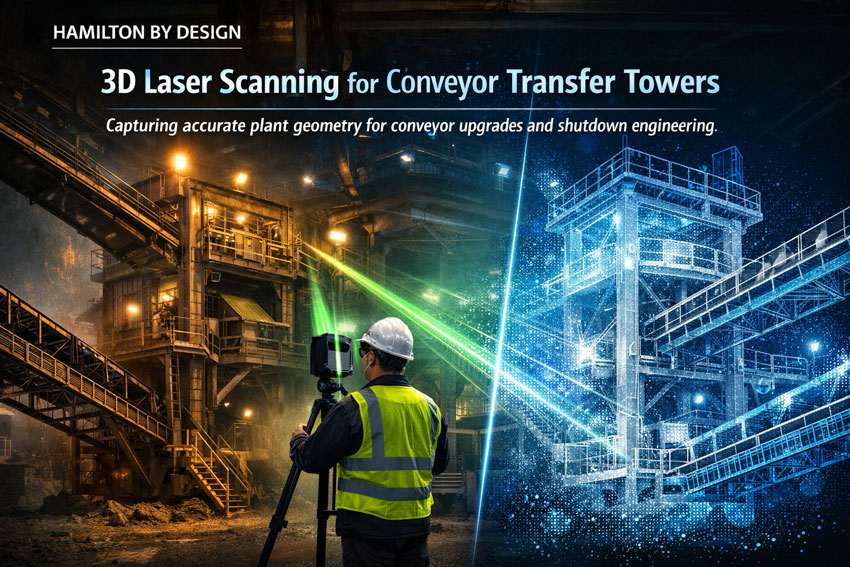
At Hamilton By Design, engineering-grade scanning is used to capture precise geometry of conveyor transfer towers and surrounding plant infrastructure. This data can then be converted into accurate digital models used for mechanical design, plant upgrades, and engineering analysis.
Learn more about our engineering scanning capabilities here:
👉 https://www.hamiltonbydesign.com.au/home/engineering-services/3d-laser-scanning/
Why Conveyor Transfer Towers Are Difficult to Measure
Transfer towers are often some of the most complex areas within a processing plant. They typically contain multiple systems operating within a confined structure including conveyors, transfer chutes, structural supports, and maintenance platforms.
These environments can include:
• multiple conveyors entering and exiting the structure
• chute systems with wear liners
• structural steel frames and supports
• maintenance walkways and access platforms
• dust control and service equipment
Because of the tight layout and elevation changes within these structures, traditional measurement methods can be slow and prone to error.
In many facilities, the original engineering drawings may also be outdated due to years of plant modifications.
Accurate measurement is therefore essential when designing upgrades or modifications to conveyor transfer systems.
Using 3D Laser Scanning to Capture Transfer Tower Geometry
Engineering-grade 3D laser scanning uses LiDAR technology to capture millions of spatial measurements of plant infrastructure.
The resulting dataset forms a point cloud model representing the exact geometry of conveyors, structural steel, chutes, and surrounding plant equipment.
This digital model allows engineers to analyse plant layouts and develop accurate engineering designs before physical work begins.
Laser scanning provides several advantages when working in conveyor transfer towers.
Accurate Existing Conditions
Scanning captures the true geometry of plant infrastructure, allowing engineers to design modifications based on reliable data rather than outdated drawings.
Improved Design Planning
Digital models generated from scan data allow engineers to verify clearances and identify potential clashes before installation.
Reduced Shutdown Risk
Engineering teams can plan installation work more effectively using digital models created from scan data.
Faster Data Capture
Laser scanning can capture complex structures quickly compared with traditional measurement methods.
3D Scanning for Mining Shutdown Projects
Many conveyor transfer tower upgrades are performed during planned mining shutdowns, where engineering teams must complete inspections, modifications, and installations within tight timeframes.
Laser scanning provides a fast and reliable way to capture accurate plant geometry before shutdown work begins. Engineers can then analyse the digital model and develop upgrade designs in advance.
This approach reduces the risk of unexpected installation issues during shutdown periods.
You can learn more about scanning applications during plant shutdowns here:
From Laser Scan to Engineering Model
The laser scanning workflow for conveyor transfer towers typically follows a structured process.
- Planning scan locations within the transfer tower
- Capturing plant geometry using LiDAR scanners
- Registering scan positions to create a unified point cloud
- Extracting geometry from the point cloud dataset
- Creating engineering CAD models for design analysis
These models allow engineers to analyse plant infrastructure and design upgrade solutions with greater confidence.
Reverse Engineering Conveyor Infrastructure
In many mining plants, original equipment drawings are missing or no longer reflect the current infrastructure. In these cases, laser scanning can be used to reverse engineer existing equipment and structures.
By capturing the geometry of conveyors, chutes, and supporting structures, engineers can recreate accurate CAD models used for redesign, replacement components, or plant upgrades.
Hamilton By Design provides reverse engineering services using high-accuracy scanning technology.
Learn more about this process here:
👉 https://www.hamiltonbydesign.com.au/reverse-engineer-3d-scanning/
Digital Engineering for Conveyor Transfer Towers
Digital models created from laser scanning allow engineers to analyse plant infrastructure in a controlled environment before work begins on site.
These models support engineering tasks such as:
• chute design and optimisation
• conveyor upgrade planning
• structural modifications
• clash detection and layout verification
• maintenance planning and documentation
For mining operations, this approach improves the reliability of plant upgrade projects and reduces engineering risk.
Engineering Support from Hamilton By Design
Hamilton By Design provides engineering-led 3D laser scanning and mechanical design services supporting mining and industrial infrastructure projects across Australia.
Our services include:
• conveyor transfer tower scanning
• plant upgrade engineering
• mechanical design and modelling
• reverse engineering of plant infrastructure
• digital engineering models and inspections
By combining scanning technology with engineering expertise, we help mining and industrial clients capture accurate plant geometry and convert it into practical engineering solutions.

Learn More About Engineering-Grade Laser Scanning
For a full overview of engineering-grade laser scanning and its applications in mining and industrial plants, visit:
👉 https://www.hamiltonbydesign.com.au/home/engineering-grade-3d-laser-scanning-mining-industrial/
Anthony Hamilton
Principal Engineer
Hamilton By Design