

Engineering-Grade 3D Laser Scanning for Mining & Industrial Plants | Hamilton By Design
Mining and industrial facilities are complex environments where accurate engineering data is essential for safe and effective plant design, maintenance, and upgrades. Many facilities have evolved over decades, resulting in equipment modifications, undocumented changes, and outdated drawings.
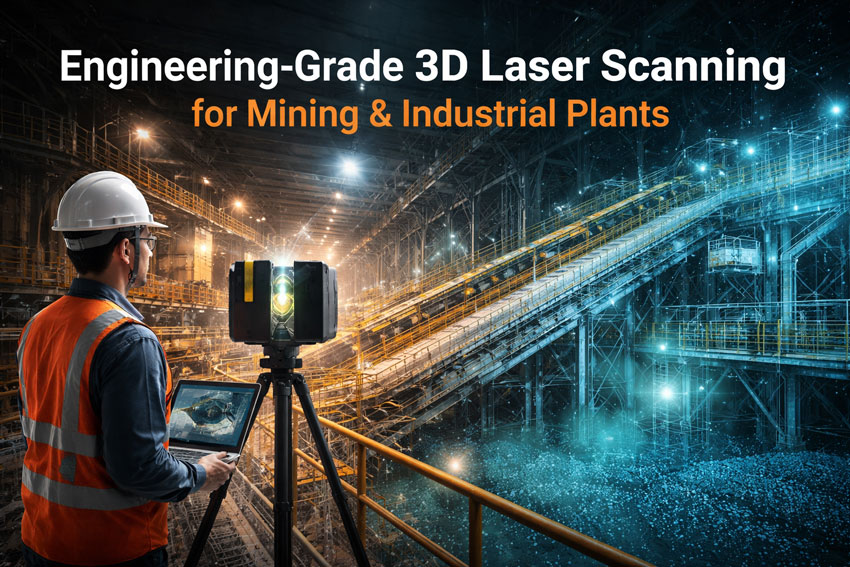
Engineering-grade 3D laser scanning provides a highly accurate method of capturing the real geometry of existing infrastructure. Using advanced LiDAR scanning technology, engineers can generate detailed point-cloud datasets that form the foundation for accurate digital models, engineering design, and asset management.
At Hamilton By Design, we provide engineering-led 3D laser scanning services to capture existing plant geometry and convert it into accurate engineering models used for design, inspections, and upgrade projects across mining and heavy industry.
What Is Engineering-Grade 3D Laser Scanning?
Engineering-grade laser scanning uses LiDAR (Light Detection and Ranging) sensors to capture millions of spatial measurements of physical environments. These measurements form a point cloud dataset representing the exact geometry of equipment, structures, and plant infrastructure.
Unlike conventional surveying techniques, laser scanning captures complete environments with millimetre-level accuracy and significantly reduces measurement risk.
Typical accuracy for engineering applications:
| Method | Accuracy | Typical Use |
|---|---|---|
| Engineering laser scanning | 2–6 mm | Plant design & modelling |
| Total station survey | 5–20 mm | Survey control |
| Manual measurement | 10–50 mm | Basic field checks |
For engineering design projects, this level of accuracy enables reliable modelling of conveyors, structural steel, piping systems, and mechanical equipment.
Why Mining and Industrial Plants Use Laser Scanning
Industrial facilities often contain:
- tightly packed equipment
- complex structural steel
- ageing infrastructure
- undocumented plant modifications
Traditional measurement methods can be slow and prone to error. Laser scanning allows engineers to capture accurate geometry quickly and safely.
Key advantages include:
Accurate Existing Conditions
Engineering designs depend on reliable dimensional data. Laser scanning captures the true geometry of plant infrastructure, allowing engineers to design upgrades with confidence.
Reduced Shutdown Risk
Scanning allows engineers to analyse plant layouts and verify clearances before shutdown work begins. This reduces the risk of installation issues and unexpected clashes.
Faster Engineering Design
Accurate digital models enable faster mechanical design development and reduce the need for repeated site visits.
Improved Safety
Scanning reduces the need for manual measurements in hazardous areas such as conveyors, elevated structures, and confined plant environments.
Typical Applications in Mining and Industrial Plants
Engineering laser scanning is widely used across heavy industry to support design, inspection, and upgrade projects.
Common applications include:
Conveyor and Transfer Station Design
Laser scanning allows engineers to capture the geometry of existing conveyor structures and surrounding infrastructure. This data is used to design transfer upgrades, maintenance improvements, and material handling modifications.
Mining Shutdown Engineering
During shutdown projects, scanning can capture plant infrastructure quickly, allowing engineering teams to develop upgrade designs and installation plans.
Plant Upgrade Projects
When equipment is being replaced or upgraded, scanning provides accurate dimensional data to ensure new equipment integrates correctly with existing infrastructure.
Structural Inspection and Assessment
Laser scanning can be used to document structural conditions and generate accurate models for engineering analysis.
Reverse Engineering of Equipment
Where original drawings are missing or outdated, scanning can be used to recreate CAD models of existing equipment for redesign or replication.
From Point Cloud to Engineering Model
The laser scanning workflow typically follows a structured engineering process:
- Site planning and scan strategy
- LiDAR scanning of plant infrastructure
- Registration of scan positions
- Creation of unified point cloud datasets
- Feature extraction and modelling
- Integration with CAD platforms such as SolidWorks
The resulting models allow engineers to analyse plant geometry, verify clearances, and develop design solutions based on accurate data.
Digital Twins for Industrial Infrastructure
Laser scanning enables the creation of digital twins of industrial facilities. A digital twin is a detailed digital representation of plant infrastructure used for engineering analysis, planning, and asset management.
Digital twins provide several advantages:
- accurate representation of plant geometry
- improved upgrade planning
- clash detection for new equipment
- improved documentation of infrastructure
For many industrial sites, digital twins provide a foundation for long-term engineering asset management.
Laser Scanning vs Traditional Survey Methods
Laser scanning provides several advantages over conventional measurement methods.
| Feature | Laser Scanning | Traditional Survey |
|---|---|---|
| Data captured | Entire environment | Individual points |
| Speed | Very fast | Slow |
| Accuracy | High | Moderate |
| Safety | Reduced manual measurement | Field work required |
| Modelling capability | Excellent | Limited |
Because of these advantages, laser scanning has become the preferred method for capturing existing conditions in complex industrial facilities.
Engineering-Led Laser Scanning
Many scanning providers focus primarily on surveying. At Hamilton By Design, scanning is integrated directly with mechanical engineering workflows.
This means scanning data is captured with engineering design in mind, enabling seamless integration with modelling, design verification, and upgrade engineering.
Our engineering team specialises in:
- mining infrastructure engineering
- mechanical design for processing plants
- industrial equipment modelling
- digital engineering workflows
By combining engineering expertise with scanning technology, we provide data that can be used directly for engineering design and project planning.
Engineering Services Supporting Laser Scanning
Laser scanning often supports broader engineering projects. Hamilton By Design provides a range of engineering services related to scanning and digital modelling, including:
- mechanical engineering design
- conveyor and chute engineering
- plant upgrade design
- structural inspection
- engineering verification
- digital engineering models
These services allow scanning data to be converted into practical engineering outcomes.
Frequently Asked Questions
How accurate is engineering-grade laser scanning?
Industrial laser scanning systems typically achieve accuracy within 2–6 millimetres, depending on the scanning equipment and site conditions.
Can laser scanning be performed during plant operation?
Yes. Laser scanning can often be performed safely while plant equipment is operating, reducing the need for shutdowns during data capture.
What industries use laser scanning?
Laser scanning is widely used in:
- mining
- mineral processing
- manufacturing
- heavy industry
- infrastructure engineering
How is laser scanning used in engineering design?
The point cloud dataset generated during scanning is used to create engineering models, which allow engineers to design upgrades, analyse clearances, and verify equipment integration.
Engineering-Grade 3D Laser Scanning Across Australia
Hamilton By Design provides engineering-led laser scanning services supporting mining and industrial infrastructure projects across Australia and internationally.
Our experience in mechanical engineering, plant infrastructure, and digital modelling allows us to capture accurate engineering data and convert it into practical design solutions.

Contact Hamilton By Design
If you require accurate digital models of mining or industrial infrastructure, Hamilton By Design can assist with engineering-grade 3D laser scanning and mechanical design services.
Anthony Hamilton
Principal Engineer
Hamilton By Design