

Mining and industrial processing plants are rarely static environments. Over time, equipment upgrades, maintenance modifications, structural repairs, and operational improvements result in plant infrastructure that no longer matches the original engineering drawings.
Before engineers can design plant upgrades, install new equipment, or modify existing infrastructure, they must first understand the true geometry of the existing plant environment.
Capturing accurate existing conditions is therefore one of the most important steps in any plant upgrade project.
Engineering teams commonly use 3D laser scanning, LiDAR surveying, and digital modelling techniques to create accurate representations of existing infrastructure before design work begins.
At Hamilton By Design, engineering-grade scanning technology is used to capture precise plant geometry and convert it into digital engineering models used for upgrade planning and design.
For an overview of how scanning supports mining and industrial infrastructure projects, see:
👉 https://www.hamiltonbydesign.com.au/home/engineering-grade-3d-laser-scanning-mining-industrial/
Why Existing Conditions Matter in Plant Upgrade Projects
Plant upgrades often involve installing new equipment within complex existing infrastructure. This may include:
• upgrading conveyors and transfer towers
• installing new processing equipment
• modifying structural steel frameworks
• improving maintenance access and safety systems
• expanding plant throughput capacity
If the existing plant geometry is not accurately understood, installation work can become difficult or even impossible during shutdown periods.
Small dimensional differences between drawings and the real plant environment can lead to major installation challenges.
For this reason, capturing accurate existing conditions has become a critical step in modern mining infrastructure engineering.
Learn more about the broader engineering services supporting mining and mineral processing projects here:
👉 https://www.hamiltonbydesign.com.au/home/mining-mineral-processing/
Traditional Methods of Capturing Existing Conditions
Historically, engineers relied on manual measurements and traditional surveying techniques to capture plant geometry.
These methods often involved:
• tape measurements
• total station surveys
• manual sketching and documentation
• physical inspections of plant infrastructure
While these methods can still be useful for small tasks, they are often slow and limited when working in large and complex industrial environments.
Mining plants frequently contain tightly packed infrastructure such as conveyors, structural steel, pipework, platforms, and maintenance equipment. Capturing this complexity using manual methods can be difficult and time-consuming.
Modern Approach: 3D Laser Scanning
Today, engineers increasingly rely on 3D laser scanning technology to capture existing plant conditions.
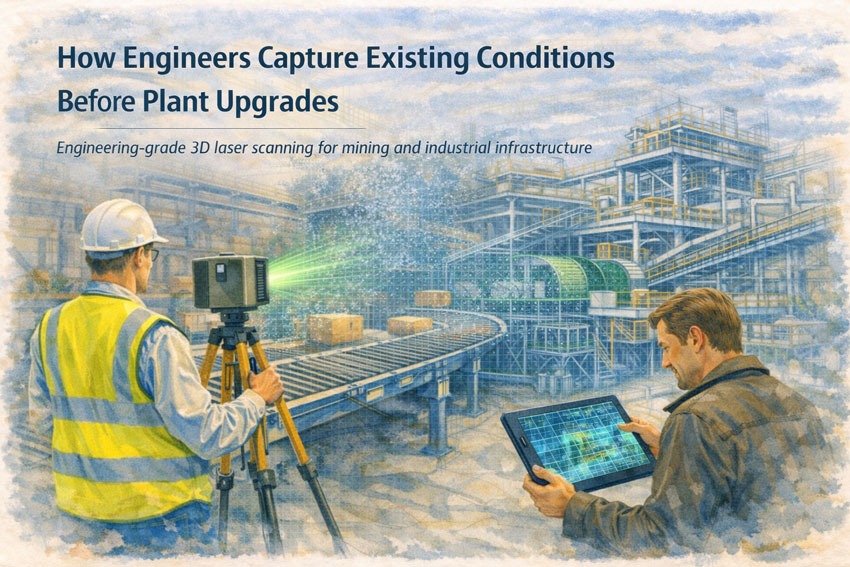
Laser scanning uses LiDAR technology to collect millions of spatial measurements of plant infrastructure. These measurements are combined into a point cloud dataset representing the exact geometry of the environment.
This digital dataset allows engineers to create highly accurate models of existing plant infrastructure before design work begins.
You can learn more about these services here:
👉 https://www.hamiltonbydesign.com.au/home/engineering-services/3d-laser-scanning/
From Point Cloud to Engineering Model
Once laser scanning data has been captured, the point cloud dataset can be processed and converted into engineering models used for design and analysis.
Typical workflow includes:
- Planning scan locations within the plant
- Capturing infrastructure using LiDAR scanners
- Registering scan positions to create a unified point cloud
- Extracting structural and equipment geometry
- Creating CAD models for engineering analysis
These digital models allow engineers to analyse plant layouts, verify clearances, and design upgrade solutions before work begins on site.
Supporting Mining Plant Upgrade Engineering
Accurate digital models created from laser scanning are commonly used in projects involving:
• conveyor system upgrades
• transfer chute redesign
• structural modifications
• plant expansion projects
• installation of new processing equipment
By analysing the existing plant environment digitally, engineers can detect potential clashes and plan installation work before shutdown periods.
To learn more about engineering-grade scanning used for plant upgrade projects, visit:
👉 https://www.hamiltonbydesign.com.au/engineering-grade-3d-laser-scanning-mining-plant-upgrades/
Reducing Risk During Shutdown Work
Many plant upgrades must be completed during planned shutdown periods, where time is limited and installation delays can be costly.
Capturing existing conditions before shutdown work begins allows engineers to develop upgrade designs and installation strategies in advance.
Digital models created from scan data allow engineering teams to:
• verify equipment clearances
• plan installation procedures
• identify potential conflicts between structures
• reduce unexpected installation challenges
This significantly improves the reliability of plant upgrade projects.
Engineering-Led Scanning for Mining Infrastructure
At Hamilton By Design, laser scanning is integrated directly with mechanical engineering workflows.
Rather than simply capturing survey data, scanning is performed with the goal of supporting engineering design and infrastructure upgrades.
This approach allows scan data to be converted into practical engineering solutions including:
• mechanical design models
• plant upgrade engineering
• structural analysis models
• digital infrastructure documentation
By combining engineering expertise with advanced scanning technology, accurate plant data can be used to develop reliable engineering outcomes.

Learn More
If you would like to learn more about how engineers capture existing conditions before plant upgrades, explore the following resources:
Engineering-grade scanning overview:
👉 https://www.hamiltonbydesign.com.au/home/engineering-grade-3d-laser-scanning-mining-industrial/
Mining and mineral processing engineering services:
👉 https://www.hamiltonbydesign.com.au/home/mining-mineral-processing/
3D laser scanning engineering services:
👉 https://www.hamiltonbydesign.com.au/home/engineering-services/3d-laser-scanning/
Mining plant upgrade engineering:
👉 https://www.hamiltonbydesign.com.au/engineering-grade-3d-laser-scanning-mining-plant-upgrades/
Anthony Hamilton
Principal Engineer
Hamilton By Design