


Mining processing plants are continually evolving. Equipment upgrades, conveyor modifications, structural changes, and production improvements often result in plant infrastructure that no longer matches the original engineering drawings.
Before any plant upgrade can be designed or installed, engineers must understand the existing geometry of the plant environment. Inaccurate measurements or outdated drawings can lead to installation issues, costly delays, and unexpected shutdown risks.
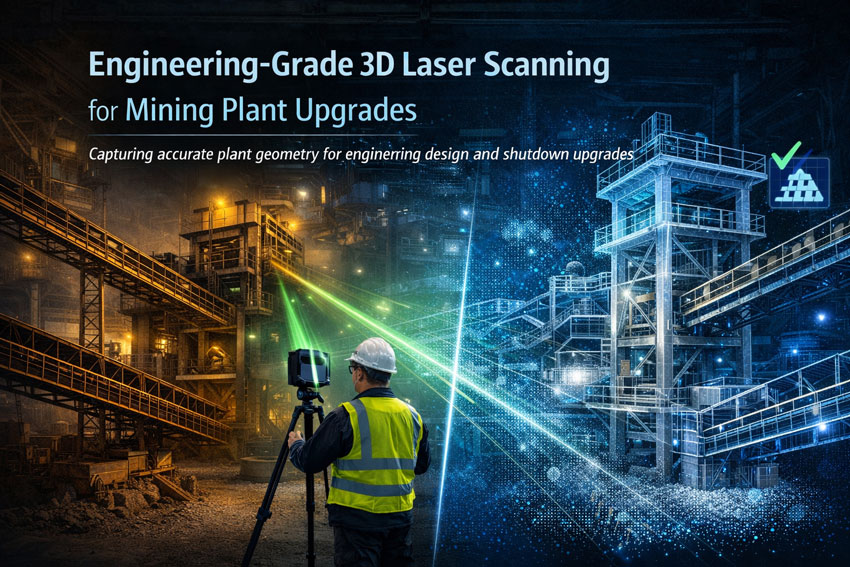
Engineering-grade 3D laser scanning provides a highly accurate method for capturing the true geometry of mining plant infrastructure. By using advanced LiDAR scanning technology, engineers can generate detailed point cloud datasets that allow accurate modelling of conveyors, transfer towers, structural steel, and plant equipment.
At Hamilton By Design, engineering-led laser scanning is used to capture accurate existing conditions and convert them into digital engineering models that support mining plant upgrade projects across Australia and internationally.
Why Accurate Data Is Critical for Mining Plant Upgrades
Plant upgrade projects often involve installing new equipment within existing infrastructure. This may include:
• upgrading conveyors and transfer points
• installing new processing equipment
• modifying structural steel
• expanding plant capacity
• improving maintenance access
In many mining plants, drawings may be outdated due to years of modifications and operational changes. Even small dimensional differences can create installation problems during shutdown work.
Engineering-grade scanning captures the true geometry of plant infrastructure, allowing engineers to design upgrade solutions based on reliable data.
What Is Engineering-Grade 3D Laser Scanning?
3D laser scanning uses LiDAR technology to measure millions of points in a physical environment. These measurements are combined into a point cloud dataset representing the exact geometry of plant infrastructure.
Unlike traditional measurement methods, laser scanning captures entire structures quickly and accurately.
Typical accuracy levels for engineering applications:
| Measurement Method | Typical Accuracy |
|---|---|
| Engineering laser scanning | 2–6 mm |
| Survey total station | 5–20 mm |
| Manual measurement | 10–50 mm |
This level of accuracy enables engineers to confidently model plant infrastructure and design equipment upgrades.
For a broader overview of industrial scanning applications, see:
👉 https://www.hamiltonbydesign.com.au/home/engineering-grade-3d-laser-scanning-mining-industrial/
Capturing Existing Plant Geometry
Mining plants contain complex infrastructure including conveyors, chutes, structural steel, pipework, and access platforms. These components often exist in tight arrangements that are difficult to measure manually.
Laser scanning allows engineers to capture entire plant environments quickly and safely.
Typical areas scanned during plant upgrade projects include:
• conveyor transfer stations
• crushing and screening infrastructure
• transfer towers
• structural steel frameworks
• processing plant equipment
The resulting digital model provides a reliable foundation for engineering design.
From Laser Scan to Engineering Model
Once scanning is complete, the captured point cloud dataset can be converted into detailed engineering models used for design and analysis.
The typical workflow includes:
- Planning scan locations within the plant
- Capturing plant geometry using LiDAR scanners
- Registering scan positions into a unified point cloud
- Extracting structural and equipment geometry
- Creating engineering CAD models
These models allow engineers to analyse plant layouts, verify clearances, and develop upgrade designs.
Reducing Risk During Shutdown Installations
Many mining plant upgrades are installed during scheduled shutdowns where work must be completed within limited timeframes.
Engineering-grade scanning allows design work to be completed before shutdown periods begin.
Digital models created from scan data allow engineers to:
• verify equipment clearances
• plan installation procedures
• detect potential clashes between equipment
• reduce unexpected installation issues
This approach significantly reduces engineering risk during shutdown work.
You can learn more about scanning during shutdown projects here:
Reverse Engineering Existing Plant Infrastructure
In many mining operations, original design drawings are incomplete or outdated. In these cases, laser scanning can be used to reverse engineer existing infrastructure.
By capturing the geometry of conveyors, structural steel, and plant equipment, engineers can recreate accurate CAD models used for redesign and plant upgrades.
Hamilton By Design provides reverse engineering services using high-accuracy scanning technology.
Learn more about reverse engineering with scanning:
👉 https://www.hamiltonbydesign.com.au/reverse-engineer-3d-scanning/
Engineering Applications for Mining Plant Upgrades
Engineering-grade scanning supports a wide range of mining plant upgrade projects including:
Conveyor Upgrade Projects
Laser scanning captures conveyor structures and surrounding plant infrastructure, enabling engineers to design upgrades with accurate geometry.
Transfer Chute Redesign
Accurate digital models allow engineers to redesign transfer chutes to improve material flow and reduce blockages.
Structural Modifications
Scanning provides the geometry required to design modifications to structural steel and support structures.
Plant Expansion Projects
Digital plant models allow engineers to evaluate layout changes and verify equipment placement before installation.
Engineering-Led Laser Scanning
While many scanning providers focus primarily on surveying, Hamilton By Design integrates scanning directly with mechanical engineering workflows.
This approach ensures the captured geometry is suitable for engineering design and modelling.
Hamilton By Design supports mining and industrial projects with services including:
• engineering-grade 3D laser scanning
• mechanical engineering design
• conveyor and chute engineering
• plant upgrade design
• reverse engineering of plant infrastructure
Learn more about our scanning services here:
👉 https://www.hamiltonbydesign.com.au/home/engineering-services/3d-laser-scanning/
Engineering-Grade Laser Scanning Across Australia
Hamilton By Design provides engineering-led 3D laser scanning and mechanical engineering consulting services supporting mining infrastructure projects across Australia and internationally.
By combining scanning technology with engineering expertise, we help mining operations capture accurate plant geometry and develop reliable engineering solutions for plant upgrades.

Contact Hamilton By Design
If your project requires accurate digital models of existing mining plant infrastructure, Hamilton By Design can assist with engineering-grade laser scanning and engineering design services.
Anthony Hamilton
Principal Engineer
Hamilton By Design