3D Scanning for Gladstone

Gladstoneโ€™s Industrial Powerhouse: How 3D LiDAR Scanning, Engineering & Digital Modelling Are Transforming CQ Projects

Gladstone is unlike any other regional city in Australia. It is a true industrial powerhouse โ€” home to the countryโ€™s largest multicommodity port, three LNG mega-plants, major alumina refineries, a huge aluminium smelter, power stations, chemical facilities, cement production and a constant cycle of shutdown and maintenance projects. If you work in engineering, fabrication, construction or heavy industry, Gladstone represents one of the most complex, interesting and opportunity-rich environments in the country.

At Hamilton By Design, we bring engineering-grade 3D LiDAR laser scanning, mechanical and structural engineering, 3D modelling and fabrication-ready drafting to support the precision required in this region. With so many brownfield assets, tight shutdown windows, high-risk environments and complex layouts, Gladstoneโ€™s industrial clients rely on accurate data and robust engineering to ensure safe, efficient and reliable project outcomes.

This article explores why Gladstone is such a unique engineering ecosystem โ€” and how modern digital tools are improving plant upgrades, maintenance, fabrication, installation and long-term reliability.


Why Gladstone Is One of Australiaโ€™s Most Unique Engineering Environments

Gladstoneโ€™s industrial landscape is the result of decades of strategic investment and natural geographic advantages. No other regional city has this density of heavy processing facilities, export terminals and energy infrastructure in one place.

1. A Mega-Scale Industrial Port

The Port of Gladstone is Queenslandโ€™s largest multicommodity port, handling:

  • coal
  • LNG
  • alumina
  • aluminium
  • cement
  • bulk chemicals
  • mineral products
  • general and containerised freight

The portโ€™s footprint includes conveyors, loading towers, wharf structures, pipelines, tanks, gantries and processing equipment โ€” much of which requires ongoing scanning, modelling and engineering to maintain safe, efficient operations.

2. Three LNG Plants on Curtis Island

Gladstone is home to Australiaโ€™s only cluster of three major LNG export facilities, each containing:

  • pressure vessels
  • cryogenic tanks
  • kilometres of pipe racks
  • modularised process trains
  • large structural steel assemblies
  • jetties and marine loading arms

This creates unparalleled demand for digital engineering, scanning and verification.

3. A Complete Heavy-Industry Chain

Few cities have such an interconnected set of process plants:

  • Queensland Alumina Limited (QAL)
  • Rio Tinto Yarwun Alumina Refinery
  • Boyne Aluminium Smelter
  • NRG and other power facilities
  • Cement Australia

Each site requires constant:

  • shutdown planning
  • precise measurement
  • design modifications
  • structural integrity checks
  • digital as-builts
  • engineering documentation

This continuous workload makes Gladstone one of the biggest users of LiDAR scanning and mechanical/structural engineering in Australia.

4. The City Runs on Projects

Gladstoneโ€™s industrial sector operates year-round:

  • maintenance shutdowns
  • brownfield upgrades
  • fabrication campaigns
  • equipment replacements
  • process improvements

Accurate spatial data is not optional โ€” it is essential for avoiding clashes, rework and costly delays.


3D LiDAR Laser Scanning โ€” Reducing Risk in Gladstoneโ€™s Complex Industrial Plants

In a brownfield environment like Gladstone, complexity is the norm:

  • crowded pipe racks
  • confined spaces
  • undocumented modifications
  • ageing platforms and walkways
  • shifting alignment over time
  • corrosion and wear
  • intricate mechanical layouts

Traditional surveying simply cannot capture enough detail to support safe and efficient upgrades.

Thatโ€™s why Hamilton By Design delivers engineering-grade 3D LiDAR scanning, capturing entire facilities with millimetre-level accuracy.

Our scanning provides high-resolution digital data for:

  • refineries
  • smelters
  • LNG plants
  • conveyors and materials handling
  • marine loading facilities
  • tanks and pressure systems
  • structural steel
  • civil and terrain modelling

The result is a precise, true-to-life digital environment used for design, clash detection, structural checks, fabrication planning and QA.

Learn more about our scanning capabilities here:
3D Laser Scanning

For Gladstone, LiDAR scanning means:

  • fewer shutdown delays
  • safer engineering access
  • accurate tie-in points
  • reduced rework during installation
  • better fabrication accuracy
  • confidence in brownfield modifications

In an environment where time = money, this technology is transformative.


3D Modelling & Drafting โ€” Turning Complexity into Clarity

Once the scan data is captured, Hamilton By Design converts it into structured 3D CAD models and fabrication-ready drawings. This process is essential in Gladstoneโ€™s industrial context, where upgrades often occur inside densely packed areas with zero room for error.

We deliver:

  • SolidWorks models of equipment, structures and layouts
  • general arrangement (GA) drawings
  • detailed fabrication drawings
  • piping/isometric drawings
  • platform, handrail and structural packages
  • alignment and clearance analysis
  • digital QA documentation

For LNG, alumina, port and refinery clients, accurate 3D modelling prevents clashes, supports tender and fabrication packages, and provides a reliable digital reference long after the project is complete.


Mechanical & Structural Engineering for Gladstoneโ€™s Heavy Industry

Gladstoneโ€™s operating environment requires engineering that is:

  • robust
  • precise
  • compliant
  • optimised for reliability
  • grounded in real-world site conditions

Hamilton By Design provides mechanical and structural engineering for:

  • plant upgrades and retrofits
  • conveyor and materials handling systems
  • support structures, frames and platforms
  • tanks, piping and pressure systems
  • fatigue, stress and load assessments
  • access and maintenance design
  • lifting, mounting and replacement systems

Our engineer-led approach ensures all designs are supported by verified data from LiDAR scanning and validated using modern analysis tools.


Where We Add the Most Value in Gladstone

1. Refinery & Smelter Shutdown Engineering

Scanning + modelling reduces:

  • tie-in errors
  • mismatch in fabricated steel
  • shutdown overruns
  • safety risks

2. LNG Plant Modifications & Brownfield Upgrades

LiDAR gives accurate data for:

  • pipe rerouting
  • structural steel changes
  • equipment replacement
  • modular installation

3. Port Facilities & Marine Loading Infrastructure

We support:

  • conveyor structures
  • wharf upgrades
  • loadout systems
  • marine walkways and assets

4. Fabrication & Workshop Support

Local fabricators benefit from:

  • accurate shop drawings
  • digital QA
  • validated steel cutting
  • correct fit-up on first installation

5. Civil & Terrain Modelling

For foundations, tank pads, laydown areas and access roads.


End-to-End Accountability: Scan โ†’ Model โ†’ Engineer โ†’ Draft โ†’ Deliver

Gladstoneโ€™s project environment involves many contractors โ€” which can lead to miscommunication. Hamilton By Design solves this with a unified workflow:

  1. 3D LiDAR Scan
  2. Point Cloud Registration
  3. 3D CAD Modelling
  4. Mechanical & Structural Engineering
  5. Fabrication-Ready Drafting
  6. Digital QA & Documentation

One team. One process. One accountable source.
Minimal rework. Maximum clarity.


Hamilton By Design logo displayed on a blue tilted rectangle with a grey gradient background

Gladstoneโ€™s Future Is Heavy Industry + Digital Precision โ€” And Weโ€™re Ready

With rising LNG activity, alumina growth, port expansions, hydrogen projects and ongoing shutdowns, Gladstone is entering a new era of industrial development. Accurate data, digital modelling and strong engineering discipline are no longer optional โ€” they are core to safe, efficient and cost-effective project delivery.

Hamilton By Design is here to support Gladstone with:

  • precision 3D LiDAR scanning
  • mechanical & structural engineering
  • 3D modelling and CAD drafting
  • digital project documentation
  • fabrication-ready deliverables

Whether youโ€™re planning a shutdown, designing a new structure, upgrading existing systems or documenting a complex brownfield environment, we help you build with confidence.

Our Clients

Name
Would you like us to arrange a phone consultation for you?

Mackayโ€™s Industrial Edge

Mackayโ€™s Industrial Edge โ€” How 3D LiDAR, Modern Engineering & Digital Modelling Supercharge Regional Projects

Located on the tropical Queensland coast but powering heavy industry, mining support and agricultural logistics, Mackay stands as a unique regional powerhouse. With its massive sugar industry, proximity to the Bowen Basin coalfields, thriving fabrication sector, marine and port operations โ€” plus a growing push toward industrial expansion โ€” the cityโ€™s infrastructure demands are both diverse and complex.

At Hamilton By Design, we recognise that projects in Mackay need more than โ€œold-schoolโ€ drawings or rough-site surveys. Thatโ€™s why we offer state-of-the-art 3D LiDAR laser scanning, comprehensive mechanical and structural engineering, advanced 3D modelling, and fabrication-ready drafting โ€” all designed to meet Mackayโ€™s rigorous industrial, mining-support and agricultural demands.

If youโ€™re planning an upgrade to a processing facility, expanding a plant or fabricating complex steelwork, our services ensure precision, efficiency and reliability from start to finish.


Why Mackay Is a Perfect Fit for Digital Engineering & 3D Scanning

Mackayโ€™s blend of industries โ€” sugar mills, mining, fabrication, marine, port logistics and heavy machinery โ€” means that most facilities are a patchwork of legacy infrastructure, ongoing modifications and high-demand production cycles.

That brings challenges like:

  • undocumented pipework, conveyors or structural changes;
  • tight tolerances for retrofits or new installations;
  • heavy mechanical equipment requiring accurate alignment and structural support;
  • short windows for shutdowns or maintenance;
  • mixed use of fabrication, mining-grade components, and agricultural processing equipment.

For these reasons, the old ways of tape-measure site surveys and manual sketches are often not enough.

Enter 3D LiDAR scanning. By capturing the entire facility geometry with millimetre-level accuracy, you get a complete digital โ€œas-builtโ€ record โ€” capturing everything from structural steel, ductwork, conveyors, foundations, and terrain, to existing equipment and utilities.

Through Hamilton By Designโ€™s professional scanning services, Mackay clients receive real-world data that supports safer, faster and more accurate project planning, design and fabrication.


From Point Cloud to Precision Design: 3D Modelling & Drafting

Once your site is scanned, our team converts the raw scan data into intelligent 3D CAD models โ€” delivering:

  • accurate mechanical and structural layouts;
  • fabrication-ready drawings (GA, detail drawings, isometrics, BOMs);
  • clash detection and interference checking before fabrication starts;
  • easy visualisation for stakeholders, clients and contractors;
  • digital archives for future modifications or maintenance.

This kind of precision work dramatically reduces risk โ€” especially for brownfield sites or mixed-use facilities common in Mackayโ€™s industrial sector.


Engineering Support Built for Mackayโ€™s Key Industries

Whether itโ€™s a sugar mill retrofit, mining support workshop, marine fabrication yard, or industrial workshop expansion โ€” the range of engineering challenges in Mackay is enormous. Hamilton By Design brings specialist mechanical and structural engineering expertise to the table, offering:

  • structural assessments (supports, platforms, load-bearing frames, foundations)
  • alignment and vibration analysis for conveyors, heavy machinery, pumps
  • design of new equipment layouts, piping, ducting and supports
  • fatigue, stress and load-bearing analysis (FEA) when needed
  • compliance-ready drawings and design documentation for local regulations and safety standards

This level of engineering support is often critical for projects involving heavy loads, mining-grade equipment, or large-scale fabrication โ€” exactly the types of projects abundant across Mackay.


3D LiDAR Laser Scanning โ€” The Game Changer for Mackay Projects

Especially when plants are being upgraded, new modules added, or older sites refurbished, accurate spatial data is the foundation for success.

Our 3D LiDAR laser scanning service ensures:

  • complete, precise capture of existing site geometry โ€” steelwork, structure, terrain, utilities;
  • minimal site downtime โ€” faster capture than manual survey;
  • safer field operations (less need for manual measurements in active plants);
  • high-fidelity base for design, modelling and fabrication;
  • better coordination between contractors, fabricators and engineers.

Learn more about our 3D LiDAR services here: https://www.hamiltonbydesign.com.au/home/3d-lidar-scanning-digital-quality-assurance/3d-laser-scanning/

For a city like Mackay โ€” with fast-paced industrial demand, tight tolerances, and high-volume production โ€” this technology isnโ€™t just beneficial, itโ€™s essential.


One Integrated Workflow: From Scan to Delivery

What sets Hamilton By Design apart is our seamless, end-to-end service:

  1. Conduct 3D LiDAR scan of the facility or site
  2. Process point-cloud data and clean up for modelling
  3. Build detailed 3D CAD models โ€” mechanical, structural, architectural
  4. Perform engineering assessments, structural/ mechanical analysis or modifications as needed
  5. Produce fabrication-ready drawings and documentation
  6. Provide digital reports, QA data and as-built records for the client

Having a single point of accountability โ€” scan, model, engineer, deliver โ€” reduces miscommunication, avoids rework and ensures that every part of the project is aligned, documented, and traceable.


Hamilton By Design logo displayed on a blue tilted rectangle with a grey gradient background

Why Mackay Businesses Should Use Hamilton By Design

Whether youโ€™re running a sugar mill, a fabrication workshop servicing Bowen Basin mines, a workshop for heavy equipment repairs, or a marine engineering facility servicing port exports โ€” Mackayโ€™s industrial landscape is complex.

By using cutting-edge 3D laser scanning, accurate modelling, and expert engineering, Hamilton By Design helps you:

  • save time and money on site surveys;
  • avoid costly rework from inaccurate measurements;
  • ensure tighter tolerances, safer installations and compliance;
  • speed up design, fabrication and installation;
  • maintain digital records for ongoing maintenance or future upgrades.

For industries in Mackay that deal with heavy loads, tight schedules, and high-volume production โ€” this is a competitive advantage.

Our Clients
Name
Would you like us to arrange a phone consultation for you?

Lessons from a Landmark Case:

The Importance of Robust Structural Design Review

In 2024, SafeWork SA concluded a landmark case involving a spectator-roof collapse during a football club redevelopment project in South Australia. While no life-threatening injuries occurred, the incident highlighted how critical it is for design, review, and certification processes to work together to ensure safety on site.

This was the first successful design-related prosecution under South Australiaโ€™s Work Health and Safety Act, sending a clear signal to the engineering and construction sector: design decisions carry legal and safety obligations, not just technical ones.

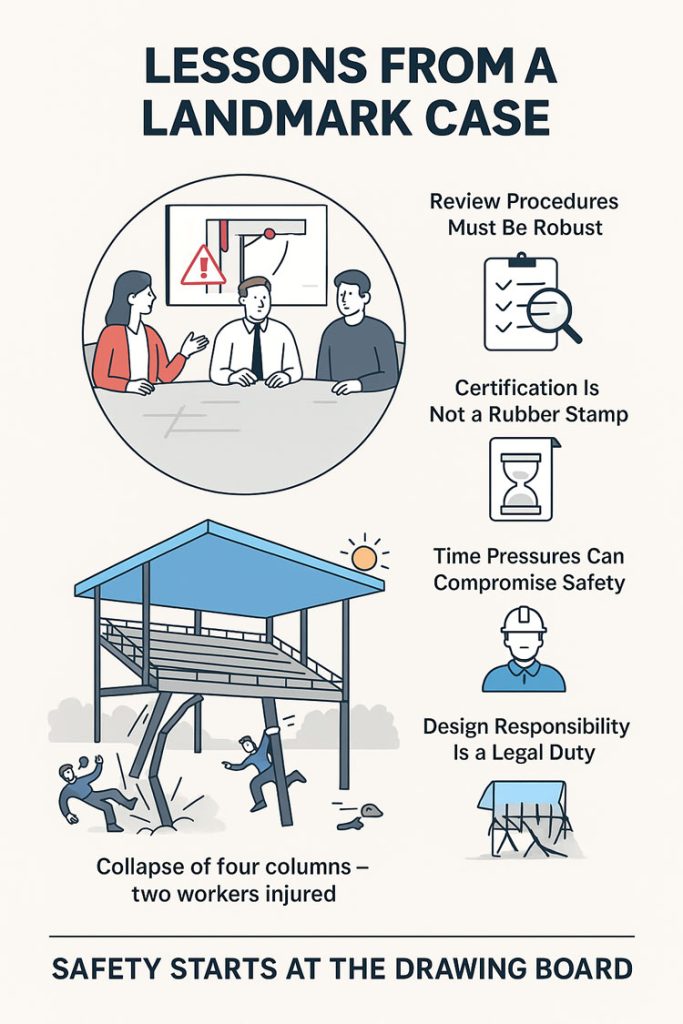
Infographic titled โ€œLessons from a Landmark Case,โ€ showing engineers reviewing a design, icons highlighting robust review procedures, proper certification, time-pressure risks, and legal design responsibilities. The lower illustration depicts a structure collapsing after four column failures with two workers falling, emphasising the message โ€œSafety starts at the drawing board

What Happened (Briefly)

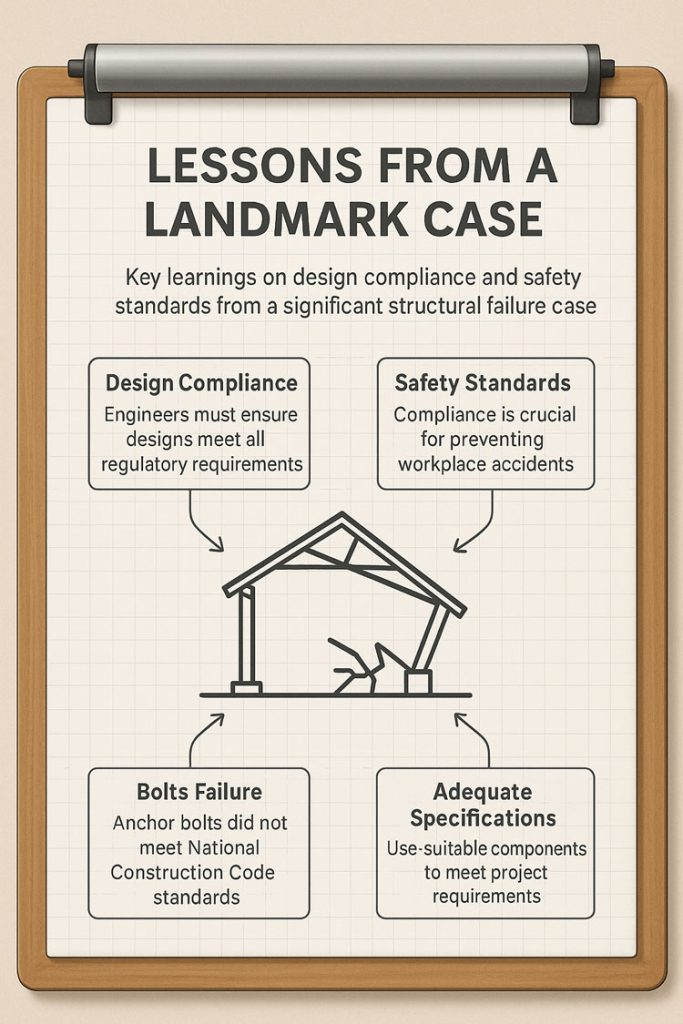
During roof sheeting works in late 2021, four of seven supporting columns of a cantilevered spectator roof failed, causing two apprentices to slide down the roof sheets. SafeWork SAโ€™s investigation found that the anchor bolts specified for the column base plates were inadequate and did not meet the requirements of the National Construction Code (NCC).

An independent compliance review also failed to detect this issue, allowing the error to pass unchecked into construction. The result was a collapse that could have had far more severe consequences had the roof been fully loaded or occupied.

Key Learnings for the Industry

This case underscores several important lessons for engineers, designers, project managers, and certifiers:

1. Design Responsibility Is a WHS Duty

Under the WHS Act, designers have a duty to ensure their work is safe not just in its intended use, but during construction. This means bolts, connections, and base plates must be designed for real-world loads โ€” including wind uplift, combined shear and tension, and concrete breakout limits per NCC and relevant Australian Standards.

2. Review Procedures Must Be Robust โ€” and Followed

Having a documented review procedure is not enough if it isnโ€™t rigorously applied. Independent verification and internal peer review are critical to catching design errors before they reach site.

3. Certification Is Not a Rubber Stamp

Independent certifiers play a key role in safeguarding public safety. They must actively verify that designs meet compliance, rather than simply sign off on documentation.

4. Time Pressures Can Compromise Safety

Compressed project timelines were noted as a factor in missed opportunities to catch the error. Project teams must resist the temptation to shortcut review steps when schedules are tight โ€” safety must remain non-negotiable.

5. Documentation & Traceability Protect Everyone

Maintaining calculation records, checklists, and review signoffs creates a clear audit trail. This helps demonstrate due diligence if something goes wrong.

Infographic titled โ€˜Lessons From a Landmark Caseโ€™ displayed on a clipboard. It highlights key learnings from a structural failure case: design compliance, safety standards, bolts failure, and adequate specifications. At the centre is a simple line drawing of a collapsed structure, with arrows pointing to four labelled boxes describing the importance of regulatory compliance, workplace safety standards, anchor bolt failures, and using suitable components to meet project requirements

Why This Matters

The collapse at Angaston Football Club was a relatively small incident with minor injuries โ€” but it could easily have been catastrophic. By learning from cases like this, the industry can improve its processes and prevent future failures.

As professionals, our role is to design for safety, verify rigorously, and document clearly. Doing so protects workers, end-users, and our own organisations.

Legal & Ethical Considerations

This post is intended as a learning resource, not as an allocation of blame. The case referenced is a matter of public record through SafeWork SA and SAET decisions, and all commentary here focuses on general principles of safe design and compliance.

We recommend that other practitioners review their own QA and certification procedures in light of this case to ensure compliance with the National Construction Code and WHS obligations.

More Information —> The Advertiser / Adelaide Now

Hamilton By Design logo displayed on a blue tilted rectangle with a grey gradient background

Mechanical Engineering | Structural Engineering

Mechanical Drafting | Structural Drafting

3D CAD Modelling | 3D Scanning

Chute Design

SolidWorks Contractors in Australia

Hamilton By Design โ€“ Blog