3D Scanning for Gladstone

Gladstone’s Industrial Powerhouse: How 3D LiDAR Scanning, Engineering & Digital Modelling Are Transforming CQ Projects

Gladstone is unlike any other regional city in Australia. It is a true industrial powerhouse — home to the country’s largest multicommodity port, three LNG mega-plants, major alumina refineries, a huge aluminium smelter, power stations, chemical facilities, cement production and a constant cycle of shutdown and maintenance projects. If you work in engineering, fabrication, construction or heavy industry, Gladstone represents one of the most complex, interesting and opportunity-rich environments in the country.

At Hamilton By Design, we bring engineering-grade 3D LiDAR laser scanning, mechanical and structural engineering, 3D modelling and fabrication-ready drafting to support the precision required in this region. With so many brownfield assets, tight shutdown windows, high-risk environments and complex layouts, Gladstone’s industrial clients rely on accurate data and robust engineering to ensure safe, efficient and reliable project outcomes.

This article explores why Gladstone is such a unique engineering ecosystem — and how modern digital tools are improving plant upgrades, maintenance, fabrication, installation and long-term reliability.


Why Gladstone Is One of Australia’s Most Unique Engineering Environments

Gladstone’s industrial landscape is the result of decades of strategic investment and natural geographic advantages. No other regional city has this density of heavy processing facilities, export terminals and energy infrastructure in one place.

1. A Mega-Scale Industrial Port

The Port of Gladstone is Queensland’s largest multicommodity port, handling:

  • coal
  • LNG
  • alumina
  • aluminium
  • cement
  • bulk chemicals
  • mineral products
  • general and containerised freight

The port’s footprint includes conveyors, loading towers, wharf structures, pipelines, tanks, gantries and processing equipment — much of which requires ongoing scanning, modelling and engineering to maintain safe, efficient operations.

2. Three LNG Plants on Curtis Island

Gladstone is home to Australia’s only cluster of three major LNG export facilities, each containing:

  • pressure vessels
  • cryogenic tanks
  • kilometres of pipe racks
  • modularised process trains
  • large structural steel assemblies
  • jetties and marine loading arms

This creates unparalleled demand for digital engineering, scanning and verification.

3. A Complete Heavy-Industry Chain

Few cities have such an interconnected set of process plants:

  • Queensland Alumina Limited (QAL)
  • Rio Tinto Yarwun Alumina Refinery
  • Boyne Aluminium Smelter
  • NRG and other power facilities
  • Cement Australia

Each site requires constant:

  • shutdown planning
  • precise measurement
  • design modifications
  • structural integrity checks
  • digital as-builts
  • engineering documentation

This continuous workload makes Gladstone one of the biggest users of LiDAR scanning and mechanical/structural engineering in Australia.

4. The City Runs on Projects

Gladstone’s industrial sector operates year-round:

  • maintenance shutdowns
  • brownfield upgrades
  • fabrication campaigns
  • equipment replacements
  • process improvements

Accurate spatial data is not optional — it is essential for avoiding clashes, rework and costly delays.


3D LiDAR Laser Scanning — Reducing Risk in Gladstone’s Complex Industrial Plants

In a brownfield environment like Gladstone, complexity is the norm:

  • crowded pipe racks
  • confined spaces
  • undocumented modifications
  • ageing platforms and walkways
  • shifting alignment over time
  • corrosion and wear
  • intricate mechanical layouts

Traditional surveying simply cannot capture enough detail to support safe and efficient upgrades.

That’s why Hamilton By Design delivers engineering-grade 3D LiDAR scanning, capturing entire facilities with millimetre-level accuracy.

Our scanning provides high-resolution digital data for:

  • refineries
  • smelters
  • LNG plants
  • conveyors and materials handling
  • marine loading facilities
  • tanks and pressure systems
  • structural steel
  • civil and terrain modelling

The result is a precise, true-to-life digital environment used for design, clash detection, structural checks, fabrication planning and QA.

Learn more about our scanning capabilities here:
3D Laser Scanning

For Gladstone, LiDAR scanning means:

  • fewer shutdown delays
  • safer engineering access
  • accurate tie-in points
  • reduced rework during installation
  • better fabrication accuracy
  • confidence in brownfield modifications

In an environment where time = money, this technology is transformative.


3D Modelling & Drafting — Turning Complexity into Clarity

Once the scan data is captured, Hamilton By Design converts it into structured 3D CAD models and fabrication-ready drawings. This process is essential in Gladstone’s industrial context, where upgrades often occur inside densely packed areas with zero room for error.

We deliver:

  • SolidWorks models of equipment, structures and layouts
  • general arrangement (GA) drawings
  • detailed fabrication drawings
  • piping/isometric drawings
  • platform, handrail and structural packages
  • alignment and clearance analysis
  • digital QA documentation

For LNG, alumina, port and refinery clients, accurate 3D modelling prevents clashes, supports tender and fabrication packages, and provides a reliable digital reference long after the project is complete.


Mechanical & Structural Engineering for Gladstone’s Heavy Industry

Gladstone’s operating environment requires engineering that is:

  • robust
  • precise
  • compliant
  • optimised for reliability
  • grounded in real-world site conditions

Hamilton By Design provides mechanical and structural engineering for:

  • plant upgrades and retrofits
  • conveyor and materials handling systems
  • support structures, frames and platforms
  • tanks, piping and pressure systems
  • fatigue, stress and load assessments
  • access and maintenance design
  • lifting, mounting and replacement systems

Our engineer-led approach ensures all designs are supported by verified data from LiDAR scanning and validated using modern analysis tools.


Where We Add the Most Value in Gladstone

1. Refinery & Smelter Shutdown Engineering

Scanning + modelling reduces:

  • tie-in errors
  • mismatch in fabricated steel
  • shutdown overruns
  • safety risks

2. LNG Plant Modifications & Brownfield Upgrades

LiDAR gives accurate data for:

  • pipe rerouting
  • structural steel changes
  • equipment replacement
  • modular installation

3. Port Facilities & Marine Loading Infrastructure

We support:

  • conveyor structures
  • wharf upgrades
  • loadout systems
  • marine walkways and assets

4. Fabrication & Workshop Support

Local fabricators benefit from:

  • accurate shop drawings
  • digital QA
  • validated steel cutting
  • correct fit-up on first installation

5. Civil & Terrain Modelling

For foundations, tank pads, laydown areas and access roads.


End-to-End Accountability: Scan → Model → Engineer → Draft → Deliver

Gladstone’s project environment involves many contractors — which can lead to miscommunication. Hamilton By Design solves this with a unified workflow:

  1. 3D LiDAR Scan
  2. Point Cloud Registration
  3. 3D CAD Modelling
  4. Mechanical & Structural Engineering
  5. Fabrication-Ready Drafting
  6. Digital QA & Documentation

One team. One process. One accountable source.
Minimal rework. Maximum clarity.


Hamilton By Design logo displayed on a blue tilted rectangle with a grey gradient background

Gladstone’s Future Is Heavy Industry + Digital Precision — And We’re Ready

With rising LNG activity, alumina growth, port expansions, hydrogen projects and ongoing shutdowns, Gladstone is entering a new era of industrial development. Accurate data, digital modelling and strong engineering discipline are no longer optional — they are core to safe, efficient and cost-effective project delivery.

Hamilton By Design is here to support Gladstone with:

  • precision 3D LiDAR scanning
  • mechanical & structural engineering
  • 3D modelling and CAD drafting
  • digital project documentation
  • fabrication-ready deliverables

Whether you’re planning a shutdown, designing a new structure, upgrading existing systems or documenting a complex brownfield environment, we help you build with confidence.

Our Clients
Name
Would you like us to arrange a phone consultation for you?

Townsville’s Industrial Frontier

Townsville’s Industrial Frontier — How 3D LiDAR, Digital Engineering and Modern Drafting Are Powering North Queensland Projects

Townsville is much more than a tropical coastal city — it’s the beating industrial heart of Northern Australia. As the largest urban centre north of the Sunshine Coast, Townsville connects mining, maritime, defence, manufacturing and export logistics in a way few other regional centres can.

With rapid growth across the port, military infrastructure, mining-supply networks, marine services and export facilities, the region demands precision, reliability and future-ready engineering solutions. That’s where Hamilton By Design steps in — offering tailored 3D LiDAR laser scanning, comprehensive mechanical and structural engineering, advanced 3D modelling, and fabrication-ready drafting to meet Townsville’s unique and complex needs.

If you’re planning a warehouse expansion, a plant upgrade, port logistics facility, or maintenance overhaul — we give you data-driven confidence from day one.


Why Townsville Needs Digital Engineering & 3D Scanning

Townsville stands out among Australian regional cities because of its diverse economy and heavy industrial footprint:

  • It hosts one of Australia’s busiest multi-cargo seaports — Port of Townsville — handling minerals, metals, bulk exports, container freight, and supporting exports from Western and North-West Queensland mining regions.
  • It supports major mining supply chains, metal-refining operations and logistics infrastructure across the region.
  • It hosts the largest defence garrison in northern Australia — Lavarack Barracks — plus associated military, infrastructure and support-facility requirements.
  • Townsville’s urban and industrial centre sits beside a sensitive coastal environment, with proximity to the Great Barrier Reef and marine ecosystems — meaning infrastructure must often balance heavy-duty utility with environmental and spatial constraints.

This mix of heavy industry, maritime logistics, defence requirements, and environmental sensitivity demands more than standard surveys — it needs digital accuracy, thorough engineering, careful planning and future-ready documentation.


3D LiDAR Laser Scanning — The Foundation of High-Integrity Projects

When dealing with port terminals, refinery installations, mining supply warehouses, defence facilities, or heavy-machinery workshops, inaccurate site measurements can be costly — leading to misaligned equipment, interference, regulation compliance risks, fabrication errors or rework.

At Hamilton By Design, our 3D LiDAR laser scanning service captures full as-built environments with high precision, including:

  • structural steel, supports and framing
  • complex pipework, conveyors, fittings
  • terrain, civil features and existing utilities
  • machinery layout, clearances, and tie-in points

The result: a complete, millimetre-accurate digital record of your site’s geometry — ideal for analysis, retrofits, expansions or maintenance.

Discover our full capabilities here: 3D Laser Scanning
https://www.hamiltonbydesign.com.au/home/3d-lidar-scanning-digital-quality-assurance/3d-laser-scanning/

For Townsville clients, this means fewer shutdowns, safer project planning, faster fabrication, and minimized risk of unexpected clashes or construction rework.


From Point Cloud to Precision — 3D Modelling, Drafting & Engineering

Once the scan is complete and point-cloud data processed, we build intelligent 3D models and fabrication-ready documentation:

  • mechanical and structural CAD models (existing and proposed)
  • general arrangement (GA), detailed drawings, isometrics and BOMs
  • clash detection and interference checking before fabrication or retrofit
  • layout optimisation for workflow, maintenance access, and safety compliance
  • digital archives for future maintenance or expansion

For heavy-duty environments such as port facilities, refineries, warehouses, defence-related infrastructure or mining supply workshops — having accurate 3D models eliminates costly guesswork and supports efficient execution.

In short: we give you digital twins, not just drawings.


Engineering Support for Townsville’s Key Industries

Townsville’s industrial profile spans mining, export logistics, maritime, defence, metals processing and large-scale fabrication — each with its own engineering demands.

Hamilton By Design offers:

  • structural assessments (platforms, supports, frames, foundations) for retrofits or new installations
  • mechanical layout and alignment design (conveyors, cranes, heavy equipment, storage systems)
  • load, stress and fatigue analysis (FEA) for steelwork, pressure equipment, supports or chassis
  • piping, chute or conveyor design and re-routing for upgrading plants or refineries
  • compliance documentation and fabrication-ready drawings ready for procurement, tendering or regulatory approval

Whether you’re upgrading a shipping-container terminal, expanding a warehouse, installing new refinery modules, building maintenance workshops for mining machinery, or constructing support facilities for defence or export operations — our engineering-led workflow ensures you build right the first time.


Streamlined Workflow — From Scan to Delivery, One Trusted Partner

One common problem for regional projects is coordinating between multiple service providers — surveyors, draftspeople, engineers, fabricators — which often leads to miscommunication, delays, or misaligned deliverables.

Hamilton By Design offers a single-source bundle:

  1. 3D LiDAR site scan
  2. Point-cloud data processing and registration
  3. 3D CAD modelling
  4. Engineering assessment and design
  5. Fabrication-ready drafting and documentation
  6. Digital QA and delivery

We handle everything — you get consistent quality, clear responsibility, and projects that move smoothly from concept to construction.


Real-World Use Cases for Townsville Clients

Port Expansion & Upgrade Projects

As the Port of Townsville expands and modernises to handle larger cargo, new cranes, heavier loads and increased throughput, accurate 3D scans and structural/foundation assessments are critical. Our scanning + modelling + design services ensure new installations fit existing layouts perfectly, avoid clashes, and meet structural integrity and safety standards.

Mining Supply, Maintenance & Fabrication Workshops

Supporting the North-West mining region means heavy machinery maintenance, parts fabrication, and workshop upgrades. Accurate laser scans and CAD models allow fabricators to pre-validate alignments, clearances, and fit-outs before steel is cut.

Defence Infrastructure & Facility Upgrades

With the presence of large defence bases and logistics hubs, upgrades, extensions, or refurbishments often demand strict compliance and precise structural layouts. Our end-to-end digital engineering approach ensures regulations, load requirements, and integration requirements are met without surprises.

Industrial Refineries & Metals Processing Plants

Whether it’s zinc, copper or other metals processing, heavy-duty installations often include pipework, structural supports, conveyors, and complex layout constraints — perfect candidates for digital twin creation, clash detection, and fabrication-ready design.

Multi-use Warehouses, Logistics Hubs & Fabrication Yards

As Townsville grows, so does demand for supply-chain infrastructure. For logistics hubs and fabrication yards, accurate site scans and 3D planning streamline material flow, design logistics, safety compliance, and maintenance scheduling.


Hamilton By Design logo displayed on a blue tilted rectangle with a grey gradient background

Why Townsville — and Hamilton By Design — Is a Winning Combination

Townsville is uniquely placed as a northern Australia hub that supports mining, port exports, defence, fabrication, metallurgy and logistics — all under a tropical but manageable climate. That diversity means clients across sectors demand precision, reliability and best-practice engineering.

Hamilton By Design is ready to deliver just that — combining modern 3D laser scanning, smart CAD modelling, thorough engineering discipline and fabrication-ready design in one seamless package.

If you’re operating in Townsville or servicing projects across North Queensland — whether mining supply, port infrastructure, fabrication yards, defence facilities, metal processing, or logistics hubs — we’re equipped to support your next project, reduce risk, and deliver results on time and on spec.

Our Clients

Name
Would you like us to arrange a phone consultation for you?

Mackay’s Industrial Edge

Mackay’s Industrial Edge — How 3D LiDAR, Modern Engineering & Digital Modelling Supercharge Regional Projects

Located on the tropical Queensland coast but powering heavy industry, mining support and agricultural logistics, Mackay stands as a unique regional powerhouse. With its massive sugar industry, proximity to the Bowen Basin coalfields, thriving fabrication sector, marine and port operations — plus a growing push toward industrial expansion — the city’s infrastructure demands are both diverse and complex.

At Hamilton By Design, we recognise that projects in Mackay need more than “old-school” drawings or rough-site surveys. That’s why we offer state-of-the-art 3D LiDAR laser scanning, comprehensive mechanical and structural engineering, advanced 3D modelling, and fabrication-ready drafting — all designed to meet Mackay’s rigorous industrial, mining-support and agricultural demands.

If you’re planning an upgrade to a processing facility, expanding a plant or fabricating complex steelwork, our services ensure precision, efficiency and reliability from start to finish.


Why Mackay Is a Perfect Fit for Digital Engineering & 3D Scanning

Mackay’s blend of industries — sugar mills, mining, fabrication, marine, port logistics and heavy machinery — means that most facilities are a patchwork of legacy infrastructure, ongoing modifications and high-demand production cycles.

That brings challenges like:

  • undocumented pipework, conveyors or structural changes;
  • tight tolerances for retrofits or new installations;
  • heavy mechanical equipment requiring accurate alignment and structural support;
  • short windows for shutdowns or maintenance;
  • mixed use of fabrication, mining-grade components, and agricultural processing equipment.

For these reasons, the old ways of tape-measure site surveys and manual sketches are often not enough.

Enter 3D LiDAR scanning. By capturing the entire facility geometry with millimetre-level accuracy, you get a complete digital “as-built” record — capturing everything from structural steel, ductwork, conveyors, foundations, and terrain, to existing equipment and utilities.

Through Hamilton By Design’s professional scanning services, Mackay clients receive real-world data that supports safer, faster and more accurate project planning, design and fabrication.


From Point Cloud to Precision Design: 3D Modelling & Drafting

Once your site is scanned, our team converts the raw scan data into intelligent 3D CAD models — delivering:

  • accurate mechanical and structural layouts;
  • fabrication-ready drawings (GA, detail drawings, isometrics, BOMs);
  • clash detection and interference checking before fabrication starts;
  • easy visualisation for stakeholders, clients and contractors;
  • digital archives for future modifications or maintenance.

This kind of precision work dramatically reduces risk — especially for brownfield sites or mixed-use facilities common in Mackay’s industrial sector.


Engineering Support Built for Mackay’s Key Industries

Whether it’s a sugar mill retrofit, mining support workshop, marine fabrication yard, or industrial workshop expansion — the range of engineering challenges in Mackay is enormous. Hamilton By Design brings specialist mechanical and structural engineering expertise to the table, offering:

  • structural assessments (supports, platforms, load-bearing frames, foundations)
  • alignment and vibration analysis for conveyors, heavy machinery, pumps
  • design of new equipment layouts, piping, ducting and supports
  • fatigue, stress and load-bearing analysis (FEA) when needed
  • compliance-ready drawings and design documentation for local regulations and safety standards

This level of engineering support is often critical for projects involving heavy loads, mining-grade equipment, or large-scale fabrication — exactly the types of projects abundant across Mackay.


3D LiDAR Laser Scanning — The Game Changer for Mackay Projects

Especially when plants are being upgraded, new modules added, or older sites refurbished, accurate spatial data is the foundation for success.

Our 3D LiDAR laser scanning service ensures:

  • complete, precise capture of existing site geometry — steelwork, structure, terrain, utilities;
  • minimal site downtime — faster capture than manual survey;
  • safer field operations (less need for manual measurements in active plants);
  • high-fidelity base for design, modelling and fabrication;
  • better coordination between contractors, fabricators and engineers.

Learn more about our 3D LiDAR services here: https://www.hamiltonbydesign.com.au/home/3d-lidar-scanning-digital-quality-assurance/3d-laser-scanning/

For a city like Mackay — with fast-paced industrial demand, tight tolerances, and high-volume production — this technology isn’t just beneficial, it’s essential.


One Integrated Workflow: From Scan to Delivery

What sets Hamilton By Design apart is our seamless, end-to-end service:

  1. Conduct 3D LiDAR scan of the facility or site
  2. Process point-cloud data and clean up for modelling
  3. Build detailed 3D CAD models — mechanical, structural, architectural
  4. Perform engineering assessments, structural/ mechanical analysis or modifications as needed
  5. Produce fabrication-ready drawings and documentation
  6. Provide digital reports, QA data and as-built records for the client

Having a single point of accountability — scan, model, engineer, deliver — reduces miscommunication, avoids rework and ensures that every part of the project is aligned, documented, and traceable.


Hamilton By Design logo displayed on a blue tilted rectangle with a grey gradient background

Why Mackay Businesses Should Use Hamilton By Design

Whether you’re running a sugar mill, a fabrication workshop servicing Bowen Basin mines, a workshop for heavy equipment repairs, or a marine engineering facility servicing port exports — Mackay’s industrial landscape is complex.

By using cutting-edge 3D laser scanning, accurate modelling, and expert engineering, Hamilton By Design helps you:

  • save time and money on site surveys;
  • avoid costly rework from inaccurate measurements;
  • ensure tighter tolerances, safer installations and compliance;
  • speed up design, fabrication and installation;
  • maintain digital records for ongoing maintenance or future upgrades.

For industries in Mackay that deal with heavy loads, tight schedules, and high-volume production — this is a competitive advantage.

Our Clients
Name
Would you like us to arrange a phone consultation for you?

3D Laser Scanning in Singleton and the Hunter: Delivering Accuracy for Mining, Manufacturing and Industrial Projects

Singleton sits at the heart of the Hunter’s industrial engine room. Surrounded by major mines, CHPPs, power stations, fabrication workshops and heavy industrial precincts, the region depends on accurate information, efficient planning and safe, predictable project execution. With assets that have operated for decades, countless undocumented modifications and structures that no longer match original drawings, engineering teams face a constant challenge — how to measure, model and design with confidence.

This is exactly where 3D laser scanning in Singleton and Hunter regions is transforming project workflows. Hamilton By Design provides millimetre-accurate digital capture that eliminates guesswork and supports engineering, fabrication, maintenance and shutdown planning across the entire industrial sector.

Whether you’re a CHPP superintendent in Singleton, a fabrication manager in Muswellbrook, a maintenance engineer in the Hunter Valley, or a project manager responsible for upgrades across multiple sites, accurate laser scanning has become essential. This article explores why the demand for 3D scanning has surged, how the technology works, and how Hamilton By Design uses it to support safer, more efficient and more reliable outcomes across the Hunter region.


Why Singleton and the Hunter Need 3D Laser Scanning

The Hunter region is home to some of Australia’s most active heavy industrial environments. These operations consist of massive structural steel assemblies, conveyors, process equipment, platforms, chutes, bins and pipework — all subject to wear, deformation and ongoing modification. Many facilities were built long before digital documentation became standard. As a result:

  • Original drawings rarely reflect the current condition
  • Measurements taken by hand are slow, risky and often inaccurate
  • Shutdown windows are extremely tight
  • Brownfield constraints make new installations complex
  • Fabricators rely heavily on accurate data to ensure perfect fitment

Incorrect measurements don’t just cause inconvenience — they create costly fabrication errors, installation delays, safety risks and additional shutdown time.

3D laser scanning removes these risks entirely by creating a verified digital record of what is actually on site.


What 3D Laser Scanning Delivers

Hamilton By Design uses engineering-grade LiDAR scanners to capture millions of precise data points across a site. These points form a point cloud, which is a detailed 3D representation of the real environment. This data can then be used to create accurate models, drawings, simulations and digital checks.

With 3D laser scanning in Singleton and Hunter you get:

  • Accurate as-built geometry
  • Digital templates for fabrication
  • Reliable interface points for new steel or equipment
  • Precise alignment and clearance data
  • Clash identification before installation
  • Improved shutdown planning and safety

For engineers, fitters, boilermakers and fabricators, this accuracy becomes the foundation for smarter decision-making and better project outcomes.


Key Industries Using 3D Laser Scanning in Singleton and the Hunter

1. Mining & CHPP Operations

Singleton is surrounded by some of the most productive mines in the country. Mines and CHPP operations rely heavily on scanning for:

  • Chute and hopper replacements
  • Conveyor alignment checks
  • Transfer tower redesigns
  • Structural integrity assessments
  • Bin, screen and crusher upgrades
  • Digital twins for long-term planning

Because these plants operate continuously, shutdown windows are limited. Laser scanning allows accurate pre-planning, reducing time spent onsite during shutdowns and eliminating unexpected clashes.


2. Fabrication & Manufacturing

The Hunter has a strong fabrication industry, supplying steel structures, mechanical components, platforms, tanks and pipework to mining and energy clients. But fabrication quality relies on measurement quality.

3D laser scanning ensures:

  • Components fit the first time
  • Bolt holes align correctly
  • Flanges match perfectly
  • Structural steel connects without modification
  • Expensive rework on site is eliminated

Workshops across Singleton, Muswellbrook, Thornton and Rutherford increasingly depend on digital accuracy to remain competitive.


3. Power Stations & Energy Infrastructure

The Hunter region includes major power generation assets and critical energy infrastructure. Many structures are ageing, and modifications require absolute accuracy.

Laser scanning supports:

  • Platform replacements
  • Pipe rerouting
  • Structural upgrades
  • Boiler house modifications
  • Maintenance planning
  • Deformation analysis

Reliable as-built data ensures compliance and reduces risk during shutdowns.


4. Industrial, Civil and Commercial Upgrades

Singleton’s industrial footprint is expanding, and many facilities require:

  • As-built documentation
  • Renovations and extensions
  • Spatial coordination
  • Facility redevelopment
  • BIM integration

Laser scanning provides the foundation for safe and efficient project planning across commercial and industrial facilities.


The Hamilton By Design Workflow

Hamilton By Design offers a complete digital engineering solution, from scanning to modelling to fabrication-ready drawings. Our workflow includes:

1. On-Site Scanning

We capture every detail — structural steel, mechanical equipment, conveyors, platforms, bins, hoppers, pipework and building geometry.

2. Processing & Registration

Individual scans are stitched together into a single, accurate point cloud representing the full environment.

3. CAD Modelling

We convert point cloud data into:

  • 3D models
  • GA drawings
  • Fabrication details
  • DXF files for laser cutting
  • Assembly and installation references

4. Digital Fit Checks

Before fabrication begins, we overlay new designs to check for:

  • Clashes
  • Misalignments
  • Interference with existing structures
  • Access and maintenance constraints

5. Project Delivery

Clients receive data that supports safe installation and reduces downtime.


Benefits of 3D Laser Scanning in Singleton and the Hunter

Reduced Rework

Accurate digital data means fabricators build with confidence and installers avoid modifications on site.

Safer Data Capture

Laser scanning reduces the need for manual measuring in hazardous areas.

Faster Shutdown Execution

Pre-planning with accurate data speeds up installation and reduces plant downtime.

Improved Engineering and Design

Designers work from verified geometry rather than guessing from old drawings.

Better Communication

Point clouds and 3D models allow all stakeholders to visualise the site clearly.

Cost Savings from Start to Finish

Less rework, fewer delays and more efficient fabrication combine to deliver real financial value.


Why Choose Hamilton By Design?

Hamilton By Design is uniquely positioned to support Singleton and Hunter clients because:

  • We combine laser scanning expertise with real engineering capability
  • We understand mining, CHPP, fabrication and industrial environments
  • We provide end-to-end digital workflows, not just raw data
  • Our models and drawings are created with fabrication and installation in mind
  • We deliver millimetre-accurate results you can trust

Our team works closely with mine sites, fabricators, energy providers and industrial operators across the region, delivering practical solutions built on real data.


Hamilton By Design logo displayed on a blue tilted rectangle with a grey gradient background

Work With Hamilton By Design

If your project requires precise measurement, modelling, redesign or fabrication, 3D laser scanning in Singleton and the Hunter is the most reliable way to ensure accuracy and reduce risk.

Hamilton By Design is ready to support your next upgrade, shutdown, replacement or maintenance campaign with:

  • On-site laser scanning
  • Point cloud processing
  • CAD modelling
  • Fabrication drawings
  • Digital engineering support

Reach out to discuss your upcoming project — and experience the confidence that only accurate, high-quality 3D data can provide.

3D Scanning in The Hunter Valley

Hunter Valley Laser Scanning: Transforming Engineering Accuracy Across Mining, Manufacturing and Infrastructure

3D Laser Scanning

3D LiDAR Scanning – Digital Quality Assurance

Seeing the Unseen: How LiDAR Scanning is Transforming Mining Process Plants

In modern mining, where uptime is money and safety is non-negotiable, understanding the geometry of your process plant is critical. Every conveyor, chute, pipe rack, and piece of equipment must fit together seamlessly and operate reliably — but plants are messy, dusty, and constantly changing. Manual measurement with a tape or total station is slow, risky, and often incomplete.

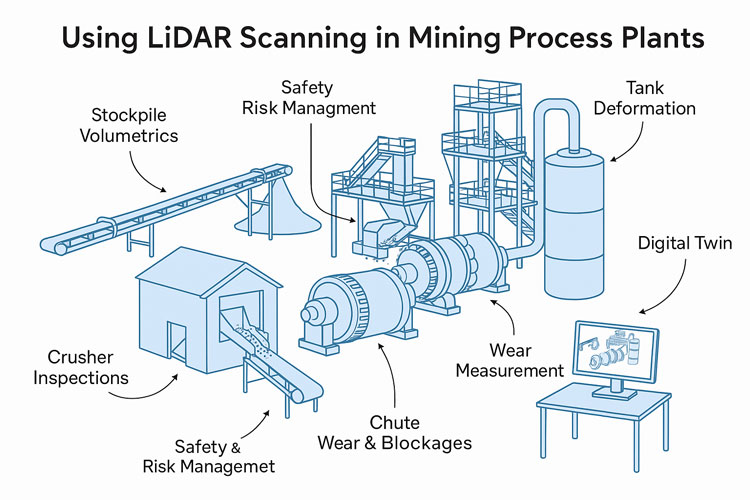
nfographic showing how LiDAR scanning is used in mining process plants, with illustrations of conveyors, crushers, tanks, mills and chutes. Labels highlight applications such as stockpile volumetrics, crusher inspections, safety and risk management, chute wear and blockages, mill wear measurement, tank deformation monitoring and creating digital twins.

This is where LiDAR scanning (Light Detection and Ranging) has become a game-changer. By capturing millions of precise 3D points per second, LiDAR gives engineers, maintenance planners, and operators an exact digital replica of the plant — without climbing scaffolds or shutting down equipment. In this post, we’ll explore how mining companies are using LiDAR scanning to solve real problems in processing plants, improve safety, and unlock operational efficiency.


What Is LiDAR Scanning?

LiDAR is a remote sensing technology that measures distance by firing pulses of laser light and recording the time it takes for them to return. Modern terrestrial and mobile LiDAR scanners can:

  • Capture hundreds of thousands to millions of points per second
  • Reach tens to hundreds of meters, depending on the instrument
  • Achieve millimeter-to-centimeter accuracy
  • Work in GPS-denied environments, such as inside mills, tunnels, or enclosed plants (using SLAM — Simultaneous Localization and Mapping)

The output is a point cloud — a dense 3D dataset representing surfaces, equipment, and structures with stunning accuracy. This point cloud can be used as-is for measurements or converted into CAD models and digital twins.


Why Process Plants Are Perfect for LiDAR

Unlike greenfield mine sites, processing plants are some of the most geometry-rich and access-constrained areas on site. They contain:

  • Complex networks of pipes, conveyors, tanks, and structural steel
  • Moving equipment such as crushers, mills, and feeders
  • Dusty, noisy, and hazardous environments with limited safe access

All these factors make traditional surveying difficult — and sometimes dangerous. LiDAR enables “no-touch” measurement from safe vantage points, even during operation. Multiple scans can be stitched together to create a complete model without shutting down the plant.


Applications of LiDAR in Process Plants

1. Wear Measurement and Maintenance Planning

LiDAR has revolutionized how mines measure and predict wear on critical process equipment:

  • SAG and Ball Mill Liners – Portable laser scanners can capture the exact wear profile of liners. Comparing scans over time reveals wear rates, helping maintenance teams schedule relines with confidence and avoid premature failures.
  • Crusher Chambers – Scanning inside primary and secondary crushers is now faster and safer than manual inspections. The resulting 3D model allows engineers to assess liner life and optimize chamber profiles.
  • Chutes and Hoppers – Internal scans show where material buildup occurs, enabling targeted cleaning and redesign to prevent blockages.

Result: Reduced downtime, safer inspections, and better forecasting of maintenance budgets.


2. Retrofit and Expansion Projects

When modifying a plant — installing a new pump, rerouting a pipe, or adding an entire circuit — having an accurate “as-built” model is crucial.

  • As-Built Capture – LiDAR provides an exact snapshot of the existing plant layout, eliminating guesswork.
  • Clash Detection – Designers can overlay new equipment models onto the point cloud to detect interferences before anything is fabricated.
  • Shutdown Optimization – With accurate geometry, crews know exactly what to cut, weld, and install — reducing surprise field modifications and shortening shutdown durations.

3. Inventory and Material Flow Monitoring

LiDAR is not just for geometry — it’s also a powerful tool for tracking material:

  • Stockpile Volumetrics – Mounted scanners on stackers or at fixed points can monitor ore, concentrate, and product stockpiles in real time.
  • Conveyor Load Measurement – Stationary LiDAR above belts calculates volumetric flow, giving a direct measure of throughput without contact.
  • Blending Control – Accurate inventory data improves blending plans, ensuring consistent plant feed quality.

4. Safety and Risk Management

Perhaps the most valuable application of LiDAR is keeping people out of harm’s way:

  • Hazardous Floor Areas – When flooring or gratings fail, robots or drones with LiDAR payloads can enter the area and collect data remotely.
  • Fall-of-Ground Risk – High walls, bin drawpoints, and ore passes can be scanned for unstable rock or buildup.
  • Escape Route Validation – Scans verify clearances for egress ladders, walkways, and platforms.

Every scan effectively becomes a permanent digital record — a baseline for monitoring ongoing structural integrity.


5. Digital Twins and Advanced Analytics

A plant-wide LiDAR scan is the foundation of a digital twin — a living, data-rich 3D model connected to operational data:

  • Combine scans with SCADA, IoT, and maintenance systems
  • Visualize live process variables in context (flow rates, temperatures, vibrations)
  • Run “what-if” simulations for debottlenecking or energy optimization

As AI and simulation tools mature, the combination of geometric fidelity and operational data opens new possibilities for predictive maintenance and autonomous plant operations.


Emerging Opportunities

Looking forward, there are several promising areas for LiDAR in mining process plants:

  • Autonomous Scan Missions – Using quadruped robots (like Spot) or SLAM-enabled drones to perform routine scanning in high-risk zones.
  • Real-Time Change Detection – Continuous scanning of critical assets with alerts when deformation exceeds thresholds.
  • AI-Driven Point Cloud Analysis – Automatic object recognition (valves, flanges, motors) to speed up model creation and condition reporting.
  • Integrated Planning Dashboards – Combining LiDAR scans, work orders, and shutdown schedules in a single interactive 3D environment.

Best Practices for Implementing LiDAR

To maximize the value of LiDAR scanning, consider:

  1. Define the Objective – Are you measuring wear, planning a retrofit, or building a digital twin? This affects scanner choice and resolution.
  2. Plan Scan Positions – Minimize occlusions and shadow zones by preplanning vantage points.
  3. Use Proper Registration – Tie scans to a control network for consistent alignment between surveys.
  4. Mind the Environment – Dust, fog, and vibration can degrade data; choose scanners with appropriate filters or protective housings.
  5. Invest in Processing Tools – The raw point cloud is only the start — software for meshing, modeling, and analysis is where value is extracted.
  6. Train Your Team – Build internal capability for scanning, processing, and interpreting the results to avoid vendor bottlenecks.

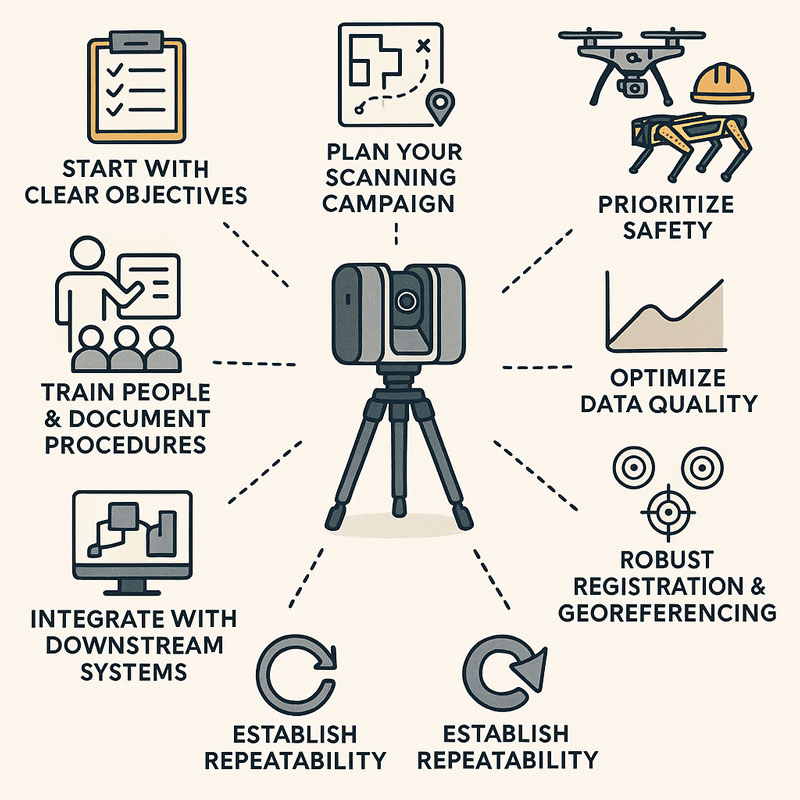
Infographic showing a 3D LiDAR scanner on a tripod surrounded by eight best-practice principles: start with clear objectives, plan your scanning campaign, prioritize safety, optimize data quality, ensure robust registration and georeferencing, establish repeatability, integrate with downstream systems, and train people with documented procedures

LiDAR scanning is no longer a niche technology — it is rapidly becoming a standard tool for mining process plants that want to operate safely, efficiently, and with fewer surprises. From mill liners to stockpiles, from shutdown planning to digital twins, LiDAR provides a clear, measurable view of assets that was impossible a decade ago.

For operations teams under pressure to deliver more with less, the case is compelling: better data leads to better decisions. And in a high-stakes environment like mineral processing, better decisions translate directly to improved uptime, reduced costs, and safer workplaces.

The next time you’re planning a shutdown, a retrofit, or even just trying to understand why a chute is plugging, consider pointing a LiDAR scanner at the problem. You may be surprised at how much more you can see — and how much time and money you can save.

3D Scanning | Mining Surface Ops | 3D Modelling

Mechanical Engineering | Structural Engineering

Mechanical Drafting | Structural Drafting

3D CAD Modelling | 3D Scanning

Chute Design

SolidWorks Contractors in Australia

Hamilton By Design – Blog