Bulk Material Handling in Mining: Engineering the Movement of Raw Materials from ROM to Plant

Mechanical engineer and client reviewing a ROM hopper with two discharge conveyors using LiDAR scanning at a mining bulk material handling facility

Bulk Material Handling in Mining | ROM, Conveyors & Transfer Engineering

Bulk material handling is at the core of almost every mining operation. From the moment raw material is extracted at the Run-of-Mine (ROM) pad through to crushing, screening, processing, and stockpiling, the safe and efficient movement of material is critical to productivity, asset reliability, and worker safety.

At Hamilton By Design, we support mining and heavy-industry clients with engineering-led mechanical design, verification, and documentation for bulk material handling systemsโ€”focusing on conveyors, transfer points, chutes, ROM bins, hoppers, and associated steelwork.


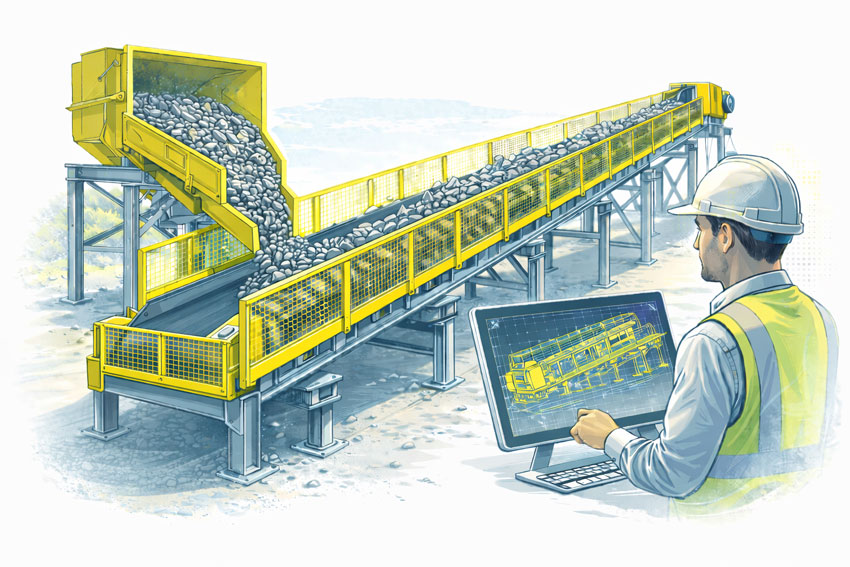
Engineering-led ROM hopper and dual conveyor discharge system being verified with LiDAR scanning in an open-cut mining operation

What Is Bulk Material Handling in Mining?

Bulk material handling refers to the mechanical systems used to move large volumes of raw or processed material, including:

  • Run-of-Mine (ROM) ore
  • Crushed rock and coal
  • Overburden and rejects
  • Processed product and fines

These systems typically include:

  • Apron feeders and ROM bins
  • Primary, secondary, and tertiary crushers
  • Conveyor belts and transfer stations
  • Chutes, hoppers, and bins
  • Stackers, reclaimers, and stockpiles

Each interface between machines is a design-critical point where poor geometry, misalignment, or incorrect loading assumptions can lead to blockages, excessive wear, spillage, downtime, and safety risks.


Engineering Challenges in Bulk Material Handling

Bulk handling systems operate under harsh conditions and face unique engineering challenges:

1. Variable Material Properties

  • Changes in moisture content, particle size, and bulk density
  • Segregation and fines generation
  • Adhesion and carryback issues

2. Transfer Point Design

  • Impact loading and wear at chute inlets
  • Flow control and trajectory management
  • Dust, spillage, and maintenance access

3. Structural and Mechanical Loads

  • Dynamic loads from material flow
  • Belt tensions and starting/stopping forces
  • Fatigue in steelwork and supports

4. Brownfield Constraints

  • Existing plant geometry and limited space
  • Legacy drawings that donโ€™t reflect as-built conditions
  • Shutdown-driven installation windows

These challenges reinforce why engineering-led design, supported by accurate site data, is essential.


From ROM to Processing: A System-Based Engineering Approach

Hamilton By Design approaches bulk material handling as a complete system, not isolated components.

Our typical workflow includes:

  1. Engineering-led site verification
    Using high-accuracy 3D LiDAR scanning to capture existing conditions at ROM pads, conveyors, and plant interfaces.
  2. Mechanical and structural design
    Developing fit-for-purpose conveyor layouts, transfer chutes, supports, and access platforms using SolidWorks-based workflows.
  3. Load definition and verification
    Applying realistic material loads and operational scenarios to reduce over-design and manage fatigue risk.
  4. Fabrication-ready documentation
    Producing drawings and models that support fit-first-time fabrication and installation during shutdowns.

This integrated approach reduces rework, delays, and operational risk.


Conveyor Transfer Points: Where Most Problems Begin

Transfer points are the highest-risk locations in bulk material handling systems.

Common issues include:

  • Poor material trajectory control
  • Excessive impact and liner wear
  • Dust escape and spillage
  • Restricted inspection and maintenance access

Engineering-led transfer design considers:

  • Material flow paths and impact angles
  • Chute geometry and liner selection
  • Maintenance clearances and access
  • Compliance with guarding and safety standards

Well-designed transfer points improve availability, reduce maintenance costs, and enhance safety outcomes.


Why Engineering Matters More Than Ever in Mining Handling Systems

As mining operations push for higher throughput and tighter shutdown schedules, the tolerance for design error is shrinking.

Engineering-driven bulk material handling delivers:

  • Predictable material flow
  • Reduced downtime and blockages
  • Improved safety and maintainability
  • Defensible design records for audits and compliance

This is especially important in brownfield mining environments, where assumptions based on outdated drawings can introduce significant risk.


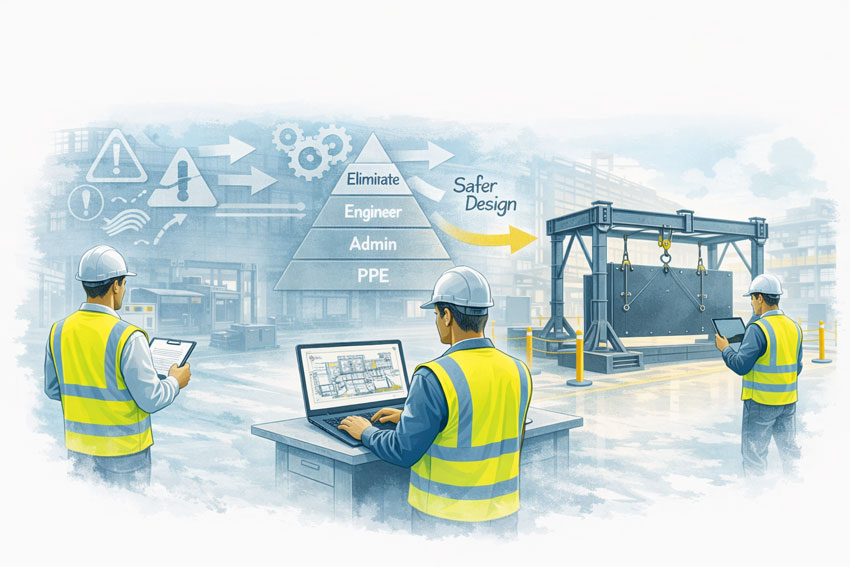
Mining engineers applying design-for-safety principles to improve material handling systems in an industrial workshop

Supporting Mining Operations Across Australia

Hamilton By Design supports bulk material handling projects across:

  • Coal handling and preparation plants (CHPPs)
  • Hard-rock crushing and screening facilities
  • Mineral processing plants
  • Ports, stockyards, and materials terminals

Our experience spans ROM handling, conveyors, transfer chutes, and plant upgrades, backed by practical site experience and engineering accountability.


Hamilton By Design logo displayed on a blue tilted rectangle with a grey gradient background

Speak With an Engineer

If you are planning:

  • A ROM handling upgrade
  • Conveyor or transfer chute modifications
  • Crushing plant changes
  • Shutdown-driven bulk handling works

๐Ÿ‘‰ Contact Hamilton By Design to discuss an engineering-led approach that reduces risk and improves outcomes.


Name
Would you like us to arrange a phone consultation for you?
Address

Our clients:


https://www.hamiltonbydesign.com.au/insights/bulk-materials-conveyor-transfer
https://www.hamiltonbydesign.com.au/standards/as-1755-conveyor-safety
https://www.hamiltonbydesign.com.au/insights/bulk-materials-conveyor-transfer

Machine Guarding for Ship Loaders, Stackers & Reclaimers in Bulk Materials Handling

Machine Guarding for Ship Loaders, Stackers & Reclaimers | Bulk Materials Safety

Why guarding matters on large bulk material machines

Ship loaders, stackers and reclaimers combine elements of mobile plant, fixed plant and continuous conveying systems. Their scale, movement and operating envelopes introduce hazards that cannot be managed with ad-hoc or legacy guarding.

Most guarding failures are not caused by a single missing guard, but by brownfield modifications, undocumented changes, and loss of original design intent. This makes engineering-led guarding essential for safety, compliance and uptime.


Australian Standards framework for guarding

AS 4024 โ€“ Safety of Machinery

The AS 4024 series provides the primary principles for machine guarding, including hazard identification, risk assessment, guarding selection, and safe distances. For bulk materials handling equipment, it must be applied in context rather than as a checklist.

AS 1755 โ€“ Conveyors: Safety requirements

AS 1755 governs conveyor-specific hazards common to ship loaders, stackers and reclaimers, including:

  • Nip points and pulleys
  • Transfer and chute interfaces
  • Emergency stop systems
  • Access for inspection and maintenance

Most real-world non-conformances occur at head/tail pulleys, transitions, take-ups and return belts beneath walkways.

AS 1657 โ€“ Fixed access systems

Guarding must coexist with compliant access. AS 1657 covers walkways, stairs, ladders, handrails and edge protection. Poor integration often leads to guards being removed to regain access โ€” undermining safety intent.

AS 4324.1 โ€“ Mobile bulk materials handling equipment

AS 4324.1 recognises ship loaders, stackers and reclaimers as integrated machines, where guarding, access, structure and maintainability must be considered together.


Guarding challenges unique to ship loaders & reclaimers

Scale and movement
These machines include slew, luff and travel motions, requiring guarding to remain effective across all operating positions.

Brownfield evolution
Temporary or reactive guarding solutions often become permanent without verification against standards.

Shutdown constraints
Guarding changes made under shutdown pressure frequently prioritise constructability over defensible engineering.


Engineering-led guarding approach

Effective guarding is based on:

  • Engineering-grade spatial understanding of reach, envelopes and access paths
  • Risk-based selection of fixed, interlocked or removable guarding in line with AS 4024
  • Integration with maintenance and operations, avoiding unsafe workarounds

On large machines, guarding that cannot be safely removed, reinstated or inspected will not survive long-term operation.


Common high-risk interfaces

Guarding assessment typically focuses on:

  • Conveyor head, tail and bend pulleys
  • Transfer points and chutes
  • Slew, luff and drive mechanisms
  • Gearboxes, brakes and take-ups
  • Return belt zones beneath accessways

Each interface must be checked against AS 4024, AS 1755, AS 1657 and AS 4324.1 as a combined framework.


Our clients:


Building toward a bulk materials handling safety framework

This post forms part of a broader technical narrative around safe, maintainable bulk materials handling systems.
Future companion topics may include:

  • Conveyor transfer point guarding
  • Brownfield guarding upgrades during life-extension works
  • Balancing guarding and access on reclaimers
  • Using validated 3D data to de-risk shutdown modifications

Together, these posts naturally support a future Bulk Materials Handling / Stacker & Reclaimer Engineering landing page without forcing a sales message.


Hamilton By Design logo displayed on a blue tilted rectangle with a grey gradient background

Key takeaway

On ship loaders, stackers and reclaimers, guarding must be engineered, spatially validated and operationally practical. When aligned with Australian Standards, guarding becomes an enabler of safe production โ€” not a liability.

Discuss machine safety and guarding for bulk materials handling equipment

If you are reviewing or upgrading ship loaders, stackers, reclaimers or conveyor systems, early engineering input can reduce safety risk, rework and shutdown pressure.

For discussions relating to:

  • Machine guarding and conveyor safety
  • Brownfield compliance with Australian Standards
  • Engineering-led reviews for bulk materials handling equipment

Please connect with us by filling out the form below.

Name
Would you like us to arrange a phone consultation for you?
Address

AS 4324.1 Brownfield Bulk Handling Assets: Engineering Mobile Equipment for Todayโ€™s Mine Sites

AS 4324.1 Bulk Handling Equipment | Brownfield Stacker & Reclaimer Engineering

Mobile equipment for the continuous handling of bulk materialsโ€”such as stackers, reclaimers, and ship loadersโ€”forms the backbone of Australiaโ€™s mining and export infrastructure. Many of these assets operate continuously in demanding environments, often well beyond their original design life.

Australian Standard AS 4324.1 provides essential guidance for the design and safe operation of this class of equipment. However, on many Australian mine sites, the practical application of the standard is misunderstood or only partially implemented, particularly when dealing with legacy machines and brownfield upgrades.

For asset owners and engineering managers, the challenge is rarely about greenfield compliance. It is about managing risk, extending asset life, and implementing upgrades without unplanned downtime.


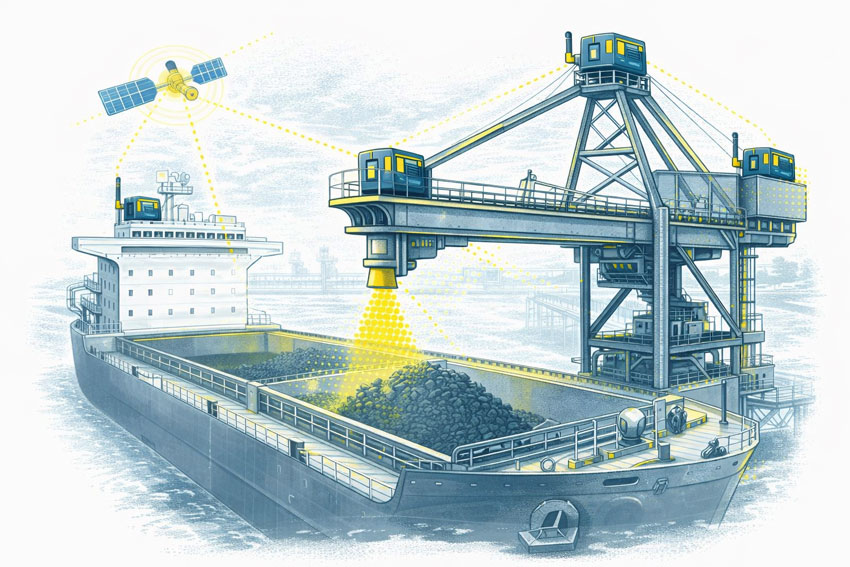
Ship loader and bulk cargo vessel with GPS monitoring units and sensor overlays illustrating controlled loading zones and engineering oversight under AS 4324.1

Understanding AS 4324.1 in a Brownfield Context

AS 4324.1 addresses mobile equipment used for continuous bulk handling, including:

  • Yard stackers and reclaimers
  • Bucket wheel reclaimers
  • Slewing and travelling machines
  • Ship loaders at export terminals

While the standard establishes a strong baseline for design and safety, many operating machines:

  • Pre-date the current revision of the standard
  • Have undergone multiple undocumented modifications
  • Operate under loading conditions that differ from original assumptions

In these situations, engineering judgement is required. Compliance becomes less about box-ticking and more about demonstrating that risks are understood, controlled, and managed over the asset lifecycle.


Common Challenges on Operating Mine Sites

Across coal handling plants, iron ore operations, and port facilities, several recurring issues emerge:

1. Incomplete or Outdated As-Built Information

Accurate geometry, slew limits, clearances, and structural interfaces are often unknown. This creates risk during upgrades and maintenance planning.

2. Fatigue and Structural Degradation

Large mobile machines experience cyclic loading across slewing, luffing, and travel motions. Fatigue cracking and unexpected failures require ongoing monitoring, not one-off assessments.

3. Access, Guarding, and Maintenance Compliance

Requirements evolve over time. Older machines may not meet current expectations for access systems, guarding, or safe maintenance practices.

4. Downtime Sensitivity

Stackers, reclaimers, and ship loaders are often production-critical assets. Upgrade windows are limited, and poor fit-up or rework can have significant commercial consequences.


Technology Supporting Modern Risk Management

While AS 4324.1 remains the foundation, modern technology allows asset owners to manage risk more effectivelyโ€”particularly on brownfield equipment.

GPS Positioning and Controlled Operating Zones

Where GPS positioning is enabled, defined operating zones can be established to:

  • Prevent interaction with stockpiles during rapid translation
  • Automatically reduce slew or travel speed in high-risk zones
  • Limit impact loads on critical components such as slew rings and fluffing gears

These systems are primarily productivity-driven, but they also reduce the likelihood of high-energy impacts that contribute to mechanical damage.


LiDAR Scanning as an Emerging Risk Layer

LiDAR scanning is not a replacement for traditional controls, and it is still evolving in this application. However, it can provide:

  • Accurate spatial awareness of surrounding structures
  • Verification of clearances and exclusion envelopes
  • A secondary risk-management layer supporting operator decision-making

When combined with engineering-led interpretation, LiDAR contributes to a layered risk approach rather than acting as a standalone safety system.


Condition Monitoring and Real Load Understanding

Accelerometers installed across a range of frequencies can deliver valuable insight into:

  • Actual operating loads
  • Dynamic response during slewing, reclaiming, and travel
  • Early indicators of fatigue-related issues

This data supports more informed maintenance decisions and provides evidence of how a machine is truly being usedโ€”often revealing load cases not considered in original designs.


Engineering-Led Compliance and Asset Life Extension

For brownfield assets, compliance with AS 4324.1 is best approached as a continuous engineering process, not a single milestone. This includes:

  • Accurate reality capture and digital models
  • Verification of clearances, interfaces, and structural geometry
  • Informed upgrade design that fits the first time
  • Risk-based decision-making supported by real operating data

This approach helps asset owners extend the life of critical machines while managing risk, performance, and availability.


How Hamilton By Design Supports Bulk Handling Assets

Hamilton By Design works with asset owners and engineering teams to support:

  • Brownfield upgrades of stackers, reclaimers, and ship loaders
  • Engineering-grade LiDAR scanning and as-built documentation
  • Fit-for-purpose mechanical design for modifications and life-extension
  • Independent engineering insight across OEM and site interfaces

Our focus is on engineering clarity, practical risk reduction, and minimising disruption to operations.


Talk to an Engineer About Your Asset

If you are planning a brownfield upgrade, life-extension, or risk review of mobile bulk-handling equipment, talk to an engineer at Hamilton By Design about how accurate data and practical engineering can support your next decision.

Our clients:

Name
Would you like us to arrange a phone consultation for you?
Address

3D Scanning for Industrial Projects in Newcastle and the Hunter Valley

Engineering the Hunter: Precision Meets Industry

Few regions in Australia represent heavy industry quite like Newcastle and the Hunter Valley.
From the coal mines at Bengalla and Mount Thorley, to the power stations at Bayswater and Eraring, to the Port of Newcastleโ€™s massive shiploaders and conveyors, this region has powered Australia for generations.

But with age, complexity, and constant upgrades come challenges:

  • Outdated drawings
  • Tight shutdown schedules
  • Complex brownfield modifications
  • Difficult site access

Thatโ€™s where 3D scanning and LiDAR modelling are transforming how industrial projects are designed, verified, and delivered โ€” ensuring every bolt, beam, and bracket fits perfectly the first time.

At Hamilton By Design, we bring together field experience, digital precision, and local knowledge to help the Hunterโ€™s industries design, maintain, and modernise with confidence.


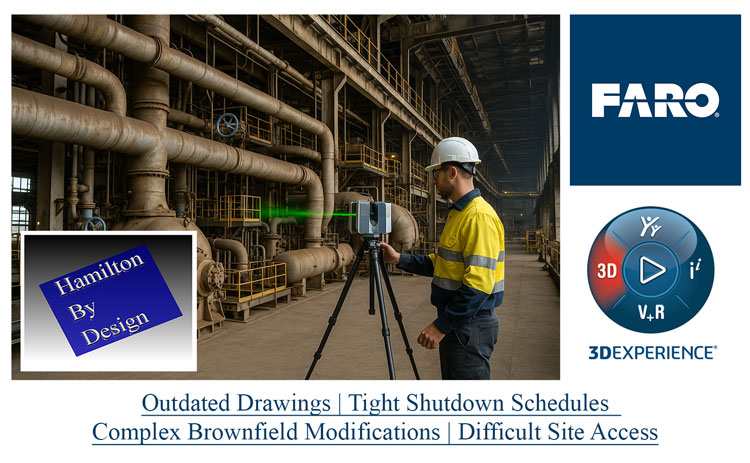
Technician operating a FARO 3D laser scanner inside an industrial plant to capture accurate geometry for brownfield upgrades, shown alongside Hamilton By Design and 3DEXPERIENCE logos with highlighted challenges such as outdated drawings and tight shutdown schedules

What Is 3D Scanning โ€” and Why It Matters in Industry

3D laser scanning, also known as LiDAR (Light Detection and Ranging), captures millions of data points across an industrial site to create a precise digital representation โ€” known as a point cloud.

This point cloud forms the foundation of a digital twin of your plant or asset โ€” an exact, measurable 3D environment that engineers can design within using SolidWorks, AutoCAD, or Navisworks.

The result?
Every measurement is accurate, every clash is detected before fabrication, and every installation happens exactly as planned.


Why Newcastle and the Hunter Valley Need Scanning More Than Ever

The Hunter is an engineering powerhouse โ€” but much of its infrastructure was built decades ago.
Many coal handling plants, power stations, and smelters are now in a constant cycle of refurbishment, retrofit, and compliance upgrade.

The challenges are familiar:

  • Old 2D drawings donโ€™t reflect todayโ€™s reality.
  • Assets have been modified repeatedly over decades.
  • Shutdown windows are shrinking.
  • Every error adds cost and delays production.

By scanning before you design, you remove uncertainty.
You donโ€™t guess clearances โ€” you know them.
You donโ€™t estimate tie-in points โ€” you model them.
You donโ€™t hope it fits โ€” you prove it digitally.

Thatโ€™s the power of 3D scanning in todayโ€™s industrial environment.


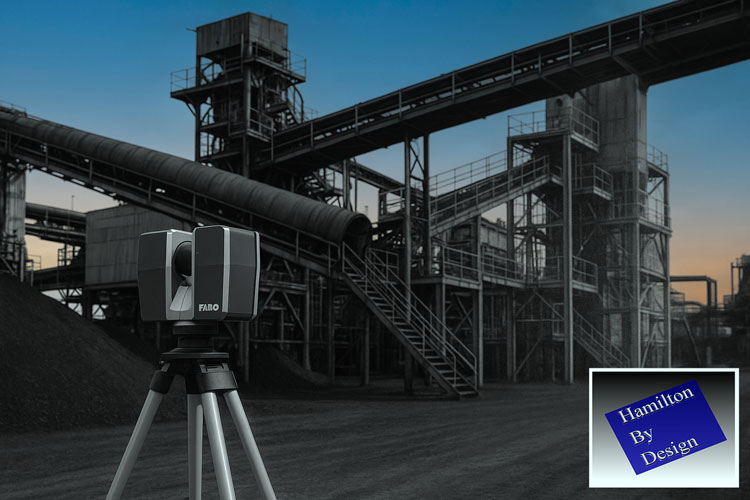
FARO 3D laser scanner set up on a tripod capturing an industrial plant for LiDAR scanning and digital modelling, with Hamilton By Design branding in the corner

Where Scanning Adds Value Across the Hunterโ€™s Industries

โš™๏ธ Power Generation

The Bayswater, Eraring, and Vales Point Power Stations are engineering icons.
Upgrades to cooling systems, ducts, platforms, and access structures require millimetre accuracy.
3D scanning ensures:

  • Every retrofit aligns with existing steelwork and pipework.
  • Structural interferences are caught before fabrication.
  • Shutdown work can be completed on time โ€” without rework.

Whether itโ€™s a fan casing replacement or a duct reroute, laser scanning removes the guesswork from aging assets.


โ›๏ธ Coal Handling and CHPP Facilities

The Hunter Valleyโ€™s CHPP network โ€” Mount Thorley Warkworth, Ravensworth, Bengalla, Hunter Valley Operations โ€” all depend on reliable mechanical systems.
These plants evolve continuously: diverter chutes, screen replacements, conveyors, and wash plant modifications.

Scanning delivers:

  • Accurate as-built geometry for plant upgrades.
  • Clash detection between new and existing equipment.
  • Shutdown planning certainty โ€” no unexpected fit-up issues.
  • Integration of SolidWorks models directly into point clouds for visual verification.

For CHPP managers and maintenance engineers, 3D scanning is now as essential as the plant itself.

Composite image showing an Australian Standard compliance graphic, a LiDAR point-cloud scan of a coal reclaimer with inspection markers, and the Hamilton By Design logo

โš“ Port of Newcastle and Coal Export Terminals

Newcastleโ€™s port is the lifeline of the Hunterโ€™s economy.
Facilities such as Port Waratah Coal Services (PWCS), Newcastle Coal Infrastructure Group (NCIG), and Carrington Terminal handle massive volumes of coal every hour.

The complexity of these sites โ€” shiploaders, conveyors, gantries, and stacker-reclaimers โ€” demands accuracy during maintenance and upgrade works.
3D scanning supports:

  • Shiploader upgrades and boom extensions.
  • Conveyor and transfer tower alignment checks.
  • Wharf structure condition monitoring.
  • Integration with mechanical and electrical systems.

By scanning before modification, downtime is reduced, safety improves, and project teams gain total confidence in every fit-up.


๐Ÿญ Aluminium and Heavy Manufacturing

At Tomago Aluminium Smelter, precision is everything.
The scale of the site โ€” from potlines to switchyards โ€” makes manual measurement impractical and unsafe.

Laser scanning captures geometry accurately across large areas, enabling:

  • Retrofit planning without full shutdowns.
  • Clearance checks for cranes, ducts, and potline infrastructure.
  • Digital twins for long-term maintenance and asset management.

Beyond Tomago, manufacturers in Waratah, Beresfield, and Thornton use scanning to validate jigs, fixtures, and workshop layouts โ€” ensuring local fabrication accuracy that matches site requirements.


๐Ÿ”‹ Emerging Energy and Infrastructure

As the Hunter region transitions toward renewable and low-emission industries, scanning plays a critical role in planning new infrastructure around existing sites.
This includes:

  • Hydrogen and gas pipeline tie-ins.
  • Solar and battery installations near existing grid connections.
  • Conversion of existing power plant structures for new technology.

Accurate point-cloud data ensures new energy meets old infrastructure safely and efficiently.


From Field to Fabrication: The Hamilton By Design Process

At Hamilton By Design, our 3D scanning workflow is built around practical, industrial needs:

  1. Site Scan & Data Capture
    Using high-precision LiDAR scanners, we safely capture full site geometry in hours, not weeks.
    Scans are performed during operation or short shutdowns, without interrupting production.
  2. Point Cloud Registration & Processing
    Multiple scans are aligned to create a unified, accurate model of your facility.
    The result is a true โ€œdigital twinโ€ of your asset, complete with millimetre accuracy.
  3. SolidWorks Modelling & Integration
    Our design team converts scan data into fully functional 3D models โ€” chutes, pipework, platforms, or structural frames โ€” ready for fabrication.
  4. Clash Detection & Design Validation
    Every new design is tested within the digital twin, ensuring it fits the first time.
  5. Fabrication Drawings & e-Drawings
    Detailed 2D and 3D deliverables are provided for fabricators, site crews, and certifiers โ€” ensuring seamless communication between design and construction.

Why Local Expertise Matters

Many engineering firms offer scanning โ€” but few understand what it takes to work on a live plant in the Hunter Valley.

Hamilton By Design combines trade experience, mechanical design, and regional understanding.
Weโ€™ve worked with the same assets, fabricators, and contractors who keep the regionโ€™s power, port, and manufacturing industries running.

We design for real fabrication conditions โ€” using Australian Standards, local materials, and practical build methods.
That means fewer redesigns, faster turnarounds, and safer installations.


Safety and Access: Scanning Without Shutdowns

Traditional site measurement often means working at heights, in confined spaces, or around operating equipment.
3D scanning eliminates those risks.

Our scanners capture data safely from the ground โ€” even in restricted or hazardous areas.
This not only improves safety but also allows projects to continue without halting production.

For large plants like Eraring or PWCS, scanning entire structures during live operation is now standard practice โ€” enabling ongoing maintenance and long-term asset integrity planning.


Case Example: Port Upgrade Without Rework

A local contractor approached Hamilton By Design for a conveyor and tower modification project at the Port of Newcastle.
Existing drawings were decades old, and the structure had been modified repeatedly.

We performed a 3D scan of the tower and adjacent conveyors, capturing the as-built geometry in one day.
The resulting model revealed several misalignments between the planned chute and existing supports.
By correcting these in SolidWorks before fabrication, the contractor avoided at least 48 hours of site rework and kept the shutdown on schedule.

Thatโ€™s measurable ROI โ€” precision that pays for itself.


The ROI of 3D Scanning in Heavy Industry

A single hour of lost production at a CHPP or power station can cost $20,000 to $50,000.
A single dayโ€™s delay can exceed $500,000 in lost revenue and labour costs.

3D scanning reduces that risk by eliminating rework and ensuring every component fits right the first time.
Typical return on investment (ROI):

  • Scanning cost: <1% of total project value.
  • Rework savings: 3โ€“10% of total cost.
  • Downtime reduction: 1โ€“3 days saved per shutdown.

When accuracy drives reliability, 3D scanning isnโ€™t an expense โ€” itโ€™s insurance.


Supporting the Hunterโ€™s Future

Newcastle and the Hunter Valley are evolving โ€” from coal and power to renewables, advanced manufacturing, and logistics.
But one thing hasnโ€™t changed: the regionโ€™s foundation in engineering, precision, and hard work.

Hamilton By Design supports that legacy with the next generation of technology โ€” scanning, digital modelling, and mechanical design that keep the regionโ€™s assets efficient, safe, and ready for the future.

Weโ€™re not an offshore CAD vendor.
Weโ€™re local engineers whoโ€™ve worked in the field, understand your equipment, and speak the same language as your crews.


Letโ€™s Build the Future of Hunter Industry โ€“ Accurately

Every project starts with one question: โ€œDo we have accurate site data?โ€

With Hamilton By Design, the answer is always yes.

We deliver:
โœ… 3D laser scanning and LiDAR modelling
โœ… Point-cloud to SolidWorks integration
โœ… Reverse engineering and FEA validation
โœ… Fabrication drawings tailored for local workshops
โœ… On-site consultation with practical engineering insight

Whether youโ€™re upgrading a conveyor at Bayswater, fabricating platforms for Tomago, or retrofitting process piping at Kooragang, we ensure your next project fits perfectly โ€” before steel is cut.

Banner displaying Hamilton By Design alongside partner and technology logos including SolidWorks, UTS, Dassault Systรจmes 3DEXPERIENCE, and FARO, with the text โ€˜3D Scanning 3D Modellingโ€™ and website www.hamiltonbydesign.com.au.

๐Ÿ‘‰ Get your industrial site scanned and modelled before your next shutdown.
Visit www.hamiltonbydesign.com.au or contact us to request a capability statement today.

Mechanical Engineering | Structural Engineering

Mechanical Drafting | Structural Drafting

3D CAD Modelling | 3D Scanning

Hamilton By Design logo displayed on a blue tilted rectangle with a grey gradient background

Our clients;

Name
Would you like us to arrange a phone consultation for you?
Address

Integrating 3D Scanning and Mechanical Design for Safer, Faster Upgrades in Coal Wash Plants

Precision Without the Guesswork

Upgrading or maintaining a coal wash plant has always been a challenge โ€” tight shutdown windows, complex layouts, and the need for perfect fit-ups between new and existing components. Traditional measurement methods, like tape measures and manual sketches, are often impossible in restricted or hazardous areas.

Thatโ€™s where 3D scanning and mechanical engineering come together. At Hamilton By Design, we combine precision laser scanning, intelligent 3D modelling, and practical mechanical design to deliver risk-free upgrades โ€” ensuring every component fits right the first time.

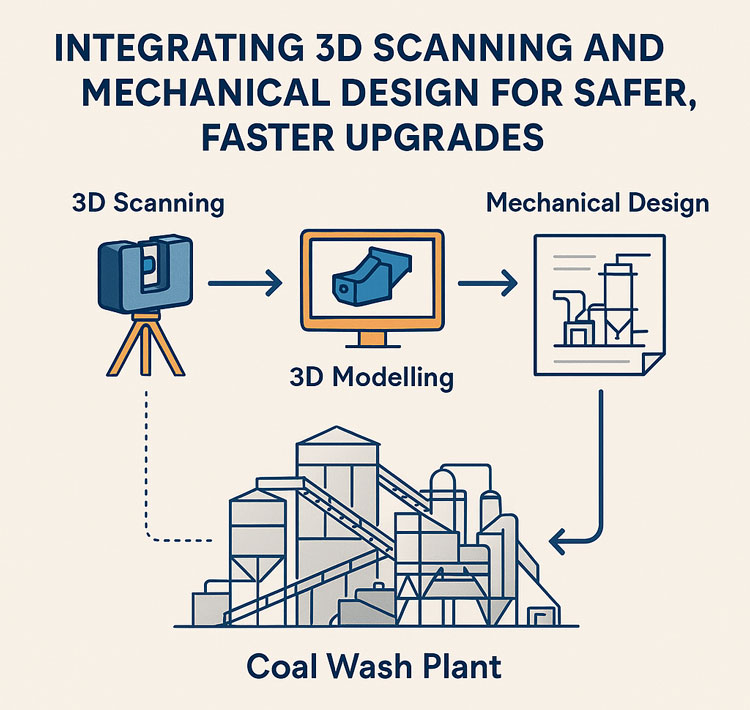
Infographic showing how 3D scanning and 3D modelling feed into mechanical design for safer, faster upgrades at a coal wash plant, with icons representing scanning, modelling, and engineering drawings

When Accuracy Matters Most

Coal wash plants are intricate systems. From cyclones, screens, and diverter chutes to pumps, piping, and structures, every part interacts under tight tolerances. A small misalignment can lead to vibration, spillage, or shutdown delays.

Our 3D scanning process captures millions of spatial data points, creating a detailed digital twin of the existing plant. This allows us to model upgrades, design replacement components, and simulate fit-up โ€” all before fabrication begins.

In many cases, scanning replaces the need to physically measure equipment. For example, in confined or high-risk spaces where a tape measure simply canโ€™t reach, scanning provides complete, line-of-sight geometry with millimetre accuracy.

Recently, our team scanned a diverter chute that had been incorrectly installed. The resulting model revealed that the chute had been fitted in the wrong orientation โ€” explaining why it wasnโ€™t sealing properly. This insight helped our client avoid further downtime and costly rework.


Combining Engineering Experience with Digital Precision

Hamilton By Design provides a full suite of mechanical engineering services tailored to the mining industry, including:

  • 3D Scanning & Point Cloud Capture โ€“ detailed mapping of existing equipment and structures
  • 3D Modelling & Reverse Engineering โ€“ accurate, editable digital models
  • Mechanical Design & Structural Replacement โ€“ like-for-like component upgrades
  • Piping Routes & Spool Fabrication โ€“ optimised pipe design and layout
  • Fabrication & Component Drawings โ€“ compliant with Australian Standards and client templates

Our engineers work across SolidWorks, AutoCAD Plant 3D, Revit, and 3D Experience platforms โ€” integrating point cloud data directly into the design workflow. This means fewer site visits, fewer surprises, and significantly less rework once fabrication begins.


From Drawings to Digital Models

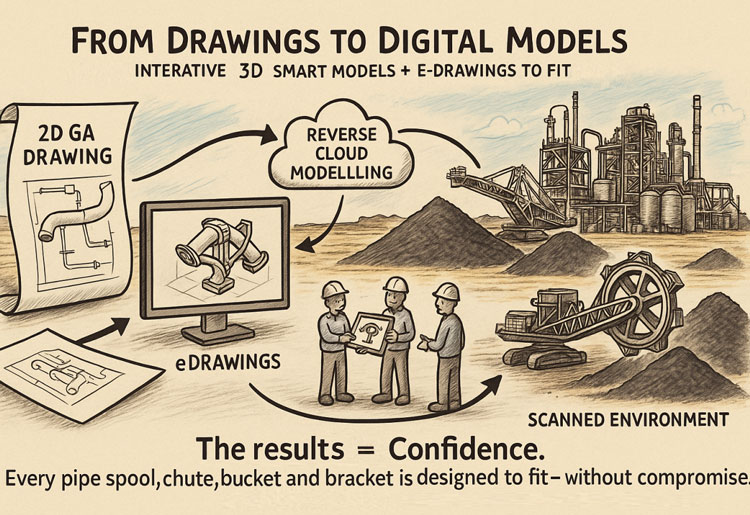
Weโ€™ve evolved beyond traditional 2D general arrangement drawings. Instead, we provide interactive 3D models and e-drawings that allow clients, fabricators, and site teams to visualise how upgrades will fit within the plant.

Our reverse cloud modelling process inserts 3D designs directly into the scanned environment. This enables engineers and site teams to measure potential interferences, check clearances, and validate installation methods โ€” long before shutdowns begin.

Illustrated workflow showing how 2D GA drawings and scanned environments are turned into 3D digital models through reverse cloud modelling and eDrawings, demonstrating confidence in fabrication fit for mining and industrial equipment.

The result = Confidence.
Every pipe spool, chute, and bracket is designed to fit โ€” without compromise.


Supporting Contractors and Plant Operators

We partner with:

  • Mining companies operating coal wash plants
  • Fabricators and contractors supplying mining equipment
  • Maintenance providers planning plant shutdowns

Their biggest challenge is finding people who design for fit and function โ€” not just form. Not all CAD or point cloud software is equal, and not every designer understands the realities of on-site installation. Thatโ€™s where Hamilton By Design stands apart.

We bring hands-on mechanical trade experience, engineering design expertise, and digital technology together โ€” helping your team deliver upgrades that work, first time.


Built to Australian Standards

All design and drawing deliverables are completed in accordance with Australian Standards, ensuring compliance, safety, and interoperability with existing documentation.

We can also supply fabrication drawings on client-specific templates, maintaining intellectual property (IP) requirements and formatting standards.


Servicing Australiaโ€™s Key Mining Regions

Hamilton By Design proudly supports coal wash plant upgrades and mechanical design projects across Australiaโ€™s leading coal regions, including:

  • Bowen Basin
  • Surat Basin
  • Hunter Valley
  • Newcastle
  • Central Coast
  • Western and Central NSW coalfields

Our local experience ensures that we understand the logistical, operational, and environmental challenges unique to each region โ€” helping projects stay compliant, efficient, and on schedule.


Why Choose Hamilton By Design?

  • Reduced Downtime: Accurate pre-shutdown planning through digital models.
  • Improved Safety: Less manual measuring in hazardous or confined areas.
  • Guaranteed Fit-Up: Fabrication drawings verified against real-world geometry.
  • Faster Turnaround: Streamlined scanning-to-design-to-fabrication workflow.
  • Proven Experience: Over two decades in mechanical engineering and plant design.

Our mission is simple โ€” to take the risk out of upgrades by combining engineering insight with digital accuracy.


Quote

โ€œPrecision scanning and mechanical design โ€” taking the risk out of plant upgrades.โ€


Letโ€™s Make Your Next Upgrade Risk-Free

If your next shutdown involves mechanical upgrades, pipework replacement, or structural modifications, talk to Hamilton By Design.

We can help you visualise, plan, and execute upgrades with confidence โ€” reducing downtime, eliminating measurement errors, and delivering safer outcomes for your team.

info@hamiltonbydesign.com.au
www.hamiltonbydesign.com.au

Mechanical Drafting | Structural Drafting

3D CAD Modelling | 3D Scanning

Chute Design

Our clients:

Name
Would you like us to arrange a phone consultation for you?
Address

From 3D Scanning to Digital Twins: The Next Step in Mining Data

Mining is evolving faster than ever.
What was once an industry defined by physical muscle โ€” haul trucks, crushers, conveyors โ€” is now being transformed by data intelligence, digital modelling, and real-time insight.

At the heart of this transformation lies a quiet revolution: 3D scanning.
Once used primarily for design verification or plant modification, scanning is now the gateway technology that feeds the emerging world of digital twins โ€” live, data-driven replicas of mine assets that help engineers predict, plan, and optimise before problems occur.

At Hamilton By Design, weโ€™ve spent years scanning and modelling chutes, hoppers, and material-handling systems across Australiaโ€™s mining sector. Each project has shown us one thing clearly:

Scanning isnโ€™t just about geometry โ€” itโ€™s about knowledge.
And digital twins are the next logical step in turning that knowledge into action.


What Exactly Is a Digital Twin?

Think of a digital twin as the digital counterpart of a physical asset โ€” a chute, a conveyor, a processing plant, even an entire mine site.

Itโ€™s not a static 3D model; itโ€™s a dynamic, data-linked environment that mirrors the real system in near real time.
Sensors feed performance data into the twin: wear rates, temperature, vibration, flow speed, throughput. The twin then responds, updating its state and allowing engineers to simulate scenarios, forecast failures, and test design changes before touching the physical equipment.

In essence, a digital twin gives you a real-time window into the life of your assets โ€” one thatโ€™s predictive, not reactive.


How 3D Scanning Powers the Digital Twin

To create a digital twin, you first need an accurate foundation โ€” and thatโ€™s where 3D scanning comes in.
The twin can only be as good as the geometry beneath it.

Laser scanning or LiDAR technology captures millimetre-accurate measurements of chutes, hoppers, crushers, conveyors, and processing structures.
This creates a precise 3D โ€œas-isโ€ model โ€” not what the plant was designed to be, but what it actually is after years of wear, repair, and modification.

That baseline geometry is then aligned with:

  • Operational data from sensors and PLCs (e.g. flow rates, temperatures, vibrations)
  • Material behaviour data from CFD and wear simulations
  • Design intent data from CAD and engineering archives

Once these layers are synchronised, the model becomes a living system โ€” continuously updated, measurable, and comparable to its physical twin.

You can see how we capture and prepare that foundation in our detailed article:
3D Scanning Chutes, Hoppers & Mining


From Reactive Maintenance to Predictive Performance

In most operations today, maintenance still works on a reactive cycle โ€” wait for a fault, shut down, repair, restart.
Itโ€™s expensive, unpredictable, and risky.

With digital twins, that model flips.
Instead of waiting for wear to become a failure, the twin uses real-time and historical data to forecast when parts will reach their limits.
The result is predictive maintenance โ€” planning shutdowns based on evidence, not emergency.

Imagine being able to simulate how a chute will behave under new flow conditions, or when a liner will reach its critical wear thickness, before you commit to a shutdown.
Thatโ€™s not future-speak โ€” itโ€™s what forward-thinking operators are doing right now.

Every hour of avoided downtime can mean tens or even hundreds of thousands of dollars saved.
Even a modest 5 % reduction in unplanned outages can add millions to annual output.


Integrating Scanning, Simulation, and Sensors

A full digital-twin workflow in mining usually includes four steps:

  1. Capture: 3D scanning provides the exact geometry of the asset.
  2. Model: Engineers integrate the geometry with CAD, CFD, and FEA models.
  3. Connect: Real-time data from sensors is linked to the model.
  4. Predict: Algorithms and engineers analyse the twin to predict future performance.

The power lies in connection.
Each new scan or dataset strengthens the model, improving its predictive accuracy. Over time, the digital twin evolves into a decision-support system for engineers, planners, and maintenance teams.


Real-World Applications Across the Mining Value Chain

1. Chute & Hopper Optimisation

Flow issues, blockages, and uneven wear can be modelled digitally before modifications are made.
This reduces trial-and-error shutdowns and improves throughput reliability.

2. Conveyor Alignment

Scanning allows engineers to identify misalignment over kilometres of belting.
A digital twin can then simulate tracking and tension to prevent belt failures.

3. Crusher and Mill Wear

By combining periodic scans with wear sensors, operators can visualise material loss and forecast replacement schedules.

4. Structural Monitoring

3D scanning enables long-term comparison between โ€œas-builtโ€ and โ€œas-maintainedโ€ geometry, detecting distortion or settlement early.

Each of these applications reinforces a core insight:

The line between mechanical engineering and data engineering is disappearing.


Why Digital Twins Matter for Australiaโ€™s Mining Future

Australiaโ€™s competitive advantage has always been resource-based.
But the next advantage will be knowledge-based โ€” how well we understand, model, and optimise those resources.

Digital twins represent that shift from raw extraction to engineering intelligence.
They help miners lower costs, reduce emissions, and improve safety, while extending asset life and reliability.

As Australia pushes toward decarbonisation and productivity targets, technologies like scanning and digital twinning will underpin the next generation of sustainable mining design.


The Hamilton By Design Approach

Our philosophy is simple: technology only matters if it serves engineering integrity.
Thatโ€™s why our process always begins with real-world problems โ€” not software.

  1. Field Capture: We conduct high-resolution 3D scans under live or shutdown conditions.
  2. Engineering Integration: Our designers and mechanical engineers turn that data into usable CAD and FEA models.
  3. Digital Twin Setup: We connect the digital model to operational data, creating a living reference that evolves with the asset.
  4. Continuous Support: We monitor, re-scan, and update as assets change.

This approach ensures every digital twin remains a tool for decision-making, not just a visualisation exercise.


A Connected Knowledge Chain

This article builds on our earlier discussion:


Digital Precision in Mining: How 3D Scanning Transforms Maintenance, Design, and Safety

That piece explored how scanning replaces manual measurement with safe, precise, data-rich modelling.
Digital twins take that same data and carry it forward โ€” connecting it to predictive insights and automated planning.

The flow looks like this:

3D Scan โ†’ Model โ†’ Digital Twin โ†’ Predict โ†’ Improve โ†’ Re-scan

Each loop makes the operation smarter, safer, and more efficient.


Lessons from Global Mining Leaders

  • Rio Tinto and BHP are already trialling digital twins for rail networks, conveyors, and entire processing plants.
  • Anglo American uses twin models to monitor tailings dam integrity, integrating LiDAR scans with geotechnical sensors.
  • Fortescue has explored twin-based predictive maintenance for haulage and fixed plant systems.

Internationally, countries like Finland and Canada have established digital-twin testbeds for mine ventilation, environmental monitoring, and process control โ€” demonstrating that twinning isnโ€™t a luxury, itโ€™s a competitive necessity.


Looking Forward: The Road to Real-Time Mines

The next decade will see digital twins move from project pilots to enterprise-wide ecosystems.
Future systems will integrate:

  • IoT sensors streaming continuous data
  • AI algorithms identifying anomalies in real time
  • Augmented-reality tools allowing operators to โ€œseeโ€ the twin overlaid on the physical plant

Combined, these will make mines safer, cleaner, and more efficient โ€” driven by data instead of downtime.


The Broader Economic Story

The technologyโ€™s value doesnโ€™t stop at the mine gate.
As digital twins become standard across energy, infrastructure, and manufacturing, Australiaโ€™s engineering capability grows alongside GDP.

Every dollar invested in scanning and twin development creates long-term dividends in productivity and sustainability.
By connecting our data and design skills to resource industries, we strengthen both our domestic economy and our global competitiveness.


Building Smarter, Safer, and More Predictable Mines

Mining will always be a physically demanding industry โ€” but its future will be defined by how intelligently we manage that physicality.

From the first laser scan to the fully connected digital twin, every step tightens the link between information and performance.

At Hamilton By Design, weโ€™re proud to stand at that intersection โ€” where mechanical precision meets digital innovation.
We help our clients not just capture data, but understand it โ€” turning measurements into models, and models into insight.

Because when you can see your mine in full digital clarity, you can shape its future with confidence.

Mechanical Engineering | Structural Engineering

Mechanical Drafting | Structural Drafting

3D CAD Modelling | 3D Scanning

Chute Design

SolidWorks Contractors in Australia

Hamilton By Design โ€“ Blog

Custom Designed – Shipping Containers

Coal Chute Design

Mechanical Engineers in Sydney