Mechanical Engineering | 3D Scanning | 3D Modelling
Category: Engineering Safety & Risk Management
Engineering Safety & Risk Management focuses on how engineering decisions directly affect safety, reliability, and risk across design, construction, and operational environments.
This category covers how engineers identify hazards, assess risks, and apply practical controls through design, verification, and documentation. Topics include safety-in-design, risk assessments, access and maintenance considerations, compliance with Australian Standards, and lessons learned from real projects.
Articles explain how safety and risk are best managed early and deliberately, using accurate information such as as-built data, engineering judgement, and fit-for-purpose design, rather than relying on assumptions or last-minute fixes.
Content is written for asset owners, project engineers, builders, and contractors who need a clearer understanding of how engineering reduces risk, supports safer workplaces, and enables defensible decision-making on power, manufacturing, mining, and building & construction projects.
Mechanical Plant Optimisation: Boosting Throughput, Reliability and Safety Across Australia
Industrial plants are under more pressure than ever to deliver higher output, reduce downtime and operate safely. Ageing equipment, inconsistent maintenance, and brownfield constraints often limit performance — but with the right engineering approach, even long-running plants can achieve major efficiency gains.
At Hamilton By Design, we specialise in mechanical plant optimisation using a powerful combination of engineering expertise, high-accuracy LiDAR scanning, precise 3D modelling, and practical redesign strategies that deliver measurable improvements.
If your goal is higher throughput, fewer breakdowns and safer shutdowns, this guide explains how mechanical optimisation transforms plant performance.
Why Mechanical Plant Optimisation Is Essential
Most processing plants — from CHPPs and quarries to manufacturing and power stations — suffer from the same long-term issues:
Reduced throughput
Conveyor misalignment
Flow bottlenecks in chutes and transfer points
Vibration, cracking and structural fatigue
Outdated drawings and unknown modifications
Premature wear and high maintenance costs
Shutdown overruns due to poor fit-up
Optimisation tackles these issues using real engineering data, not assumptions.
Step 1: LiDAR Scanning to Capture True As-Built Conditions
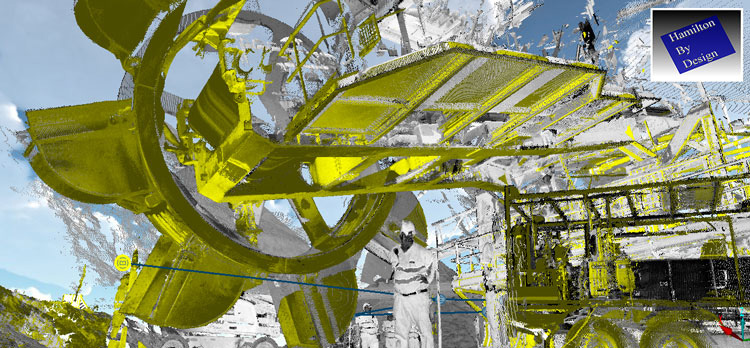
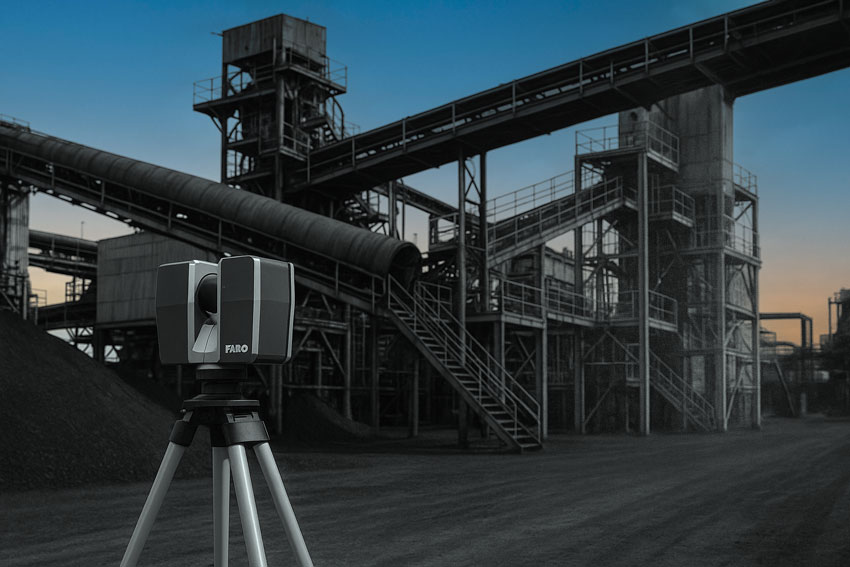
As equipment ages, it moves, twists and wears in ways that drawings rarely capture. Our FARO laser scanners map a complete digital twin of your plant with ±1–2 mm accuracy, giving engineers:
Full geometry of structural frames
Wear patterns inside chutes
Deflection in platforms, conveyor trusses and supports
Misalignment in pipes, pulleys and mechanical drives
Clash risks for future upgrades
This becomes the foundation of all optimisation work — ensuring upgrades fit first time.
Step 2: 3D Modelling & Engineering Redesign
Hamilton By Design converts point-cloud data into SolidWorks models to identify optimisation opportunities such as:
Reprofiling chutes for smoother flow
Strengthening or realigning structural members
Repositioning pumps or motors
Correcting conveyor and drive alignment
Redesigning access platforms for maintenance
Improving liner selection and service life
Every model is fabrication-ready, eliminating costly rework during shutdowns.
Step 3: Material Flow & Conveyor Performance Improvement
Flow constraints are one of the biggest sources of lost production. Through engineering review, modelling and experience, we address:
Impact zones causing excessive wear
Restrictive chute geometry
Poorly performing transfer points
Belt-tracking issues
Flow blockages
Inefficient material transitions
These improvements often deliver immediate gains in throughput and reliability.
We also perform condition assessments to understand the root causes of downtime:
Vibration analysis
Cracking and corrosion detection
Bearing, gearbox and pulley assessment
Thermal/overload risks
Misalignment and load distribution issues
This supports predictive maintenance and informed upgrade planning.
Step 5: Shutdown Planning & Upgrade Execution
By combining scanning, modelling and mechanical design, we ensure that every upgrade:
Fits perfectly into existing brownfield spaces
Reduces time on tools
Eliminates site modifications
Improves safety during installation
Delivers predictable shutdown timelines
Clients commonly see ROI within the first shutdown cycle.
Benefits of Mechanical Plant Optimisation
When optimisation is done properly, plants experience:
✔ Measurable throughput increases
✔ Longer equipment life
✔ Reduced wear and maintenance costs
✔ Safer operation and shutdown execution
✔ Accurate documentation for future projects
✔ Extended reliability of mechanical systems
With the right engineering support, even ageing plants can operate like new.
Serving Clients Across Australia
Hamilton By Design supports mechanical plant optimisation projects across: Sydney, Newcastle, Hunter Valley, Central Coast, Bowen Basin, Surat Basin, Pilbara, Perth, Adelaide, Melbourne and regional Australia.
We work across mining, CHPPs, quarries, ports, power stations, manufacturing and heavy industrial sites.
Ready to Optimise Your Plant?
If you want higher throughput, better reliability and safer operation, mechanical plant optimisation is the smartest investment you can make.
Or reach out directly for a project discussion.
Hamilton By Design — Engineering Certainty for Complex Plants.
Every shutdown fitter, maintenance crew member, and supervisor has lived the same nightmare:
A critical part arrives during shutdown. The old part is removed. Everyone gathers, ready to install the new one. Production is waiting. The pressure is on.
And then— the part doesn’t fit.
Not 2 mm out. Not 10 mm out. Sometimes 30–50 mm out, wrong angle, wrong bolt pattern, wrong centreline, or wrong geometry altogether.
The job stops. People get frustrated. Supervisors argue. Fitters cop the blame. The plant misses production. And someone eventually says the words everyone hates:
“Put the old worn-out chute back on.”
This blog is about why shutdowns fall apart like this… and how 2 mm LiDAR scanning finally gives fitters a system that gets it right the first time.
The Real Reason Parts Don’t Fit
Most shutdown failures have nothing to do with the fitter, nothing to do with the workshop, and nothing to do with the installation crew.
Parts don’t fit because:
Wrong measurements
Bad drawings
Outdated as-builts
Guesswork
Fabricators “eyeballing” dimensions
Cheap non-OEM parts purchased without geometry verification
Designers who have never seen the site
High staff turnover with no engineering history
Wear profiles not checked
Intersection points impossible to measure manually
Fitters are then expected to make magic happen with a tape measure and a grinder.
It’s not fair. It’s not professional. And it’s completely avoidable.
Shutdown Pressures Make It Even Worse
When a part doesn’t fit during a shutdown:
The entire job stalls
Crews stand around waiting
The supervisor gets hammered
The fitter gets the blame
Other shutdown tasks cannot start
The clock ticks
Production loses thousands per hour
Everyone becomes stressed and angry
And the worst part?
You were only replacing the part because the existing one was worn out. Now you’re bolting the worn-out one back on.
This isn’t good enough. Not in 2025. Not in heavy industry. Not when there is technology that eliminates this problem completely.
Why Manual Measurement Fails Every Time
Fitters often get asked to measure:
Inside chutes
Wear sections
Pipe spools with intersection points
Tanks too large to measure from one position
Walkways too long for tape accuracy
Geometry with no records
Components 10+ metres above ground
Hard-to-reach bolt patterns
Angles and centrelines distorted by wear
But some measurements simply cannot be taken safely or accurately by hand.
You can’t hang off an EWP 20 metres up measuring a worn flange angle. You can’t crawl deep inside a chute trying to measure intersecting surfaces. You can’t take a 20-metre walkway measurement with a tape measure and hope for precision.
This is not a measurement problem. This is a method problem.
Manual measurement has hit its limit. Shutdowns have outgrown tape measures.
This Is Where 2 mm LiDAR Scanning Changes Everything
Hamilton By Design uses 2 mm precision LiDAR scanning to capture the exact geometry of a site — even in areas that are:
Too high
Too big
Too unsafe
Too worn
Too complex
Too tight
Too distorted to measure manually
From the ground, up to 30 metres away, we can capture:
Wear profiles
Flange positions
Bolt patterns
Pipe centrelines
Chute geometry
Conveyor interfaces
Complex intersections
Ductwork transitions
Mill inlet/outlet shapes
Tank dimensions
Walkway alignment
Structural deflection
Existing inaccuracies
No tape measure. No guesswork. No EWP. No risk.
The result is a perfect 3D point cloud accurate within 2 mm — a digital version of real life.
2 mm Scanning + Fitter-informed Design = Parts That Fit First Time
This is where Hamilton By Design is different.
We don’t just scan and hand the files to a drafter who’s never set foot on-site.
We scan and your parts are modelled by someone who:
Has been a fitter
Understands how parts are installed
Knows what goes wrong
Knows how to design parts that actually fit
Knows where shutdowns fail
Knows what to check
Knows what NOT to trust
And most importantly — knows where the real-world problems are hidden
This fitter-informed engineering approach is why our parts fit the first time.
And why shutdown crews trust us.
Digital QA Ensures Fabrication Is Correct Before It Leaves the Workshop
Once the new chute, spool, or component is modelled, we run digital QA:
Fit-up simulation
Clash detection
Tolerance analysis
Wear profile compensation
Reverse engineering comparison
Bolt alignment verification
Centreline matching
Flange rotation accuracy
Structural interface checks
If something is out by even 2–3 mm, we know.
We fix it digitally — before the workshop cuts steel.
This stops rework. This stops shutdown delays. This stops blame. This stops stress.
Here’s what actually happens when a chute or spool fits perfectly the first time:
The plant is back online faster
No rework
No reinstalling old worn-out parts
No arguing between fitters and supervisors
No unexpected surprises
No extra access equipment
No late-night stress
No grinding or “making it fit”
Other shutdown tasks stay on schedule
Everyone looks good
Production trusts the maintenance team again
Shutdowns become predictable. Fitters become heroes, not last-minute problem-solvers.
Shutdown Example (Anonymous but Real)
A major processing plant needed a large chute replaced during a short shutdown window. Access was limited. The geometry was distorted. Measurements were impossible to take safely. The workshop needed exact dimensions, fast.
Hamilton By Design scanned the entire area from the ground — no EWP, no risk.
We produced:
Full 2 mm point cloud
As-built 3D model
New chute design
Digital fit-up validation
Workshop-ready drawings
The new chute arrived on site. The old chute came out. The new chute went straight in. Zero rework. Zero stress. Plant online early.
The supervisor called it the smoothest shutdown they’d had in 10 years.
Why Fitters Should Reach Out Directly
Sometimes fitters know more about what’s really happening on-site than anyone in the office.
Fitters see the problems. Fitters carry the blame. Fitters deal with the rework. Fitters just want parts that fit.
So we’re making this simple:
If you’re tired of fitting parts that don’t fit — If you’re tired of fixing other people’s mistakes — If you’re tired of shutdown stress —
Call Hamilton By Design.
We scan it. We model it. We get it right. Every time.
Services Featured
Hamilton By Design offers:
3D LiDAR laser scanning (2 mm precision)
3D modelling by a fitter-engineer who understands real-world installation
This paper examines the mechanical degradation, failure mechanisms, and system-level reliability implications of Australia’s ageing coal-fired power generation assets, focusing on Callide Power Station (Queensland) and Yallourn Power Station (Victoria). Both stations have experienced significant mechanical failures in the past five years, exposing vulnerabilities in maintenance, asset management, and risk governance under conditions of declining reinvestment. From a mechanical engineering standpoint, these failures illustrate the predictable end-of-life behaviour of large rotating and pressure-bound systems when maintenance expenditure, material renewal, and operational monitoring decline. The paper argues that sustained industrial reliability—and thus national energy and employment security—requires engineering-informed policy that balances decarbonisation with technical integrity management.
Coal-fired power stations are among the most complex mechanical systems ever built in Australia. They integrate high-temperature, high-pressure thermodynamic processes with massive rotating equipment, lubrication systems, and precision alignment tolerances.
From a mechanical engineer’s perspective, their reliability depends on three interlinked pillars:
Structural and material integrity,
Lubrication and vibration control, and
Predictive maintenance and monitoring.
However, as the nation accelerates toward renewable transition targets, investment in these legacy systems has declined. Mechanical failures at Callide and Yallourn are therefore not random accidents but the mechanical manifestation of economic and policy choices.
This analysis seeks to understand those failures in engineering terms, predict future risks, and outline how a re-commitment to industrial infrastructure and jobs requires a concurrent commitment to mechanical reliability.
Technical Overview of Recent Failures
Callide Power Station
Callide’s units span several generations of design and material technology. The C4 explosion (2021) was catastrophic: the failure originated within the turbine hall, leading to structural collapse and large-scale ejection of debris. Subsequent analysis by CS Energy and external investigators identified battery charger replacement errors, inadequate isolation protocols, and loss of process safety discipline as initiators.
From an engineering integrity perspective, the incident represents a compound failure:
Mechanical systems operated under degraded conditions;
Electrical and process-control systems failed to detect early anomalies;
Organisational maintenance controls were insufficient to interrupt escalation.
Later failures — including the C3 boiler pressure event (2025) and cooling tower collapse (2022) — further confirm that structural materials, corrosion protection, and load-carrying assemblies had entered the fatigue–creep interaction phase of their service life.
Yallourn Power Station
At Yallourn, the August 2025 low-pressure turbine dislodgement occurred after decades of vibration monitoring alarms and bearing wear signals. Earlier (2024) shutdowns for “high vibration alarms” indicated growing rotor dynamic instability. When the Unit 2 turbine dislodged, the damage pattern suggested bearing wear, misalignment, or bolt relaxation leading to component displacement.
In mechanical engineering terms, this is a classic late-life failure sequence:
Fatigue crack initiation in critical load-carrying components (rotor or coupling bolts),
Progressive loosening and unbalance,
Dynamic amplification under operating RPM,
Catastrophic structural displacement.
The turbine’s dislodgement was therefore an expected end-of-life event, accelerated by reduced overhaul investment and ageing metallurgical properties.
Comparative Engineering Analysis
Engineering Dimension
Callide
Yallourn
Comparison / Insight
Failure Type
Explosion / Pressure Containment Breach
Turbine Mechanical Dislodgement
Callide shows energy-release failure; Yallourn a structural integrity loss.
Root Mechanical Cause
Overpressure / process safety
Fatigue, unbalance, bearing or bolt failure
Both reflect cumulative degradation.
Indicative Material State
Creep-fatigued pressure shells; corroded supports
Thermal-fatigued steel, worn journals
Metallurgical ageing dominates both.
Maintenance Culture
Process-safety erosion
Reactive, “run-to-retirement”
Organisational degradation common factor.
System Outcome
Explosion and total destruction
Severe mechanical damage, unit outage
Both reduce grid reliability and reveal systemic neglect.
These failures share a unifying pattern recognised in mechanical reliability theory:
Late-life degradation compounded by maintenance deferral and organisational fatigue produces cascading mechanical failure modes that were once preventable.
Predicting Future Failure Behaviour
Mechanical engineers use reliability-centred maintenance (RCM) models to quantify end-of-life risk. For rotating equipment, mean time to failure (MTTF) typically decreases exponentially once fatigue propagation exceeds ~70 % of material endurance life.
Data from the National Electricity Market (NEM) indicates:
Forced outage frequency has doubled since 2012.
Vibration and lubrication alarms are rising in frequency.
Unit unavailability correlates strongly (R² > 0.8) with turbine age and last major overhaul date.
Projected forward, these indicators imply that without major overhauls or component replacements, most Australian coal units will face critical mechanical reliability decline by 2032–2035.
Engineering Economics and Policy Interaction
From an engineering management perspective, the problem is not purely technical — it is thermo-economic.
A major turbine retrofit (~A$25–40 million per unit) is uneconomic for plants scheduled for closure in under a decade.
The probability of catastrophic failure increases sharply as the cost of prevention declines below the cost of repair.
This is the engineering expression of policy-induced obsolescence: political commitments to retire coal reduce the incentive to sustain its mechanical integrity, even while industries still depend on its output.
Industrial Reliability and the Employment Interface
Reliable baseload power is the foundation for industrial continuity. From the standpoint of a mechanical engineer, industrial productivity is a function of mechanical uptime: Productivity=f(Power Reliability,Maintenance Efficiency)\text{Productivity} = f(\text{Power Reliability}, \text{Maintenance Efficiency})Productivity=f(Power Reliability,Maintenance Efficiency)
When power generation becomes intermittent—whether from renewable intermittency or coal unreliability—industrial operations must compensate with redundancy, backup generation, or load-shedding. These add capital and operational costs that ultimately affect employment.
Regional Implications
Queensland retains a stronger firm power horizon (coal + gas + hydro until ~2035), giving industry more operational certainty.
Victoria, by contrast, will face a reliability inflection point after Yallourn (2028) and Loy Yang A (2035) closures.
Without firm generation or large-scale storage online, manufacturing regions risk power volatility—directly translating to production downtime and job insecurity.
Engineering the Transition: Commitment to Jobs and Infrastructure
From a mechanical engineering ethics and systems standpoint, a commitment to industry must be synonymous with a commitment to mechanical reliability. That requires three converging actions:
Asset Integrity Management: Continuous structural health monitoring, vibration analysis, and overhaul planning for remaining thermal units. Even in decline, they must be safely and predictably retired.
Design and Commissioning of Replacement Systems: Engineers must ensure that renewable generation, storage, and transmission assets meet equivalent reliability and maintainability standards. This includes redundancy design, grid inertia replacement, and mechanical resilience of large rotating machinery (e.g., pumped hydro, turbines, bearings).
Workforce Transition as Engineering Continuity: The skills used to maintain turbines, bearings, and boilers are transferable to wind, hydro, and hydrogen equipment. Protecting those jobs preserves both mechanical capability and national energy security.
Engineering Conclusions
From a mechanical engineer’s viewpoint, the failures at Callide and Yallourn are textbook case studies of end-of-life degradation under policy-driven neglect. They illustrate that:
Mechanical degradation is predictable — vibration, lubrication, and thermal-stress indicators were present years before failure.
Organisational and policy decisions override engineering recommendations — maintenance deferral was economic, not technical.
Systemic reliability cannot be sustained without mechanical investment — whether in turbines, batteries, or hydro equipment, engineering integrity remains central.
A national commitment to industry equals a commitment to engineering.
If Australia seeks to safeguard its industrial base and employment, it must invest not only in new energy technologies but in the mechanical soundness of the systems that bridge the transition. Neglecting this will reproduce the same failure patterns—just in new forms of infrastructure.
References (Indicative)
CS Energy (2024). Callide C4 Incident Investigation Summary.
WattClarity (2025). Analysis of Yallourn Unit 2 Trip and Frequency Response.
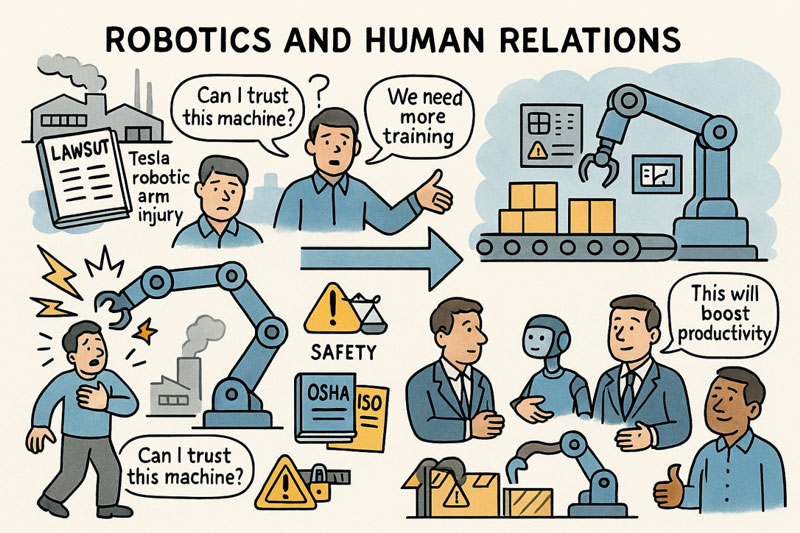
Robots are no longer the stuff of science fiction—they are embedded in our factories, warehouses, and even food-processing plants. They promise efficiency, speed, and the ability to take on dangerous jobs humans shouldn’t have to do. Yet, as recent headlines show, this promise comes with serious risks. From the lawsuit against Tesla over a robotic arm that allegedly injured a worker to the tragic death of a Wisconsin pizza factory employee crushed by a machine, the conversation about human–robot relations has never been more urgent.
This blog post explores the promise and peril of robotics in the workplace, drawing lessons from recent incidents and asking: how do we ensure humans and robots can coexist safely?
The Rise of Robotics in Everyday Work
Robotics is spreading quickly across industries. Automotive giants like Tesla rely on robotic arms for precision assembly, while food plants use automated systems to handle packaging and processing. According to the International Federation of Robotics, robot installations worldwide continue to grow year after year. For businesses, it’s a clear win: fewer errors, lower costs, and reduced human exposure to dangerous tasks.
But with robots entering smaller facilities—where safety infrastructure may be weaker—the risks grow. A mis calibrated robot, a missed safety step, or a poorly trained operator can turn a productivity tool into a deadly hazard.
When Robots Go Wrong: Lessons from Recent Cases
Tesla’s Robotic Arm Lawsuit A former technician at Tesla claims he was struck and knocked unconscious by a robotic arm while performing maintenance. The lawsuit highlights a crucial point: safety procedures like lockout/tagout aren’t optional—they are lifesaving. When machines are energized during servicing, even a momentary slip can have devastating consequences.
Wisconsin Pizza Factory Fatality In a smaller manufacturing plant, a worker lost his life after being crushed by a robotic machine. Unlike Tesla, this wasn’t a high-tech car factory but a food facility—showing that robotics risks extend far beyond Silicon Valley. Smaller plants may lack robust safety training, yet they are increasingly embracing automation.
Both cases are tragic reminders that technology alone can’t guarantee safety. Human oversight, training, and organizational commitment to safety matter just as much.
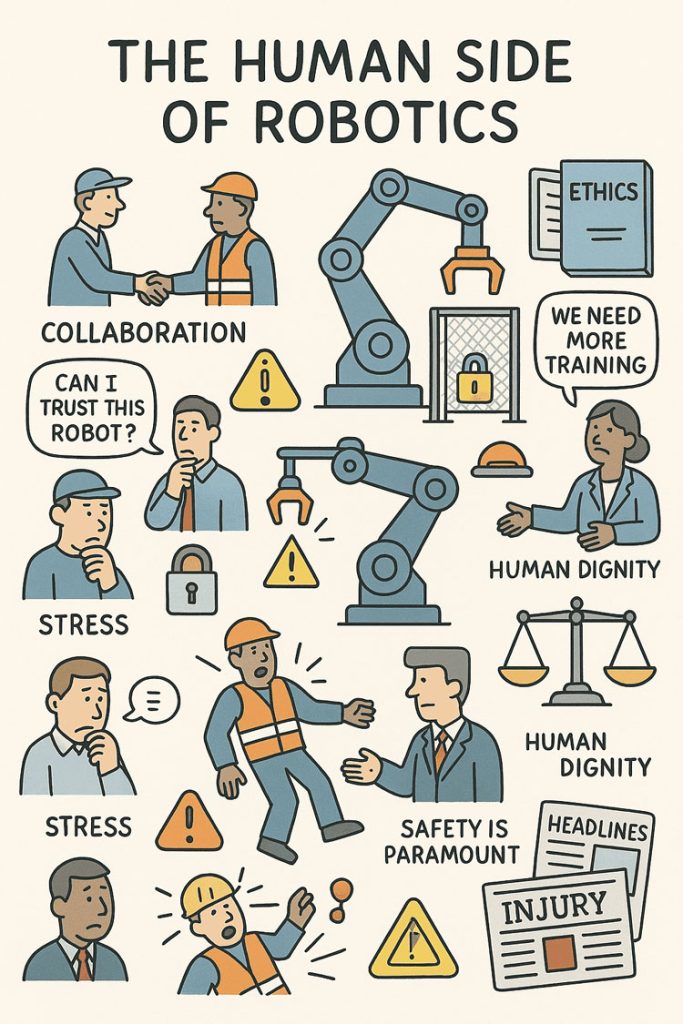
The Human Side of Robotics
When people think about robots at work, they often picture job displacement. But for many workers, the immediate concern is safety. Studies show that trust plays a huge role: workers who believe robots are reliable tend to perform better. However, misplaced trust—assuming a machine will always stop when needed—can be just as dangerous as fear or mistrust.
Beyond physical risks, robots can also affect morale and mental health. Workers may feel devalued or expendable when machines take over critical tasks. The challenge isn’t just engineering safer robots—it’s creating workplaces where humans feel respected and protected.
Building a Safer Future Together
So how do we strike the right balance between robotics innovation and human well-being? A few key steps stand out:
Design Safety Into the Machine: Emergency stops, advanced sensors, and fail-safes should be standard features—not optional add-ons.
Enforce Safety Protocols: OSHA’s lockout/tagout rules exist for a reason. Employers must ensure that servicing robots without proper shutdowns is never allowed.
Invest in Training: Robots are only as safe as the people who interact with them. Ongoing, practical training helps prevent accidents.
Foster a Safety Culture: Workers should feel empowered to report unsafe practices without fear of retaliation.
Update Regulations: As robots spread into more industries, regulators must adapt. International safety standards like ISO 10218 need to be more widely enforced, especially in smaller facilities.
Conclusion
Robotics is here to stay. It has the potential to make our workplaces more efficient, less physically demanding, and even safer. But incidents like those at Tesla and the Wisconsin pizza plant remind us that without proper safeguards, the cost of automation can be measured in human lives.
The future of human–robot relations doesn’t have to be one of fear or tragedy. With the right mix of engineering, regulation, and workplace culture, robots and humans can work side by side—not as rivals, but as partners. The question isn’t whether we should embrace robotics, but whether we’ll do so responsibly, putting people’s safety and dignity first.
Elevating Engineering Precision: 3D CAD Design, Laser Scanning, and Simulation for Custom Steel Fabrication
In modern engineering, accuracy, efficiency, and adaptability are not just desired—they are essential. At Hamilton By Design, we combine cutting-edge tools like 3D CAD design, 3D laser scanning, and SolidWorks FEA Simulation with practical expertise in custom steel fabrication to deliver intelligent, end-to-end solutions for complex engineering projects.
From detailed CAD Modelling to field-accurate Faro Scanning, our consultancy supports Australian industries with precise, timely, and cost-effective design solutions.
The Role of 3D CAD Design in Modern Engineering
3D CAD design (Computer-Aided Design) forms the foundation of most modern engineering workflows. It transforms initial concepts into detailed digital models, enabling design validation, collaboration, and modification long before anything is physically built.
Using tools like SolidWorks, our experienced 3D CAD designers create accurate representations of components, assemblies, and entire systems. This not only reduces costly errors during fabrication but also allows clients to visualise and interact with their product in a virtual environment.
With 3D CAD design at the core, we help clients navigate engineering challenges—from product development to mechanical infrastructure—faster and with greater confidence.
3D Modelling: Bridging Concept and Construction
Closely integrated with CAD design is 3D modelling, which allows designers to create digital prototypes of physical objects. At Hamilton By Design, 3D modelling is used not just for form but also for function. Our models include precise dimensions, material properties, tolerances, and interaction points.
Whether it’s reverse engineering an existing plant structure or designing custom brackets for a conveyor system, our 3D modelling ensures high fidelity and interoperability across platforms.
The Power of 3D Laser Scanning for Engineering Accuracy
To capture as-built environments with unmatched accuracy, we use 3D laser scan for engineering projects of all sizes. Leveraging Faro scanning technology, we generate detailed point clouds that map real-world environments down to millimetre accuracy.
This Faro scan data is then converted into actionable geometry for further CAD modelling or simulation. It’s particularly valuable in retrofit, maintenance, or upgrade projects, where existing site data is often incomplete or outdated.
Whether you’re updating mechanical systems in a processing plant or ensuring compliance in a structural audit, 3D laser scanning delivers the reliable data you need for precise engineering decisions.
From Scan to Simulation: Enhancing Designs with SolidWorks FEA
After creating a digital model, it’s crucial to understand how it will perform under real-world conditions. That’s where SolidWorks FEA simulation comes in.
SolidWorks Simulation allows our team to perform finite element analysis (FEA) on assemblies, evaluating factors such as stress, strain, fatigue, and thermal distribution. By integrating FEA into the design process, we validate designs before they are fabricated—saving both time and material costs.
This proactive approach is particularly useful in custom steel fabrication, where load-bearing components must meet stringent safety and performance criteria.
CAD Modelling in Custom Steel Fabrication
Custom steel fabrication is both an art and a science. It requires a deep understanding of materials, tolerances, and manufacturing techniques. At Hamilton By Design, we combine advanced CAD modelling with practical fabrication experience to create components that meet your exact requirements.
Whether you need custom brackets, enclosures, chutes, or full-scale structural assemblies, our models are production-ready and tailored to your fabrication process. We provide DXFs, laser-cutting files, and BOMs that integrate seamlessly with your shop floor operations.
Why Choose a 3D CAD Designer?
A skilled 3D CAD designer does more than just draw. They anticipate fitment issues, consider manufacturing constraints, and collaborate across disciplines to create practical, buildable designs.
At Hamilton By Design, our team brings over a decade of experience across heavy industry, defence, mining, and manufacturing. We understand the nuances of real-world engineering and tailor our CAD services to each project’s unique needs.
Integrating Faro Scanning with SolidWorks
One of our key differentiators is the seamless integration of Faro scan data into SolidWorks. This workflow allows us to:
Overlay scanned data onto CAD designs
Identify deviations between as-built and as-designed models
Rapidly develop retrofit solutions with accurate field measurements
Conduct clash detection and ensure proper clearances
This end-to-end capability reduces rework, shortens project timelines, and increases overall design quality.
Applications Across Industry
Our services benefit a broad range of industries, including:
Manufacturing – Tooling, jigs, and production line modifications
Defence – CAD design and simulation for retrofit and upgrade works
Construction – Structural steel design and site validation
Whether you’re fabricating a single part or overseeing a multi-million-dollar infrastructure upgrade, our tools and experience help you deliver with confidence.
The Difference
At Hamilton By Design, we don’t just deliver drawings—we provide engineering certainty. By combining the precision of 3D CAD, the power of SolidWorks simulation, and the real-world accuracy of Faro scanning, we help clients design, assess, and fabricate with confidence.
If you’re looking for an Australian mechanical engineering consultancy that delivers intelligent design, detailed modelling, and practical support for custom steel fabrication projects, we’re ready to help.
Let’s Work Together
Visit www.hamiltonbydesign.com.au to learn more or contact us to discuss how we can support your next engineering challenge.
Unlocking Engineering Potential with the 3DEXPERIENCE Platform
At Hamilton By Design, we are committed to pushing the boundaries of innovation and efficiency in industrial design and engineering. One of the most powerful tools enabling this shift is the 3DEXPERIENCE platform by Dassault Systèmes — a cloud-based, integrated environment that transforms how engineering, design, and manufacturing teams collaborate and operate.
But what makes this platform such a game-changer, particularly in heavy industrial environments?
A Unified Digital Ecosystem
Traditional design and engineering workflows often involve disjointed software systems, siloed communication, and a lack of visibility across teams. The 3DEXPERIENCE platform solves these challenges by offering a centralised digital workspace. It unifies CAD, simulation, data management, and project collaboration under one roof.
At Hamilton By Design, this means we can collaborate with clients, suppliers, and internal teams in real time — reducing delays, increasing transparency, and ensuring version control is never an issue.
Smarter Collaboration and Real-Time Decision-Making
For industrial clients, time is money. Delays caused by miscommunication or outdated files can cost thousands in downtime. With the 3DEXPERIENCE platform, all stakeholders — from engineers and designers to procurement and management — can access a single source of truth, anytime, anywhere.
Changes to 3D models, drawings, or requirements are reflected instantly across the platform. That kind of visibility ensures we’re always aligned with the project vision, improving decision-making speed and accuracy.
Advanced 3D Modelling and Simulation
Designing for complex environments — such as processing plants, mines, or heavy machinery installations — requires robust tools. The 3DEXPERIENCE platform delivers powerful 3D modelling and simulation capabilities through applications like CATIA, SIMULIA, and ENOVIA.
Whether we’re reverse engineering existing assets from LIDAR scans or developing new plant layouts, the platform helps us validate designs early through simulation and stress testing. This leads to fewer surprises during fabrication or installation, and stronger, safer designs.
Integration with LIDAR Scanning and Point Cloud Data
At Hamilton By Design, we often start projects using high-resolution LIDAR scans, capturing real-world conditions with millimetre precision. The 3DEXPERIENCE platform allows seamless integration of point cloud data, enabling our team to design directly within real-world geometry — reducing fitment issues and rework.
This integration ensures we don’t just create models — we create smart, context-aware models that interact meaningfully with the physical world.
Scalability and Security
As a cloud-based system, the 3DEXPERIENCE platform is scalable and secure. Whether we’re working on a small component upgrade or a large-scale plant overhaul, we can expand our toolset, users, and data storage with ease — all while maintaining enterprise-level data protection.
Conclusion
The 3DEXPERIENCE platform empowers Hamilton By Design to deliver faster, smarter, and more integrated engineering solutions. For clients in the heavy industrial space, it means fewer risks, better collaboration, and a clear digital path from concept to completion.
Want to know how the 3DEXPERIENCE platform can help your next project? Get in touch today at sales@hmailtonbydesign.com.au
To provide the best experiences, we use technologies like cookies to store and/or access device information. Consenting to these technologies will allow us to process data such as browsing behaviour or unique IDs on this site. Not consenting or withdrawing consent, may adversely affect certain features and functions.
Functional
Always active
The technical storage or access is strictly necessary for the legitimate purpose of enabling the use of a specific service explicitly requested by the subscriber or user, or for the sole purpose of carrying out the transmission of a communication over an electronic communications network.
Preferences
The technical storage or access is necessary for the legitimate purpose of storing preferences that are not requested by the subscriber or user.
Statistics
The technical storage or access that is used exclusively for statistical purposes.The technical storage or access that is used exclusively for anonymous statistical purposes. Without a subpoena, voluntary compliance on the part of your Internet Service Provider, or additional records from a third party, information stored or retrieved for this purpose alone cannot usually be used to identify you.
Marketing
The technical storage or access is required to create user profiles to send advertising, or to track the user on a website or across several websites for similar marketing purposes.