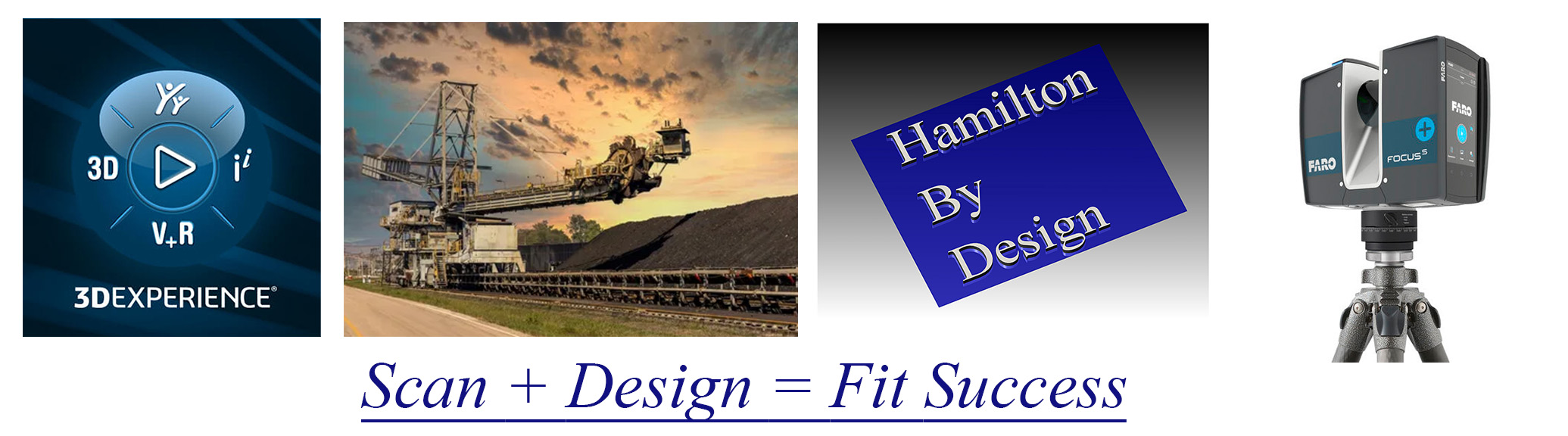
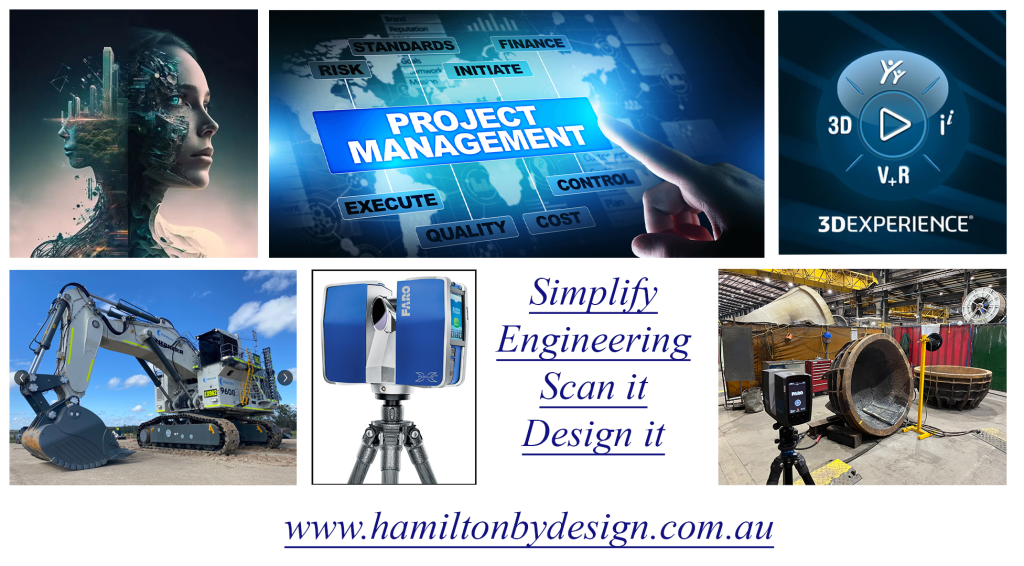
Mechanical Engineering | 3D Scanning | 3D Modelling
Category: Conveyor Reliability
Conveyor reliability covers engineering approaches used to improve the performance, availability, and safety of conveyor systems in mining and industrial operations. This category explains how engineering-led analysis, accurate site data, and practical design improvements support reliable conveyor operation across new and existing installations.
Content in this category focuses on real-world conveyor reliability workflows, including system assessment, alignment and layout checks, structural and mechanical verification, and the use of digital engineering tools to reduce downtime, maintenance issues, and unplanned failures.
In today’s world, accuracy and efficiency can make or break a project. Whether you’re working in architecture, construction, engineering, or product design, you need reliable data — and you need it fast. That’s where 3D point clouds come in.
But there’s an important catch: not all scans are created equal. The difference between an average scan and a great one often comes down to the person behind the scanner. Having someone who understands 3D modeling take the scans can dramatically improve your project’s accuracy, reliability, and overall success.
Let’s break down why.
The Power of 3D Point Clouds
Point clouds are essentially millions of tiny data points that capture the shape of an object, room, or entire site. Together, they create a highly detailed digital snapshot of the real world.
Here’s why this matters:
Precision you can trust – Point clouds deliver incredibly detailed measurements, capturing even the smallest curves and angles.
Nothing gets missed – Multiple scan angles ensure a full, 360° view of your site or object.
Speed and efficiency – What used to take hours (or days) with manual measurements can be captured in minutes.
Built-in context – You’re not just getting numbers; you’re getting a complete digital environment to work inside.
Future-proof data – Once you have a scan, you have a permanent record of your space, ready to use months or years later.
From clash detection to as-built verification, point clouds save time, reduce errors, and make collaboration across teams smoother than ever.
Why the Person Taking the Scan Matters
While technology is powerful, experience is what makes the results reliable. Having a skilled 3D modeler operate the scanner can be the difference between a good project and a great one.
Here’s why an expert makes all the difference:
They know what matters – A modeler understands which details are critical for your project and ensures they’re captured.
Fewer gaps, fewer surprises – Experienced pros know how to plan scan positions to cover every angle and avoid blind spots.
Cleaner, more accurate data – They reduce common issues like noise, misalignment, or missing sections that can throw off your model.
Time saved, headaches avoided – No one wants to redo a scan halfway through a project. A professional ensures you get it right the first time.
Confidence from start to finish – When you know your model is accurate, you can move forward with design and construction decisions without second-guessing.
In short: a great scanner operator doesn’t just deliver data — they deliver peace of mind.
The Bottom Line
3D point clouds are already transforming how projects are planned and delivered. But pairing them with an experienced 3D modeler takes things to the next level.
You’ll get better data, faster turnarounds, and a far lower risk of costly mistakes. And when your goal is to deliver projects on time, on budget, and with zero surprises, that’s an edge you can’t afford to miss.
Getting Coal, Hard Rock, and ROM Material Flow Right
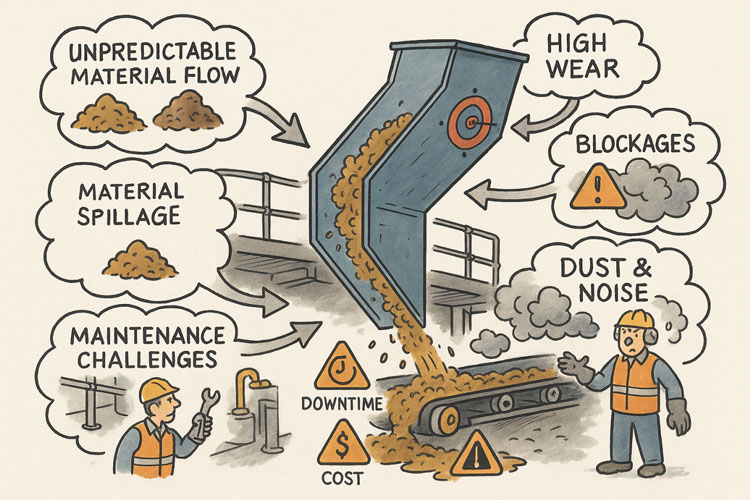
Chute design is one of the most critical yet challenging aspects of mining and mineral processing. Whether you are handling coal, hard rock ore, or raw ROM material, chutes and transfer stations are the unsung workhorses of every operation. When designed well, they guide material smoothly, minimise wear, and keep conveyors running. When designed poorly, they cause blockages, spillage, excessive dust, and expensive downtime.
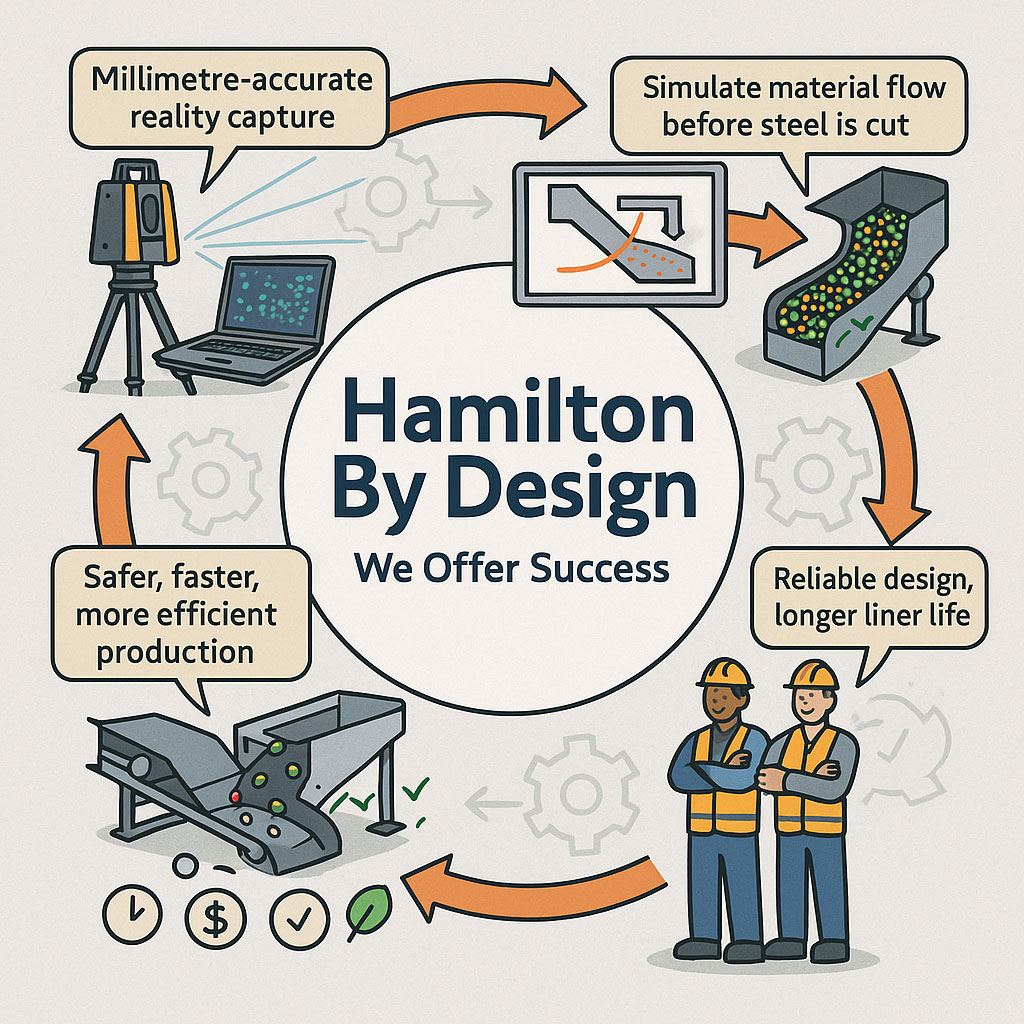
Modern chute design has moved far beyond rules of thumb and back-of-the-envelope sketches. Today, successful projects rely on accurate as-built data, particle trajectory analysis, and advanced Discrete Element Method (DEM) simulation to predict, visualise, and optimise material flow before steel is cut. In this article, we explore why these tools have become essential, how they work together, and where software can — and cannot — replace engineering judgement.
The Challenge of Chute Design
Coal and hard rock have very different flow behaviours. Coal tends to be softer, generate more dust, and be prone to degradation, while hard rock is more abrasive and can damage chutes if impact angles are not controlled. ROM material adds another level of complexity — oversize lumps, fines, and moisture variation can cause hang-ups or uneven flow.
Chute design must balance several competing objectives:
Control the trajectory of incoming material to reduce impact and wear
Prevent blockages by maintaining flowability, even with wet or sticky ore
Manage dust and noise to meet environmental and workplace health requirements
Fit within existing plant space with minimal modification to conveyors and structures
Be maintainable — liners must be accessible and replaceable without excessive downtime
Meeting all these goals without accurate data and simulation is like trying to design in the dark.
Capturing the Truth with 3D Scanning
The first step in any successful chute project is to understand the as-built environment. In many operations, drawings are outdated, modifications have been made over the years, and the real plant geometry may differ from what is on paper. Manual measurement is slow, risky, and often incomplete.
This is where 3D laser scanning changes the game. Using tripod-mounted or mobile LiDAR scanners, engineers can capture the entire transfer station, conveyors, surrounding steelwork, and services in a matter of hours. The result is a dense point cloud with millimetre accuracy that reflects the true state of the plant.
From here, the point cloud is cleaned and converted into a 3D model. This ensures the new chute design will not clash with existing structures, and that all clearances are known. It also allows maintenance teams to plan safe access for liner change-outs and other work, as the scanned model can be navigated virtually to check reach and access envelopes.
Understanding Particle Trajectory
Once the physical environment is known, the next challenge is to understand the particle trajectory — the path that material takes as it leaves the head pulley or previous transfer point.
Trajectory depends on belt speed, material characteristics, and discharge angle. For coal, fine particles may spread wider than the coarse fraction, while for ROM ore, large lumps may follow a ballistic path that needs to be controlled to prevent impact damage.
Accurately modelling trajectory ensures that the material enters the chute in the right location and direction. This minimises impact forces, reducing wear on liners and avoiding the “splash” that creates spillage and dust. It also prevents the material from hitting obstructions or dead zones that could lead to build-up and blockages.
Modern software can plot the trajectory curve for different loading conditions, providing a starting point for chute geometry. This is a critical step — if the trajectory is wrong, the chute design will be fighting against the natural path of the material.
The Power of DEM Simulation
While trajectory gives a first approximation, real-world flow is far more complex. This is where Discrete Element Method (DEM) simulation comes into play. DEM models represent bulk material as thousands (or millions) of individual particles, each following the laws of motion and interacting with one another.
When a DEM simulation is run on a chute design:
You can visualise material flow in 3D, watching how particles accelerate, collide, and settle
Impact zones become clear, showing where liners will wear fastest
Areas of turbulence, dust generation, or segregation are identified
Build-up points and potential blockages are predicted
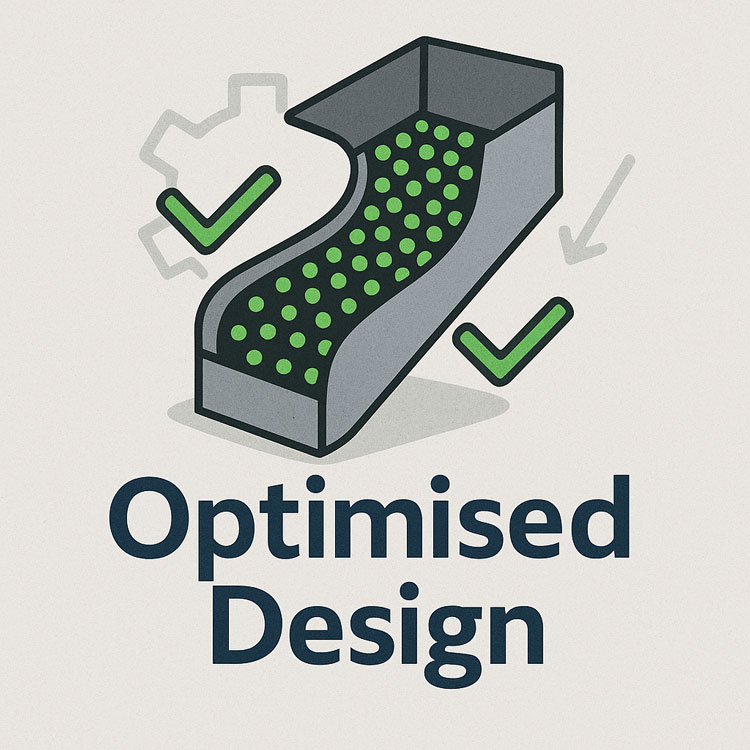
This allows engineers to experiment with chute geometry before fabrication. Angles can be changed, ledges removed, and flow-aiding features like hood and spoon profiles or rock-boxes optimised to achieve smooth, controlled flow.
For coal, DEM can help ensure material lands gently on the receiving belt, reducing degradation and dust. For hard rock, it can ensure that the energy of impact is directed onto replaceable wear liners rather than structural plate. For ROM ore, it can help prevent oversize lumps from wedging in critical locations.
🖥 Strengths and Limitations of Software
Modern DEM packages are powerful, but they are not magic. Software such as EDEM, Rocky DEM, or Altair’s tools can simulate a wide range of materials and geometries, but they rely on good input data and skilled interpretation.
Key strengths include:
Ability to model complex, 3D geometries and particle interactions
High visualisation power for communicating designs to stakeholders
Capability to run multiple scenarios (different feed rates, moisture contents, ore types) quickly
However, there are limitations:
Material calibration is critical. If the particle shape, friction, and cohesion parameters are wrong, the results will not match reality.
Computational cost can be high — detailed simulations of large chutes with millions of particles may take hours or days to run.
Engineering judgement is still needed. Software will not tell you the “best” design — it will only show how a proposed design behaves under given conditions.
That’s why DEM is best used as part of a holistic workflow that includes field data, trajectory analysis, and experienced design review.
From Model to Real-World Results
When the simulation results are validated and optimised, the design can be finalised. The point cloud model ensures the chute will fit in the available space, and the DEM results give confidence that it will perform as intended.
This means fabrication can proceed with fewer changes and less risk. During shutdown, installation goes smoothly, because clashes have already been resolved in the digital model. Once commissioned, the chute delivers predictable flow, less spillage, and longer liner life.
Why It Matters More Than Ever
Today’s mining operations face tighter production schedules, stricter environmental compliance, and increasing cost pressures. Downtime is expensive, and the margin for error is shrinking.
By combining 3D scanning, trajectory modelling, and DEM simulation, operations can move from reactive problem-solving to proactive improvement. Instead of waiting for blockages or failures, they can design out the problems before they occur, saving both time and money.
Partnering for Success
At Hamilton by Design, we specialise in turning raw site data into actionable insights. Our team uses advanced 3D scanning to capture your transfer stations with precision, builds accurate point clouds and CAD models, and runs calibrated DEM simulations to ensure your new chute design performs from day one.
Whether you’re working with coal, hard rock, or ROM ore, we help you deliver designs that fit first time, reduce maintenance headaches, and keep production running.
Contact us today to see how our integrated scanning and simulation workflow can make your next chute project safer, faster, and more reliable.
How 3D Laser Scanning is Redefining Reality for Design, Construction & Heritage
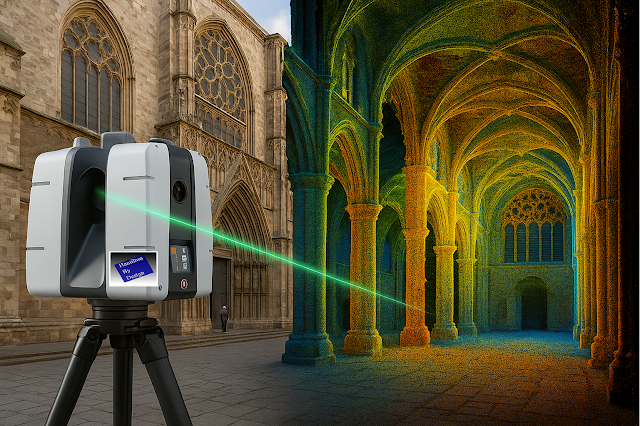
Imagine standing before a centuries-old cathedral, where every carved arch, every stained-glass pane, every weathered stone holds centuries of stories. Capturing its true form and condition with tape measure and camera? Tedious and prone to errors. But with 3D laser scanning, you can digitally freeze every detail—down to the imperfections—turning reality into an exact, manipulable model.
In an age where precision, speed, and data-driven decisions are non-negotiable, 3D laser scanning is no longer “nice to have”—it’s essential. Let’s explore what it is, why it’s transformative, where it’s being used most powerfully, and how you can harness its potential.
What Is 3D Laser Scanning?
At its core, 3D laser scanning sometimes called terrestrial laser scanning, (TLS) is the emission of laser pulses toward surfaces, recording the time it takes for those pulses to bounce back. From that comes a dense “point cloud” — billions of precise data points mapping shape, texture, orientation, and distance.
These point clouds become high-fidelity models, maps, meshes, or BIM ready files. Whether you’re scanning building exteriors, interiors, or industrial components, the result is more than just imagery—it’s measurable, analyzable geometry.
How It Works — The Process
Preparation & Planning
Define what you need: the level of detail (LOD), resolution, range, and whether external conditions (light, weather) will interfere.
Data Capture
Position the scanner at multiple stations to cover all surfaces. Use targets or reference markers for alignment and capture with overlapping scans.
Processing & Registration
Merge scans to align them properly, clean noise, filter out irrelevant data (like people, moving objects), calibrate.
Post-processing & Deliverables
Convert point clouds into usable outputs—floorplans, sections, elevations, 3D meshes, BIM models, virtual walkthroughs. Run analyses (clash detection, deformation etc.).
Integration & Use
Use the data in design, restoration, facility management, or documentation. The quality of integration (into BIM, GIS, CAD) is key to unlocking value.
Key Benefits
Benefit
What It Means in Practice
Real-World Impact
Extreme Precision
Sub-millimetre to millimetre accuracy depending on the scanner and conditions.
Less rework. Better fit for retrofit, renovation, or mechanical systems in tight tolerances.
Speed + Efficiency
Collect large amounts of spatial data in far less time than traditional measurement.
Faster project turnaround. Reduced site time costs.
Non-Contact / Low Disruption
Good for fragile structures, hazardous or difficult-to-access places.
Preserves integrity of heritage buildings; safer for workers.
Comprehensive Documentation
Full visual & geometric context.
Informs future maintenance. Acts as an archival record.
Better Decision Making & Conflict Detection
Early clash detection; scenario simulation; what-if modelling.
Avoids costly mistakes; helps build consensus among stakeholders.
Enhanced Visualisation & Communication
Stakeholders can see exactly what exists vs. what’s being proposed.
Facility Management: Digital twins, maintenance, asset tracking.
Environment & Surveying: Terrain mapping, forestry, flood risk mapping (especially when combined with aerial systems or mobile scanning).
Challenges & Best Practices
Nothing is perfect. To get the most out of 3D laser scanning, anticipate and mitigate:
Environmental factors: Light, dust, rain, reflective surfaces can introduce noise.
Data overload: Massive point clouds are large; need strong hardware & efficient workflows.
Alignment & registration errors: Overlaps, control points, and calibration are vital.
Skill & Planning: Good operators + good planning = much better outcomes.
Key best practices:
Use reference targets for precise registration.
Capture overlap of 30-50% between scan positions.
Break project into manageable segments.
Clean noise early.
Think ahead about deliverables and how clients will use the data (design, BIM, VR etc.).
Case Studies & Stories
Heritage in Danger: A cathedral in Europe threatened by pollution and structural decay was laser scanned. The point cloud revealed minute deformations, enabling an accurate restoration plan—saving costs and preserving history.
Infrastructure Efficiency: A civil engineering firm reduced design clashes by 80% on a complex highway project by integrating scans with their BIM workflow.
Industrial Switch-Over: Manufacturing plant layout was reconfigured using scan data; downtime reduced because the virtual model matched reality better than the old blueprints.
Software, Tools & Ecosystem
While scanners are vital, the software ecosystem is what unlocks value. Tools that turn raw data into actionable insights include:
Reality capture tools (processing point clouds).
BIM / CAD integration (e.g. Revit, AutoCAD).
Visualization tools (VR, AR, walkthrough).
Data sharing & collaboration platforms.
Cloud storage / processing if large point clouds.
SaaS/cloud-based workflows are increasingly important to share among remote teams, facilitate stakeholder review, and ensure data is accessible beyond just technical users.
Why It Matters Now
Global pressures (heritage, sustainability, faster build cycles, remote work) are raising the bar.
Regulatory compliance and “as-built” requirements are stricter.
Digital twins & smart infrastructure demand high fidelity data.
3D laser scanning acts as a bridge: between physical world and digital twin; between heritage past and future; between design promise and build reality.
If you have a survey scan and want to make sense of point cloud data, contact Hamilton By Design
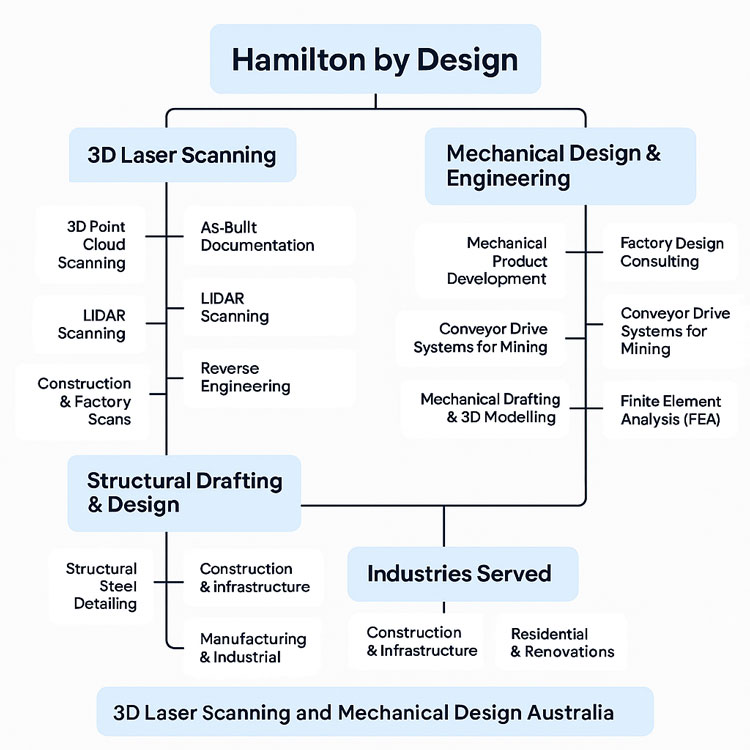
When it comes to precision engineering, structural drafting, and mechanical design services, Hamilton by Design leads the way. We provide advanced 3D laser scanning solutions across Perth, Sydney, Brisbane, Melbourne, and the Hunter Valley — giving clients accurate data for smarter decisions and efficient project delivery.
3D Laser Scanning Across Australia
Our 3D laser scanning services capture exact measurements of your site, plant, or equipment to create detailed 3D point clouds and as-built documentation. This reduces rework, saves time, and improves project planning.
We offer:
3D Laser Scanning Perth & Fremantle – Industrial plant surveys, mining site scanning, and reverse engineering.
3D Laser Scanning Sydney & Melbourne – Building surveys, renovation planning, and structural inspections.
3D Laser Scanning Brisbane & Hunter Valley – Factory layouts, conveyor drive design, and structural scanning.
3D Laser Scanning for Engineering & Mining – Point cloud scanning, clash detection, and 3D modelling.
Our team uses the latest 3D scanning and LiDAR technology to produce millimetre-accurate results that engineers, architects, and builders can trust.
Structural Drafting & Design Services
Hamilton by Design provides structural drafting services across Australia, including:
Structural Design and Drafting – For residential, commercial, and industrial projects.
Steel Detailing & Shop Drawings – Produced to Australian drafting standards.
Structural Scanning Services Brisbane & Sydney – Helping engineers assess existing structures for upgrades or repairs.
Our experienced structural design engineers work closely with builders, architects, and civil engineers in Hamilton and beyond to deliver reliable, build-ready plans.
Operation, Design Challenges, and the Role of Direct Drive Units In the highly demanding and regulated world of underground coal mining, the reliable and efficient transport of coal from the mining face to the surface is critical. Among the many systems involved in this process, conveyor drives play a pivotal role. These systems are tasked with powering conveyor belts that haul coal over long distances through often confined and hazardous environments. A vital part of this setup includes the use of direct drive units (DDUs), particularly in low-profile applications such as underground operations.
This document explores the functionality of conveyor drives in underground coal mines, the unique challenges faced in their operation, the complexities design engineers encounter in their development, and the concept of the phase “outbye”—a term widely used in underground mining to describe the direction and location of operations.
Conveyor Drives in Underground Coal Mining
A conveyor drive is a mechanical system that powers conveyor belts used to transport materials, in this case, coal. In underground mines, these conveyor belts often run for several kilometers, extending from the coal face (the area where coal is actively being cut and mined) to the shaft or drift that brings the coal to the surface.
The drive systems can be located at several points along the belt:
Head drive: Located at the discharge end of the conveyor.
Tail drive: Located at the loading end.
Mid-belt drives: Installed partway along long conveyors to help manage torque and reduce belt tension.
In the context of underground coal mines, the term “conveyor drive” is generally associated with the head or tail drive unit, which powers the movement of the belt.
Role of Direct Drive Units (DDUs)
Direct Drive Units are electric motors directly coupled to the drive shaft of the conveyor pulley, eliminating the need for intermediary gearboxes or belt drives. These units are especially advantageous in underground mining due to their compact design, reliability, and reduced maintenance.
Benefits of DDUs in Underground Coal Mines
Compact Size: Ideal for low-profile mining applications where vertical space is restricted.
Energy Efficiency: With fewer mechanical components, DDUs offer less friction and mechanical losses.
Lower Maintenance: No gearboxes or belt couplings to service.
Increased Reliability: Fewer parts mean fewer failure points.
Improved Safety: The enclosed design minimizes exposure to moving parts and flammable materials.
Operational Challenges of Conveyor Drives Underground
Underground coal mining presents a set of challenges not commonly encountered in surface operations. Conveyor drives, as the lifeblood of coal transportation, are central to these operational difficulties.
1. Space Constraints
Underground roadways are typically narrow and low, especially in coal seams with minimal thickness. This limitation forces the use of low-profile conveyor systems, which in turn limits the size and configuration of the drive units.
2. Dust and Moisture Exposure
Coal dust is highly abrasive and, in certain concentrations, explosive. Moisture from groundwater or the mining process further complicates the reliability of drive components. Ensuring DDUs are properly sealed and rated for these harsh conditions is critical.
3. Heat and Ventilation
Electric motors generate heat, which must be dissipated. However, underground mines have limited ventilation. Overheating can be a major issue, requiring cooling systems or specialized motor enclosures.
4. Explosion-Proof Requirements
Due to the potential presence of methane gas and coal dust, all electrical equipment, including conveyor drives, must comply with stringent explosion-proof standards (e.g., IECEx or ATEX ratings).
5. Long Haul Distances
Modern coal faces can be several kilometers from the shaft bottom. Transporting coal over long distances places mechanical stress on conveyor belts and drive units, increasing the risk of failure if not properly engineered.
6. Maintenance Access
Accessing conveyor drives for inspection or maintenance can be difficult in tight underground environments. Failures that require replacement or repair can cause significant production delays.
7. Load Variability
The volume of coal being hauled can vary significantly during a shift, which places variable demands on the drive system. The control systems must be able to accommodate fluctuating loads without mechanical strain.
Engineering and Design Challenges
Design engineers are tasked with creating conveyor drive systems that are not only robust and efficient but also compact and compliant with mining regulations. Some of the key design challenges include:
1. System Integration in Confined Spaces
Engineering a system that fits into limited space while delivering the necessary power is a fundamental challenge. Direct drive units help address this by eliminating gearboxes, but the motor itself must still be sized correctly.
2. Material Selection
Materials used must be corrosion-resistant, non-sparking, and capable of withstanding vibration, dust ingress, and moisture. This often limits design options and increases costs.
3. Thermal Management
Ensuring that the drive units do not overheat requires careful thermal modeling and the use of heat-resistant components. In some cases, passive or active cooling systems are integrated.
4. Compliance with Standards
Designs must adhere to a host of mining and electrical standards for flameproof and intrinsically safe equipment. Certification processes can be lengthy and expensive.
5. Modularity and Transportability
Since access to underground sites is limited, equipment must be modular or transportable in pieces small enough to be moved through shafts or drifts. Assembling and commissioning underground adds another layer of complexity.
6. System Control and Monitoring
Advanced drives require smart control systems that can adjust to load demands, monitor for faults, and integrate with mine-wide automation systems. Designing these systems requires interdisciplinary expertise.
7. Redundancy and Reliability Engineering
System failure underground can halt production and pose safety risks. Engineers must design for redundancy and easy switch-over between drive systems when necessary.
Understanding the Term “Outbye”
In underground mining terminology, directionality is essential for communication and logistics. The terms “inbye” and “outbye” are commonly used to describe relative directions underground.
What Does “Outbye” Mean?
Outbye refers to the direction away from the coal face and toward the surface or the mine entrance.
Conversely, inbye means toward the coal face.
For example:
If a miner is walking from the coal face toward the conveyor belt transfer station, they are walking outbye.
If a service vehicle is heading toward the longwall face, it is moving inbye.
Relevance of “Outbye” in Conveyor Systems
In conveyor operations:
The coal face is the inbye starting point.
The belt head drive and transfer points to the main conveyor system are located outbye.
Maintenance and service activities often take place outbye to avoid interfering with production at the face.
Understanding this term is critical for coordinating activities underground, as directions are often communicated using inbye and outbye references rather than compass points or distances.
Innovations and Future Trends
The mining industry continues to evolve, and conveyor drive systems are no exception. Some of the emerging trends and technologies include:
1. Variable Speed Drives (VSDs)
VSDs allow precise control over motor speed and torque, improving efficiency and reducing mechanical stress. They are increasingly paired with direct drive units to optimize performance.
2. Condition Monitoring
Sensors embedded in motors and drive systems can provide real-time feedback on vibration, temperature, and load. Predictive maintenance models reduce downtime.
3. Permanent Magnet Motors
These motors offer higher efficiency and torque density compared to traditional induction motors, making them well-suited for space-constrained environments.
4. Automation and Remote Control
Fully integrated systems that allow operators to monitor and control conveyor drives from surface control rooms are becoming standard.
5. Modular, Plug-and-Play Designs
Future drive units are being designed with ease of installation and replacement in mind, enabling faster deployment and lower maintenance impact.
Conclusion
Conveyor drive systems in underground coal mining are vital to the continuous flow of material and, by extension, the productivity of the entire mining operation. The adoption of direct drive units is helping to meet the unique demands of underground environments by providing compact, reliable, and efficient power transmission solutions.
However, these systems are not without their challenges. From the operational constraints of underground environments to the rigorous demands placed on design engineers, the development and maintenance of these systems require specialized knowledge, innovative thinking, and strict adherence to safety standards.
Moreover, understanding mining-specific terminology such as “outbye” provides important context for the deployment and maintenance of conveyor systems. As technology continues to advance, we can expect to see more intelligent, adaptive, and efficient conveyor drive systems that are better suited to the evolving demands of underground coal mining.
There are two things we’ve always believed at Hamilton By Design:
Accuracy matters.
If you can model it before you make it, do it.
That’s why when the FARO Focus S70 hit the scene in 2017, we were early to the party — not just because it was shiny and new (though it was), but because we knew it would change how we support our clients in mining, processing, and manufacturing environments.
The S70 didn’t just give us a tool — it gave us a superpower: the ability to see an entire site, down to the bolt heads and pipe supports, in full 3D before anyone picked up a wrench. Dust, heat, poor lighting — no problem. With its IP54 rating and extended temperature range, this scanner thrives where other tools tap out.
And we’ve been putting it to work ever since.
“Measure Twice, Cut Once” Just Got a Whole Lot More Real
Laser scanning means we no longer rely on outdated drawings, forgotten markups, or that sketch someone did on the back of a clipboard in 2004.
We’re capturing site geometry down to millimetres, mapping full plant rooms, structural steel, conveyors, tanks, ducts — you name it. And the moment we leave site, we’ve already got the data we need, registered and ready to drop into SolidWorks.
Which, by the way, we’ve been using since 2001.
Yes — long before CAD was cool, we were deep into SolidWorks building models, simulating loads, tweaking fit-ups, and designing smarter mechanical solutions for complex environments. It’s the other half of the story — scan it, then model it, all in-house, all under one roof.
Safety by Design – Literally
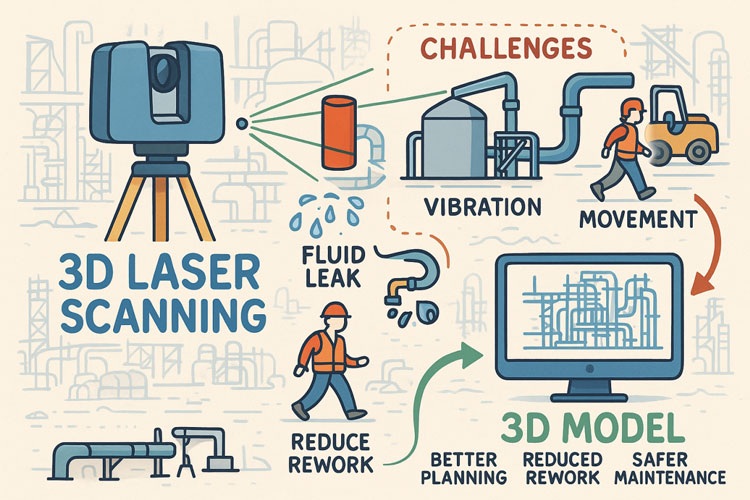
Here’s the part people often overlook: 3D laser scanning isn’t just about accuracy — it’s about safety.
We’ve worked across enough plants and mine sites to know that the real hazards are often the things you don’t see in a drawing. Tight access ways. Awkward pipe routing. Obstructions waiting to drop something nasty when a shutdown rolls around.
By scanning and reviewing environments virtually, we can spot those risks early — hazard identification before boots are even on the ground. We help clients:
Reduce time-on-site
Limit the number of field visits
Minimise exposure to high-risk zones
Plan safer shutdowns and installations
That’s a big win in any plant or processing facility — not just for compliance, but for peace of mind.
From Point Cloud to Problem Solved
Since 2017, our scanning and modelling workflows have supported:
Brownfield upgrade projects
Reverse engineering of legacy components
Fabrication and installation validation
Creation of digital twins
Asset audits and documentation updates
And when you pair that with 24 years of SolidWorks expertise, you get more than just a pretty point cloud — you get practical, buildable, fit-for-purpose engineering solutions backed by deep industry knowledge.
Thinking about your next project? Let’s make it smarter from the start.
We’ll scan it, model it, and engineer it as we have been doing for decades — with zero guesswork and full confidence.
To provide the best experiences, we use technologies like cookies to store and/or access device information. Consenting to these technologies will allow us to process data such as browsing behaviour or unique IDs on this site. Not consenting or withdrawing consent, may adversely affect certain features and functions.
Functional
Always active
The technical storage or access is strictly necessary for the legitimate purpose of enabling the use of a specific service explicitly requested by the subscriber or user, or for the sole purpose of carrying out the transmission of a communication over an electronic communications network.
Preferences
The technical storage or access is necessary for the legitimate purpose of storing preferences that are not requested by the subscriber or user.
Statistics
The technical storage or access that is used exclusively for statistical purposes.The technical storage or access that is used exclusively for anonymous statistical purposes. Without a subpoena, voluntary compliance on the part of your Internet Service Provider, or additional records from a third party, information stored or retrieved for this purpose alone cannot usually be used to identify you.
Marketing
The technical storage or access is required to create user profiles to send advertising, or to track the user on a website or across several websites for similar marketing purposes.