

Maximizing Equipment Efficiency with ISO 18436.2 Maintenance Strategies

At Hamilton By Design, we know that keeping your equipment running efficiently isn’t just about quick fixes; it’s about adopting the right maintenance strategies to ensure long-term reliability and performance. With advancements in condition monitoring and diagnostic techniques, the ISO 18436.2 standard has become a cornerstone for effective maintenance practices—and it’s at the heart of how we help our clients optimize their operations.

In this blog post, we’ll explore the major maintenance strategies aligned with ISO 18436.2 and how they can transform your plant’s productivity.


What is ISO 18436.2?

ISO 18436.2 is an internationally recognized standard that defines the competencies required for personnel performing condition monitoring and diagnostics. It focuses on advanced tools like vibration analysis, helping engineers identify equipment issues before they lead to costly downtime.

At Hamilton By Design, our team is ISO 18436.2-certified, meaning we bring the highest level of expertise to your maintenance needs.


Maintenance Strategies That Deliver Results

ISO 18436.2 aligns with several key maintenance strategies designed to improve reliability, minimize downtime, and optimize equipment performance. Here’s how they work:

1. Reactive Maintenance

Reactive maintenance is the traditional “run-to-failure” approach where repairs are made after a breakdown. While not ideal for critical assets, tools like vibration analysis can still play a role by identifying root causes post-failure. This can help inform more proactive strategies in the future.

2. Preventive Maintenance (PM)

Preventive maintenance involves scheduling regular maintenance tasks to prevent failures. While effective to some extent, PM can lead to over-maintenance. By incorporating vibration analysis and other condition monitoring techniques, preventive measures can be more precisely targeted, reducing unnecessary downtime.

3. Condition-Based Maintenance (CBM)

Condition-Based Maintenance uses real-time equipment data to identify issues as they arise. This strategy is central to ISO 18436.2 and includes tools like vibration analysis, thermography, and ultrasonic testing. CBM ensures that maintenance is performed only when necessary, saving time and money.

Benefits:

  • Reduces unplanned downtime.
  • Optimizes maintenance schedules.
  • Extends equipment lifespan.

4. Predictive Maintenance (PdM)

Predictive Maintenance takes CBM a step further, using data trends and analytics to predict when failures are likely to occur. With the expertise of ISO 18436.2-certified personnel, PdM uses advanced tools to detect subtle signs of wear or stress, allowing for intervention before a problem becomes critical.

Key Tools:

  • Vibration analysis for early detection of imbalance or misalignment.
  • Infrared thermography to spot heat anomalies.
  • Ultrasonic testing to identify leaks and material defects.

5. Reliability-Centered Maintenance (RCM)

RCM focuses on understanding the specific failure modes of critical assets and tailoring maintenance strategies accordingly. This approach integrates condition monitoring insights to prioritize tasks that align with operational goals.

Benefits:

  • Aligns maintenance efforts with production priorities.
  • Reduces the risk of unexpected equipment failures.

6. Proactive Maintenance

Proactive maintenance identifies and addresses root causes of recurring issues. By analyzing data from vibration and other diagnostic tools, engineers can resolve underlying problems like misalignment, improper lubrication, or material fatigue.

Impact:

  • Prevents repetitive failures.
  • Improves long-term equipment reliability.

7. Total Productive Maintenance (TPM)

TPM involves a plant-wide effort, from operators to management, to ensure optimal equipment effectiveness. ISO 18436.2-certified personnel can support TPM by providing actionable condition monitoring insights and training operators in basic diagnostic techniques.


How Hamilton By Design Helps

At Hamilton By Design, we bring these strategies to life through tailored maintenance solutions that align with your plant’s needs. Here’s how we can help:

1. Advanced Condition Monitoring:
Our team uses state-of-the-art tools to monitor equipment health, including vibration analysis, thermography, and ultrasonic testing.

2. Tailored Maintenance Plans:
Every plant is unique. We develop maintenance strategies based on your specific equipment, production goals, and operational priorities.

3. Expert Training and Certification:
We empower your team by offering ISO 18436.2 training, giving them the skills to sustain and enhance maintenance programs.

4. Ongoing Support:
Maintenance is a journey, not a destination. We provide continuous support to refine and optimize your practices as your operations evolve.


The Hamilton By Design Advantage

Adopting advanced maintenance strategies aligned with ISO 18436.2 isn’t just about improving equipment reliability—it’s about unlocking greater productivity and profitability for your business.

With our expertise, you can transition from reactive to predictive maintenance, reduce unplanned downtime, and extend the lifespan of your critical assets.

Ready to take your plant’s maintenance strategy to the next level? Contact Hamilton By Design today to find out how we can help.

Visit us at: www.hamiltonbydesign.com.au
Email us: sales@hamiltonbydesign.com.au
Call us: +61 0477 002 249


Hamilton By Design | Transforming Maintenance | Elevating Performance | Mechanical Engineering
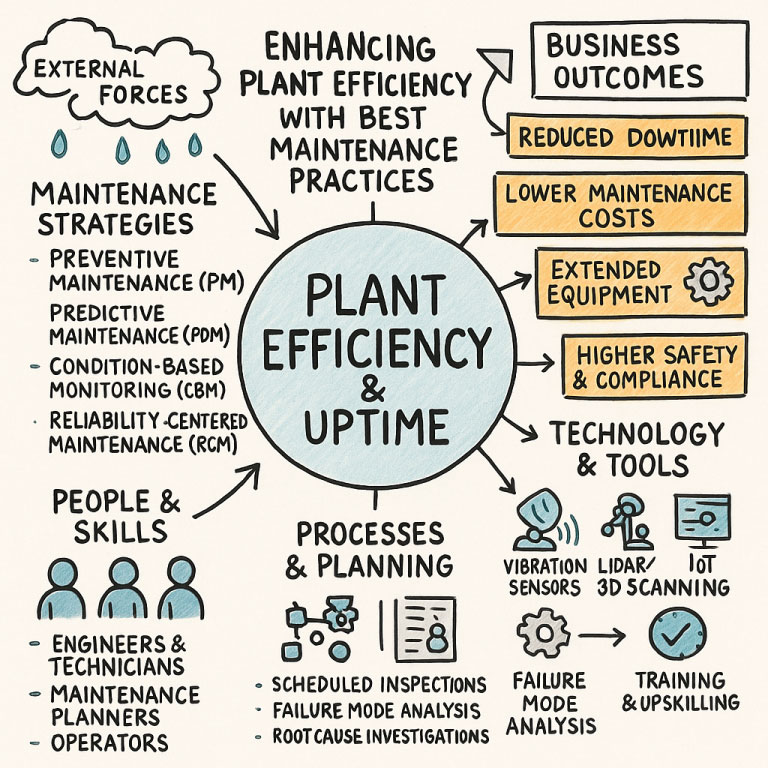
Enhancing Plant Efficiency with Best Maintenance Practices: A White Paper by Hamilton By Design

Hand-drawn infographic titled “Plant Efficiency & Uptime,” showing the key elements that enhance plant performance. Surrounding the central circle are categories including maintenance strategies (PM, PDM, CBM, RCM), people and skills (engineers, technicians, planners, operators), processes and planning (inspections, failure mode analysis, root-cause investigations), and technology and tools (vibration sensors, LiDAR/3D scanning, IoT, training). Benefits highlighted include reduced downtime, lower maintenance costs, extended equipment life, and higher safety and compliance.


In today’s competitive industrial landscape, maintaining high levels of Overall Equipment Effectiveness (OEE) is a cornerstone of operational success. Achieving this requires adopting advanced maintenance practices that minimize downtime, reduce operational costs, and extend the lifecycle of critical assets.

This white paper outlines best maintenance practices aligned with the ISO 18436.2 standard and highlights how Hamilton By Design’s team of mechanical engineers can partner with your organization to enhance your plant’s OEE. By leveraging our expertise in condition-based and predictive maintenance, we can optimize equipment performance and drive measurable improvements in productivity and reliability.

The Role of Maintenance in Maximizing OEE

OEE is a comprehensive measure of manufacturing productivity, defined by three critical components:

  1. Availability: Minimizing downtime to maximize operational hours.
  2. Performance: Ensuring equipment runs at optimal speeds.
  3. Quality: Reducing defects and waste during production.

Maintenance strategies are key to influencing these factors. Moving beyond reactive approaches to predictive and condition-based maintenance can significantly enhance equipment reliability and efficiency, ensuring better alignment with OEE goals.


Adopting Best Maintenance Practices

Condition-Based Maintenance (CBM)

CBM involves monitoring the real-time condition of equipment to predict and prevent failures. At Hamilton By Design, we integrate cutting-edge technologies like vibration analysis, thermography, and ultrasonic testing to enable proactive interventions before problems escalate.

How CBM Enhances OEE:
  • Reduces unplanned downtime (Availability).
  • Maintains consistent performance by addressing issues early (Performance).
  • Prevents production disruptions that cause defects (Quality).

Predictive Maintenance (PdM)

Predictive maintenance leverages data analytics to anticipate potential failures. By applying ISO 18436.2-certified practices, we implement advanced diagnostic tools and algorithms to forecast maintenance needs with precision.

Our Approach:
  • Deploy vibration analysis tools managed by certified Level II and III analysts.
  • Use infrared thermography to detect heat anomalies in electrical and mechanical systems.
  • Employ ultrasonic testing to identify leaks and structural weaknesses.
Benefits for OEE:
  • Prolonged equipment lifespan by addressing issues at their inception.
  • Higher productivity with fewer interruptions.
  • Reduced maintenance costs through targeted interventions.

Reliability-Centered Maintenance (RCM)

RCM focuses on optimizing maintenance strategies for each asset, emphasizing a deep understanding of failure modes and effects. Our engineers employ RCM to prioritize maintenance tasks that align with your plant’s specific OEE goals.

Steps We Implement:
  1. Asset Function Analysis: Understanding the purpose and criticality of each asset.
  2. Failure Mode and Effects Analysis (FMEA): Identifying risks and developing mitigation strategies.
  3. Data-Driven Decision Making: Using condition monitoring data to guide maintenance schedules.
Impact on OEE:
  • Ensures maintenance is aligned with production priorities.
  • Reduces waste and rework caused by unexpected equipment malfunctions.

Leveraging ISO 18436.2 Standards

ISO 18436.2 defines the competencies required for condition monitoring personnel, ensuring a standardized approach to predictive maintenance. Hamilton By Design’s mechanical engineers are certified under this standard, offering expertise in:

  • Vibration analysis for detecting unbalance, misalignment, and bearing faults.
  • Developing and managing comprehensive condition monitoring programs.
  • Interpreting and analyzing complex diagnostic data for actionable insights.

How Hamilton By Design Can Assist

Customized Maintenance Solutions

We recognize that every plant has unique operational challenges. Hamilton By Design tailors maintenance strategies to your specific needs, focusing on:

  • Asset Criticality Assessment: Identifying and prioritizing key equipment for monitoring and intervention.
  • Technology Integration: Implementing IoT-enabled sensors, data platforms, and diagnostic tools.
  • Program Development: Designing maintenance schedules aligned with production cycles and OEE targets.

Expert Training and Certification

Our team provides in-depth training for your personnel, ensuring they gain ISO 18436.2 certification and the skills to sustain advanced maintenance programs.

Ongoing Support and Continuous Improvement

Maintenance isn’t static. Hamilton By Design offers ongoing support to refine your maintenance practices, ensuring your plant stays ahead of evolving operational demands.


Case Study: Improving OEE with Hamilton By Design

Challenge: A manufacturing plant experienced frequent equipment failures, leading to a 15% drop in OEE.

Solution: Hamilton By Design implemented a tailored predictive maintenance program:

  • Installed vibration sensors on critical rotating machinery.
  • Trained plant engineers to monitor and analyze data using ISO 18436.2 standards.
  • Provided ongoing diagnostics and recommendations.

Outcome:

  • Downtime was reduced by 40%, significantly improving availability.
  • Equipment performance stabilized, enhancing productivity.
  • Defects decreased by 25%, improving product quality.

Maximizing OEE requires a strategic approach to maintenance that integrates advanced tools, skilled personnel, and data-driven insights. Hamilton By Design’s mechanical engineers, certified under ISO 18436.2, are uniquely equipped to help your plant achieve these goals.

By partnering with us, you can transform your maintenance practices, boost operational efficiency, and secure a competitive edge in your industry. Let Hamilton By Design help you take the first step toward a more reliable and productive future.

WorkTrek – 8 Ways to Improve Your Plant Maintenance
Practical tips for improving maintenance processes, reducing downtime, and boosting productivity.
https://worktrek.com/blog/how-to-improve-plant-maintenance/

Petrochem Expert – Best Practices for Plant Maintenance
Explores how proper maintenance planning ensures efficiency, reliability, and safety in plant operations.
https://petrochemexpert.com/best-practices-for-plant-maintenance-ensuring-operational-efficiency-and-safety/

MaintBoard – Maintenance Planning Strategies
Highlights how scheduling, IoT tools, and predictive approaches improve plant reliability and uptime.
https://maintboard.com/maintenance-planning-strategies

Hamilton By Design – Mechanical Engineering for Mining & Industry
Showcases engineering solutions designed to reduce downtime, improve reliability, and optimize plant performance.
https://www.hamiltonbydesign.com.au/mechanical-engineering-mining-industry-australia/

Hamilton By Design – Drafting & LiDAR / Scanning Services
Describes how accurate scanning and drafting streamline retrofits, reducing errors and saving time during plant upgrades.
https://www.hamiltonbydesign.com.au/services-drafting-lidar-scanning/

Hamilton By Design – Blog: Maximising Uptime at Transfer Points
Focuses on optimising chutes, hoppers, and conveyors to minimise stoppages and keep production flowing.
https://www.hamiltonbydesign.com.au/blog-engineering-insights/

Mechanical Designers

Mechanical Engineers Design

3D Mechanical Engineering

Mechanical Engineering Consultants

3D Laser Scanning