Why 3D Laser Scanning Might Be the Best Thing You Haven’t Tried Yet

In the world of building, maintaining, and improving anything physical — from mining sites to machinery and industrial plants — accuracy isn’t a bonus; it’s essential.

That’s where 3D laser scanning comes in. And if you haven’t explored how it works (or how easy it is to use), it’s worth taking a moment to learn how Hamilton By Design is using it to help companies all over Australia.

Visit the full page here: Hamilton By Design – 3D Laser Scanning



What Is 3D Laser Scanning – and Why Should You Care?

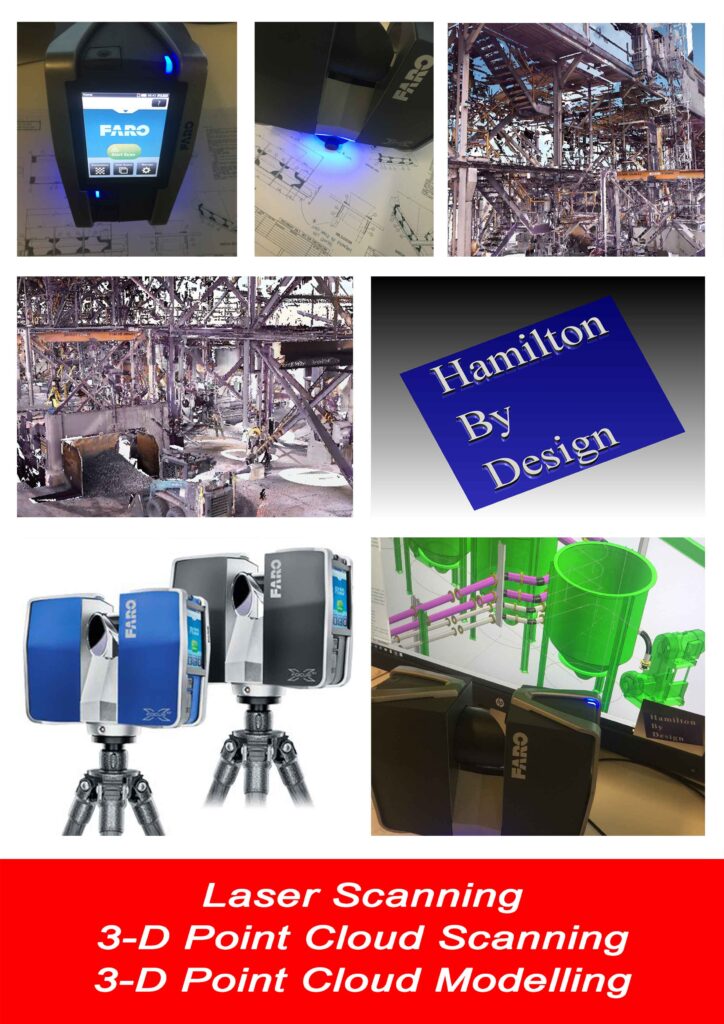
Imagine being able to get an exact digital version of a building, a plant room, or even a set of steel structures — all without needing to stop production or bring in tape measures and ladders. That’s what 3D laser scanning does.

Using advanced scanning equipment, we can capture every detail of a structure or environment and turn it into a highly accurate digital model. No guesswork. No rework. No surprises.

Think of it like Google Street View — but for your machinery, plant, or site.


Who Uses It – And What For?

At Hamilton By Design, we work with clients across the country in industries like:

  • Mining and minerals

  • Heavy industry

  • Construction and engineering

  • Manufacturing

  • Energy and infrastructure

They use 3D scans for things like:

  • Upgrading plant rooms without taking things apart first

  • Modifying equipment without clashing into existing structures

  • Creating “as-built” records of facilities for safety and compliance

  • Planning shutdowns with fewer risks and unknowns

Whether you’re fixing, building, or upgrading, scanning gives you a smarter way to plan.


The Real Value: Less Downtime, More Certainty

One of the biggest wins our clients see is speed. A scan that takes a day can save weeks of redesigns, measurement errors, or clashes down the track.

We’ve scanned conveyor systems, CHPP facilities, tank farms, processing equipment, and even confined spaces — all while the client kept working. The result? Better decisions, cleaner installs, and safer planning.


What Happens After the Scan?

After the scanning is complete, we deliver a digital 3D model of your asset. You can use this model to:

  • Design upgrades

  • Check clearances

  • Add new equipment into the space

  • Or just have a clean, accurate reference for future work

Our team also provides 3D CAD modelling, so if you want a fully engineered solution — not just the scan — we can help turn the model into your next design.


We’re Local — But We Work Nationally

With offices and scanners based in Perth, Brisbane, Central Coast, Mount Isa, and Melbourne, we’re never too far from where you are. And we work with all sorts of clients — from large mine operators to local manufacturers.

Our flexibility is what clients value most — whether it’s a one-day site visit or an ongoing partnership.


Why Hamilton By Design?

We’re not just a scanning company. We’re mechanical design engineers who know what comes after the scan. That means your data isn’t just collected — it’s actually useful, actionable, and ready for design, manufacturing, or project planning.

We’ve helped teams reduce rework, avoid shutdown delays, and get projects right the first time.


Ready to See What It Looks Like?

Whether you’re a site supervisor, a plant engineer, or just looking for a smarter way to manage infrastructure, 3D scanning could be the tool that makes your job easier.

Check out the full details here:

www.hamiltonbydesign.com.au/3d-laser-scanning

Or, if you’d prefer to talk through how it might work for your site, we’re just a call or email away.
Name
Would you like us to arrange a phone consultation for you?
Address

3D Modelling with You Now — and 3D Modelling in the Future

 3D Modelling 


By Hamilton By Design | www.hamiltonbydesign.com.au

In the 1980s through to the early 2000s, AutoCAD ruled
supreme. It revolutionised the way engineers and designers approached 2D
drafting, enabling technical drawings to be created and shared with speed and
precision across industries. For two decades, it set the benchmark for visual
communication in engineering and construction. But that era has passed.

Today, we live and work in a three-dimensional world — not
only in reality, but in design.

From 2D Drafting to Solid Modelling: The New Standard

At Hamilton By Design, we see 3D modelling not just
as a tool, but as an essential evolution in how we think, design, and
manufacture. The transition from 2D lines to solid geometry has reshaped the
possibilities for every engineer, machinist, and fabricator.

With the widespread adoption of platforms like SolidWorks,
design engineers now routinely conduct simulations, tolerance analysis, motion
studies, and stress testing — all in a virtual space before a single part is
made. Companies like Tesla, Ford, Eaton, Medtronic,
and Johnson & Johnson have integrated 3D CAD tools into their
product development cycles with great success, dramatically reducing rework,
increasing precision, and accelerating innovation.

Where 2D design was once enough, now solid models drive
machining
, laser cutting, 3D printing, automated
manufacturing
, and finite element analysis (FEA) — all from a single
digital source.

A Growing Ecosystem of Engineering Capability

It’s not just the software giants making waves — a global
network of specialised engineering services is helping bring 3D design to life.
Companies like Rishabh Engineering,
Shalin Designs, CAD/CAM Services Inc., Archdraw Outsourcing,
and TrueCADD provide design and
modelling support to projects around the world.

At Hamilton By Design, we work with and alongside these
firms — and others — to deliver scalable, intelligent 3D modelling solutions to
the Australian industrial sector. From laser scanning and site
capture
to custom steel fabrication, we translate concepts into
actionable, manufacturable designs. Our clients benefit not only from our
hands-on trade knowledge but also from our investment in cutting-edge tools and
engineering platforms.

So What’s Next? The Future Feels More Fluid Than Solid

With all these tools now at our fingertips — FEA simulation,
LiDAR scanning, parametric modelling, cloud collaboration — the question
becomes: what comes after 3D?

We’ve moved from pencil to pixel, from 2D lines to
intelligent digital twins. But now the line between design and experience
is beginning to blur. Augmented reality (AR), generative AI design, and
real-time simulation environments suggest that the next wave may feel more
fluid than solid
— more organic than mechanical.

We’re already seeing early glimpses of this future:

  • Generative
    design tools that evolve geometry based on performance goals
  • Real-time
    digital twins updating with sensor data from operating plants
  • AI-driven
    automation that simplifies design iterations in minutes, not days

In short: the future of 3D design might not be “3D” at all
in the traditional sense — it could be interactive, immersive, adaptive.

At Hamilton By Design — We’re with You Now and into the
Future

Whether you’re looking to upgrade legacy 2D drawings,
implement laser-accurate reverse engineering, or develop a full-scale 3D model
for simulation or manufacturing — Hamilton By Design is here to help.

We bring hands-on trade experience as fitters, machinists,
and designers, and combine it with the modern toolset of a full-service
mechanical engineering consultancy. We’re not just imagining the future of
design — we’re building it.

Let’s design smarter. Let’s think in 3D — and beyond.


Hamilton By Design logo displayed on a blue tilted rectangle with a grey gradient background

Our clients:

Name
Would you like us to arrange a phone consultation for you?
Address

Harnessing the Power of LiDAR: Revolutionizing Engineering with 3D Scanning & SolidWorks

Title: Harnessing the Power of LiDAR: Revolutionizing Engineering with 3D Scanning & SolidWorks

Introduction

At Hamilton By Design, we are committed to integrating cutting-edge technologies to enhance our engineering processes. One such technology that has transformed the landscape of design and construction is LiDAR (Light Detection and Ranging). This advanced 3D scanning tool offers unparalleled precision and efficiency, enabling us to deliver superior outcomes for our clients.

The Evolution of LiDAR Technology

LiDAR technology has come a long way since its inception in the 1960s. Initially developed for meteorological and atmospheric research, it has evolved into a versatile tool used across various industries, including civil engineering, architecture, and environmental monitoring. The integration of GPS and advancements in laser technology have significantly enhanced LiDAR’s accuracy and applicability.

Advantages of Incorporating LiDAR into Engineering

  1. Exceptional Accuracy and Detail LiDAR systems emit laser pulses to measure distances with remarkable precision, creating high-resolution point clouds that capture intricate details of structures and terrains. This level of accuracy is crucial for tasks such as topographic mapping, structural analysis, and as-built documentation.
  2. Efficiency in Data Collection Traditional surveying methods can be time-consuming and labor-intensive. LiDAR, on the other hand, can rapidly collect vast amounts of data, significantly reduce field time and accelerate project timelines.
  3. Enhanced Safety and Accessibility LiDAR enables remote data collection in hazardous or hard-to-reach areas, minimizing risks to personnel. Whether it’s scanning a deteriorating structure or surveying rugged terrain, LiDAR ensures safety without compromising data quality.
  4. Integration with BIM and Digital Twins The detailed 3D models generated by LiDAR can be seamlessly integrated into Building Information Modeling (BIM) systems, facilitating better design visualization, clash detection, and project coordination. This integration supports the creation of digital twins, allowing for real-time monitoring and maintenance planning.
  5. Cost-Effectiveness By reducing the need for repeated site visits and minimizing errors through accurate data capture, LiDAR contributes to cost savings throughout the project lifecycle. Its efficiency translates into reduced labor costs and optimized resource allocation.

Applications in Engineering Projects

At Hamilton By Design, we’ve leveraged LiDAR technology across various projects:

  • Infrastructure Development: Accurate terrain modeling for road and bridge design.
  • Heritage Conservation: Detailed documentation of historical structures for preservation efforts.
  • Urban Planning: Comprehensive city modeling to inform sustainable development.

Conclusion

The integration of LiDAR 3D scanning tools into our engineering processes has revolutionized the way we approach design and construction. Its precision, efficiency, and versatility align with our commitment to delivering innovative and high-quality solutions.

As technology continues to advance, we remain dedicated to adopting tools like LiDAR that enhance our capabilities and set new standards in engineering excellence.

Laser Scan | Hamilton By Design

For more information on how Hamilton By Design utilizes LiDAR technology in our projects, visit our website at www.hamiltonbydesign.com.au.

Mechanical Engineers Structural Engineers

Structural Drafting | Mechanical Drafting | 3D Laser Scanning

Mechanical Engineering

Want to know how 3D Scanning can help your next project?
Get in touch today at sales@hamiltonbydesign.com.au