Stop Reacting — Start Engineering

How Smart Mechanical Strategies Extend CHPP Life

Every coal wash plant in Australia tells the same story: constant throughput pressure, harsh operating conditions, and the never-ending battle against wear, corrosion, and unplanned downtime. The reality is simple — if you don’t engineer for reliability, you’ll spend your time repairing failure.

At Hamilton By Design, we specialise in mechanical engineering, 3D scanning, and digital modelling for coal handling and preparation plants (CHPPs). Our goal is to help site teams transition from reactive maintenance to a precision, data-driven strategy that keeps production steady and predictable.
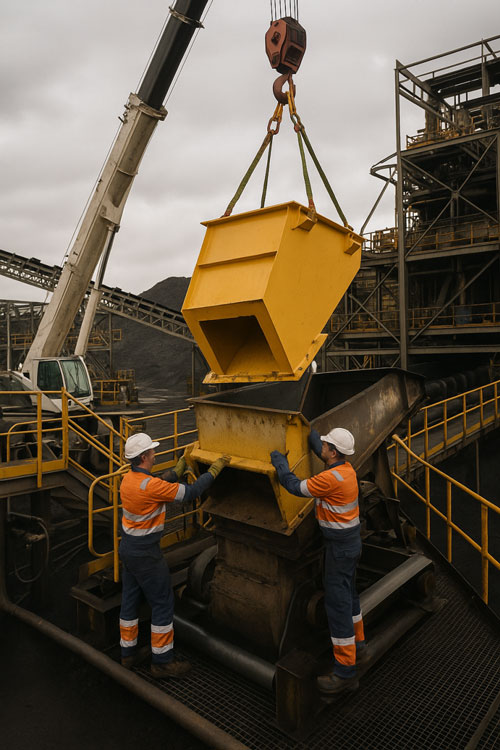
Workers guiding a crane-lifted yellow chute into position at a coal handling and preparation plant, with conveyor infrastructure and safety equipment visible on site

Design for Reliability — Not Reaction

Reliability begins with smart mechanical design. Poor geometry, limited access, and undersized components lead to fatigue and repeated downtime. Instead, modern CHPP maintenance programs start by engineering for fit, lift, and life:

  • Fit: Design components that align with the existing structure — every bolt, flange, and mating face verified digitally before fabrication.
  • Lift: Incorporate certified lifting points that comply with AS 4991 Lifting Devices, and ensure clear access paths for cranes or chain blocks.
  • Life: Select wear materials suited to the physics of the process — quenched and tempered steel for impact, rubber or ceramic for abrasion, and UHMWPE for slurry lines.

It’s not just about parts; it’s about engineering foresight. A well-designed plant component is safer to install, easier to inspect, and lasts longer between shutdowns.


Scan What You See — Not What You Think You Have

Over time, every wash plant drifts from its original drawings. Field welds, retrofits, and corrosion mean that “as-built” and “as-exists” are rarely the same thing.

That’s where LiDAR scanning transforms maintenance. Using sub-millimetre accuracy, 3D laser scans capture your plant exactly as it stands — every pipe spool, every chute, every bolt hole.

With this data, our engineers can:

  • Overlay new models directly into your point cloud to confirm fit-up before fabrication.
  • Identify alignment errors, corrosion zones, and clearance conflicts before shutdowns.
  • Generate true digital twins that allow for predictive maintenance and simulation.

LiDAR scanning isn’t just a measurement tool; it’s an insurance policy against rework and lost production.
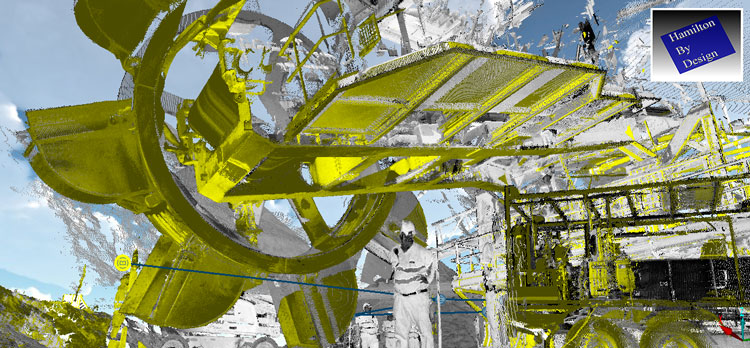
3D LiDAR point cloud of a CHPP plant showing detailed structural geometry, equipment, platforms, and personnel captured during an industrial site scan for engineering and upgrade planning.

Corrosion: The Hidden Killer in Every CHPP

Coal and water don’t just move material — they create acidic environments that eat through untreated or aging steel. In sumps, launders, and under conveyors, corrosion silently compromises strength until a structure is no longer safe to walk on.

Regular inspections are the first line of defence. At Hamilton By Design, we recommend combining:

  • Daily visual checks by operators for surface rust and coating damage.
  • Thickness testing during shutdowns to track wall loss on chutes and pipes.
  • 3D scan comparisons every 6–12 months to quantify deformation and corrosion in critical structures.

With modern tools, you can see corrosion coming long before it becomes a failure.


From Data to Decision: Predictive Maintenance in Action

A coal wash plant produces a river of data — motor loads, vibration levels, pump pressures, liner thickness, and flow rates. The key is turning that data into insight.

By integrating scanning results, maintenance records, and sensor data, plant teams can identify trends that point to future breakdowns. For example:

  • Vibration trending can reveal bearing fatigue weeks before failure.
  • Load monitoring can detect screen blinding or misalignment.
  • Scan data overlays can show sagging supports or displaced chutes.

When you understand what your plant is telling you, you move from reacting to problems to predicting and preventing them.
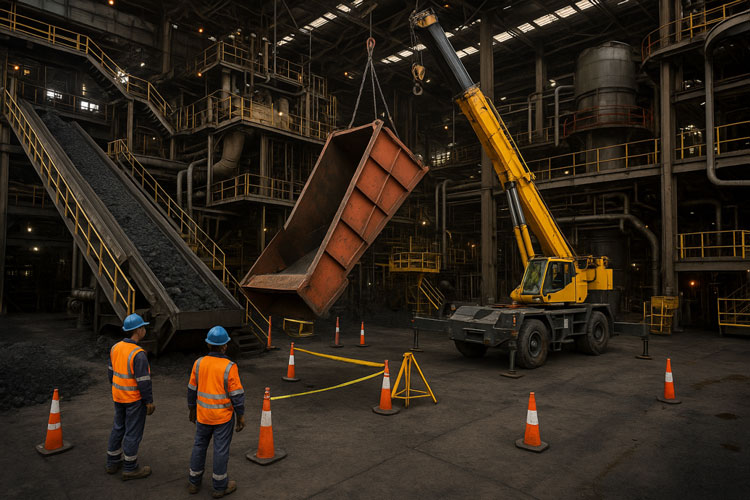

Industrial shutdown scene showing workers monitoring a mobile crane lifting a large steel chute inside a coal processing plant, with safety cones and exclusion zones in place

Shutdowns: Planned, Precise, and Productive

Every shutdown costs money — the real goal is to make every hour count. The best shutdowns start months ahead with validated design data and prefabrication QA.

Before you cut steel or mobilise cranes, every component should be digitally proven to fit. Trial assemblies, lifting studies, and bolt access checks prevent costly surprises once you’re on the clock.

At Hamilton By Design, our process combines:

  • LiDAR scanning to confirm as-built geometry.
  • SolidWorks modelling and FEA for mechanical verification.
  • Pre-installation validation to ensure bolt holes, flanges, and lift paths align on day one.

That’s how you replace chutes, spools, and launders in a fraction of the usual time — safely, and with confidence.
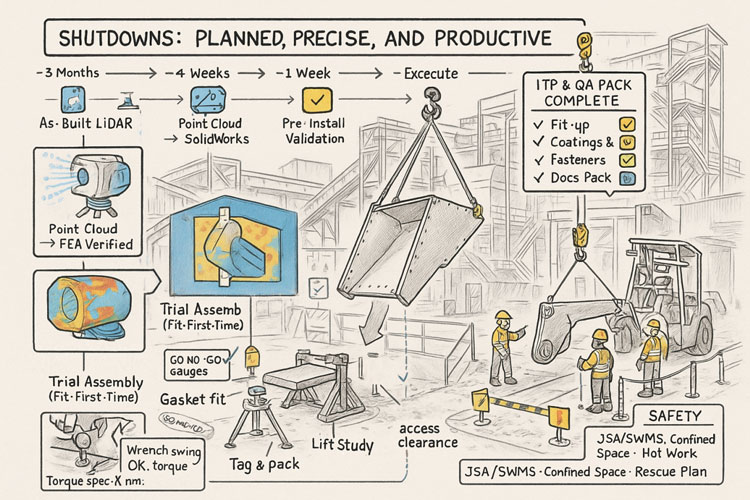
Hand-drawn infographic showing the shutdown workflow from LiDAR scanning and FEA verification through SolidWorks modelling, pre-install validation, trial assembly, lift study, and execution, including ITP and QA checks, safety steps, and onsite installation activities

The Payoff: Reliability You Can Measure

The plants that invest in engineering-led maintenance see results that are tangible and repeatable:

Improvement AreaTypical Gain
Reduced unplanned downtime30–40%
Increased liner lifespan25–50%
Shorter shutdown duration10–20%
Fewer fit-up issues and rework60–80%
Improved safety performance20–30%

Reliability isn’t luck — it’s engineered.


Your Next Step: A Confidential Mechanical Assessment

Whether your plant is in the Bowen Basin, Hunter Valley, or Central West NSW, our team can deliver a confidential mechanical and scanning assessment of your wash plant.

We’ll benchmark your current maintenance strategy, identify high-risk areas, and provide a clear roadmap toward predictive, engineered reliability.

📩 For a confidential assessment of your current wash plant, contact:
info@hamiltonbydesign.com.au

Stop reacting. Start engineering. Build reliability that lasts.

Hamilton By Design Logo

Mechanical Engineering | Structural Engineering

Mechanical Drafting | Structural Drafting
3D CAD Modelling | 3D Scanning

Chute Design

Mechanical Engineering Sydney: Why Local Expertise Beats Offshore Design

When Local Knowledge Makes All the Difference

Across Sydney, the Central Coast, and Newcastle, more contractors and plant managers are discovering a simple truth — offshore engineering might look cost-effective, but local expertise delivers better outcomes every time.

When drawings don’t meet Australian Standards, materials can’t be sourced locally, or site measurements are off by just a few millimetres, “cheap” design quickly becomes expensive rework.

That’s why businesses across NSW are turning to Hamilton By Design — a Sydney-based mechanical engineering practice that understands how to bridge design and construction through real-world experience, compliance, and precision.

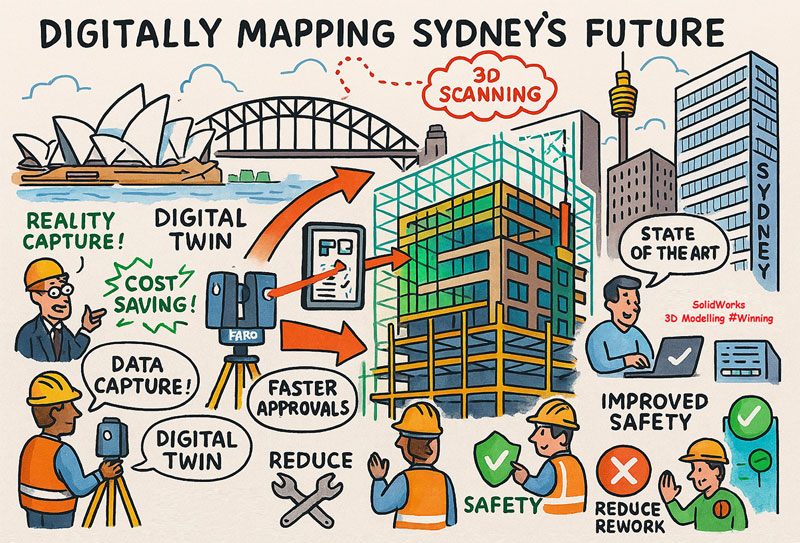
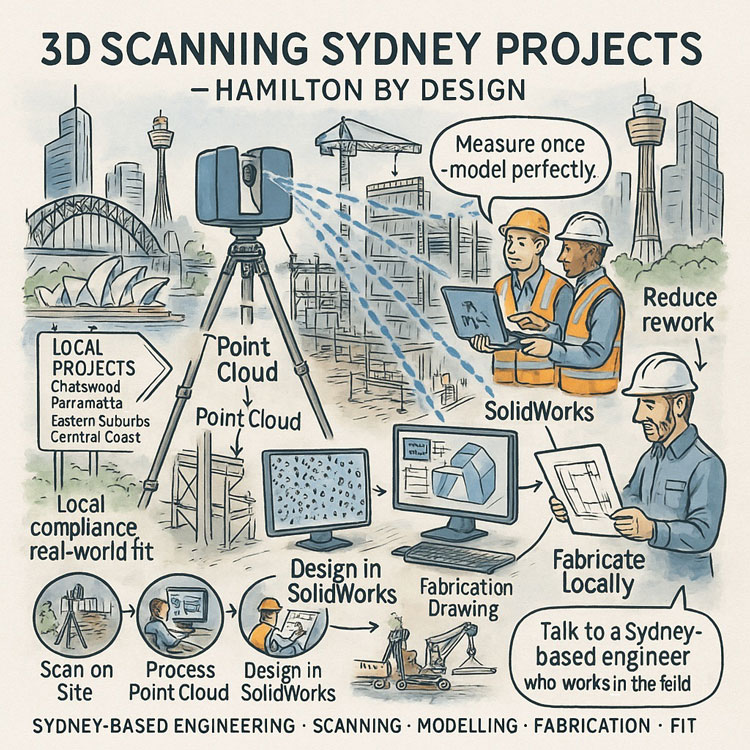
Illustrated infographic showing Hamilton By Design’s 3D scanning workflow in Sydney, including onsite LiDAR scanning, point-cloud processing, SolidWorks modelling, and local fabrication, with Sydney landmarks in the background

Built for Australia, Not Adapted for It

Engineering design isn’t universal.
Sydney’s environment, industry, and regulatory framework are unique — from local council approval requirements to the coastal conditions that affect corrosion and material selection.

At Hamilton By Design, our drawings and models are created with Australian Standards front and centre. We design for:

  • AS 4100 (Steel Structures)
  • AS 3990 (Mechanical Equipment Design)
  • AS 1657 (Walkways, Platforms & Stairs)
  • AS 4991 (Lifting Devices)
  • AS 4024 (Machine Safety)

Designing to these standards means your project moves faster through approvals, fabrication, and certification — with no surprises down the track.

Offshore designers often mean well, but they don’t work within these standards every day.
A single misinterpreted load case or welding symbol can mean days of rework on site.
A local engineer gets it right the first time.


Drawings That Fabricators Love

A good drawing doesn’t just look professional — it saves hours in the workshop.
Hamilton By Design creates fabrication drawings that make sense to the people who use them.

We think like tradespeople because we’ve been tradespeople.
Our background in fitting, machining, and CNC fabrication ensures every detail — from weld prep to bolt clearances — reflects how the job will actually be built.

That means fewer questions from the shop floor, cleaner fit-ups, and faster turnaround from fabrication to installation.

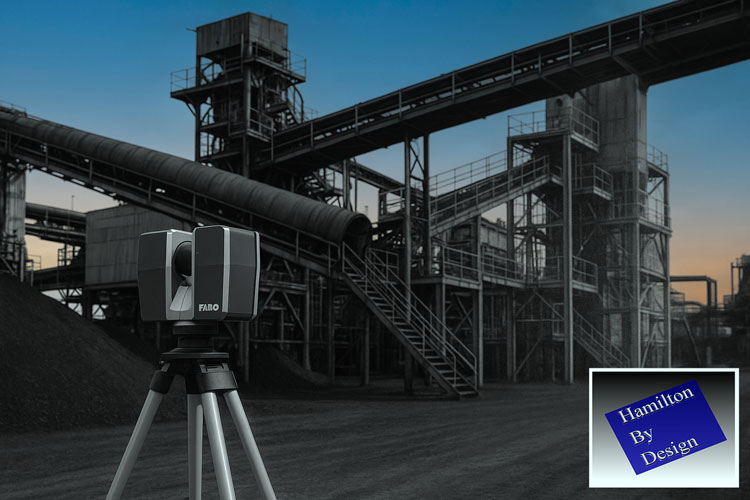
FARO 3D laser scanner set up on a tripod capturing an industrial plant for LiDAR scanning and digital modelling, with Hamilton By Design branding in the corner

Local Materials. Local Supply Chains. Fewer Delays.

Sydney’s fabrication and construction industry runs on locally available materials — from Bluescope steel to Bisalloy plate.
When offshore drawings specify unavailable materials or imperial sizes, fabrication stalls.

Our team specifies components, sections, and finishes that Sydney and Central Coast suppliers actually stock.
That reduces lead times, avoids substitutions, and keeps projects moving.

We also design with Sydney’s coastal environment in mind — using corrosion-resistant coatings, sealants, and fasteners suitable for marine-influenced locations like Parramatta, Botany, and Gosford.


Designed to Fit the Site — The First Time

It’s one thing to design in CAD; it’s another to make it fit in the field.
Sydney worksites can be complex — restricted access, uneven terrain, or legacy structures that don’t match the old drawings.

That’s why Hamilton By Design uses 3D scanning and LiDAR technology to capture accurate site data before design begins.
We integrate those scans directly into SolidWorks, building models that align with real-world geometry.

Every bracket, pipe run, and platform is verified in 3D before fabrication starts — ensuring a smooth installation with no rework.


Sydney Expertise with Regional Reach

We proudly serve clients across Sydney, Newcastle, and the Central Coast, working with builders, maintenance contractors, and fabrication workshops who value local knowledge.

Our typical projects include:

  • Plant upgrades and retrofits in brownfield sites.
  • Fabrication drawing packages for chutes, platforms, and pipework.
  • Reverse engineering from worn or obsolete components.
  • 3D scanning for as-built documentation.
  • Finite Element Analysis (FEA) for structural verification.

Every project benefits from our combined trade and engineering background — practical solutions grounded in decades of hands-on experience.


Smooth Communication. Real Accountability.

When you work with a local engineer, you’re not waiting overnight for an email response from another time zone.
You can pick up the phone, meet on site, or review models in person.

That direct collaboration saves time, reduces misunderstandings, and builds confidence between all stakeholders — engineers, fabricators, and project managers alike.

At Hamilton By Design, we value clear communication. You’ll know exactly what stage your project is at, what we’re designing, and how it aligns with your goals.


The Real Cost of Offshore Design

Offshore pricing often looks appealing — until you factor in delays, non-compliance, or fabrication mismatches.
Here’s what typically happens when projects cut corners:

ChallengeOffshore DesignLocal Expertise (Hamilton By Design)
Standards & CodesOften missed or misappliedFully compliant with AS/NZS standards
Material AvailabilitySpecified incorrectlyDesigned for Australian supply chains
CommunicationDelayed and unclearDirect, same-day response
Site UnderstandingBased on photosBased on 3D scans and site visits
Rework RiskHighMinimal – verified before fabrication

When you calculate the true cost — lost time, rework, freight, and approval delays — offshore design rarely saves money.

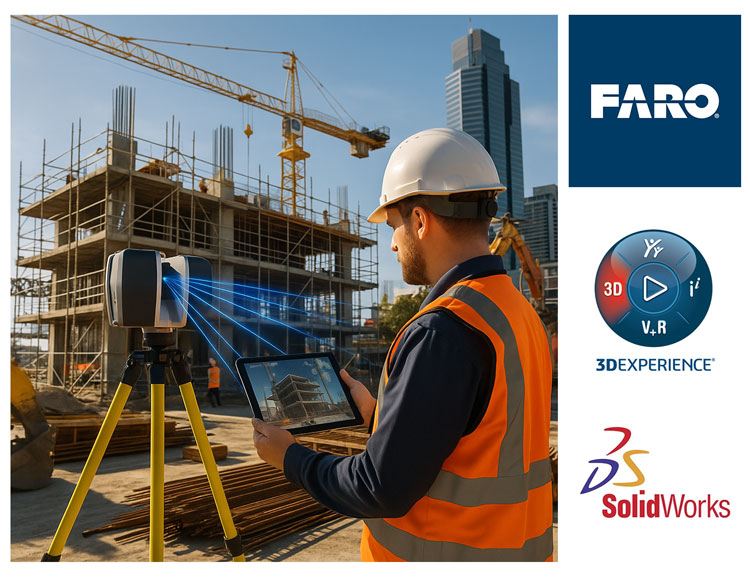
Technician using a FARO 3D laser scanner and tablet to capture a construction site for digital modelling, with 3DEXPERIENCE and SolidWorks logos shown on the side

Real Example: Central Coast Fabrication Success

A local contractor recently engaged Hamilton By Design to assist with a pump platform upgrade on the Central Coast.
Previous offshore drawings had mismatched hole patterns and unsupported loads.

We performed a quick 3D scan, remodelled the assembly in SolidWorks, and issued fabrication drawings ready for workshop production.
The new structure was installed without modification, saving the client several days of rework and earning rapid certifier approval.

That’s what local insight delivers — certainty and speed.


Why Choose a Sydney-Based Engineer

Sydney projects move quickly.
They need partners who can respond fast, understand the regulations, and coordinate seamlessly with site teams.

Hamilton By Design offers:
Over 25 years of trade and design experience
SolidWorks and FEA capability since 2011
3D scanning and as-built modelling for existing plants
Fabrication drawings built for local workshops
Practical designs created by people who’ve worked in the field

We’re based in Sydney and proud to support regional clients in Newcastle, the Central Coast, and Western Sydney.


Talk to a Sydney-Based Engineer Who’s Worked in the Field

Every project is a partnership — and great results come from working with people who understand your environment.
Hamilton By Design isn’t just another design service; we’re your local mechanical engineering partner — practical, responsive, and invested in your success.

If you’re planning a plant upgrade, mechanical installation, or fabrication project, let’s make sure your drawings are done right the first time.

Banner displaying Hamilton By Design alongside partner and technology logos including SolidWorks, UTS, Dassault Systèmes 3DEXPERIENCE, and FARO, with the text ‘3D Scanning 3D Modelling’ and website www.hamiltonbydesign.com.au

👉 Talk to a Sydney-based engineer who’s worked in the field.
Visit www.hamiltonbydesign.com.au or contact us today to discuss your next project.

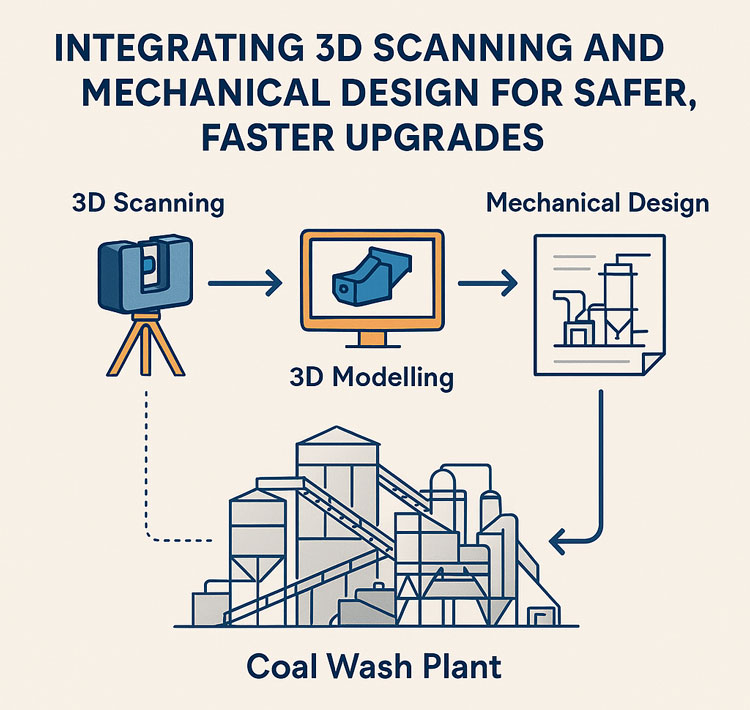
Integrating 3D Scanning and Mechanical Design for Safer, Faster Upgrades in Coal Wash Plants

Precision Without the Guesswork

Upgrading or maintaining a coal wash plant has always been a challenge — tight shutdown windows, complex layouts, and the need for perfect fit-ups between new and existing components. Traditional measurement methods, like tape measures and manual sketches, are often impossible in restricted or hazardous areas.

That’s where 3D scanning and mechanical engineering come together. At Hamilton By Design, we combine precision laser scanning, intelligent 3D modelling, and practical mechanical design to deliver risk-free upgrades — ensuring every component fits right the first time.

Infographic showing how 3D scanning and 3D modelling feed into mechanical design for safer, faster upgrades at a coal wash plant, with icons representing scanning, modelling, and engineering drawings

When Accuracy Matters Most

Coal wash plants are intricate systems. From cyclones, screens, and diverter chutes to pumps, piping, and structures, every part interacts under tight tolerances. A small misalignment can lead to vibration, spillage, or shutdown delays.

Our 3D scanning process captures millions of spatial data points, creating a detailed digital twin of the existing plant. This allows us to model upgrades, design replacement components, and simulate fit-up — all before fabrication begins.

In many cases, scanning replaces the need to physically measure equipment. For example, in confined or high-risk spaces where a tape measure simply can’t reach, scanning provides complete, line-of-sight geometry with millimetre accuracy.

Recently, our team scanned a diverter chute that had been incorrectly installed. The resulting model revealed that the chute had been fitted in the wrong orientation — explaining why it wasn’t sealing properly. This insight helped our client avoid further downtime and costly rework.


Combining Engineering Experience with Digital Precision

Hamilton By Design provides a full suite of mechanical engineering services tailored to the mining industry, including:

  • 3D Scanning & Point Cloud Capture – detailed mapping of existing equipment and structures
  • 3D Modelling & Reverse Engineering – accurate, editable digital models
  • Mechanical Design & Structural Replacement – like-for-like component upgrades
  • Piping Routes & Spool Fabrication – optimised pipe design and layout
  • Fabrication & Component Drawings – compliant with Australian Standards and client templates

Our engineers work across SolidWorks, AutoCAD Plant 3D, Revit, and 3D Experience platforms — integrating point cloud data directly into the design workflow. This means fewer site visits, fewer surprises, and significantly less rework once fabrication begins.


From Drawings to Digital Models

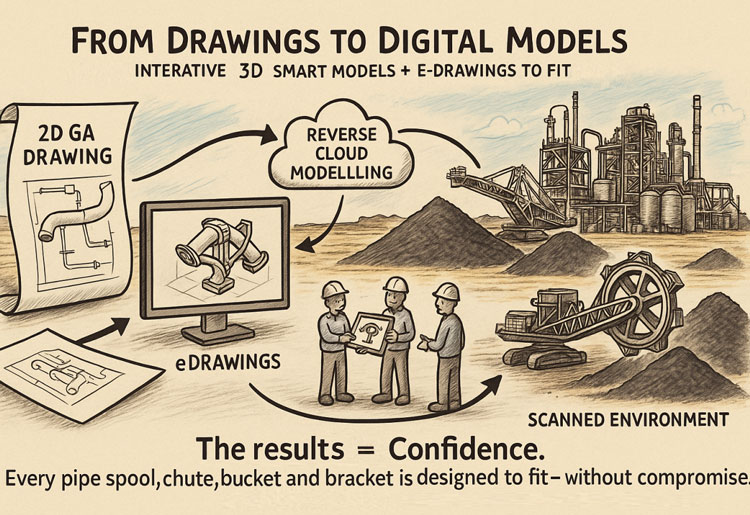
We’ve evolved beyond traditional 2D general arrangement drawings. Instead, we provide interactive 3D models and e-drawings that allow clients, fabricators, and site teams to visualise how upgrades will fit within the plant.

Our reverse cloud modelling process inserts 3D designs directly into the scanned environment. This enables engineers and site teams to measure potential interferences, check clearances, and validate installation methods — long before shutdowns begin.

Illustrated workflow showing how 2D GA drawings and scanned environments are turned into 3D digital models through reverse cloud modelling and eDrawings, demonstrating confidence in fabrication fit for mining and industrial equipment.

The result = Confidence.
Every pipe spool, chute, and bracket is designed to fit — without compromise.


Supporting Contractors and Plant Operators

We partner with:

  • Mining companies operating coal wash plants
  • Fabricators and contractors supplying mining equipment
  • Maintenance providers planning plant shutdowns

Their biggest challenge is finding people who design for fit and function — not just form. Not all CAD or point cloud software is equal, and not every designer understands the realities of on-site installation. That’s where Hamilton By Design stands apart.

We bring hands-on mechanical trade experience, engineering design expertise, and digital technology together — helping your team deliver upgrades that work, first time.


Built to Australian Standards

All design and drawing deliverables are completed in accordance with Australian Standards, ensuring compliance, safety, and interoperability with existing documentation.

We can also supply fabrication drawings on client-specific templates, maintaining intellectual property (IP) requirements and formatting standards.


Servicing Australia’s Key Mining Regions

Hamilton By Design proudly supports coal wash plant upgrades and mechanical design projects across Australia’s leading coal regions, including:

  • Bowen Basin
  • Surat Basin
  • Hunter Valley
  • Newcastle
  • Central Coast
  • Western and Central NSW coalfields

Our local experience ensures that we understand the logistical, operational, and environmental challenges unique to each region — helping projects stay compliant, efficient, and on schedule.


Why Choose Hamilton By Design?

  • Reduced Downtime: Accurate pre-shutdown planning through digital models.
  • Improved Safety: Less manual measuring in hazardous or confined areas.
  • Guaranteed Fit-Up: Fabrication drawings verified against real-world geometry.
  • Faster Turnaround: Streamlined scanning-to-design-to-fabrication workflow.
  • Proven Experience: Over two decades in mechanical engineering and plant design.

Our mission is simple — to take the risk out of upgrades by combining engineering insight with digital accuracy.


Quote

“Precision scanning and mechanical design — taking the risk out of plant upgrades.”


Let’s Make Your Next Upgrade Risk-Free

If your next shutdown involves mechanical upgrades, pipework replacement, or structural modifications, talk to Hamilton By Design.

We can help you visualise, plan, and execute upgrades with confidence — reducing downtime, eliminating measurement errors, and delivering safer outcomes for your team.

📧 info@hamiltonbydesign.com.au
🌐 www.hamiltonbydesign.com.au

Hamilton By Design logo displayed on a blue tilted rectangle with a grey gradient background.

Mechanical Drafting | Structural Drafting
3D CAD Modelling | 3D Scanning

Chute Design

Building Sydney Smarter: How 3D Scanning and LiDAR Are Transforming Construction Accuracy

A New Era of Construction Accuracy in Sydney

Sydney’s construction industry is booming — from commercial towers and infrastructure upgrades to industrial developments and complex refurbishments. But as sites become more congested and designs more complex, achieving perfect alignment between fabricated and installed components has never been more challenging.

That’s where 3D scanning and LiDAR technology come in. At Hamilton By Design, we provide high-precision digital capture and 3D modelling services that ensure every element of your construction project fits seamlessly together, saving time, cost, and effort onsite.


Capturing the Real Site with LiDAR Scanning

Using LiDAR (Light Detection and Ranging) scanners, we capture millions of laser measurements per second to create an exact 3D digital record — known as a point cloud — of your construction site or structure.

This means we can document existing conditions, monitor progress, and verify installations with millimetre-level precision. For Sydney builders, engineers, and contractors, that data eliminates the guesswork and drastically reduces costly clashes and rework later on.


From Point Cloud to 3D Model

Once the LiDAR data is captured, it’s processed into detailed 3D CAD and BIM models compatible with leading design software such as Revit, AutoCAD, SolidWorks, and Navisworks.

These accurate models allow design teams to:

  • Validate and update as-built conditions before fabrication
  • Detect clashes and misalignments before installation
  • Plan modifications and extensions with confidence
  • Coordinate between mechanical, structural, and architectural disciplines

By working from a true digital twin of your Sydney site, you can be sure every part — from prefabricated frames to pipe runs — will fit exactly where it should.


Why Sydney Construction Projects Are Turning to 3D Scanning

  • Reduced Rework: Identify design and fabrication issues before they reach site.
  • Improved Safety: Capture high or restricted areas without scaffolding or shutdowns.
  • Shorter Installation Times: Minimise downtime and delays during fit-up.
  • Precise Documentation: Maintain accurate records for QA and handover.
  • Better Collaboration: Integrate real-world data into your BIM environment.

From commercial fit-outs to infrastructure projects across Greater Sydney, 3D scanning provides a single source of truth for every stakeholder.


Typical Sydney Projects Using LiDAR and 3D Modelling

Hamilton By Design supports a range of construction and engineering clients, including:

  • Commercial and residential developments in the CBD and inner suburbs
  • Industrial plant upgrades across Western Sydney
  • Transport and infrastructure projects under NSW Government programs
  • Refurbishment and brownfield works requiring detailed as-built verification

Each project benefits from faster delivery, greater precision, and stronger communication between designers, builders, and clients.


Partner with Hamilton By Design

If you’re working on a Sydney construction or infrastructure project and need accurate 3D site data, as-built modelling, or fit-up verification, Hamilton By Design can help.

Our experienced mechanical and design specialists combine field scanning with advanced 3D modelling to deliver practical, reliable results that make construction smoother — and smarter.

Mechanical Engineers in Sydney

Hamilton By Design Logo www.hamiltonbydesign.com.au
Hamilton By Design logo displayed on a blue tilted rectangle with a grey gradient background

Mechanical Engineering | Structural Engineering

3D Scanning Sydney

Engineering Services

get in touch

sales@hamiltonbydesign.com.au

📍 Based in Sydney — working across NSW and Australia
📧 info@hamiltonbydesign.com.au
🌐 www.hamiltonbydesign.com.au

Capture. Model. Verify. Deliver — precision that builds Sydney better.

Seeing the Unseen: How LiDAR Scanning is Transforming Mining Process Plants

In modern mining, where uptime is money and safety is non-negotiable, understanding the geometry of your process plant is critical. Every conveyor, chute, pipe rack, and piece of equipment must fit together seamlessly and operate reliably — but plants are messy, dusty, and constantly changing. Manual measurement with a tape or total station is slow, risky, and often incomplete.

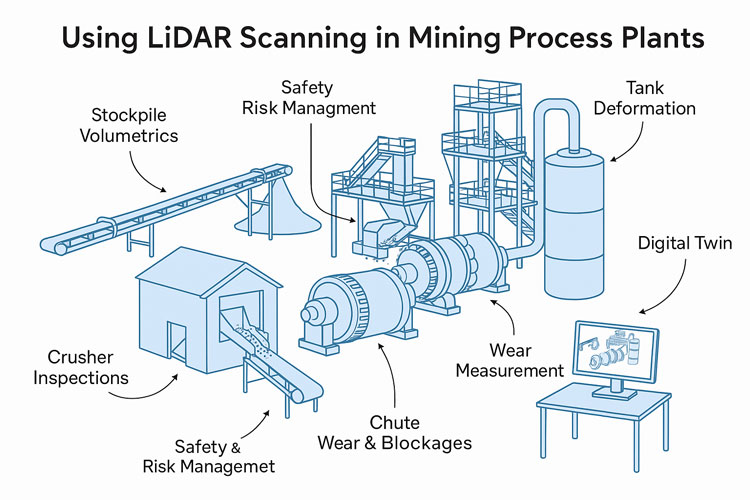
nfographic showing how LiDAR scanning is used in mining process plants, with illustrations of conveyors, crushers, tanks, mills and chutes. Labels highlight applications such as stockpile volumetrics, crusher inspections, safety and risk management, chute wear and blockages, mill wear measurement, tank deformation monitoring and creating digital twins.

This is where LiDAR scanning (Light Detection and Ranging) has become a game-changer. By capturing millions of precise 3D points per second, LiDAR gives engineers, maintenance planners, and operators an exact digital replica of the plant — without climbing scaffolds or shutting down equipment. In this post, we’ll explore how mining companies are using LiDAR scanning to solve real problems in processing plants, improve safety, and unlock operational efficiency.


What Is LiDAR Scanning?

LiDAR is a remote sensing technology that measures distance by firing pulses of laser light and recording the time it takes for them to return. Modern terrestrial and mobile LiDAR scanners can:

  • Capture hundreds of thousands to millions of points per second
  • Reach tens to hundreds of meters, depending on the instrument
  • Achieve millimeter-to-centimeter accuracy
  • Work in GPS-denied environments, such as inside mills, tunnels, or enclosed plants (using SLAM — Simultaneous Localization and Mapping)

The output is a point cloud — a dense 3D dataset representing surfaces, equipment, and structures with stunning accuracy. This point cloud can be used as-is for measurements or converted into CAD models and digital twins.


Why Process Plants Are Perfect for LiDAR

Unlike greenfield mine sites, processing plants are some of the most geometry-rich and access-constrained areas on site. They contain:

  • Complex networks of pipes, conveyors, tanks, and structural steel
  • Moving equipment such as crushers, mills, and feeders
  • Dusty, noisy, and hazardous environments with limited safe access

All these factors make traditional surveying difficult — and sometimes dangerous. LiDAR enables “no-touch” measurement from safe vantage points, even during operation. Multiple scans can be stitched together to create a complete model without shutting down the plant.


Applications of LiDAR in Process Plants

1. Wear Measurement and Maintenance Planning

LiDAR has revolutionized how mines measure and predict wear on critical process equipment:

  • SAG and Ball Mill Liners – Portable laser scanners can capture the exact wear profile of liners. Comparing scans over time reveals wear rates, helping maintenance teams schedule relines with confidence and avoid premature failures.
  • Crusher Chambers – Scanning inside primary and secondary crushers is now faster and safer than manual inspections. The resulting 3D model allows engineers to assess liner life and optimize chamber profiles.
  • Chutes and Hoppers – Internal scans show where material buildup occurs, enabling targeted cleaning and redesign to prevent blockages.

Result: Reduced downtime, safer inspections, and better forecasting of maintenance budgets.


2. Retrofit and Expansion Projects

When modifying a plant — installing a new pump, rerouting a pipe, or adding an entire circuit — having an accurate “as-built” model is crucial.

  • As-Built Capture – LiDAR provides an exact snapshot of the existing plant layout, eliminating guesswork.
  • Clash Detection – Designers can overlay new equipment models onto the point cloud to detect interferences before anything is fabricated.
  • Shutdown Optimization – With accurate geometry, crews know exactly what to cut, weld, and install — reducing surprise field modifications and shortening shutdown durations.

3. Inventory and Material Flow Monitoring

LiDAR is not just for geometry — it’s also a powerful tool for tracking material:

  • Stockpile Volumetrics – Mounted scanners on stackers or at fixed points can monitor ore, concentrate, and product stockpiles in real time.
  • Conveyor Load Measurement – Stationary LiDAR above belts calculates volumetric flow, giving a direct measure of throughput without contact.
  • Blending Control – Accurate inventory data improves blending plans, ensuring consistent plant feed quality.

4. Safety and Risk Management

Perhaps the most valuable application of LiDAR is keeping people out of harm’s way:

  • Hazardous Floor Areas – When flooring or gratings fail, robots or drones with LiDAR payloads can enter the area and collect data remotely.
  • Fall-of-Ground Risk – High walls, bin drawpoints, and ore passes can be scanned for unstable rock or buildup.
  • Escape Route Validation – Scans verify clearances for egress ladders, walkways, and platforms.

Every scan effectively becomes a permanent digital record — a baseline for monitoring ongoing structural integrity.


5. Digital Twins and Advanced Analytics

A plant-wide LiDAR scan is the foundation of a digital twin — a living, data-rich 3D model connected to operational data:

  • Combine scans with SCADA, IoT, and maintenance systems
  • Visualize live process variables in context (flow rates, temperatures, vibrations)
  • Run “what-if” simulations for debottlenecking or energy optimization

As AI and simulation tools mature, the combination of geometric fidelity and operational data opens new possibilities for predictive maintenance and autonomous plant operations.


Emerging Opportunities

Looking forward, there are several promising areas for LiDAR in mining process plants:

  • Autonomous Scan Missions – Using quadruped robots (like Spot) or SLAM-enabled drones to perform routine scanning in high-risk zones.
  • Real-Time Change Detection – Continuous scanning of critical assets with alerts when deformation exceeds thresholds.
  • AI-Driven Point Cloud Analysis – Automatic object recognition (valves, flanges, motors) to speed up model creation and condition reporting.
  • Integrated Planning Dashboards – Combining LiDAR scans, work orders, and shutdown schedules in a single interactive 3D environment.

Best Practices for Implementing LiDAR

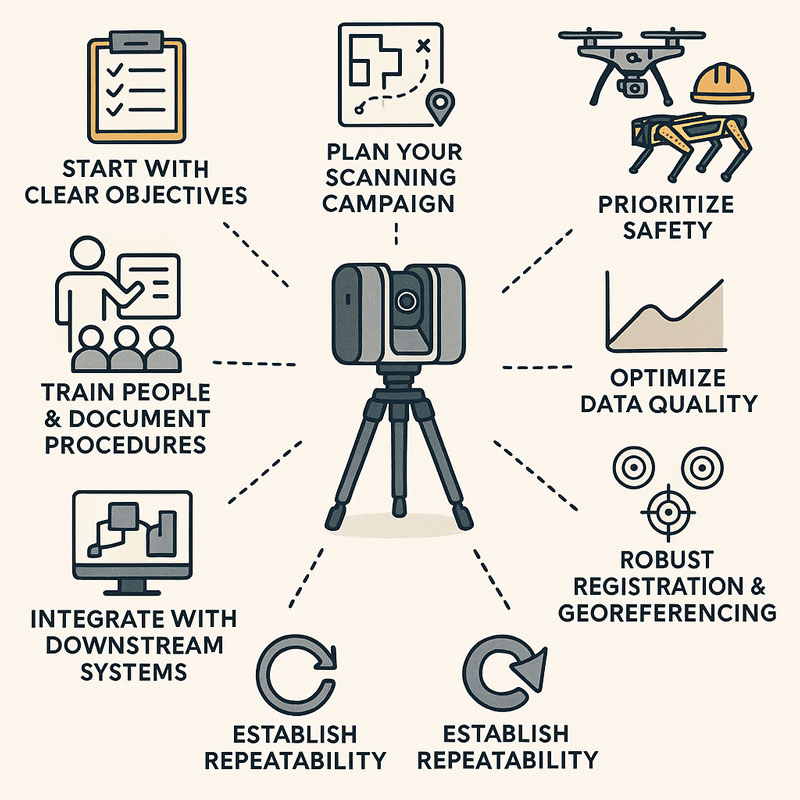
To maximize the value of LiDAR scanning, consider:

  1. Define the Objective – Are you measuring wear, planning a retrofit, or building a digital twin? This affects scanner choice and resolution.
  2. Plan Scan Positions – Minimize occlusions and shadow zones by preplanning vantage points.
  3. Use Proper Registration – Tie scans to a control network for consistent alignment between surveys.
  4. Mind the Environment – Dust, fog, and vibration can degrade data; choose scanners with appropriate filters or protective housings.
  5. Invest in Processing Tools – The raw point cloud is only the start — software for meshing, modeling, and analysis is where value is extracted.
  6. Train Your Team – Build internal capability for scanning, processing, and interpreting the results to avoid vendor bottlenecks.

Infographic showing a 3D LiDAR scanner on a tripod surrounded by eight best-practice principles: start with clear objectives, plan your scanning campaign, prioritize safety, optimize data quality, ensure robust registration and georeferencing, establish repeatability, integrate with downstream systems, and train people with documented procedures

LiDAR scanning is no longer a niche technology — it is rapidly becoming a standard tool for mining process plants that want to operate safely, efficiently, and with fewer surprises. From mill liners to stockpiles, from shutdown planning to digital twins, LiDAR provides a clear, measurable view of assets that was impossible a decade ago.

For operations teams under pressure to deliver more with less, the case is compelling: better data leads to better decisions. And in a high-stakes environment like mineral processing, better decisions translate directly to improved uptime, reduced costs, and safer workplaces.

The next time you’re planning a shutdown, a retrofit, or even just trying to understand why a chute is plugging, consider pointing a LiDAR scanner at the problem. You may be surprised at how much more you can see — and how much time and money you can save.

3D Scanning | Mining Surface Ops | 3D Modelling

Mechanical Engineering | Structural Engineering

Mechanical Drafting | Structural Drafting
3D CAD Modelling | 3D Scanning

Chute Design

SolidWorks Contractors in Australia

Hamilton By Design – Blog

The Future of Smelting & Steelmaking:

Trends Shaping a Greener, Smarter Industry


Steel has been the backbone of industrial progress for over 150 years. It is the invisible framework behind our skyscrapers, bridges, transport systems, and modern cities. But the industry that gave us the Industrial Revolution is now facing one of the greatest transitions in its history. The combined pressures of climate change, regulatory scrutiny, fluctuating energy costs, and global trade realignments are forcing steelmakers to rethink how steel is made, used, and traded.

Recent news reports show a fascinating picture: a sector in the middle of transformation, experimenting with new technologies like hydrogen-based direct reduction, while still relying on traditional blast furnace smelting to meet soaring demand. In this article, we explore the future direction of the smelting and steelmaking industry, what challenges lie ahead, and where the biggest opportunities are likely to emerge.


The Push for Green Steel

Hydrogen & Direct Reduced Iron (DRI): A Pathway to Decarbonization

Hydrogen-based steel production remains the single most promising pathway for deep decarbonization in the steel sector. Instead of using metallurgical coal and coke to chemically reduce iron ore, hydrogen can be used to produce direct reduced iron (DRI) that can then be melted in an electric arc furnace (EAF). This dramatically cuts CO₂ emissions, especially if the hydrogen is produced using renewable energy.

Projects like Salzgitter’s Salcos program in Germany are leading the way. Salzgitter has been developing one of the most ambitious hydrogen-based steel transformation roadmaps in Europe, gradually phasing in hydrogen reduction units and retiring carbon-intensive blast furnaces. Similarly, Australia’s NeoSmelt initiative, backed by Rio Tinto and ARENA, is exploring a combination of DRI and electric smelting furnaces to create a pathway that works for Australian ore quality and energy markets.

But this transition is anything but smooth. Salzgitter has recently delayed later stages of its program, citing economic and regulatory headwinds, such as the high cost of hydrogen, uncertain carbon pricing, and the slow rollout of renewable energy infrastructure. This highlights a hard truth: the green transition will not be instant or cheap. The next decade will likely be defined by pilot projects, incremental scale-ups, and careful balancing between economic viability and climate commitments.


The Coal Paradox

Even as green steel makes headlines, metallurgical coal is seeing a surprising resurgence. Demand for coal-based blast furnace production remains robust, especially in China and India, where domestic infrastructure spending continues to grow. In fact, recent research from the Global Energy Monitor shows that coal-based capacity is still expanding, even as global climate targets call for steep reductions in emissions.

This paradox points to the transitional nature of the current era. For the foreseeable future, the world will be living in a dual-track steel economy: one track relying on traditional blast furnaces and coke ovens to meet near-term demand, and another experimenting with hydrogen, electric smelting, and alternative reduction technologies.

For businesses, this means they cannot simply abandon existing capacity overnight. Instead, expect to see retrofit investments to improve the efficiency of blast furnaces, capture more waste heat, and install carbon capture and storage (CCS) where feasible. This “cleaner coal” approach will act as a bridge until low-carbon technologies can compete at scale on cost and availability.


Regional Shifts & Strategic Investments

Australia’s Green Steel Ambitions

Australia is emerging as a key player in the global conversation on sustainable steelmaking. The country has vast high-grade iron ore resources, growing renewable energy capacity, and a strategic interest in maintaining domestic steelmaking capability.

  • BlueScope’s $1.15B blast furnace reline at Port Kembla is one of the largest industrial projects in the nation’s history, designed to keep steel production secure for another 20 years. This investment shows that Australia is taking a pragmatic approach — continuing to support blast furnace technology while planning for a green future.
  • The NeoSmelt project, which just secured nearly $20M in government funding, is a potential game-changer. It will explore how to combine renewable-powered hydrogen and electric furnaces to make a commercial-scale green steel process that works with Australian ore.
  • The potential takeover of Whyalla Steelworks by a consortium led by BlueScope could turn the plant into a testbed for low-emissions ironmaking, providing a national blueprint for decarbonizing heavy industry.

Global Trade & Policy Realignment

Meanwhile, trade policy is also shaping the future. The EU and U.S. have resumed talks to revisit steel and aluminium tariffs, with a focus on creating carbon-based trade measures. If implemented, this could reward producers who adopt low-carbon technologies while penalizing those that rely on high-emission processes. For global producers, this will accelerate investment in low-emissions capacity to stay competitive in export markets.


Innovation Beyond Furnaces

The transformation of steelmaking is not just about switching fuels — it’s about reimagining the entire production system.

  • Modular, low-emission smelting plants like those being developed in Western Australia by Metal Logic allow companies to build capacity closer to demand centers, reduce transport emissions, and scale production up or down as needed.
  • Digital twins and AI-driven process control are making smelting more efficient. By modeling every step of the steelmaking process, producers can optimize energy use, reduce material losses, and increase yield — all of which improve profitability and lower emissions simultaneously.
  • Circular economy practices, such as increased use of scrap steel in EAFs, are becoming a central strategy. Recycling steel uses a fraction of the energy required to make virgin steel and fits neatly into the industry’s sustainability narrative.

This convergence of physical and digital innovation will likely create a new generation of steel plants that are smaller, smarter, and cleaner than their 20th-century predecessors.


Where the Industry is Headed

Looking ahead, the future of smelting and steelmaking will be defined by hybridization, regulation, and resilience:

  • Hybrid production systems will dominate for at least the next decade. Expect blast furnaces to operate alongside hydrogen-based DRI units and electric smelters as companies transition gradually.
  • Stricter carbon regulations will push companies to adopt low-carbon pathways faster than market forces alone would dictate. Carbon border adjustment mechanisms (CBAMs) will effectively tax “dirty steel” in major economies, making investment in green capacity a competitive necessity.
  • Domestic capability building will remain critical. The COVID-era supply chain crises reminded governments why domestic production matters. Expect to see policies that support keeping steelmaking onshore, even if that requires subsidies or preferential procurement.
  • Collaborative innovation will become the norm. Mining giants, energy producers, and technology firms are already forming alliances to solve the “green steel puzzle.” This cross-industry collaboration will unlock new efficiencies and accelerate commercialization.

Final Thoughts

The smelting and steelmaking industry is standing at the crossroads of history. The coming years will test its ability to balance sustainability with profitability, scale with flexibility, and tradition with innovation.

Companies that embrace this challenge — investing in low-carbon technology, digital transformation, and strategic partnerships — will not just survive the coming disruption but thrive as leaders in a new, greener industrial age. Steel may be one of the oldest materials in human civilization, but its future is being forged right now, and it has never been more exciting.

References

Salzgitter Salcos Project

Global Energy Monitor – Steel Sector Reports

ARENA NeoSmelt Funding Announcement

Challenges in the Australian Smelting Industry