
How 3D Laser Scanning Supports As-Built Documentation Under Australian Building Codes & Legal Requirements

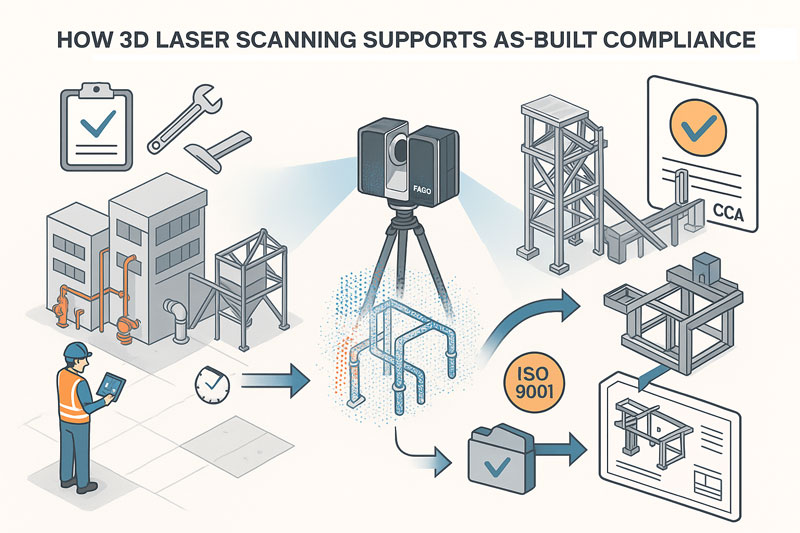
illustration of 3d scanning and building code of australia

1. What the Building Code of Australia (BCA) and Australian Standards Require

While the BCA (part of the National Construction Code – NCC) does not mandate 3D laser scanning, it does mandate that:

You must provide accurate, verifiable as-built documentation, including:

  • As-built drawings reflecting what was actually constructed
  • Evidence that construction aligns with design intent and approvals
  • Documentation for certification, compliance, commissioning and future maintenance

These requirements flow through:

  • NCC Volume 1 – Construction documentation, fire systems, mechanical services
  • AS 1100 – Technical drawing standards
  • AS 5488 – Subsurface utility information
  • AS 9001/ISO 9001 – Quality management documentation
  • State-based WHS / Plant Safety legislation
  • Engineering registration Acts (NSW, QLD, VIC)
  • Client-specific QA frameworks (e.g., TfNSW Digital Engineering, mining compliance standards, government project handover requirements)

These frameworks all emphasise accuracy, traceability, verification and record-keeping.


2. Common Problems with Traditional As-Built Documentation

Most non-compliance issues in handover packages arise because traditional methods rely on:

  • Manual tape measurements
  • Incomplete mark-ups on outdated drawings
  • Limited site access
  • Errors stacking up across multiple trades
  • No accurate record of clashes and deviations
  • No evidence trail for certifiers

This often results in:

  • Disputes between builders, certifiers and subcontractors
  • Rework costs during commissioning
  • Safety risks due to undocumented services or variations
  • Delays in obtaining Occupation Certificates (OC)

3. How 3D Laser Scanning Directly Supports Legal & BCA/NCC Compliance

✔ 3D Scanning Provides “Verified As-Constructed Evidence”

Point clouds record geometry with millimetre–level accuracy, giving:

  • Audit-proof evidence of what exists
  • Time-stamped scanning sessions
  • A defensible digital record for certifiers, engineers and auditors

This is extremely helpful for:

  • Compliance sign-off
  • Dispute resolution
  • Safety compliance
  • Future upgrades or modifications

✔ Produces Accurate As-Built Drawings That Meet AS 1100 Requirements

Laser scanning allows you to generate:

  • Certified 2D as-built drawings
  • 3D models
  • Fabrication-ready details
  • Clash-free spatial coordination drawings

This ensures:

  • Dimensions are correct
  • Penetrations, fall directions, service locations and structural offsets are true to field conditions
  • All documentation aligns with NCC-required accuracy

✔ Eliminates Measurement Errors That Could Breach Compliance

Regulators and certifiers need as-built documents to match constructed work.

Laser scanning:

  • Removes subjective tape measurements
  • Captures difficult/unsafe areas safely
  • Ensures penetrations, ductwork, pipe routes and tolerances match required clearances
  • Supports inspections under NCC (fire, structural, mechanical, accessibility, plant rooms, etc.)

✔ Simplifies BCA Documentation for Fire, Mechanical & Structural Systems

Scanning assists with validating:

Fire Safety Systems

  • Hydrants, hose reels, fire pump rooms
  • Fire damper locations
  • Egress paths and spatial compliance
  • Service penetrations

Mechanical Systems

  • Duct routes
  • Plant room layouts
  • Fan coil units / AHU placement
  • Shaft centre-lines
  • Compliant access paths

Structural Elements

  • Columns
  • Beams
  • Brackets
  • Plant mounts
  • Retrofitted steelwork
  • Tolerance checks

The point cloud provides certifiers with confidence that what was installed does not deviate from approved plans beyond allowable tolerances.


✔ Strengthens ISO 9001 & Government QA Requirements

Most government tenders (TfNSW, Defence, Health Infrastructure, QBuild, etc.) require:

  • Traceable QA
  • As-constructed verification
  • Digital documentation

A 3D scan becomes proof of measurement, improving your QA process by providing:

  • Verifiable dimensional control
  • Pre-fabrication QA
  • Handover packages that exceed minimum compliance

4. How Hamilton By Design Can Position This Service

3D Laser Scanning Enables:

  • NCC-compliant as-built documentation
  • Faster certifier approval
  • Fewer construction disputes
  • Reduced rework during commissioning
  • Better safety compliance
  • Accurate digital twins for maintenance and lifecycle management

You can state (truthfully):

“Our 3D scans provide defensible, audit-ready as-built records that satisfy NCC, engineering, and certification requirements. Certifiers appreciate the precision because it removes ambiguity and reduces approval delays.”

Hamilton By Design logo displayed on a blue tilted rectangle with a grey gradient background

Why Shutdown Parts Don’t Fit

Accuracy of 3D LiDAR Scanning With FARO

Mechanical Engineering | Structural Engineering

Mechanical Drafting | Structural Drafting
3D CAD Modelling | 3D Scanning

Chute Design

Lessons from a Landmark Case:

The Importance of Robust Structural Design Review

In 2024, SafeWork SA concluded a landmark case involving a spectator-roof collapse during a football club redevelopment project in South Australia. While no life-threatening injuries occurred, the incident highlighted how critical it is for design, review, and certification processes to work together to ensure safety on site.

This was the first successful design-related prosecution under South Australia’s Work Health and Safety Act, sending a clear signal to the engineering and construction sector: design decisions carry legal and safety obligations, not just technical ones.

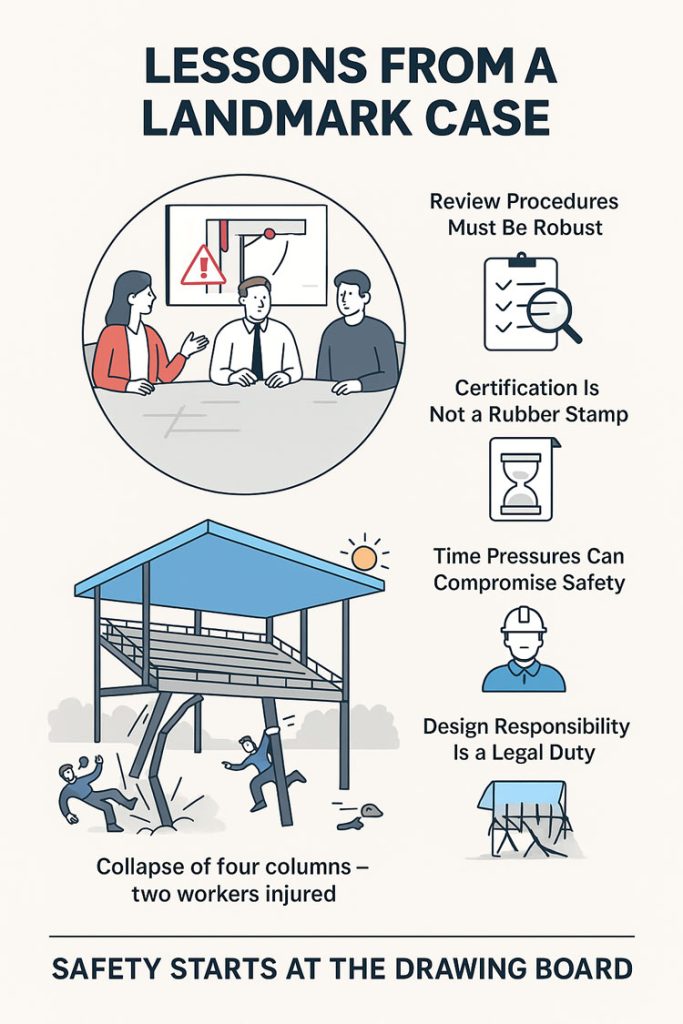
Infographic titled “Lessons from a Landmark Case,” showing engineers reviewing a design, icons highlighting robust review procedures, proper certification, time-pressure risks, and legal design responsibilities. The lower illustration depicts a structure collapsing after four column failures with two workers falling, emphasising the message “Safety starts at the drawing board

What Happened (Briefly)

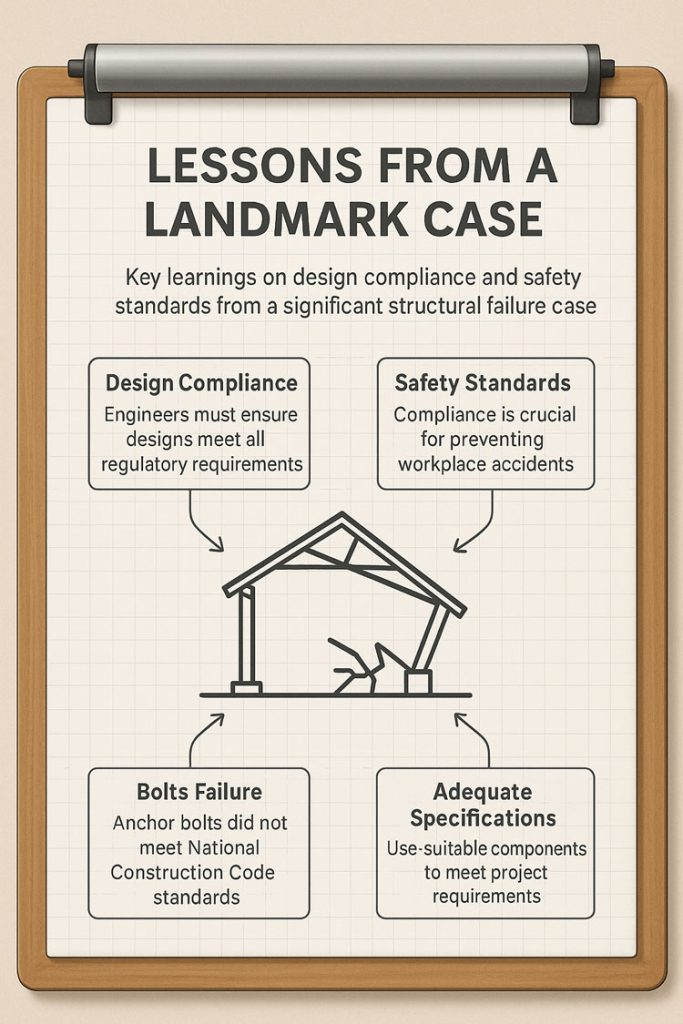
During roof sheeting works in late 2021, four of seven supporting columns of a cantilevered spectator roof failed, causing two apprentices to slide down the roof sheets. SafeWork SA’s investigation found that the anchor bolts specified for the column base plates were inadequate and did not meet the requirements of the National Construction Code (NCC).

An independent compliance review also failed to detect this issue, allowing the error to pass unchecked into construction. The result was a collapse that could have had far more severe consequences had the roof been fully loaded or occupied.

Key Learnings for the Industry

This case underscores several important lessons for engineers, designers, project managers, and certifiers:

1. Design Responsibility Is a WHS Duty

Under the WHS Act, designers have a duty to ensure their work is safe not just in its intended use, but during construction. This means bolts, connections, and base plates must be designed for real-world loads — including wind uplift, combined shear and tension, and concrete breakout limits per NCC and relevant Australian Standards.

2. Review Procedures Must Be Robust — and Followed

Having a documented review procedure is not enough if it isn’t rigorously applied. Independent verification and internal peer review are critical to catching design errors before they reach site.

3. Certification Is Not a Rubber Stamp

Independent certifiers play a key role in safeguarding public safety. They must actively verify that designs meet compliance, rather than simply sign off on documentation.

4. Time Pressures Can Compromise Safety

Compressed project timelines were noted as a factor in missed opportunities to catch the error. Project teams must resist the temptation to shortcut review steps when schedules are tight — safety must remain non-negotiable.

5. Documentation & Traceability Protect Everyone

Maintaining calculation records, checklists, and review signoffs creates a clear audit trail. This helps demonstrate due diligence if something goes wrong.

Infographic titled ‘Lessons From a Landmark Case’ displayed on a clipboard. It highlights key learnings from a structural failure case: design compliance, safety standards, bolts failure, and adequate specifications. At the centre is a simple line drawing of a collapsed structure, with arrows pointing to four labelled boxes describing the importance of regulatory compliance, workplace safety standards, anchor bolt failures, and using suitable components to meet project requirements

Why This Matters

The collapse at Angaston Football Club was a relatively small incident with minor injuries — but it could easily have been catastrophic. By learning from cases like this, the industry can improve its processes and prevent future failures.

As professionals, our role is to design for safety, verify rigorously, and document clearly. Doing so protects workers, end-users, and our own organisations.

Legal & Ethical Considerations

This post is intended as a learning resource, not as an allocation of blame. The case referenced is a matter of public record through SafeWork SA and SAET decisions, and all commentary here focuses on general principles of safe design and compliance.

We recommend that other practitioners review their own QA and certification procedures in light of this case to ensure compliance with the National Construction Code and WHS obligations.

More Information —> The Advertiser / Adelaide Now

Hamilton By Design logo displayed on a blue tilted rectangle with a grey gradient background

Mechanical Engineering | Structural Engineering

Mechanical Drafting | Structural Drafting
3D CAD Modelling | 3D Scanning

Chute Design

SolidWorks Contractors in Australia

Hamilton By Design – Blog