Why 3D Scan Your Vehicle? Automotive 3D Scanning Explained
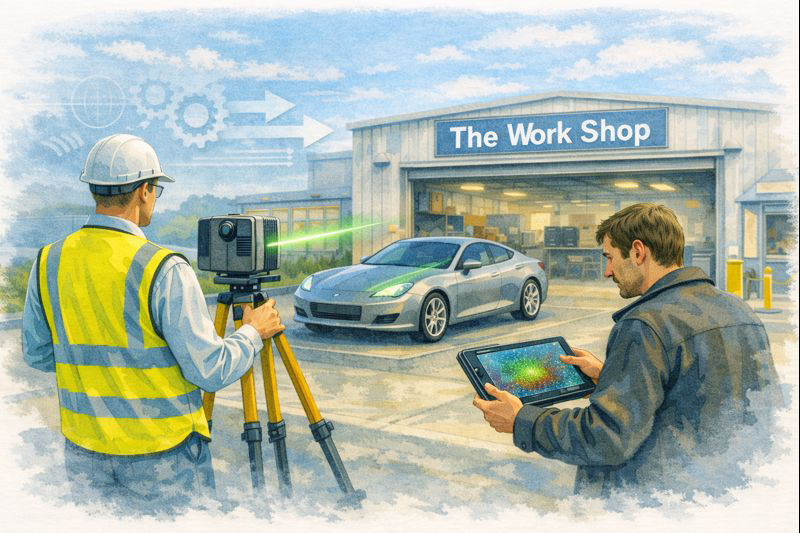
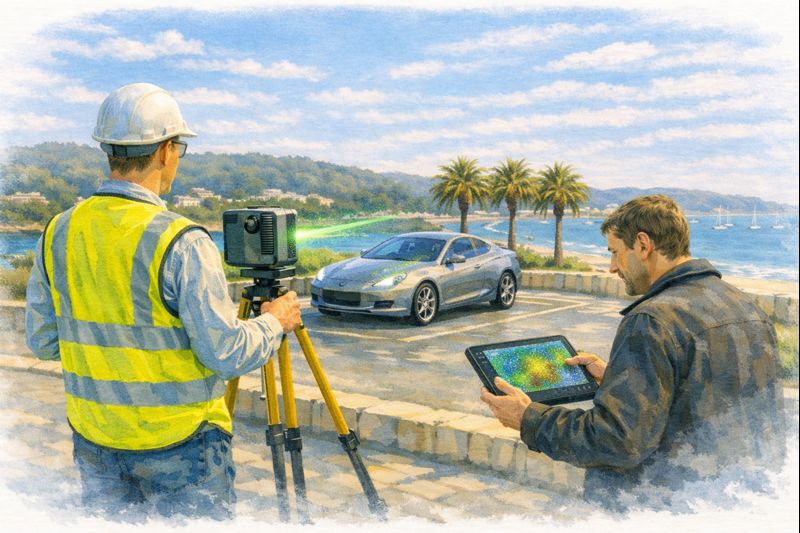
At first glance, 3D scanning a vehicle might sound like something reserved for manufacturers or motorsport teams. In reality, 3D vehicle scanning is becoming increasingly common for everyday automotive projects — from restorations and modifications to verification, documentation, and future-proofing.
So why would someone invest in 3D scanning their vehicle? The answer is simple: accuracy, confidence, and better outcomes.
Turning a Car Into Data
A vehicle 3D scan captures millions of precise measurement points across the surface of a car or its components. This data forms a highly accurate digital model — often called a point cloud — which can then be used for CAD design, analysis, and fabrication.
Unlike manual measurement, 3D scanning:
Captures complex curves and surfaces
Eliminates guesswork
Creates a permanent digital record
Once scanned, your vehicle becomes a measurable digital asset, not just a physical object.
1. Reverse Engineering Parts That No Longer Exist
One of the most common reasons people scan vehicles is to recreate parts that can’t be bought anymore.
This is especially relevant for:
Classic and vintage cars
Imported vehicles
Low-production or discontinued models
With a 3D scan, components such as panels, brackets, housings, or trims can be accurately recreated or improved — without relying on worn samples or rough measurements.
2. Custom Modifications That Fit First Time
Custom automotive work only works when parts fit exactly as intended.
People scan their vehicles to design:
Body kits, guards, and aero components
Custom exhausts and mounts
Roll cages and chassis modifications
3D scanning allows designers and fabricators to work from real vehicle geometry, significantly reducing rework, delays, and trial-and-error fitting.
3. Vehicle Restoration and Heritage Preservation
For restoration projects, 3D scanning provides a way to capture the vehicle before changes begin.
Benefits include:
Preserving original geometry
Recording factory alignment and clearances
Digitally archiving rare or historically significant vehicles
This approach is particularly valuable when restoring vehicles where originality and accuracy matter.
4. Accident Damage Assessment and Verification
Not all damage is visible to the naked eye.
After an accident, 3D scanning can:
Detect subtle deformation
Compare damaged areas against original geometry
Provide objective measurement data
This is useful for repair planning, insurance discussions, and verifying whether a vehicle has returned to its intended shape.
5. Motorsport and Performance Development
In motorsport and performance tuning, precision is everything.
Vehicles are scanned to:
Analyse body shape and aerodynamics
Design lightweight performance components
Validate compliance with regulations
3D scanning shortens development cycles and allows performance improvements to be based on measured reality, not assumptions.
6. Quality Control and Build Verification
For custom builds and low-volume manufacturing, scanning provides a way to check what was built against what was designed.
This helps:
Verify panel alignment
Confirm clearances
Identify deviations early
It’s an objective way to ensure quality and reduce risk before a vehicle is signed off or delivered.
7. Creating a Digital Twin of Your Vehicle
Some owners choose to scan their vehicle simply to create a digital twin — a complete virtual representation of the car.
A digital twin can be used for:
Future modifications
Ongoing maintenance planning
Design work without touching the car
Once created, it becomes a long-term reference that adds value over the vehicle’s lifetime.
8. Improving Collaboration Between Trades
Vehicle projects often involve multiple parties:
Owners
Engineers
Designers
Fabricators
A 3D scan ensures everyone works from the same accurate dataset, reducing miscommunication and costly mistakes.
9. Documentation, Insurance, and Peace of Mind
A 3D scan provides:
Timestamped evidence of vehicle condition
Objective, defensible measurement data
Clear documentation for high-value assets
This can be useful for insurance, resale, or engineering certification.
10. Future-Proofing Your Vehicle
Once scanned:
The vehicle never needs to be re-measured
Data can be reused indefinitely
Modifications become easier over time
Many people scan a vehicle once, then benefit from that data for years.
The Real Reason People Scan Their Vehicles
People don’t scan their vehicles because the technology looks impressive.
They scan them because it:
Saves time
Reduces risk
Improves accuracy
Leads to better decisions
In short:
3D scanning transforms a vehicle from something you measure repeatedly into something you understand completely.
Automotive 3D Scanner Technology | Vehicle & Car Laser Scanning
The automotive industry has always pushed the limits of precision. From body panels and chassis alignment to aftermarket modifications and reverse engineering, accuracy is everything. This is where the automotive 3D scanner has moved from a niche tool to an essential part of modern automotive workflows.
Whether you’re restoring classic vehicles, developing custom components, or validating manufacturing tolerances, 3D scanning of vehicles is now the fastest and most reliable way to capture real-world geometry.
Why Automotive 3D Scanning Matters
Traditional vehicle measurement methods — tape measures, calipers, and manual templates — are slow, subjective, and prone to error. In contrast, vehicle 3D scanning captures millions of data points in minutes, creating a precise digital replica of a car or component.
This digital data can be used for:
Reverse engineering parts
CAD modelling and redesign
Fitment verification
Quality control
Digital archiving of rare or legacy vehicles
For automotive professionals, accuracy is no longer optional — it’s a competitive advantage.
What Is a 3D Scanner for Automotive Applications?
A 3D scanner for automotive use is a device that captures the exact shape and dimensions of a vehicle or its components using laser or structured light technology. The result is a highly accurate point cloud or mesh that can be converted into CAD models.
Common scanner types include:
Laser-based scanners
Structured light scanners
Handheld and tripod-mounted systems
For industrial and engineering use, the car laser scanner remains the preferred option due to its accuracy, repeatability, and ability to scan reflective or complex surfaces.
Automotive Use Cases for 3D Scanning
1. 3D Scanning of Vehicle Bodies
Full 3D scanning of vehicle exteriors allows teams to:
Capture exact body geometry
Design aerodynamic add-ons
Validate panel alignment
Reproduce damaged or unavailable parts
This is particularly valuable for motorsport, restoration, and custom fabrication projects.
2. 3D Scanner for Cars in Restoration & Classic Vehicles
When original drawings no longer exist, a 3D scanner for cars becomes the only way to accurately reproduce parts.
Applications include:
Recreating discontinued components
Digitally preserving rare vehicles
Designing upgrades without altering originality
3. Automotive Laser Scanning for Manufacturing
In production and fabrication environments, laser scanner automotive systems are used to:
Verify tolerances
Compare as-built vehicles to CAD
Detect deformation or misalignment
Reduce rework and scrap
This level of insight is impossible with manual inspection alone.
Choosing the Best 3D Scanner for Automotive Work
Selecting the best 3D scanner for automotive use depends on accuracy requirements, environment, and workflow integration.
Key factors to consider:
Accuracy & resolution (sub-millimetre for engineering)
Speed of capture
Ability to scan reflective surfaces
Compatibility with CAD software
Portability for workshop or site use
For engineering-grade outcomes, tripod-mounted or hybrid systems often outperform consumer-level handheld devices.
Car Laser Scanner vs Traditional Measurement
A car laser scanner provides several advantages over conventional measurement methods:
Traditional Measurement
Automotive 3D Scanning
Manual & subjective
Objective & repeatable
Limited reference points
Millions of data points
Time-consuming
Rapid capture
Difficult to archive
Permanent digital record
This is why 3D scanning of vehicle geometry is now standard practice in high-value automotive work.
Integrating 3D Scanning Into Automotive Design
Once scanning is complete, the data feeds directly into:
CAD design
Simulation & analysis
Fitment studies
Manufacturing workflows
This scan-to-CAD process allows engineers and designers to work from reality, not assumptions.
Automotive 3D Scanning for the Future
As vehicles become more complex — electric drivetrains, lightweight materials, tighter tolerances — vehicle 3D scanning will continue to grow in importance.
Future applications include:
Digital twins of vehicles
Predictive maintenance modelling
AI-driven quality control
Automated inspection systems
What was once cutting-edge is now becoming standard practice.
Final Thoughts
An automotive 3D scanner is no longer just a tool for specialists — it’s a foundational technology for modern automotive design, fabrication, and verification.
Whether you’re selecting the best 3D scanner for automotive work, implementing laser scanner automotive systems in production, or using 3D scanning of vehicle geometry for restoration and reverse engineering, the benefits are clear:
Higher accuracy
Faster workflows
Reduced risk
Better outcomes
In an industry where millimetres matter, 3D scanning of vehicles delivers confidence — from concept to completion.
Fabrication Integrated Modelling (FIM): Why It’s the Future for Local Fabricators
Why It Is the Future for Local Fabricators
The fabrication industry is undergoing a fundamental transformation. Increasing project complexity, tighter tolerances, compressed schedules, labour shortages, and rising material costs are placing unprecedented pressure on fabricators — particularly local workshops operating in competitive markets. At the same time, clients are demanding greater certainty: certainty of fit, certainty of schedule, and certainty of cost.
Traditional fabrication workflows, built around 2D drawings and manual interpretation, are no longer sufficient to meet these expectations. They rely heavily on experience, assumptions, and rework — all of which introduce risk. In this environment, Fabrication Integrated Modelling (FIM) is emerging not as a luxury, but as a necessity.
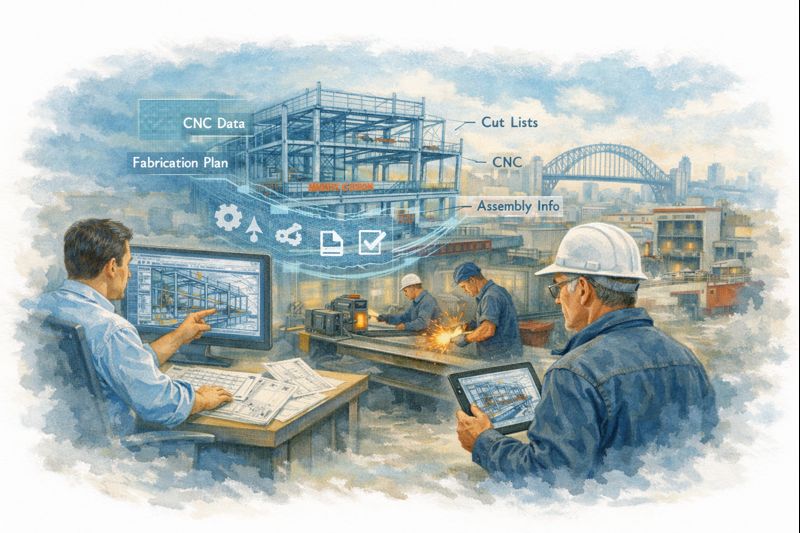
FIM represents a shift from drawing-based fabrication to model-driven fabrication, where a single, coordinated digital model governs design intent, fabrication detailing, procurement, machining, assembly, and installation. For local fabricators, this shift offers a path to higher productivity, improved margins, and long-term relevance in an evolving industry.
What Is Fabrication Integrated Modelling (FIM)?
Fabrication Integrated Modelling is a methodology where the fabrication model becomes the primary source of truth across the entire project lifecycle. Instead of treating design, drafting, fabrication, and installation as disconnected stages, FIM integrates them into a continuous digital workflow.
In an FIM environment:
Engineering intent is embedded directly into the model
Fabrication constraints are considered from the outset
Quantities, tolerances, and interfaces are defined digitally
Fabrication data flows directly to machines and shop documentation
Installation sequencing is validated before material is cut
The model is not merely a visual aid — it is a fully informed digital prototype of the fabricated asset.
From Drawings to Data: A Fundamental Shift
Historically, fabrication has relied on 2D drawings as the primary communication tool. These drawings require interpretation by drafters, trades, and supervisors, each introducing assumptions based on experience and context. While this approach has worked for decades, it becomes increasingly fragile as projects grow more complex.
Fabrication Integrated Modelling replaces interpretation with explicit data. Hole locations, weld preparations, connection details, clearances, and tolerances are all defined within the model. This reduces ambiguity and ensures that everyone — from estimator to machine operator — is working from the same information.
The result is a dramatic reduction in errors, clarifications, and rework.
Why FIM Is Gaining Momentum Now
Several industry pressures are accelerating the adoption of FIM:
Increasing complexity of industrial and infrastructure projects
Reduced tolerance for errors during shutdowns and brownfield upgrades
Labour shortages and loss of experienced trades
Higher expectations for schedule and cost certainty
Growing integration of CNC and automated fabrication equipment
FIM addresses these challenges by improving coordination, predictability, and efficiency at the source — before fabrication begins.
Key Benefits of Fabrication Integrated Modelling
Reduced Errors and Rework
Rework is one of the most significant drains on fabrication profitability. Errors discovered on the workshop floor or during installation often result in cascading impacts: delays, additional labour, material waste, and strained relationships with clients.
By resolving interfaces, clashes, and tolerances digitally, FIM enables fabricators to identify and eliminate issues before steel is cut. Assemblies are tested virtually, connections are validated, and fit-up risks are significantly reduced.
This proactive approach shifts problem-solving upstream, where changes are faster, cheaper, and less disruptive.
Improved Fabrication Efficiency and Throughput
Fabrication speed is not achieved by rushing work — it is achieved by removing uncertainty. FIM provides clarity on what needs to be fabricated, in what order, and to what tolerance.
Benefits include:
Clear fabrication sequencing
Reduced downtime waiting for clarifications
Better planning of labour and machine utilisation
More predictable workshop flow
Local fabricators using FIM often report smoother operations, fewer interruptions, and a higher percentage of “right-first-time” components.
Better Use of Skilled Labour
Skilled trades are becoming harder to find and retain. Fabrication Integrated Modelling helps maximise the value of skilled workers by giving them better information, not more guesswork.
Fitters receive assemblies that align as expected. Welders focus on quality rather than correcting geometry. Supervisors make decisions based on accurate model data rather than assumptions. Apprentices gain clarity and confidence by working from model-based instructions.
Rather than replacing experience, FIM captures and amplifies it.
Seamless Integration with CNC and Fabrication Equipment
One of the strongest advantages of FIM is its ability to connect directly with modern fabrication equipment. The same model used for coordination and verification can generate machine-ready data, including:
NC files for beam lines and plate processors
Cut lists and nesting data
Part numbers and assembly marks
Machining references
This eliminates duplication of effort and reduces the risk of transcription errors. It also shortens the time between design approval and fabrication start, improving responsiveness to project changes.
Competitive Advantage for Local Fabricators
Local fabricators often compete with offshore suppliers on price alone — a contest that is difficult to win. FIM allows local workshops to compete on value rather than cost.
Key differentiators enabled by FIM include:
Faster response to changes
Higher confidence in fit-up for complex or brownfield sites
Reduced installation risk
Stronger collaboration with engineers and constructors
When site conditions change — as they inevitably do — local fabricators using FIM can adapt quickly, update models, and deliver revised components without significant disruption. This agility is a powerful advantage over remote fabrication alternatives.
FIM in Brownfield and Upgrade Projects
Brownfield projects present some of the greatest challenges in fabrication. Existing assets rarely match legacy drawings, and tolerances are often tight. Discovering misalignment during installation can result in costly delays and extended shutdowns.
Fabrication Integrated Modelling, often combined with accurate site capture, allows fabricators to design and fabricate components that align with actual site conditions rather than assumptions.
This approach reduces:
On-site modifications
Temporary works
Installation delays
Safety risks associated with forced fit-ups
For local fabricators servicing industrial plants and operational facilities, FIM is rapidly becoming an expected capability.
Financial Benefits: Protecting Margins, Not Just Schedules
While FIM is often associated with speed and accuracy, its most important benefit may be margin protection.
Model-based workflows enable:
More accurate pricing through reliable quantities
Reduced contingency allowances
Predictable labour and machine hours
Lower material waste
Fewer disputes and variations
By increasing certainty, FIM allows fabricators to price work confidently rather than defensively. Over time, this leads to healthier margins and more sustainable operations.
Earlier Engagement and Better Project Outcomes
Fabricators who adopt FIM often find themselves involved earlier in projects. Engineers and asset owners increasingly recognise the value of fabrication input during design development.
Early collaboration enables:
Design for manufacture and assembly
Smarter connection strategies
Reduced installation complexity
Improved safety outcomes
This shifts the fabricator’s role from reactive supplier to active project partner, strengthening relationships and improving project outcomes for all parties.
Overcoming Barriers to Adoption
Adopting Fabrication Integrated Modelling requires investment — not only in software and systems, but in people and processes. Common challenges include:
Training requirements
Changes to established workflows
Initial productivity adjustments
Cultural resistance to new methods
Successful fabricators address these challenges incrementally. They start with pilot projects, focus on repeatable wins, and work closely with engineering and modelling partners to build capability over time.
The risk of maintaining outdated workflows is increasingly greater than the risk of change.
The Future of Fabrication: Integrated Digital Ecosystems
FIM is not the final destination — it is the foundation for a more connected fabrication industry. As digital maturity increases, fabrication models will increasingly link to:
Digital twins
Quality assurance records
Traceability and compliance systems
Asset management platforms
Automated inspection and verification
In this future, the fabrication model becomes a long-term asset, supporting not only construction but operation and maintenance.
Why Fabrication Integrated Modelling Is the Future for Local Fabricators
Local fabrication is not disappearing — it is evolving. Workshops that continue to rely solely on 2D drawings and manual processes will face increasing pressure from cost, risk, and competition. Those that embrace Fabrication Integrated Modelling will position themselves for long-term success.
By adopting FIM, local fabricators can:
Deliver higher quality with greater confidence
Reduce rework and wasted effort
Protect margins in competitive markets
Strengthen relationships with engineers and clients
Build resilient, future-ready businesses
Fabrication Integrated Modelling is not about replacing trades or experience. It is about supporting them with better information, clearer intent, and integrated workflows.
For local fabricators willing to invest in capability and collaboration, FIM is not just the future — it is the pathway to remaining relevant, competitive, and profitable in an increasingly digital industry.
Refineries, Heritage Buildings & Industrial Retrofits Done Right
The Inner West of Sydney is home to some of the city’s most complex refurbishment environments. From legacy refinery and industrial sites through to heritage-listed warehouses, factories, and commercial buildings, these assets were never designed with modern codes, loading requirements, or services in mind.
Yet today, they’re being asked to support:
New plant and equipment
Adaptive re-use and change of occupancy
Heavier floor loads
Updated fire, seismic, and structural standards
Modern services routing in very old structures
This is where many refurbishment projects run into trouble — not because the design is poor, but because the starting information is wrong or incomplete.
The Inner West Problem: Old Buildings, New Standards
Much of the Inner West’s industrial and heritage building stock was constructed:
Under superseded Australian Standards
With unknown material properties
Using construction methods no longer permitted
With undocumented modifications over decades of use
What often looks acceptable visually may be:
Structurally marginal under modern load cases
Locally compromised due to corrosion, settlement, or fatigue
Modified in ways that no longer match original drawings
When these issues are discovered late in the design process, the outcome is almost always the same:
Redesign
Strengthening
Programme delays
Budget escalation
Why Waiting Until “Detailed Design” Is Too Late
A common scenario we see in Inner West refurbishments:
Concept design proceeds based on legacy drawings or assumptions
Floor layouts, equipment, and architectural intent are developed
Engineering review begins
Structural checks identify:
Inadequate floor capacity
Unsupported penetrations
Changed load paths
Degraded or altered members
Design is forced to change — often significantly
At this point, the engineer isn’t blocking creativity — they’re responding to reality.
The issue isn’t engineering input. The issue is when the true condition of the structure becomes visible.
Start With a Scan: Let Designers Create With Confidence
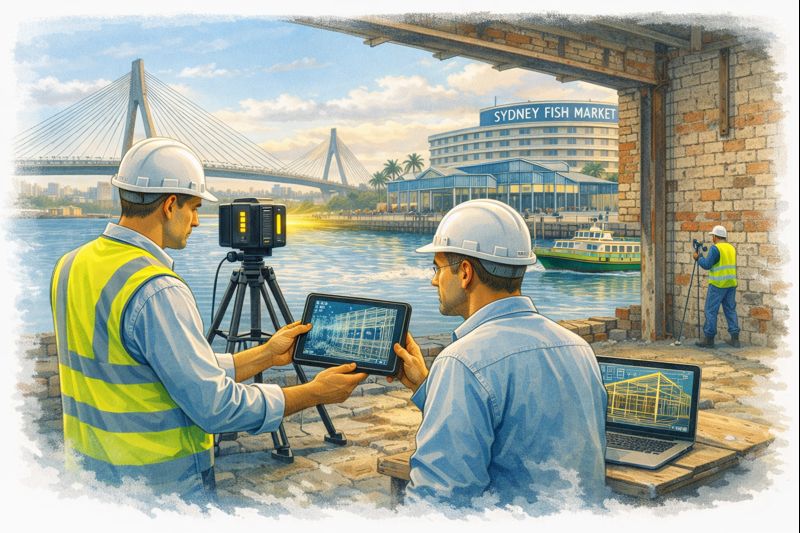
Engineering-grade 3D laser scanning at the very beginning of a refurbishment changes the entire dynamic of a project.
Instead of reacting to unknowns later, the project team starts with:
Verified geometry
True floor levels and deflection
Structural alignment and deformation
Accurate column, beam, and slab positions
Measured deviations from original drawings
This gives architects and designers something powerful:
Freedom to design within known constraints — not guessed ones.
Heritage & Industrial Retrofits: Why Scanning Matters Even More
Heritage Buildings
Heritage structures often prohibit invasive investigation early on. 3D scanning allows:
Non-intrusive verification of geometry
Identification of movement or deformation
Assessment of tolerance drift over time
Planning of sympathetic strengthening solutions
Refineries & Legacy Industrial Sites
Inner West refinery and process facilities bring additional challenges:
Tight access
Live plant interfaces
Safety-critical environments
Brownfield congestion
Scanning provides:
Safe remote measurement
Clash-free retrofit design
Confidence before shutdowns
Reduced rework during construction
When Standards Change, Reality Matters
One of the most common late-stage surprises in refurbishments is floor capacity.
Buildings that performed adequately for decades may no longer comply with:
Current live load requirements
Change-of-use provisions
Equipment point loads
Modern safety factors
Without accurate structural geometry and context, engineers are forced to:
Assume worst-case scenarios
Over-design strengthening
Restrict layouts unnecessarily
Early scanning supports informed engineering judgement, often resulting in:
Targeted strengthening instead of blanket solutions
Retention of original fabric where possible
Reduced material and construction costs
From Point Cloud to Engineering Decisions
At Hamilton By Design, scanning is not a standalone service — it’s an engineering tool.
Our process typically supports:
Structural verification of existing buildings
Floor flatness, level, and deflection assessment
Alignment checks of columns and frames
Scan-to-CAD models for design integration
Fit-for-purpose information for refurbishment decisions
This is especially critical in Inner West projects, where:
Every millimetre matters
Access is limited
Heritage considerations are real
Late changes are costly
Design With Knowledge, Not Surprises
Refurbishments don’t fail because buildings are old. They fail because assumptions survive too long.
By starting with an engineering-led scan:
Designers get space to create
Engineers get data they can trust
Asset owners avoid late-stage shocks
Projects move forward with confidence
If you’re planning a refinery upgrade, heritage refurbishment, or adaptive re-use project in Inner West Sydney, the smartest decision you can make is to scan first — before concept becomes constraint.
Thinking about a refurbishment or retrofit in the Inner West?
Engineering-grade 3D scanning at the start gives your project clarity, confidence, and creative freedom — not limitations.
3D Scanning Meets SolidWorks AI: AURA & Automated Drawings
If you’ve spent any time in SolidWorks, you know the truth: the real work doesn’t start at modelling — it starts at documentation. Drawings, dimensions, revisions, and change control are where hours disappear.
That’s exactly where AURA — the AI Virtual Assistant inside 3DEXPERIENCE platform and SolidWorks Connected is quietly changing the game — especially when it’s paired with engineering-grade 3D scanning and LiDAR data.
For engineers, asset owners, and project teams working in brownfield or live environments, this combination is moving work from painful to almost effortless.
What Is AURA in SolidWorks?
AURA is the AI assistant embedded into the 3DEXPERIENCE ecosystem. It’s not a chatbot bolted on the side — it’s context-aware AI that understands what you’re doing inside SolidWorks and helps automate repetitive, high-friction tasks.
AURA is already leading the way in:
Automated drawing creation
Intelligent dimension and view suggestions
Faster annotation and documentation workflows
Reduced manual clean-up during revisions
In short, AURA reduces the time between a finished model and a usable drawing set.
Why 3D Scanning Changes Everything
On its own, AI automation is powerful. But when you feed it accurate real-world geometry from 3D scanning, it becomes transformational.
Traditional Workflow (The Old Pain)
Manual site measurement
Assumptions about what’s “square” or “level”
Rework when drawings hit site reality
Revisions, RFIs, delays
Modern Workflow with 3D Scanning + AURA
Site captured with 3D LiDAR scanning
Dense, accurate point clouds imported into SolidWorks
Models built from reality, not assumptions
AURA automates drawing views, dimensions, and documentation
Faster sign-off, fewer clashes, less rework
This is where 3D scanning stops being “nice to have” and becomes mission-critical.
Automated Drawings Built on Reality
When point cloud data drives the model, AURA has something incredibly valuable to work with: truth.
That means:
Drawings reflect as-built conditions, not legacy CAD
Dimensions align with real geometry
Hidden clashes are identified earlier
Fabrication drawings match site conditions the first time
For shutdowns, upgrades, and brownfield projects, this is huge.
The result: 👉 Fewer site variations 👉 Fewer fabrication surprises 👉 Faster approvals 👉 Lower project risk
Why Engineers Are Leaning Into AI + 3D Scanning
Once teams experience this workflow, it’s hard to go back.
Engineers quickly notice:
Drawing creation time drops dramatically
Less mental load managing repetitive documentation
More time spent on engineering decisions, not drafting chores
Greater confidence that drawings reflect reality
When 3D scanning feeds SolidWorks and AURA handles the busywork, engineering becomes cleaner, calmer, and far more predictable.
Where Hamilton By Design Fits In
At Hamilton By Design, we sit at the intersection of:
Engineering-led 3D scanning
Point cloud to SolidWorks modelling
Real-world industrial and building services projects
Practical deployment of AI-enabled workflows
We don’t just scan — we engineer with the data.
That means:
LiDAR scans captured with downstream modelling in mind
Clean, structured point clouds optimised for SolidWorks
Models built to support AURA-driven automated drawings
Outputs that fabrication teams and contractors can actually use
The Rise of the “AURA + LiDAR Consultant”
This is a new role emerging in modern engineering teams: someone who understands 3D scanning, SolidWorks, and how AI like AURA fits into real project delivery.
That’s exactly the conversation we’re having every day.
If you’re:
Struggling with drawing production time
Managing upgrades in complex existing facilities
Tired of site conditions not matching drawings
Curious how AI and 3D scanning actually work together (not just in marketing slides)
👉 Check in at www.hamiltonbydesign.com.au We’re always happy to chat with you as your AURA + LiDAR consultant.
Final Thought: This Isn’t the Future — It’s Already Here
AI-assisted design isn’t replacing engineers. It’s removing the friction that slows good engineers down.
When AURA automates drawing creation and 3D scanning ensures models are grounded in reality, the result is simple:
✔ Better drawings ✔ Faster delivery ✔ Fewer surprises ✔ More time spent engineering
And once you work this way, there’s no going back.
AS 1100 & LiDAR Scanning: Compliant Engineering Drawings from Point Clouds
If you’ve ever tried to update old plant drawings, verify a brownfield tie-in, or issue “as-built” documentation after a shutdown, you’ll know the pain: the site never matches the drawings, access is limited, and the smallest dimensional miss can cascade into rework, clashes, and schedule blowouts.
That’s where engineering-grade LiDAR scanning and AS 1100 (the Australian Standard for technical drawing) make a powerful combination. LiDAR gives you truth data (reality capture), and AS 1100 gives you a shared language for turning that truth into clear, consistent, contract-ready documentation.
AS 1100 standardises the way we communicate engineering information through drawings: layout, line types, projection methods, dimensioning rules, tolerancing conventions, symbols, notes, and drawing presentation.
In practice, AS 1100 helps you answer questions like:
Which edges are visible vs hidden? (line conventions)
How are views arranged and interpreted? (projection and view layout)
How do we dimension so the fabricator can’t misread it? (dimensioning rules)
How do we document what matters vs what’s “reference only”? (notes and drawing hierarchy)
How do we keep drawing sets consistent across multiple contributors? (formatting + standards)
That consistency is exactly what’s needed after a scan—because point clouds are rich, but they’re not automatically “communicable” in the way a compliant drawing set is.
What LiDAR scanning adds that drawings alone can’t
A LiDAR scanner captures millions (often billions) of spatial points that represent real surfaces—steel, concrete, pipe, equipment, structure—creating a point cloud that can be registered into a unified coordinate system.
In the engineering context, the big advantages are:
Speed: capture complex geometry quickly, often with minimal disruption
Coverage: see what’s hard to measure with tape/total station (overhead services, congested pipe racks, odd geometry)
Context: capture “everything,” not just what someone remembered to measure
Traceability: you can always “go back” to the scan for verification and queries
Clash prevention: scan-to-CAD makes it far easier to design upgrades that actually fit
But here’s the key: a point cloud isn’t a deliverable most trades can fabricate from directly. That’s why AS 1100 becomes the bridge between capture and construction.
The combined workflow: Point cloud → model → AS 1100 drawings
1) Capture the site as it really is
We scan the area of interest and register scans into a coordinated dataset. This becomes the base truth for everything that follows. If the project is shutdown-driven, we plan scanning around access windows and risk controls (often capturing adjacent tie-in zones too, because “nearby” services are where surprises live).
2) Establish intent: “What are we delivering?”
Not every project needs the same output. Typical outcomes include:
As-built drawings for existing assets
As-found models to support new design work
Dimensional verification for fit-up and prefabrication
Digital QA against design intent (scan-vs-model comparison)
3) Convert scan data into engineering geometry (as much as needed)
Sometimes the best output is a controlled 3D model (plant layout, pipe spools, structural members). Other times the project is best served by 2D drawings extracted from a model.
We’ll typically create:
key datums and grids
primary steel / structure
equipment envelopes and critical interfaces
piping runs and connection points (where relevant)
floor levels, platforms, access constraints, clearance zones
4) Document to AS 1100 so the drawing set is unambiguous
This is where AS 1100 shines. We turn geometry into drawings that read cleanly and consistently across teams.
drawing borders, title blocks, revision control, and drawing register discipline
In short: LiDAR gives accuracy, AS 1100 gives clarity.
Where AS 1100 + LiDAR scanning delivers immediate value
Brownfield upgrades and tie-ins
Tie-ins fail when the “as-built” condition is wrong. A scan gives you real geometry; AS 1100 drawings package it so designers, fabricators, and installers share the same reference. This is especially useful when multiple contractors are interfacing.
Fabrication and spool accuracy
If you’re fabricating offsite (pipe spools, platform steel, handrail sections, ducting), you need dependable dimensions and an agreed drawing language. Scan-derived models support accuracy; AS 1100 drawings support fabrication interpretation and QA sign-off.
Shutdown planning and constructability
A point cloud is a brilliant planning tool—access routes, crane clearances, removal paths, temporary works, and “what’s in the way.” But shutdown packages still need compliant drawings for permits, isolations, install workpacks, and handover packs. AS 1100 keeps those packages readable and defensible.
Verification and “what changed?”
Sites evolve. A scan provides a timestamped snapshot. Drawings updated to AS 1100 become the controlled record: what was there, what was installed, and what the current state is. That matters for maintenance, safety, and future projects.
Practical example: Turning a congested pipe rack into a buildable upgrade
Imagine you’re adding a new line through an existing pipe rack:
Scan the rack to capture all existing services, supports, cable trays, and steel
Model critical geometry (existing plus proposed) to check routing and supports
Clash check before fabrication begins
Issue AS 1100 drawings for:
support details
spool isometrics (if applicable)
arrangement drawings showing tie-in locations
sections through congestion zones
installation notes and tolerances where appropriate
Verify post-install with a follow-up scan if required for QA/closeout
That’s the “work together” part: the scan stops guesswork, and AS 1100 stops misinterpretation.
Common mistakes when scanning isn’t tied back to AS 1100
Delivering point clouds without a drawing strategy (stakeholders can’t use them effectively)
Over-modelling everything (time is spent modelling non-critical items instead of delivering useful documentation)
Unclear dimensioning (scan accuracy is wasted if dimensions are presented ambiguously)
No controlled datums (people argue about “where zero is” and models drift between disciplines)
Weak revision control (the drawing set becomes untrustworthy fast)
A standards-led drawing approach prevents most of these.
How we approach it at Hamilton By Design
Our angle is simple: engineering-led scanning—not scanning for its own sake.
We capture reality with LiDAR.
We translate it into the level of model detail the project actually needs.
We document outputs with the discipline and consistency expected in Australian engineering environments.
Closing thought: accuracy is only valuable if it’s understandable
LiDAR scanning can deliver millimetre-grade spatial truth. But in real projects, truth still has to travel through people—engineers, drafters, fabricators, installers, supervisors, and asset owners.
AS 1100 makes that truth readable. LiDAR makes it reliable.
Together, they turn messy real-world geometry into clear, controlled documentation that supports safer installs, faster shutdowns, and fewer surprises.
To provide the best experiences, we use technologies like cookies to store and/or access device information. Consenting to these technologies will allow us to process data such as browsing behaviour or unique IDs on this site. Not consenting or withdrawing consent, may adversely affect certain features and functions.
Functional
Always active
The technical storage or access is strictly necessary for the legitimate purpose of enabling the use of a specific service explicitly requested by the subscriber or user, or for the sole purpose of carrying out the transmission of a communication over an electronic communications network.
Preferences
The technical storage or access is necessary for the legitimate purpose of storing preferences that are not requested by the subscriber or user.
Statistics
The technical storage or access that is used exclusively for statistical purposes.The technical storage or access that is used exclusively for anonymous statistical purposes. Without a subpoena, voluntary compliance on the part of your Internet Service Provider, or additional records from a third party, information stored or retrieved for this purpose alone cannot usually be used to identify you.
Marketing
The technical storage or access is required to create user profiles to send advertising, or to track the user on a website or across several websites for similar marketing purposes.