


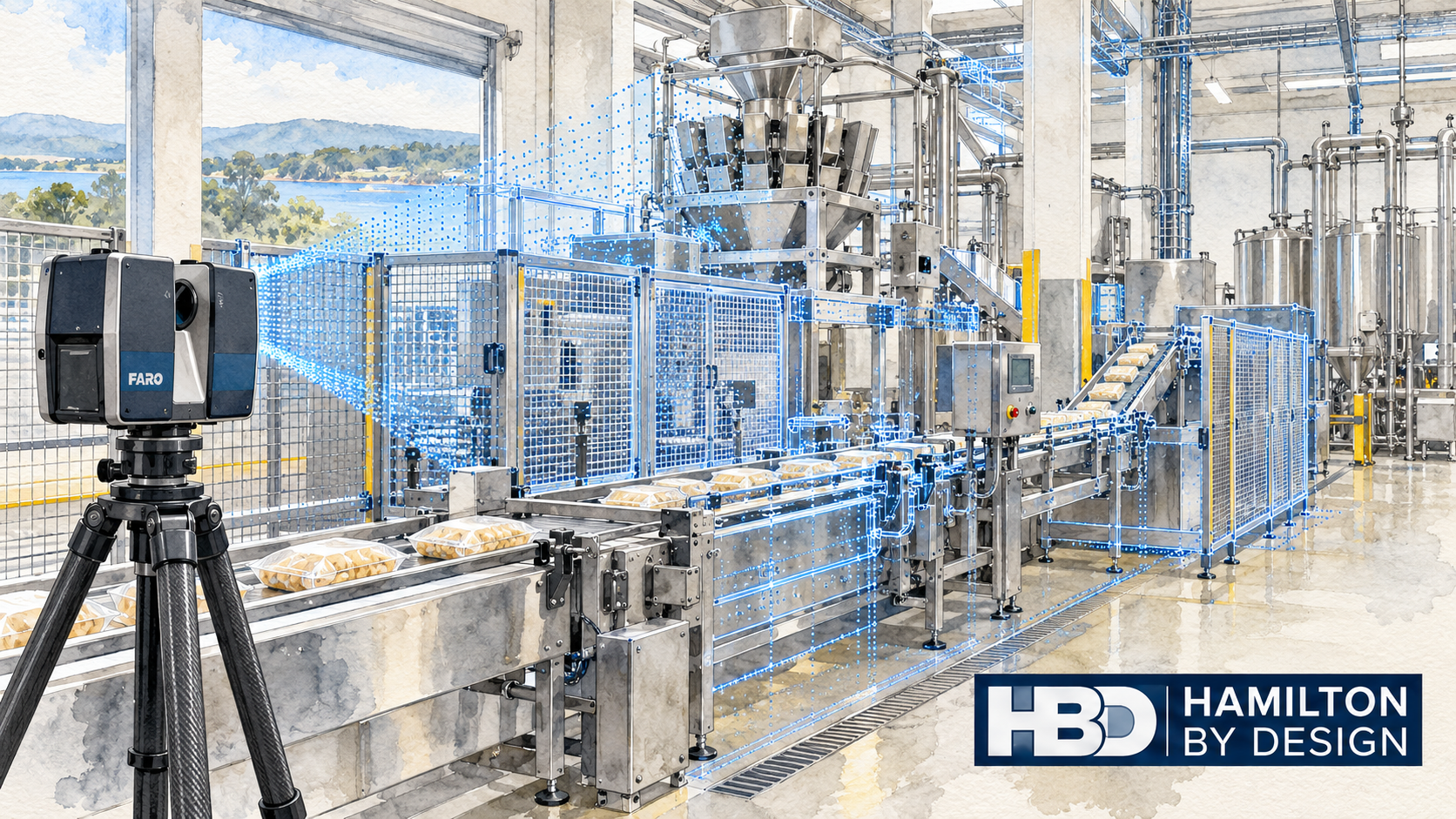
Food Manufacturing Engineering and 3D Scanning in Berkeley Vale
Berkeley Vale has an industrial identity that is not always apparent to people from outside the Central Coast. Although the suburb is commonly associated with residential neighbourhoods and its position near Tuggerah Lake, it also supports significant food processing, packaged-goods manufacturing, engineering, packaging and industrial operations.
The presence of major manufacturers, including Sanitarium Health Food Company, has given Berkeley Vale a long-established connection with Australian food production. The surrounding industrial precincts near Enterprise Drive, Corella Close and Hereford Street further support contract manufacturing, packaging, precision machining, equipment maintenance and associated services.
For local manufacturers, the challenge is not simply to install new machinery. New equipment must operate safely and efficiently within existing factories where floor space, access, services and production shutdowns are tightly controlled.
Hamilton By Design provides food manufacturing engineering in Berkeley Vale, including production-line scanning, machine-interface measurement, machine-guarding documentation, 3D modelling and plant-modification drafting. Our objective is to give manufacturers accurate information about their existing plant before new equipment is designed, fabricated or installed.
Berkeley Vale’s Place in Central Coast Manufacturing
Berkeley Vale forms part of a broader Central Coast manufacturing network that includes Wyong, Tuggerah, Ourimbah, Lisarow, Somersby and Gosford. These locations collectively support food and beverage production, packaged goods, warehousing, machinery manufacture, fabrication and industrial maintenance.
Berkeley Vale is particularly important because it combines established production facilities with access to Wyong Road, Tuggerah and the M1 Pacific Motorway. This provides practical connections to Sydney, Newcastle and regional New South Wales.
The area also benefits from an established industrial workforce and a network of local trades, fabricators, engineering businesses and equipment suppliers. These capabilities help manufacturers maintain existing production assets while introducing new technology and increasing output.
Hamilton By Design is based in Wyong and provides engineering and 3D scanning services across the NSW Central Coast. Our local position allows us to support Berkeley Vale manufacturers without the mobilisation requirements normally associated with bringing a specialist team from Sydney or interstate.
Why Established Food Factories Are Difficult to Modify
Many food-manufacturing facilities have developed progressively rather than being built as a single, fully coordinated system. A production line may contain machinery installed at different times by different suppliers. Conveyors may have been extended, guarding altered, services rerouted and access arrangements changed to meet evolving production requirements.
As a result, the original factory drawings may no longer represent what is physically present.
This creates uncertainty when planning a new machine, replacing a conveyor, modifying guarding or rearranging part of a production line. A relatively small dimensional error can affect several connected systems, including:
- Conveyor centre-lines and transfer heights
- Equipment infeed and discharge positions
- Guarding clearances
- Operator and maintenance access
- Pipework and electrical services
- Floor penetrations and mounting points
- Structural supports and platforms
- Product flow through the production line
Traditional manual measurement can be adequate for simple installations. However, it becomes less dependable when the project involves crowded machinery, irregular geometry or several connected interfaces.
A 3D scan captures the visible production environment as a coordinated spatial record. This gives the project team a reliable basis for design instead of requiring critical decisions to be made from outdated drawings, isolated measurements or assumptions.
Production-Line Scanning in Berkeley Vale
Production-line scanning involves capturing the existing factory environment using terrestrial LiDAR equipment. The scanner records millions of measured points representing machinery, floors, walls, columns, conveyors, platforms, services and other visible features.
The captured scans are registered to create a coordinated three-dimensional point cloud. This point cloud can then be reviewed, measured and used as the foundation for CAD models and modification drawings.
Hamilton By Design provides 3D laser scanning on the Central Coast for manufacturers, asset owners, project engineers and fabricators. Depending on the project requirements, the resulting information can support:
- Existing equipment layouts
- Production-line modification planning
- Machine replacement projects
- Conveyor extensions and alterations
- Guarding surveys
- Access and clearance reviews
- Fabrication measurements
- Installation planning
- As-built documentation
- Future factory-layout development
The purpose of scanning is not to produce data for its own sake. The value comes from converting the captured geometry into information that can be used to make engineering, fabrication and installation decisions.
Converting Point Clouds into Usable Engineering Information
A point cloud provides a detailed record of the visible factory, but most manufacturers and fabricators ultimately require CAD information or drawings.
Hamilton By Design can use the registered scan data to produce:
- Two-dimensional factory layouts
- Production-line plans and elevations
- Three-dimensional equipment envelopes
- SolidWorks assemblies
- Machine-interface models
- Guarding layouts
- Modification drawings
- Fabrication geometry
- Clearance and clash-review models
- Existing-condition documentation
Our Central Coast scan-to-CAD service focuses on converting measured site conditions into practical engineering information.
The appropriate level of modelling depends on the project. A preliminary factory-layout study may only require simplified equipment envelopes. A replacement conveyor or guarding project may require much more detailed geometry around connection points, mounting surfaces and operating clearances.
Defining the required deliverable before modelling begins helps avoid unnecessary work while ensuring the project team receives the information needed to make reliable decisions.
Measuring Machine Interfaces
Machine interfaces are among the most important and frequently underestimated parts of a brownfield production-line project.
A new machine does not operate independently. It must connect with the equipment around it and accommodate the physical conditions of the factory. Important interfaces can include:
- Conveyor transfer points
- Product entry and discharge elevations
- Chute geometry
- Floor mounting locations
- Existing bolt patterns
- Operator positions
- Maintenance withdrawal space
- Guard openings
- Electrical cabinet access
- Pipework connections
- Washdown access
- Cleaning clearances
If one interface is measured incorrectly, the consequences can extend beyond the new machine. The error may affect product transfer, guarding, access, commissioning and production reliability.
Three-dimensional scanning captures these relationships within a common coordinate system. Designers can then assess the proposed equipment against the actual production environment rather than treating each measurement as an isolated dimension.
Machine Guarding for Food-Processing Equipment
Machine guarding is particularly important in food-manufacturing facilities because production lines often contain conveyors, rollers, drives, shafts, chain systems, filling equipment, packaging machines and automated transfer points.
Changes made to production equipment can introduce new access points or alter the relationship between workers and moving machinery. Existing guarding may also become unsuitable after equipment is moved, replaced or reconfigured.
Hamilton By Design can assist with guarding surveys, 3D modelling and detailed drafting for review by the manufacturer and relevant safety stakeholders. This may include:
- Recording existing guards and machinery
- Identifying equipment interfaces
- Modelling proposed guard panels and frames
- Preparing general arrangements
- Producing component and fabrication drawings
- Documenting mounting arrangements
- Coordinating maintenance access
- Supporting design reviews against the nominated requirements
Our work is focused on mechanical design and drafting. Where a project requires formal structural certification, specialist risk assessment or another regulated professional service, the appropriate qualified party should be engaged.
Accurate scanning is particularly valuable where guarding must fit around existing machinery, services and support structures. It allows the proposed arrangement to be reviewed digitally before materials are cut or work begins inside the production area.
Plant Modification and Engineering Drafting
Plant modifications are often treated as small projects, but they can involve significant technical and operational risk. A short conveyor extension, guard alteration or equipment relocation may affect production flow, cleaning access, worker movement and surrounding services.
Hamilton By Design provides engineering drafting services on the Central Coast for plant modifications, machinery layouts and fabrication projects.
A typical Berkeley Vale manufacturing project may follow this process:
- Define the operational problem and required outcome.
- Review available drawings and equipment information.
- Scan the relevant factory or production-line area.
- Register and review the point-cloud data.
- Model the existing equipment and critical interfaces.
- Develop the proposed modification.
- Review the arrangement with operations, maintenance and safety personnel.
- Prepare drawings for approval or fabrication.
- Support installation and verify critical dimensions where required.
This process creates a traceable connection between the existing factory, the proposed design and the final documentation.
Supporting Factory Upgrades Without Unnecessary Disruption
Production availability is central to food manufacturing. Access for measurement may need to occur during cleaning periods, maintenance windows, weekends or planned shutdowns.
A well-planned scan can capture a large amount of spatial information during a relatively short site visit. Once the required areas have been captured, much of the measurement, modelling and drafting work can continue away from the production floor.
This can reduce:
- Repeated entry into controlled production areas
- Dependence on individual manual measurements
- Disruption to operators and maintenance teams
- Return visits to confirm missing dimensions
- Uncertainty during fabrication
- Installation changes during a shutdown
Scanning does not eliminate the need for engineering review or physical verification of hidden conditions. However, it can significantly improve the completeness and reliability of the visible existing-condition information.
Local Engineering Support from Wyong
Hamilton By Design’s Central Coast base provides a practical advantage for Berkeley Vale clients. We can attend the site, discuss the problem with the people who operate and maintain the equipment, and define the scanning and drafting scope around the actual project requirements.
Our nearby 3D engineering scanning service in Wyong supports industrial and brownfield projects throughout the northern Central Coast.
We also work with manufacturers and factories in other established industrial areas, including Somersby factory engineering and 3D scanning. This broader regional experience is relevant because Central Coast manufacturers frequently share equipment suppliers, fabricators, contractors and logistical requirements.
The benefit of local support is not simply shorter travel. It provides greater flexibility when access must be coordinated around production, when the scope needs to be reviewed on site or when a critical interface requires confirmation.
Engineering Data for Future Plant Decisions
A registered point cloud can become more than a record for one immediate modification. Subject to the agreed scope, confidentiality requirements and retention arrangements, the information can provide a foundation for future factory planning.
Hamilton By Design can develop and retain project information such as:
- Production-line point clouds
- Equipment layouts
- Guarding surveys
- Machine-interface measurements
- CAD assemblies
- Plant-modification drawings
- Design-review records
- Revision-controlled project documentation
The usefulness of this information increases when it is managed consistently. Future projects can begin with an established spatial reference rather than restarting the measurement process every time an equipment change is considered.
However, the point cloud must also be treated as a dated record. Factories continue to change, and the project team should confirm whether subsequent modifications have occurred before relying on earlier scan data.
Opportunities for Berkeley Vale Manufacturers
Berkeley Vale’s established manufacturing base creates several opportunities for engineering-led digital capture.
Manufacturers can use production-line scanning to prepare for machinery replacement, improve guarding, document undocumented equipment and plan layout changes. Equipment suppliers can use scan data to understand the available installation space before developing a proposal. Fabricators can receive more reliable tie-in geometry, while maintenance teams can use coordinated layouts to prepare shutdown work.
The strongest applications are generally those where:
- The existing drawings are incomplete or outdated.
- New components must fit existing equipment.
- Production shutdown time is expensive.
- Manual measurement is difficult or unsafe.
- Several contractors must coordinate within the same space.
- A failed installation would cause substantial disruption.
- The factory needs an accurate digital record before modification.
In these situations, scanning should be viewed as a project risk-control measure rather than simply another surveying cost.
Frequently Asked Questions
Who can scan a production line on the Central Coast?
Hamilton By Design provides engineering-led production-line scanning from its Wyong base. We support manufacturers in Berkeley Vale, Tuggerah, Wyong, Somersby, Gosford and other Central Coast industrial areas.
Can a production line be scanned while the factory is operating?
It may be possible, depending on the machinery, site controls and required information. Moving equipment and personnel can affect the quality of some captured surfaces, so access is normally planned with the client. Critical areas may be captured during a shutdown, cleaning period or controlled production window.
What can be produced from a factory scan?
Deliverables can include registered point clouds, equipment layouts, two-dimensional plans, elevations, three-dimensional CAD models, SolidWorks assemblies, guarding layouts and modification drawings. The correct deliverable depends on what the client needs to design, review, fabricate or install.
Can 3D scanning replace engineering drawings?
The scan records the visible physical environment, but it does not automatically become an engineering drawing. The point cloud must be interpreted and converted into the appropriate CAD model or drawing for the project.
Can Hamilton By Design design machine guarding?
Hamilton By Design can assist with guarding surveys, mechanical design, 3D modelling and fabrication drawings. The required safety review, risk assessment and approval responsibilities should be defined with the client at the beginning of the project.
Does LiDAR capture equipment hidden behind guards or machinery?
No. LiDAR records visible surfaces. Hidden components, internal details and obstructed areas may require additional access, equipment information, manual measurement or a separate inspection.
How accurate is production-line scanning?
Accuracy depends on scanner position, distance, surface condition, visibility and registration requirements. Hamilton By Design defines the required level of accuracy according to the intended outcome rather than applying one general tolerance to every project.
Can scan data be used for future factory modifications?
Yes, provided the relevant part of the factory has not changed and the original scan is suitable for the new purpose. Where modifications have occurred, supplementary scanning may be required.
Is production-line scanning disruptive?
Scanning is generally less disruptive than extensive manual measurement because a large amount of visible geometry can be captured during a planned access period. Site arrangements still need to account for food-safety procedures, machinery movement, cleaning and personnel access.
What information is needed to request a proposal?
Useful information includes the project objective, approximate size of the production area, required deliverables, available drawings, preferred access times, shutdown restrictions and the machinery or interfaces requiring detailed measurement.
Discuss a Berkeley Vale Manufacturing Project
Hamilton By Design provides food manufacturing engineering, production-line scanning, machine-guarding documentation and plant-modification drafting in Berkeley Vale and throughout the Central Coast.
Whether the project involves replacing one machine, modifying a conveyor, developing new guarding or documenting an entire production area, the first step is to establish what information is required and how it will be used.
Contact Hamilton By Design to discuss your Berkeley Vale factory project, arrange a site review or request a proposal for production-line scanning and engineering documentation.

Contact Us – Talk To Us
Our clients:
























