


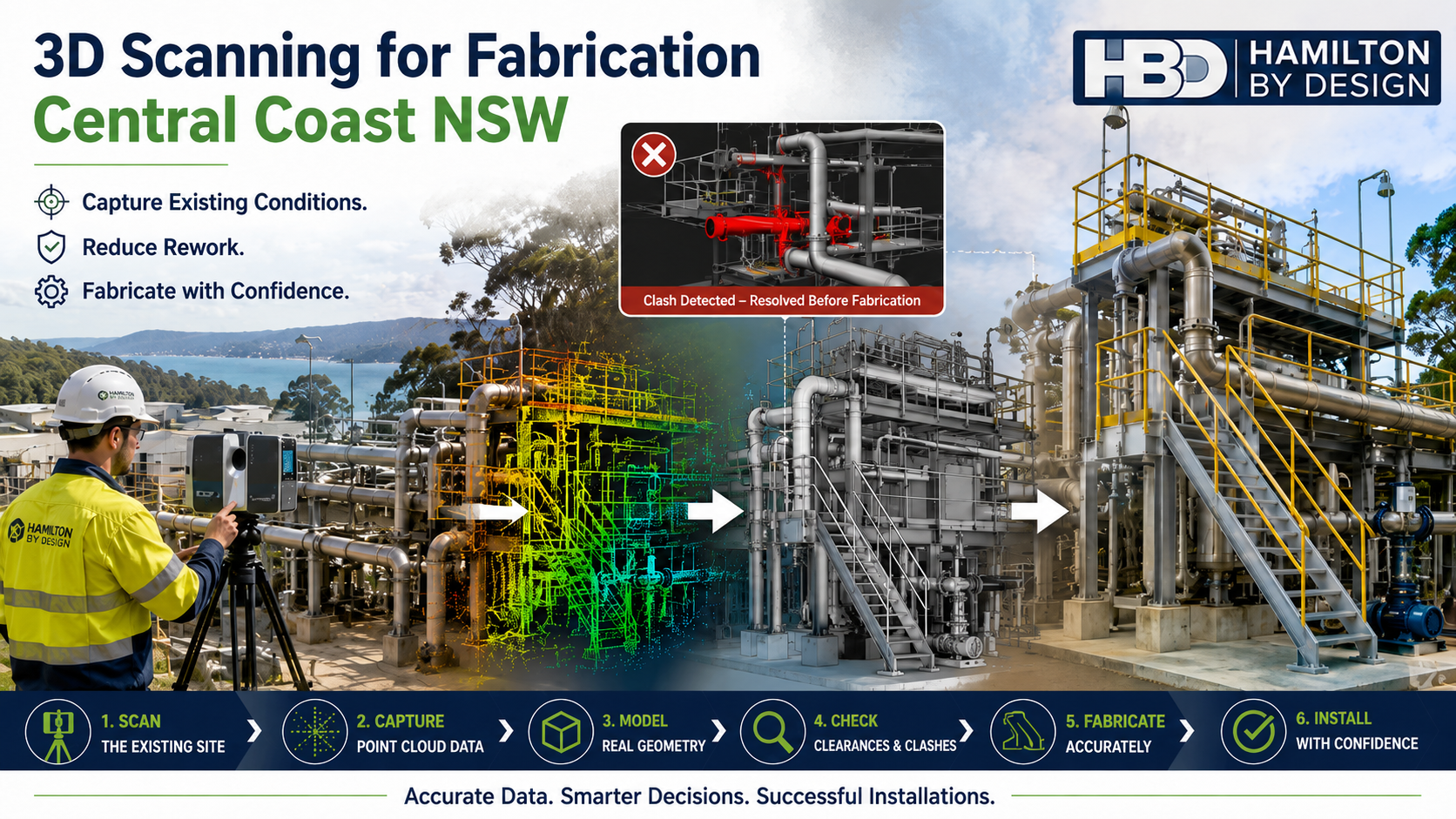
Engineering-Led 3D Scanning for Fabrication, Fit-Up and Site Verification on the Central Coast NSW
Fabrication problems become expensive when they are discovered too late.
A pipe spool does not line up with an existing flange.
A fabricated platform clashes with pipework or structural steel.
A replacement guard cannot be installed around the existing equipment.
A chute, hopper or machine frame does not fit the available site envelope.
A shutdown is delayed because the fabricated component needs cutting, welding or modification on site.
Hamilton By Design provides 3D scanning for fabrication across the Central Coast NSW, helping fabricators, engineers, project managers, maintenance teams and asset owners capture accurate site information before fabrication begins.
Using LiDAR scanning, registered point clouds and CAD modelling, we turn real site conditions into practical engineering information for:
- Fabrication planning
- Scan-to-CAD modelling
- Fit-up verification
- Structural and mechanical design
- Pipework and spool detailing
- Clash review
- Installation planning
- As-built documentation
The objective is straightforward: find dimensional and spatial problems before steel, pipework or mechanical components are manufactured.
This Central Coast service page supports our national 3D Scanning for Fabrication service.
Why Central Coast Fabrication Projects Benefit from 3D Scanning
Fabrication projects across the Central Coast support manufacturing plants, food and beverage facilities, fabrication workshops, water infrastructure, pump stations, industrial estates, quarries, marine facilities, commercial buildings and council assets.
Many of these projects involve existing or brownfield sites where:
- Original drawings are unavailable
- Drawings no longer match the actual site
- Machinery has been replaced or relocated
- Pipework has been modified over time
- Structural steel is not square or level
- Access around the equipment is restricted
- Shutdown or installation time is limited
- New fabricated components must connect to older assets
These conditions create risk when new components must fit around or connect to existing:
- Structural steel
- Pipework
- Pumps and valves
- Conveyors
- Platforms and walkways
- Tanks and vessels
- Machine frames
- Guards and covers
- Ductwork
- Building services
- Concrete structures
- Existing production equipment
3D scanning helps reduce this risk by capturing the existing geometry before fabrication starts.
Instead of relying only on tape measurements, photographs, sketches or unverified drawings, the fabrication team can use a registered point cloud, CAD model or engineering drawing based on the actual site.
Locally Based Central Coast 3D Scanning Support
Hamilton By Design is based on the NSW Central Coast and can support projects across:
- Wyong
- Tuggerah
- Berkeley Vale
- Somersby
- West Gosford
- Lisarow
- Erina
- Charmhaven
- Warnervale
- Lake Haven
- Gosford
- Woy Woy
- Kincumber
- Terrigal
- The Entrance
- Surrounding Central Coast industrial areas
Being locally based can make it easier to arrange:
- Initial site inspections
- Short-notice scanning
- Pre-shutdown data capture
- Follow-up measurements
- Meetings with fabricators and installers
- Workshop scanning
- Installation verification
- Additional scan coverage where required
Projects can also be supported throughout Sydney, Newcastle, the Hunter Valley and regional New South Wales.
3D Scanning for Fabrication Australia
Common Fabrication Problems 3D Scanning Helps Avoid
3D scanning is particularly valuable when a fabricated component must fit into an existing operating site.
Common problems include:
- Existing drawings not matching the site
- Missing or unreliable dimensions
- Incomplete manual measurements
- Pipework being modified after the original drawings were prepared
- Existing steelwork being out of square
- Flanges not being located where expected
- Bolt holes or connection points not lining up
- Handrails obstructing installation
- Cable trays or services crossing the proposed installation area
- Insufficient maintenance access
- Limited crane, forklift or EWP access
- Large components being difficult to modify on site
- Fabricators being forced to “make it fit”
- Shutdown work being delayed by unexpected rework
The earlier these issues are identified, the easier they are to correct.
A clash found in the CAD model may require a minor design adjustment. The same clash discovered after fabrication may require cutting, welding, repainting, transport and workshop rework.
When discovered during installation, it may also affect permits, lifting equipment, access equipment, trades, production and the available shutdown window.
Fabrication Types Supported by 3D Scanning
Structural Steel Fabrication
3D scanning can support the design and fabrication of:
- Access platforms
- Walkways
- Stairs
- Ladders
- Handrails
- Equipment support frames
- Pipe support steelwork
- Machine platforms
- Mezzanine modifications
- Structural strengthening
- Access-system modifications
- Replacement structural members
The scan data can help confirm:
- Beam and column locations
- Existing member sizes
- Connection points
- Floor levels
- Head clearances
- Handrail locations
- Concrete and steel interfaces
- Bolt-up locations
- Available installation space
- Potential clashes with services
This is particularly useful where new steelwork must connect to an older structure or fit around existing plant.
3D Laser Scanning Services
Pipework and Spool Fabrication
Pipework fabrication is one of the strongest applications for 3D scanning.
A registered point cloud can help identify:
- Existing pipe routes
- Flange centres
- Flange orientations
- Pump nozzle locations
- Valve positions
- Pipe diameters
- Pipe support positions
- Tie-in locations
- Surrounding obstructions
- Installation access
- Maintenance clearance
- Spool fit-up requirements
Applications may include:
- Pump station pipework
- Process pipework
- Cooling-water systems
- Compressed-air lines
- Hydraulic pipework
- Wastewater pipework
- Stainless-steel process lines
- Dust-extraction ducting
- Replacement pipe spools
- Plant service modifications
Scanning can reduce the risk of a spool being manufactured from old drawings, incomplete measurements or assumptions made from photographs.
Machine Guards and Access Covers
Machine guards frequently need to fit closely around existing equipment while maintaining operator and maintenance access.
3D scanning can support:
- Conveyor guards
- Pump guards
- Belt and pulley guards
- Coupling guards
- Chain-drive guards
- Access covers
- Machine enclosures
- Expanded-mesh guards
- Sheet-metal guards
- Stainless-steel guards
- UV-stabilised polycarbonate guarding
- Removable maintenance panels
The scan data can help confirm:
- Machine envelope
- Fixing locations
- Existing brackets
- Handrail interfaces
- Door swing clearance
- Operator access
- Maintenance access
- Removal paths
- Clearance around moving components
- Nearby pipework and electrical services
This helps the fabricator design a guard that can be manufactured, transported, installed and removed for maintenance.
Central Coast – NSW
Chutes, Hoppers and Materials-Handling Equipment
3D scanning can support fabrication associated with:
- Transfer chutes
- Hoppers
- Bins
- Conveyor skirts
- Deflectors
- Wear liners
- Conveyor guards
- Loading arrangements
- Discharge transitions
- Access platforms
- Maintenance covers
- Supporting steelwork
The point cloud can be used to confirm:
- Conveyor centreline
- Belt elevation
- Existing chute position
- Discharge geometry
- Supporting steel locations
- Maintenance access
- Installation envelope
- Surrounding walkways and handrails
- Available lifting and removal paths
This can be particularly useful for quarries, recycling facilities, manufacturing plants, bulk-material facilities and industrial processing sites.
Mechanical Frames, Brackets and Equipment Supports
Mechanical components often appear simple until they must connect to an existing machine or structure.
3D scanning can support:
- Machine bases
- Equipment skids
- Pump frames
- Motor support frames
- Replacement brackets
- Pipe supports
- Instrument supports
- Duct supports
- Equipment mounting plates
- Maintenance stands
- Custom lifting or handling frames
- Fabricated mechanical assemblies
The scan can capture the surrounding geometry and provide reliable reference information for CAD modelling and detailing.
Tanks, Vessels and Ductwork
Scanning can assist with fabrication and modification involving:
- Storage tanks
- Process vessels
- Tank platforms
- Access ladders
- Replacement nozzles
- Duct transitions
- Exhaust ductwork
- Dust-extraction systems
- Ventilation systems
- Support frames
- Access openings
- Tank covers
- Industrial enclosures
Important geometry may include:
- Tank diameter
- Nozzle position and orientation
- Existing supports
- Access restrictions
- Nearby pipework
- Structural steel
- Building penetrations
- Available duct route
- Installation clearance
Replacement and Reverse-Engineered Components
Some Central Coast facilities operate equipment for which drawings are incomplete, unavailable or no longer supported by the original manufacturer.
Depending on the component and required accuracy, scanning may support:
- Replacement guards
- Covers
- Brackets
- Frames
- Housings
- Castings
- Pump components
- Equipment interfaces
- Worn fabricated assemblies
- Obsolete mechanical components
Large site geometry may be captured using terrestrial LiDAR scanning, while smaller components may require handheld or structured-light scanning.
The scanning method should be selected to suit the component size, surface condition, tolerance and final manufacturing process.
LiDAR Scanning for Council Infrastructure Central Coast NSW
Central Coast Industries We Support
Hamilton By Design can support fabrication scanning for:
- Manufacturing
- Food and beverage production
- FMCG facilities
- Packaging plants
- Water and wastewater infrastructure
- Pump stations
- Council infrastructure
- Fabrication workshops
- Structural steel contractors
- Mechanical contractors
- Industrial maintenance
- Quarries and material handling
- Recycling facilities
- Marine and waterfront assets
- Commercial plant rooms
- Warehouses and distribution facilities
- Utilities
- Transport infrastructure
- Brownfield plant upgrades
- Shutdown and maintenance projects
This service is particularly useful where fabrication is completed off site and then transported to an operating facility for installation.
From Site Scan to Fabrication Information
1. Scope Review
We review the proposed fabrication work and available project information, including:
- Existing drawings
- Site sketches
- Photographs
- Marked-up plans
- Proposed CAD models
- Fabrication concepts
- Required connection points
- Tolerance requirements
- Installation constraints
- Requested deliverables
The required scan coverage and level of modelling are then established.
2. Site Scanning
The project area is captured using suitable 3D scanning equipment.
Depending on the project, the scan may capture:
- Existing structural steel
- Floors and concrete
- Pipework
- Machinery
- Pumps and valves
- Handrails
- Platforms
- Cable trays
- Ductwork
- Building structure
- Access routes
- Surrounding installation constraints
The objective is to capture enough context around the fabrication interface, not merely the component’s connection points.
3. Point Cloud Registration
Individual scan positions are combined into a registered point cloud.
The registered data provides a measurable three-dimensional record of the site and can be reviewed from locations that may have been difficult to measure manually.
The point cloud may be supplied directly or used as the basis for further modelling and drawing development.
4. Scan-to-CAD Modelling
Relevant existing geometry can be converted into a fit-for-purpose CAD model.
Depending on the scope, this may include:
- Structural members
- Pipework
- Flanges
- Equipment envelopes
- Platforms
- Handrails
- Concrete interfaces
- Tanks
- Ductwork
- Connection points
- Clash geometry
Not every project requires a complete digital model of the facility. Modelling can be limited to the areas that affect fabrication and installation.
5. Design and Clash Review
The proposed fabricated component can be reviewed against the point cloud or existing-condition CAD model.
This can help identify:
- Geometric clashes
- Inadequate clearance
- Misaligned connection points
- Restricted installation paths
- Maintenance access problems
- Handrail or service conflicts
- Difficult bolt access
- Insufficient lifting space
- Removal-path restrictions
- Conflicts with operating equipment
Changes can then be made before material is cut.
6. Fabrication and Installation Support
The resulting point cloud, CAD model or drawings can support:
- Fabrication estimating
- Workshop detailing
- Material ordering
- Cutting and machining
- Trial assembly
- Installation planning
- Lift planning
- Shutdown preparation
- Site verification
- As-built documentation
Typical Deliverables
Depending on the agreed scope, deliverables may include:
- Registered point cloud files
- E57 files
- RCP and RCS files
- LAS files
- Autodesk ReCap projects
- 3D CAD reference models
- STEP files
- SAT files
- Parasolid files
- SolidWorks models
- Autodesk Inventor models
- AutoCAD DWG files
- Plans, sections and elevations
- General arrangement drawings
- Fabrication drawing support
- Clash-review geometry
- Site interface models
- Installation-clearance checks
- As-built documentation
- Scan images and visual site records
The deliverables can be adjusted to suit the fabrication workflow.
Some projects require only a registered point cloud and interface dimensions. Other projects may require detailed CAD models, engineering drawings or fabrication documentation.
Why Use Hamilton By Design?
Hamilton By Design combines 3D scanning with practical experience in:
- Mechanical engineering
- Mechanical drafting
- Structural and mechanical fabrication
- Fitting and machining
- Site measurement
- Reverse engineering
- SolidWorks modelling
- Inventor modelling
- AutoCAD drafting
- Brownfield plant modifications
- Industrial maintenance
- Installation planning
This means the scan is captured with the final fabrication outcome in mind.
We consider more than the visible connection points. Depending on the project, we can also consider:
- How the component will be fabricated
- How it will be transported
- How it will enter the site
- Where lifting equipment can be positioned
- Whether bolts can be accessed
- Whether welds can be completed safely
- Whether the component can be removed later
- Whether maintenance access will remain available
- Whether surrounding plant will create a clash
The result is engineering information intended to be useful during design, fabrication and installation.
When Should You Use 3D Scanning Before Fabrication?
3D scanning should be considered where:
- Existing drawings are missing or unreliable
- The plant has been modified over time
- Manual measurement would be difficult
- Fabricated components must fit into a brownfield site
- Pipe spools must connect to existing flanges
- New steelwork must connect to old structures
- Installation access is restricted
- The component is large or difficult to modify
- Site rework would be expensive
- Shutdown time is limited
- Multiple services occupy the project area
- There is little tolerance for fit-up problems
- Fabrication will occur away from the installation site
- The project requires a permanent digital site record
Frequently Asked Questions
Is 3D scanning accurate enough for fabrication?
Terrestrial laser scanning can provide suitable information for many fabrication, site-verification, modelling and clash-review projects. The required scanning method and accuracy should be matched to the component, tolerances and final manufacturing process.
Critical interfaces or tightly toleranced components may require additional verification using appropriate measurement equipment.
Can 3D scanning replace manual site measurements?
Scanning can substantially reduce the need for repeated manual measurement and can capture surrounding geometry that may otherwise be overlooked.
Critical dimensions, flange details, bolt sizes, material thicknesses or inaccessible surfaces may still require targeted manual verification.
Can you scan an operating factory or industrial site?
Yes. Scanning can often be completed around operating equipment, subject to site access, safety requirements and the movement of people or machinery.
Where possible, moving equipment and temporary obstructions should be minimised during scanning.
Can the point cloud be used in SolidWorks?
Yes. Point cloud data can be processed and used to develop reference geometry and CAD models for SolidWorks workflows.
Depending on the project, deliverables may include STEP, SAT, Parasolid or native SolidWorks files.
Do we need a complete 3D model?
Not necessarily.
A complete model of the building or facility can add cost without improving the fabrication outcome. A fit-for-purpose model covering the connection points, surrounding geometry and installation envelope is often more practical.
Can you scan pipe flanges for spool fabrication?
Yes. Scanning can help capture flange positions, pipe routes, equipment nozzles and surrounding constraints.
The required accuracy, flange details and verification method should be agreed before the work begins.
Can scanning support fabrication quotations?
Yes. A point cloud or site model can help a fabricator understand:
- Site complexity
- Access restrictions
- Connection points
- Installation constraints
- Surrounding obstructions
- Likely fabrication scope
This can improve the quality of the quotation and reduce uncertainty.
Can the site be scanned before a shutdown?
Yes. Pre-shutdown scanning is one of the most valuable applications of the service.
It allows design, checking and fabrication to progress before the shutdown begins, reducing the amount of measurement and decision-making required during the limited shutdown window.
Can you scan inside a fabrication workshop?
Yes. Scanning may be completed in a workshop to capture:
- Existing fabricated assemblies
- Trial fit-up arrangements
- Large components
- Machine frames
- Steelwork
- Pipe assemblies
- Equipment interfaces
- Components before transport to site
What information is needed for a quotation?
Helpful information includes:
- Site address
- Description of the component being fabricated
- Photographs of the area
- Existing drawings or sketches
- Approximate area to be scanned
- Required deliverables
- Required accuracy
- Site-access requirements
- Induction requirements
- Proposed fabrication or installation date
- Shutdown dates, where applicable
Reduce Fabrication Fit-Up Risk Before Material Is Cut
If you are planning fabricated steelwork, pipework, guards, platforms, chutes, hoppers, frames or mechanical components for an existing Central Coast site, 3D scanning can help identify fit-up risks before fabrication begins.
Hamilton By Design can provide:
- Central Coast site scanning
- Point cloud registration
- Scan-to-CAD modelling
- SolidWorks and Inventor modelling
- AutoCAD drafting
- Existing-condition models
- Clash-review support
- Fabrication drawing support
- Installation planning information
- As-built documentation
Talk to Hamilton By Design
Contact Hamilton By Design to discuss 3D scanning for fabrication on the Central Coast NSW.
Please provide available drawings, photographs, site details and the proposed fabrication or installation timeframe so that the required scanning and deliverables can be reviewed.

Talk to Us – Contact Us
Hamilton By Design can assist with 3D scanning, point cloud capture, CAD modelling, fabrication drawing support and site fit-up verification.
Our clients:

























Recommended internal links
Use these links naturally through the page:
- 3D Scanning for Fabrication Australia
https://www.hamiltonbydesign.com.au/home/3d-laser-scanning/3d-scanning-for-fabrication/ - 3D Laser Scanning Services
https://www.hamiltonbydesign.com.au/home/3d-laser-scanning/ - Central Coast Pump Station 3D Scanning Services
Link to the completed Central Coast pump-station page. - LiDAR Scanning for Council Infrastructure Central Coast NSW
https://www.hamiltonbydesign.com.au/lidar-scanning-council-infrastructure-central-coast-nsw/ - 3D Scanning for Fabrication Sydney
https://www.hamiltonbydesign.com.au/home/3d-laser-scanning/3d-scanning-for-fabrication/3d-scanning-for-fabrication-sydney/