Smelter Scan to CAD Services in Newcastle NSW

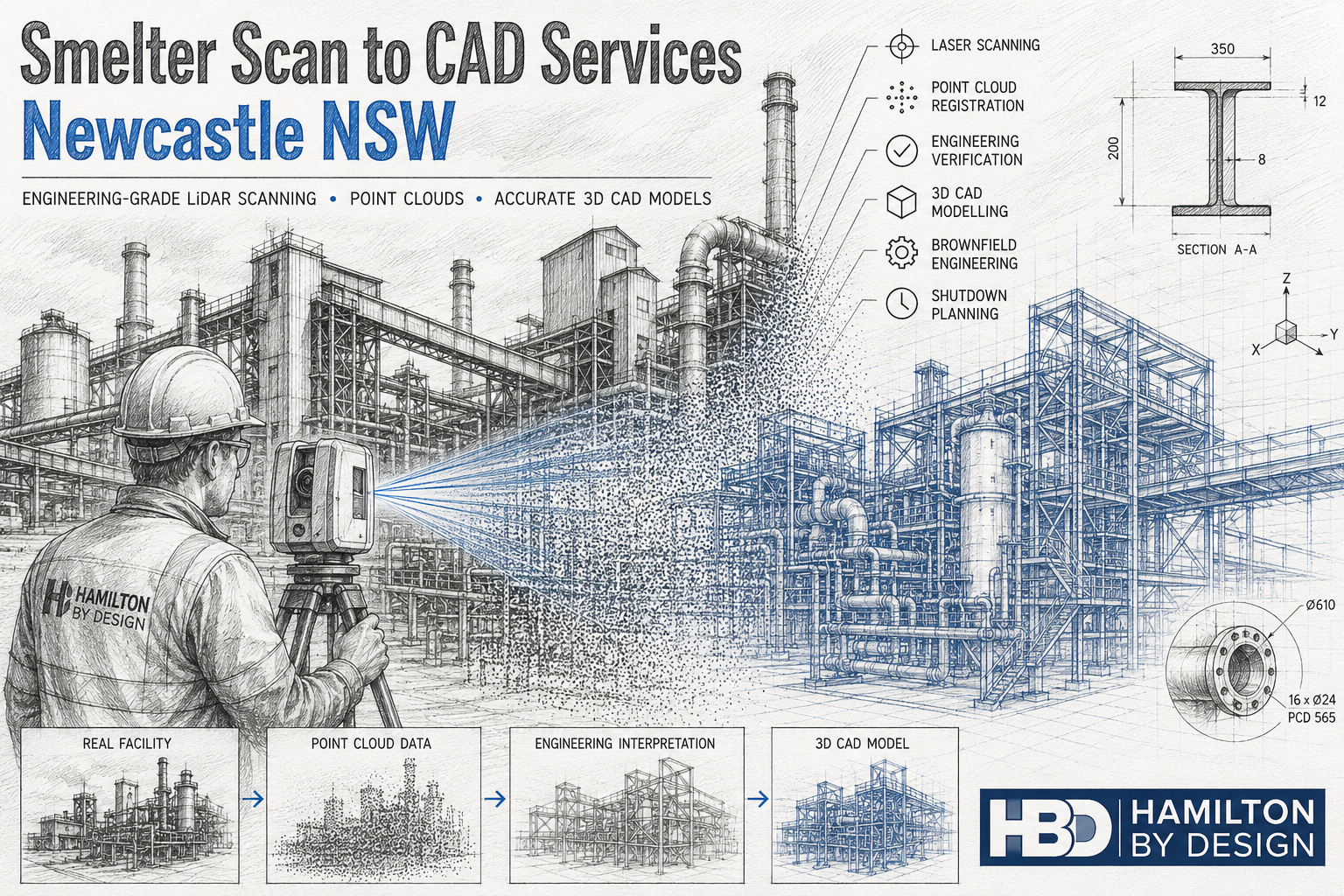
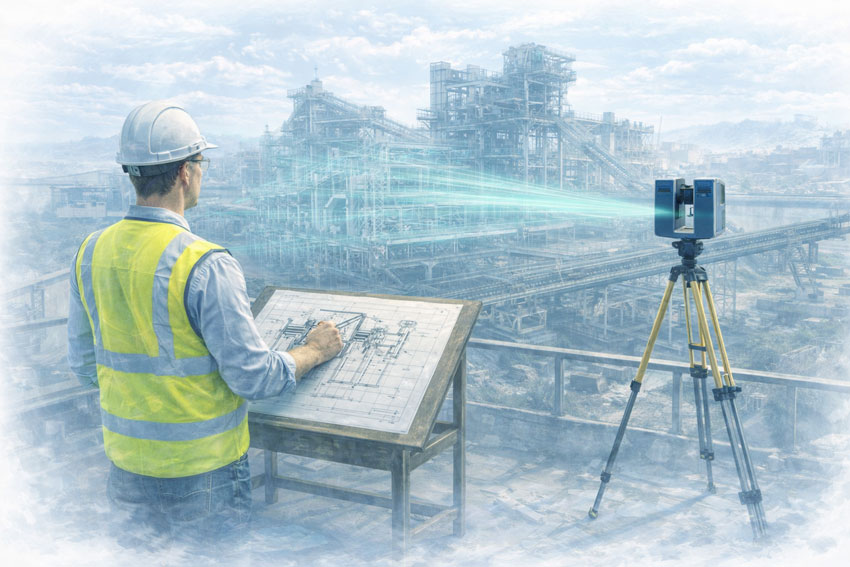
Engineering pencil drawing illustrating Smelter Scan to CAD Services in Newcastle NSW, showing LiDAR laser scanning, point cloud registration and conversion into accurate 3D CAD models for brownfield smelter and heavy industrial facilities.
Blue line-art icon of an industrial smelting furnace pouring molten metal into a ladle, representing engineering-grade 3D LiDAR scanning services for smelters, brownfield plant upgrades and as-built documentation.

Heavy industrial facilities rarely remain unchanged. Smelters are continually upgraded to improve production, replace ageing equipment, meet environmental regulations and increase operational efficiency. Over decades of operation, countless modifications are made, many of which are only partially documented or never recorded at all. As a result, engineering teams are often forced to work with outdated drawings, incomplete documentation or no reliable three-dimensional CAD model of the facility.

Hamilton By Design provides Smelter Scan to CAD Services in Newcastle NSW, transforming high-accuracy terrestrial laser scan data into engineering-grade CAD models that accurately represent existing plant conditions. These models provide a trusted foundation for brownfield engineering projects, shutdown planning, equipment replacements, structural modifications and future asset management.

Whether your project involves replacing conveyors, upgrading process equipment, modifying structural steel, rerouting pipework or expanding a processing facility, having an accurate digital model of the existing plant dramatically reduces project risk while improving engineering confidence.


Why Existing Smelter Drawings Cannot Always Be Trusted

Many smelters operating throughout the Newcastle and Hunter Region have been in service for decades. During this time they have experienced numerous shutdowns, maintenance campaigns and capital improvement projects.

Typical undocumented changes include:

  • Additional platforms and access walkways
  • Modified conveyor systems
  • Pipe rerouting
  • Structural steel alterations
  • Equipment replacements
  • Cable tray additions
  • Temporary modifications becoming permanent
  • New services installed around existing infrastructure

While individual projects may have produced updated drawings, these revisions are not always consolidated into a complete plant model. Over time, engineering documentation becomes fragmented, making it increasingly difficult to determine the true “as-built” condition of the facility.

This creates significant challenges whenever new engineering work is required.


The Cost of Working from Outdated Information

When engineering teams lack an accurate three-dimensional representation of the plant, projects become more complex than necessary.

Common issues include:

  • Unexpected clashes during installation
  • Fabrication errors
  • Incorrect field measurements
  • Delayed shutdowns
  • Increased site rework
  • Additional crane time
  • More site welding and modifications
  • Higher project costs
  • Safety risks associated with unforeseen obstacles

Every incorrect assumption increases project risk.

Accurate Scan to CAD services eliminate much of this uncertainty by providing engineers with an engineering-grade digital representation of the existing facility before design work begins.


What is Scan to CAD?

Scan to CAD is the process of converting terrestrial laser scan data into intelligent engineering models.

Rather than relying solely on old drawings or manual measurements, millions of highly accurate laser measurements are captured throughout the facility to create a complete three-dimensional point cloud.

Experienced engineers then interpret this data to develop accurate CAD models representing existing equipment, structures and plant layouts.

The result is an engineering model that reflects the current state of the facilityโ€”not how it looked twenty years ago.


Our Scan to CAD Workflow

Hamilton By Design follows a structured engineering workflow designed specifically for complex industrial facilities.

1. High-Accuracy Laser Scanning

Using professional terrestrial laser scanners, millions of survey-grade measurements are captured throughout the plant.

Typical assets include:

  • Furnace buildings
  • Material handling systems
  • Pipework
  • Tanks
  • Chutes
  • Hoppers
  • Structural steel
  • Platforms
  • Conveyors
  • Cable trays
  • Mechanical equipment
  • Access structures

Large facilities can be captured with complete overlap to ensure comprehensive coverage and minimal shadowing.


2. Point Cloud Registration

Individual scans are registered into one accurate coordinate system.

This creates a unified digital representation of the entire facility while maintaining engineering-grade accuracy suitable for detailed design work.


3. Engineering Interpretation

Unlike automated modelling software, engineering interpretation identifies:

  • Structural members
  • Mechanical equipment
  • Process pipework
  • Equipment interfaces
  • Critical connection points
  • Existing plant constraints

Engineering judgement ensures the model reflects functional plant assets rather than simply reproducing raw geometry.


4. CAD Model Development

Point cloud data is converted into engineering CAD models suitable for design and documentation.

Depending on project requirements, deliverables may include:

  • Mechanical equipment
  • Structural steel
  • Pipework
  • Access platforms
  • Stairs
  • Handrails
  • Tanks
  • Ducting
  • Buildings
  • Foundations

Models can be produced to the required Level of Detail (LOD) to support conceptual studies, detailed engineering or fabrication.


5. Verification

Critical dimensions are checked against the registered point cloud before project completion.

Verification commonly includes:

  • Flange locations
  • Bolt centres
  • Equipment centres
  • Structural interfaces
  • Pipe elevations
  • Nozzle positions

This verification process gives engineering teams greater confidence that the CAD model accurately reflects existing site conditions.


Typical Smelter Applications

Scan to CAD services support a wide range of engineering activities, including:

Brownfield Plant Modifications

Existing infrastructure is accurately modelled before new equipment is designed.

This significantly reduces installation conflicts.


Shutdown Planning

Shutdown durations are often measured in hours rather than days.

Accurate CAD models enable:

  • Off-site fabrication
  • Installation planning
  • Lift studies
  • Construction sequencing
  • Clash reviews

Better planning helps minimise production downtime.


Conveyor Upgrades

Conveyor replacements frequently require precise integration with existing structures.

Scan to CAD provides engineers with accurate structural interfaces before fabrication begins.


Structural Modifications

Existing platforms, access systems and support structures can be accurately modelled before alterations are designed.

This improves fabrication accuracy while reducing field modifications.


Equipment Replacement

Replacement pumps, tanks, vessels, ductwork and process equipment can be designed to fit existing plant geometry before arriving on site.


Engineering Software Compatible Deliverables

Hamilton By Design can supply deliverables compatible with many common engineering platforms, including:

  • SOLIDWORKS
  • Autodesk Inventor
  • AutoCAD
  • Autodesk Plant 3D
  • Autodesk Revit
  • Navisworks
  • STEP
  • SAT
  • DWG
  • DXF
  • IFC
  • E57
  • RCP
  • LAS

This flexibility allows engineering teams to continue working within their preferred software environment.


Benefits of Accurate Scan to CAD Models

Investing in accurate engineering models provides measurable project benefits:

  • Reduced site measurements
  • Improved design accuracy
  • Lower fabrication risk
  • Fewer installation clashes
  • Reduced shutdown duration
  • Better project planning
  • Faster engineering workflows
  • Improved asset documentation
  • Enhanced maintenance planning
  • Long-term digital asset management

For facilities undertaking ongoing brownfield improvements, a reliable CAD model becomes a valuable engineering asset that continues delivering value long after the initial scanning project is complete.


Supporting Newcastle’s Heavy Industry

Newcastle has long been recognised as one of Australia’s major industrial centres, supporting steel manufacturing, mineral processing, bulk materials handling, port infrastructure and heavy engineering. Many of these facilities have evolved through decades of expansion, leaving engineering teams with incomplete or outdated documentation.

Hamilton By Design specialises in engineering-led Scan to CAD services that bridge this gap. By combining high-accuracy terrestrial laser scanning with mechanical engineering expertise, we produce practical CAD models that support real-world engineering decisions.

Whether your project involves a single process area or an entire smelter, our workflow provides engineering teams with accurate digital information they can rely on for design, fabrication and construction.


Hamilton By Design logo displayed on a blue tilted rectangle with a grey gradient background

Why Choose Hamilton By Design?

Hamilton By Design understands that successful brownfield projects begin with accurate existing-condition information. We combine terrestrial laser scanning with practical engineering experience to deliver CAD models that are not only geometrically accurate but also structured for engineering use.

Our services are tailored to the needs of heavy industry, with experience supporting shutdowns, equipment upgrades, structural modifications, process improvements and long-term asset management. From initial site capture through to verified CAD deliverables, we focus on reducing uncertainty so your engineering team can design with confidence.

If your Newcastle smelter or heavy industrial facility lacks reliable 3D CAD models, Hamilton By Design can help convert reality into accurate engineering dataโ€”providing the digital foundation needed for safer, faster and more cost-effective projects.

Talk to Us – Contact Us

Name
Would you like us to arrange a phone consultation for you?
Address

Our clients:

Engineering-Led LiDAR & Mechanical Design for Mining & Heavy Industry โ€“ Singleton NSW

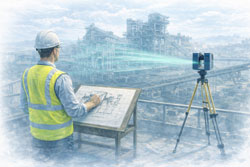
Engineer-led LiDAR scanning at a mining heavy-industry site with point cloud overlay used for mechanical design and brownfield engineering.

Engineering-Led LiDAR & Mechanical Design for Mining & Heavy Industry โ€“ Singleton NSW

Hamilton By Design provides engineering-led LiDAR scanning and mechanical design services to support mining and heavy-industry projects in Singleton and the Upper Hunter Valley, NSW. Our work focuses on brownfield assets, live operating plant, and shutdown-driven projects where accuracy, constructability, and risk control are critical.

This is not survey-only scanning. We integrate engineering judgement with high-accuracy reality capture to deliver fabrication-ready, fit-first-time outcomes for coal operations, CHPPs, and associated mining infrastructure across the Hunter Valley.


Mechanical engineer capturing a mining plant with LiDAR scanning, showing point cloud data integrated into engineering design workflows.

Engineering-Led LiDAR for the Hunter Valley Mining Region

Mining operations around Singleton operate in one of Australiaโ€™s most established coal regions, characterised by:

  • Long-life assets with decades of incremental modification
  • Incomplete or outdated as-built documentation
  • Tight shutdown windows aligned to production constraints
  • High consequence of rework in live operating environments

Our engineering-led LiDAR approach is designed for operating mine sites and processing facilities where assumptions introduce safety, cost, and schedule risk.


Integrated Scan-to-Engineering Workflow

We deliver a single, accountable workflow tailored to Hunter Valley mining operations:

  1. On-site LiDAR scanning undertaken by engineers familiar with coal operations, access constraints, and site safety requirements
  2. Engineering-grade point-cloud processing aligned to modelling tolerances and fabrication requirements
  3. Mechanical and structural CAD modelling developed directly from scan data
  4. Fabrication-ready drawings suitable for workshop manufacture and site installation
  5. Engineering support through fabrication, installation, and shutdown execution

This workflow reduces interface risk between scanning, design, fabrication, and construction โ€” a key issue on shutdown-critical coal sites.


Mining & Heavy Industry Applications in Singleton

Brownfield Engineering & Existing Assets

Singleton-region operations rely heavily on brownfield plant and infrastructure that has evolved over decades. We support brownfield engineering where:

  • Original drawings are unreliable or unavailable
  • Multiple generations of modifications exist
  • Interface accuracy and access are critical

LiDAR provides accurate existing-condition data, while engineering oversight ensures the information is applied correctly during design and verification.


Shutdown-Driven Projects

Shutdowns in the Hunter Valley are tightly planned and production-critical.

Our work supports shutdown success by:

  • Capturing existing conditions prior to outages
  • Eliminating site measurement during shutdowns
  • Verifying interfaces, access, and constructability
  • Reducing fabrication and installation risk

Pre-validated designs improve safety, execution quality, and schedule certainty.


CHPP & Bulk Materials Handling

Coal Handling and Preparation Plants dominate the Upper Hunter Valley.

Our engineering-led LiDAR services support:

  • Conveyors and transfer stations
  • Hoppers, bins, and chutes
  • Crushers, screens, and feeders
  • Walkways, platforms, and guarding upgrades

Accurate scan-to-CAD workflows enable confident redesign, replacement, and compliance upgrades in operating CHPP environments.


Heavy Plant & Mining Equipment

We support projects involving large and complex coal-handling plant where traditional measurement methods are unsafe or impractical, including:

  • Stackers and reclaimers
  • Large conveyor systems
  • Structural steelwork and access platforms

Engineering-led scanning ensures interfaces, envelopes, and installation constraints are understood before fabrication begins.


Risk Management for Hunter Valley Mining Projects

In mature coal regions like Singleton, risk is driven by unknown conditions, interface complexity, and limited tolerance for shutdown overruns.

Our approach reduces risk by:

  • Removing reliance on outdated drawings and assumptions
  • Capturing accurate existing conditions prior to design
  • Identifying clashes and access constraints early
  • Reducing site rework and hot works
  • Supporting safer shutdown execution

Risk is managed upstream, where it is cheapest and safest to control.


What Makes Our Approach Different

  • Engineer-led LiDAR scanning, not technician-only capture
  • Mechanical and structural engineering capability in-house
  • Coal and heavy-industry focus
  • Brownfield and shutdown experience
  • Single point of responsibility from scan through to design output

Typical Deliverables

Depending on project scope, deliverables may include:

  • Registered point-cloud datasets
  • Engineering-grade 3D CAD models
  • Mechanical and structural drawings
  • Interface and clearance verification
  • Fabrication and installation documentation

All deliverables are developed with fabrication, installation, and operational use in mind.


Hamilton By Design logo displayed on a blue tilted rectangle with a grey gradient background
3D LiDAR scanning and 3D modelling service button โ€” laser scanner capturing a point cloud for engineering and CAD modelling
Mechanical engineering services

Who We Support

Our services support:

  • Coal mine asset owners and operators
  • CHPP operators
  • Maintenance and shutdown teams
  • Project engineers and managers
  • Fabricators and constructors operating in the Upper Hunter Valley

We work directly with asset owners or as part of multi-disciplinary project teams.


Talk to an Engineer

If you are planning:

  • A brownfield upgrade
  • A shutdown-driven project
  • CHPP modifications or replacements
  • Conveyor or heavy plant upgrades

Hamilton By Design can support your project in Singleton and the Upper Hunter Valley with engineering-led LiDAR scanning and mechanical design.

Contact us to discuss your site, constraints, and project objectives.

Name
Would you like us to arrange a phone consultation for you?
Address

Our clients:


Engineering-Led LiDAR & Mechanical Design for Mining & Heavy Industry โ€“ Cobar NSW

Engineer-led LiDAR scanning at a mining heavy-industry site with point cloud overlay used for mechanical design and brownfield engineering.

Engineering-Led LiDAR & Mechanical Design for Mining | Cobar NSW

Hamilton By Design provides engineering-led LiDAR scanning and mechanical design services to support mining and heavy-industry projects in Cobar and Western New South Wales. Our work focuses on brownfield assets, live operating plant, and shutdown-driven projects where accuracy, constructability, and risk control are critical.

This is not survey-only scanning. We integrate engineering judgement with high-accuracy reality capture to deliver fabrication-ready, fit-first-time outcomes for base-metals operations, processing facilities, and heavy industrial infrastructure in remote and legacy environments.


Engineering-Led LiDAR for Western NSW Mining

Mining operations in and around Cobar operate within established districts where assets have evolved over decades. Common challenges include:

  • Legacy infrastructure with incomplete or outdated as-built documentation
  • Multiple generations of plant modifications
  • Restricted access and ageing structures
  • High consequence of rework during shutdowns
  • Remote logistics that penalise design errors

Our engineering-led LiDAR approach is designed for operating mine sites and processing facilities where assumptions create safety, cost, and schedule risk.


Mechanical engineer capturing a mining plant with LiDAR scanning, showing point cloud data integrated into engineering design workflows.

Integrated Scan-to-Engineering Workflow

We deliver a single, accountable workflow suited to remote and brownfield mining operations:

  1. On-site LiDAR scanning undertaken by engineers familiar with mining safety, access, and constructability constraints
  2. Engineering-grade point-cloud processing aligned to modelling tolerances and fabrication requirements
  3. Mechanical and structural CAD modelling developed directly from scan data
  4. Fabrication-ready drawings suitable for workshop manufacture and site installation
  5. Engineering support through fabrication, installation, and commissioning

This workflow reduces interface risk between scanning, design, fabrication, and construction โ€” particularly important where site access and logistics are constrained.


Mining & Heavy Industry Applications in Cobar

Brownfield Engineering & Existing Assets

Cobar-region operations rely heavily on long-life assets that have been modified through decades of maintenance and shutdown work. We support brownfield engineering where:

  • Original drawings are unavailable or unreliable
  • Equipment interfaces are complex or undocumented
  • Clearance, access, and compliance are critical

LiDAR provides accurate existing-condition data, while engineering oversight ensures the information is applied correctly during design and verification.


Shutdown-Driven Projects

Shutdown windows in remote mining regions are tightly planned and high consequence.

Our work supports shutdown success by:

  • Capturing existing conditions before outages
  • Eliminating site measurement during shutdowns
  • Verifying interfaces, access, and constructability
  • Reducing fabrication and installation risk

Pre-validated designs improve safety, execution quality, and schedule certainty.


Processing Plants & Materials Handling

Mining operations in Western NSW include complex processing and materials-handling infrastructure.

Our engineering-led LiDAR services support:

  • Conveyors and transfer stations
  • Hoppers, bins, and chutes
  • Crushers, screens, and feeders
  • Walkways, platforms, and guarding upgrades

Accurate scan-to-CAD workflows enable confident redesign, replacement, and compliance upgrades in operating plants.


Heavy Plant & Industrial Equipment

We support projects involving large and complex equipment where traditional measurement methods are unsafe or impractical, including:

  • Fixed and mobile processing plant
  • Structural steelwork and access systems
  • Maintenance platforms and guarding systems

Engineering-led scanning ensures interfaces, envelopes, and installation constraints are understood before fabrication begins.


Risk Management for Remote & Legacy Mining Assets

In established mining districts like Cobar, risk is driven by unknown conditions, ageing infrastructure, and interface complexity.

Our approach reduces risk by:

  • Removing reliance on outdated drawings and assumptions
  • Capturing accurate existing conditions prior to design
    n- Identifying clashes and access constraints early
  • Reducing site rework and hot works
  • Supporting safer shutdown execution

Risk is managed upstream, where it is cheapest and safest to control.


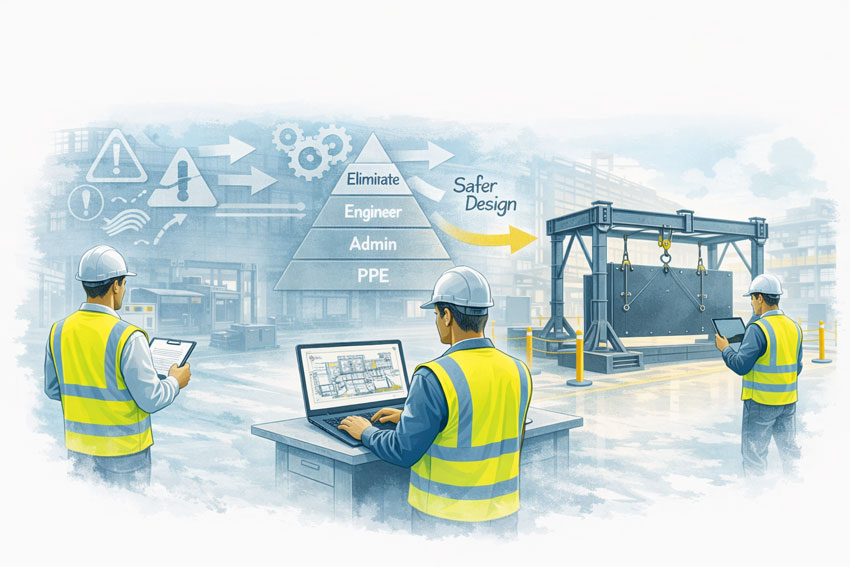
Mining engineers applying design-for-safety principles to improve material handling systems in an industrial workshop

What Makes Our Approach Different

  • Engineer-led LiDAR scanning, not technician-only capture
  • Mechanical and structural engineering capability in-house
  • Mining and heavy-industry focus
  • Brownfield and shutdown experience
  • Single point of responsibility from scan through to design output

Typical Deliverables

Depending on project scope, deliverables may include:

  • Registered point-cloud datasets
  • Engineering-grade 3D CAD models
  • Mechanical and structural drawings
  • Interface and clearance verification
  • Fabrication and installation documentation

All deliverables are developed with fabrication, installation, and operational use in mind.


Who We Support

Our services support:

  • Base-metals mining asset owners
  • Processing plant operators
  • Maintenance and shutdown teams
  • Project engineers and managers
  • Fabricators and constructors operating in Western NSW

We work directly with asset owners or as part of multi-disciplinary project teams.


Hamilton By Design logo displayed on a blue tilted rectangle with a grey gradient background
3D LiDAR scanning and 3D modelling service button โ€” laser scanner capturing a point cloud for engineering and CAD modelling
Mechanical engineering services

Talk to an Engineer

If you are planning:

  • A brownfield upgrade
  • A shutdown-driven project
  • Processing plant modifications
  • Materials-handling or heavy plant upgrades

Hamilton By Design can support your project in Cobar and Western NSW with engineering-led LiDAR scanning and mechanical design.

Contact us to discuss your site, constraints, and project objectives.

Name
Would you like us to arrange a phone consultation for you?
Address

Our clients:


Mechanical Engineering | Structural Engineering