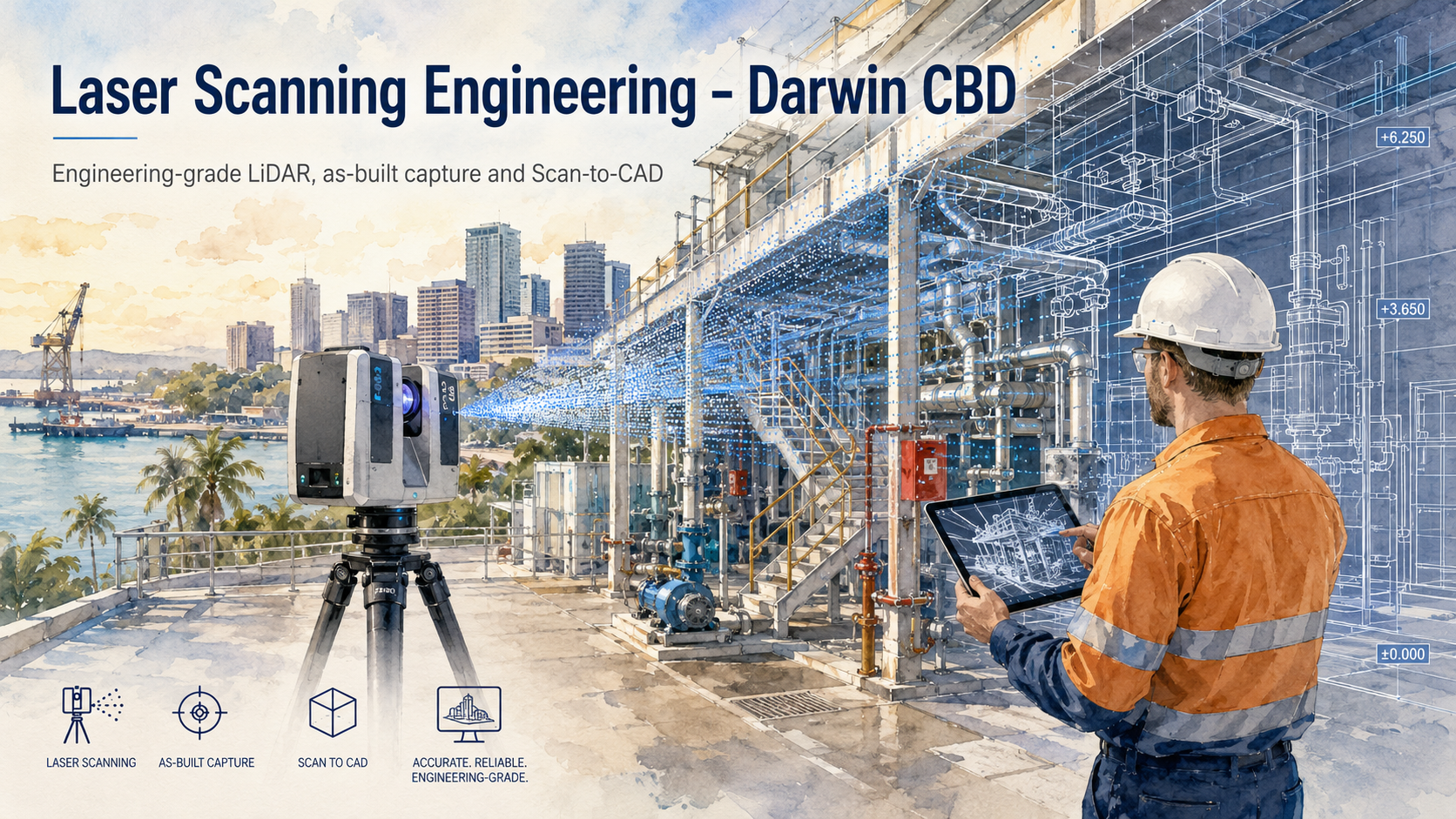
Laser Scanning Engineering โ€“ Darwin CBD

Hamilton By Design provides laser scanning engineering services in Darwin CBD for projects where designers and engineers need accurate existing-condition data before they commit to design, procurement, or construction.

Darwinโ€™s CBD and surrounding precincts combine tropical climate exposure, remote logistics, mixed-use infrastructure, and tight access windows. When scope is time-critical and site visits are expensive, engineering-grade LiDAR scanning and coordinated 3D modelling help teams make confident decisions early โ€” based on whatโ€™s actually there.

If youโ€™re looking for scanning that supports engineering outcomes (not just visuals), start here:


What We Deliver in Darwin CBD

Our Darwin CBD workflow is designed to produce usable engineering information, including:

  • 3D point clouds suitable for design coordination and verification
  • Existing-condition capture for refurbishments, upgrades, and staged works
  • Measured geometry for interfaces, clearances, penetrations, and plant tie-ins
  • Models and drawings that reflect real-world constraints

Our core scanning capability is outlined here:
https://www.hamiltonbydesign.com.au/3d-laser-scanning/


Why โ€œEngineering-Ledโ€ Scanning Matters

On CBD projects, small errors become big problems: tight plantrooms, congested service corridors, legacy construction, and compressed schedules leave little room for rework.

Engineering-led scanning means we capture what engineers actually need to know, such as:

  • critical interfaces and tie-in points
  • levels, plumb, alignment and deformation indicators
  • access constraints and installation pathways
  • โ€œunknownsโ€ that rarely appear on old drawings

This approach reduces RFIs, rework, fabrication errors, and site delays.


Hamilton By Design logo displayed on a blue tilted rectangle with a grey gradient background
3D LiDAR scanning and 3D modelling service button โ€” laser scanner capturing a point cloud for engineering and CAD modelling
Mechanical engineering services

From Scan to CAD: Turning Reality into a Design Environment

Laser scanning becomes truly valuable when it is converted into a coordinated 3D design environment.

Hamilton By Design supports Darwin CBD teams by converting scan data into structured CAD outputs that designers can use to develop the most appropriate solution for the scope of works.

Explore our 3D CAD capability here:


Mechanical Engineering Integration

Many Darwin CBD projects involve mechanical upgrades, asset life extension, or integration of new equipment into existing spaces. Accurate scan data enables mechanical designers to:

  • validate fit-up and installation clearances
  • design supports and interfaces correctly the first time
  • plan staged shutdown works with higher certainty
  • reduce the risk of โ€œsite surprisesโ€

Mechanical engineering capability:
https://www.hamiltonbydesign.com.au/mechanical-engineering/


Our clients


Typical Darwin CBD Use Cases

Our laser scanning engineering services are commonly used for:

  • Refurbishments and retrofits in occupied buildings
  • Plantroom and services coordination (tight spaces, complex interfaces)
  • Structural and mechanical integration (supports, platforms, equipment)
  • Upgrade scoping and feasibility (verify what exists before committing)
  • As-built documentation for handover and ongoing asset management

Why Laser Scanning Improves Design Quality

A 3D scan-based model gives designers and engineers a far stronger platform to develop the best design for the scope of works because it allows them to:

  • design to reality, not assumptions
  • test options digitally before issuing drawings
  • check installation constraints and access early
  • coordinate multiple disciplines with fewer clashes
  • reduce variations caused by missing or incorrect existing-condition data

For engineering project workflows specifically, see:


Talk to Us About Darwin CBD Laser Scanning

If your Darwin CBD project needs accurate, engineering-grade existing-condition capture to reduce risk and improve design outcomes, Hamilton By Design can help โ€” from scan planning through to CAD-ready deliverables.
Name
Would you like us to arrange a phone consultation for you?
Address

3D Scanning outside of Australia

3D Scanning outside of Australia

In todayโ€™s fast-moving construction, infrastructure and industrial-upgrade sectors โ€” whether in Europe, Asia, North America, Africa or South America โ€” reality is rarely simple. Projects are large, environments complex, and legacy structures old or undocumented. Thatโ€™s where 3D scanning (or 3D LiDAR scanning) becomes a game-changer.

With modern 3D scanning services, you can capture an entire site, plant, asset or building โ€” every surface, every pipe run, every structural detail โ€” in accurate digital form. Traditional measuring tools (tape measures, laser meters, manual surveying) are still useful. But on large or congested sites, or when you donโ€™t have safe access everywhere, manual methods can be slow, error-prone, and often incomplete.

By contrast, 3D scanning uses laser-based (or LiDAR-based) measurements to gather millions of data points quickly and remotely. The result is a dense โ€œpoint cloudโ€ โ€” a highly detailed and accurate 3D snapshot of reality.

3D LiDAR scanning and 3D modelling service button โ€” laser scanner capturing a point cloud for engineering and CAD modelling
Mechanical engineering services

Why 3D Scanning Works โ€” No Matter Where You Are

Hereโ€™s why 3D scanning works so well globally:

  • Speed and Efficiency: A detailed 3D scan that might take days or weeks with traditional survey methods can often be completed in hours. That means faster project starts, shorter downtime, and less disruption.
  • Safety: Because the scan can be done remotely (laser pulses travel to surfaces without the need for physical access), itโ€™s ideal for hazardous zones, tight spaces, or unstable structures.
  • Full Context: Unlike isolated point measurements, 3D scanning captures full spatial context โ€” geometry, dimensions, relationships between elements and spatial orientation. This is invaluable for retrofit design, expansions, refurbishments, or structural assessments.
  • As-Built Accuracy: For heritage buildings, older industrial plants, or legacy infrastructure โ€” where existing drawings may be outdated or missing โ€” 3D scanning provides a reliable, accurate โ€œas-builtโ€ record. Great for restoration, renovation, maintenance, or future planning.
  • Reduced Errors & Rework: Because your base designs, additions, installations or repairs on real-world data, the risk of clashes, misfits, or unexpected surprises drops dramatically โ€” which saves time and money downstream.

Where 3D Scanning Is Already Making a Difference Globally

Across the world, 3D scanning is being used in a range of industries and projects โ€” and its benefits scale with scope and complexity. Some examples:

  • Industrial plants and processing facilities โ€” mapping existing installations for maintenance, retrofits or expansions
  • Construction and infrastructure โ€” buildings, bridges, tunnels, utilities, and structural inspections
  • Heritage and restoration projects โ€” capturing intricate architectural details of historical buildings or monuments without physical contact
  • Manufacturing, factories and heavy industry โ€” reverse engineering, component inspection, machinery layout, and plant upgrades
  • Survey, mapping and urban planning โ€” terrain, topography, urban structures, utilities and civil works

Because 3D scanning is not location-specific, firms and clients worldwide โ€” regardless of local regulations or industry sector โ€” can leverage its advantages.


What Makes a 3D Scanning Service Valuable โ€” Anywhere

If youโ€™re looking to engage a 3D scanning service outside Australia, hereโ€™s what you should check to get the most value:

  • Use of current, high-resolution scanners (LiDAR or equivalent 3D scanning technology), able to generate dense point clouds with millimetre-level detail.
  • Skilled operators who understand not only how to capture data, but how to process it. Raw scans need thoughtful post-processing, registration, and sometimes CAD/BIM conversion to be truly useful.
  • Delivery of actionable, usable outputs โ€” not just raw point clouds. That means as-built models, CAD drawings, BIM-ready files or structural drawings depending on the project.
  • Clear scope definition: What you need โ€” renovation planning, plant upgrade, heritage restoration, clash detection, quality control โ€” and an understanding of what a scan can and cannot do.
  • Flexibility to work in different environments โ€” industrial sites, confined spaces, heritage structures, remote locations.

Why You Should Consider 3D Scanning for Your Next Project

Whether youโ€™re managing a factory upgrade, planning a structural refurbishment, restoring a heritage building, or designing a new facility โ€” 3D scanning gives you clarity. It removes guesswork. It captures reality, not drawings.

In many global markets today, the pressure for speed, accuracy, and cost-effectiveness is growing. Regulations, safety standards, environmental concerns and complexity of infrastructure demand better data โ€” and 3D scanning delivers.

If you havenโ€™t tried 3D scanning yet, or if youโ€™re depending on old drawings or manual survey methods, now may be the time to reconsider. The technology โ€” and the workflow โ€” has matured, and the benefits are real: faster turnarounds, safer operations, clearer documentation, and fewer surprises.

For engineers, architects, contractors, heritage specialists, surveyors and project managers around the world โ€” adopting 3D scanning could be the most efficient way to ensure project success.

Hamilton By Design logo displayed on a blue tilted rectangle with a grey gradient background
3D LiDAR scanning and 3D modelling service button โ€” laser scanner capturing a point cloud for engineering and CAD modelling
Mechanical engineering services
Name
Address
You would like to:

3D Laser Scanning

3D LiDAR Scanning โ€“ Digital Quality Assurance

3D Scanning for Construction

Transforming Projects with 3D Scanning