


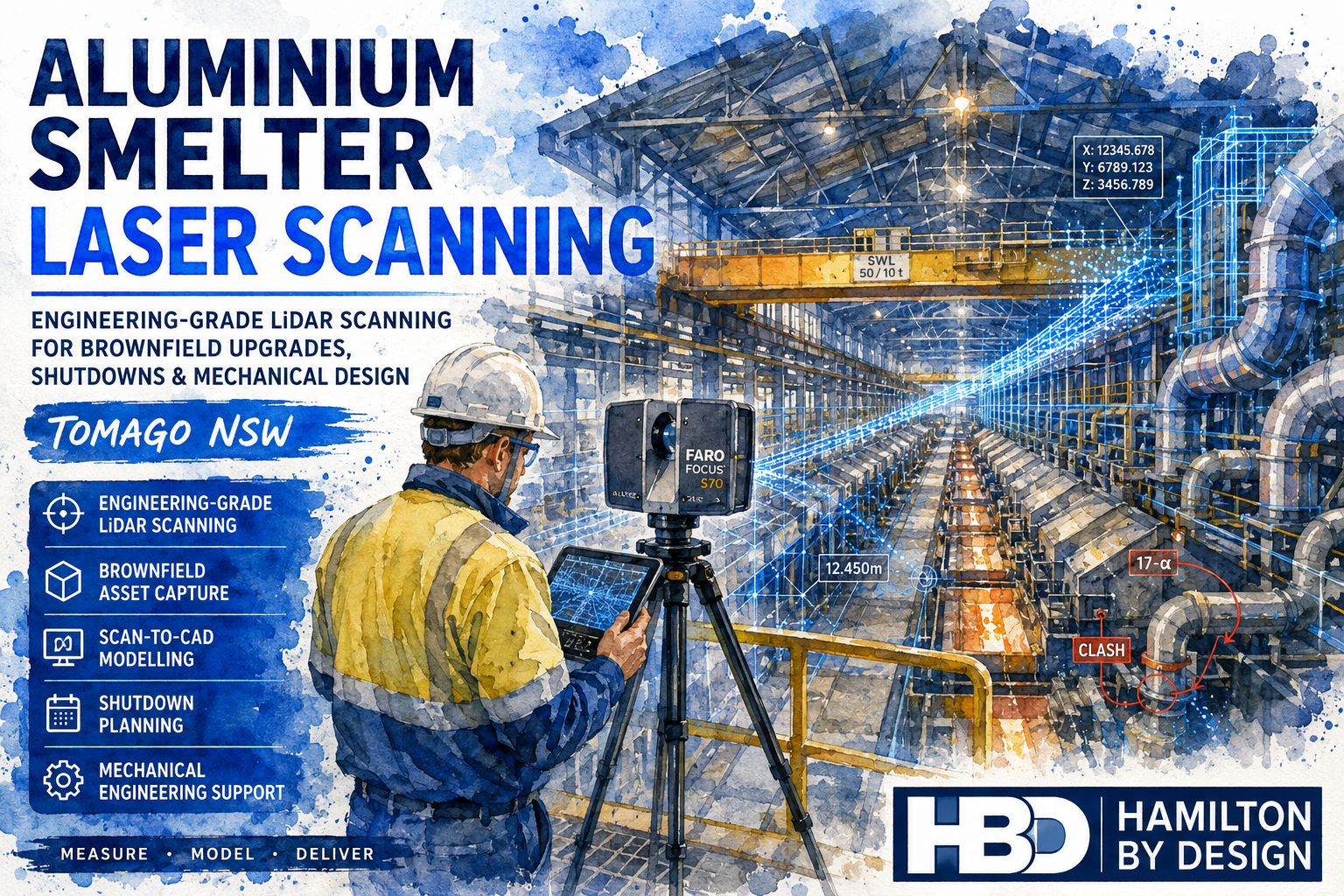
Brownfield engineering projects are among the most technically demanding activities undertaken within an aluminium smelter. Unlike a new (greenfield) facility, every modification inside an operating smelter must integrate with decades of existing infrastructure, often installed during multiple expansion and upgrade phases. Over time, plant layouts evolve, undocumented modifications occur, and original engineering drawings become outdated or incomplete.
For facilities such as Tomago Aluminium in Tomago NSW, accurate existing-condition information is essential before any engineering design, shutdown planning or equipment installation begins. Without reliable dimensional data, project teams risk discovering clashes, incorrect fabrication dimensions and unforeseen site conditions only after installation has commenced—when delays are most costly.
Hamilton By Design provides engineering-grade 3D laser scanning services that create highly accurate digital representations of existing assets. Using advanced LiDAR technology, millions of measurement points are captured in a matter of minutes, producing an engineering-quality point cloud that forms the foundation for mechanical design, structural engineering, Scan-to-CAD workflows and brownfield project delivery.
Whether your project involves replacing conveyors, upgrading process equipment or planning a major shutdown, laser scanning dramatically reduces uncertainty while improving safety, engineering confidence and project outcomes.
Why Accurate Measurement Matters in an Aluminium Smelter
Aluminium smelters operate continuously, twenty-four hours a day, every day of the year. Every hour of lost production has significant financial consequences, making shutdown windows tightly planned and carefully managed.
Unlike manufacturing facilities with spare production capacity, major engineering work often needs to occur within limited shutdown periods where multiple contractors work simultaneously.
This creates several engineering challenges:
- Existing structures may not match historical drawings.
- Pipework has often been modified over decades.
- Equipment relocations are poorly documented.
- Platforms and walkways have changed.
- Electrical cable trays have expanded.
- New services compete for limited installation space.
- Structural members have been strengthened without drawing revisions.
Traditional surveying techniques simply cannot capture the complexity of these environments efficiently.
The Brownfield Engineering Challenge
Every brownfield project starts with one simple question:
What actually exists today?
Unfortunately, this is rarely easy to answer.
Many aluminium smelters have been operating for forty years or more. During that time, thousands of engineering changes may have occurred.
Common examples include:
- Emergency repairs
- Maintenance modifications
- Temporary installations becoming permanent
- Equipment replacements
- Structural strengthening
- Additional pipe supports
- New cable routes
- Instrument upgrades
- Maintenance access improvements
Many of these modifications were completed under shutdown pressure where updating engineering drawings was understandably not the highest priority.
The result is that engineering teams often begin projects using documentation that no longer accurately reflects the physical plant.
Why Traditional Site Measurement Falls Short
Historically, engineers relied upon:
- Tape measures
- Total stations
- Hand sketches
- Photographs
- Manual dimensions
While these methods still have their place, they become increasingly impractical inside large industrial facilities.
Consider attempting to measure:
- 40 metres of overhead pipework
- Multiple elevations
- Congested cable trays
- Structural steel connections
- Existing conveyors
- Crane beams
- Process vessels
Access alone may require elevated work platforms, confined space permits, scaffolding and isolation procedures.
Even after several days onsite, only selected dimensions have been captured.
If additional information is later required, another site visit becomes necessary.
How Engineering Laser Scanning Changes the Process
Laser scanning fundamentally changes how brownfield engineering projects are delivered.
Instead of recording hundreds of manual dimensions, terrestrial LiDAR scanners collect millions of highly accurate measurements covering the complete work area.
The result is an engineering-grade point cloud that accurately represents existing plant geometry.
This digital environment allows engineers to perform much of their work from the office rather than returning repeatedly to site.
Once captured, the scan data can be converted into accurate Scan-to-CAD models and engineering drawings, enabling mechanical, structural and piping designers to work confidently using verified as-built information.
Typical benefits include:
- Complete site capture
- Reduced survey time
- Improved design accuracy
- Fewer site visits
- Better collaboration
- Improved documentation
- Reduced engineering risk
Typical Areas Scanned Within an Aluminium Smelter
Engineering projects commonly occur throughout the facility, including:
Potlines
- Structural modifications
- Busbar alterations
- Access platform changes
- Mechanical equipment installation
Casthouse
- Furnace upgrades
- Casting equipment
- Overhead cranes
- Hydraulic systems
- Cooling systems
Carbon Plant
- Conveyors
- Crushers
- Dust extraction
- Structural supports
- Material handling systems
Utility Systems
- Cooling water
- Compressed air
- Natural gas
- Fire services
- Hydraulic systems
- Electrical substations
Highly congested service corridors benefit significantly from comprehensive reality capture.
Supporting Shutdown Engineering
Shutdowns represent one of the highest-value applications for engineering laser scanning.
Every task within a shutdown depends upon accurate planning.
When equipment has already been fabricated, there is little tolerance for discovering dimensional discrepancies during installation.
Laser scanning supports shutdown engineering and brownfield project planning by providing:
- Existing-condition verification
- Installation planning
- Crane access studies
- Temporary works design
- Pipe spool verification
- Structural modification planning
- Clash detection
- Construction sequencing
The result is improved confidence before shutdown activities begin.
Mechanical Engineering Applications
Mechanical engineering projects commonly include:
- Pump replacements
- Conveyor upgrades
- Chute redesign
- Tank modifications
- Ducting replacement
- Pressure vessel connections
- Machine foundations
Instead of estimating dimensions from old drawings, engineers can design directly against the current plant geometry.
This greatly improves fabrication accuracy.
Structural Engineering Benefits
Structural engineers frequently encounter undocumented modifications.
Laser scanning enables accurate modelling of:
- Structural steel
- Columns
- Bracing
- Platforms
- Stairways
- Handrails
- Crane beams
- Pipe supports
Existing structures can then be verified before additional loads are introduced.
Digital Twins and Asset Management
Laser scanning also provides the foundation for developing digital twins.
Rather than relying solely on historical drawings, operators gain access to an accurate digital representation of the physical plant.
Benefits include:
- Asset management
- Maintenance planning
- Future project planning
- Condition assessments
- Engineering verification
- Operator training
- Long-term documentation
Where legacy equipment has little or no documentation, Hamilton By Design can also provide reverse engineering services to recreate accurate CAD models and manufacturing drawings directly from laser scan data.
Engineering Software Used
Hamilton By Design supports engineering workflows using industry-recognised software, including:
- FARO Focus terrestrial laser scanners
- FARO SCENE
- Autodesk ReCap
- Autodesk Navisworks
- SOLIDWORKS
- Autodesk Inventor
- AutoCAD
- AutoCAD Plant 3D
- Revit
- E57 point cloud exchange
- STEP and Parasolid mechanical models
This enables seamless collaboration with engineering consultants, asset owners and contractors.
Typical Deliverables
Every project is tailored to client requirements, but deliverables may include:
- Registered point clouds
- E57 files
- Autodesk ReCap projects (RCP/RCS)
- Scan-to-CAD drawings
- Existing-condition layouts
- General arrangement drawings
- Mechanical models
- Structural steel models
- Pipework models
- Equipment verification
- Clash detection reviews
- Engineering mark-ups
- As-built documentation
Why Tomago NSW Is an Ideal Application
Tomago is one of Australia’s most significant heavy industrial precincts, and engineering projects are continually undertaken to improve safety, reliability and production efficiency.
Many upgrades involve integrating modern equipment into infrastructure that has evolved over decades.
This makes accurate existing-condition information invaluable.
Laser scanning enables project teams to:
- Reduce uncertainty
- Improve engineering quality
- Minimise shutdown risk
- Support prefabrication
- Improve contractor coordination
- Reduce costly rework
For brownfield engineering, accurate information at the beginning of the project often determines the success of the entire installation.

Conclusion
Brownfield engineering projects succeed when decisions are based on accurate information. In aluminium smelters operating in Tomago NSW, where infrastructure has evolved over decades, relying on outdated drawings or incomplete measurements introduces unnecessary risk, delays and cost.
Engineering-grade laser scanning provides a reliable foundation for mechanical upgrades, shutdown planning, structural modifications and future asset management. By capturing millions of accurate measurements in a single survey, project teams gain confidence that new equipment will fit, fabrication can proceed with certainty, and installation risks are significantly reduced.
If your next project involves upgrading conveyors, replacing process equipment, modifying structural steel or planning a major shutdown, Hamilton By Design can deliver the accurate reality capture and engineering support needed to reduce uncertainty and keep your project moving forward. By combining advanced LiDAR technology with practical engineering expertise, we help aluminium smelter operators make better decisions, minimise rework and achieve safer, more efficient brownfield project outcomes throughout Tomago NSW.
Talk to Us – Contact Us
Our clients:
























