The Hunter Valley remains one of Australia’s most important industrial regions. With world-class mining operations, CHPP facilities, fabrication workshops, power generation assets and major industrial precincts, the region depends on precision, reliability and efficient project planning. As plants age and infrastructure expands, the challenge of capturing accurate site information becomes increasingly critical.
This is why laser scanning in the Hunter Valley has rapidly become a foundational tool for maintenance, engineering, redesign, shutdown preparation and fabrication accuracy. Organisations across the region are turning to laser scanning because the demands of modern industrial work simply cannot be met with traditional tape measurements or outdated drawings.
Hamilton By Design is proud to deliver engineering-grade laser scanning throughout the Hunter Valley, supporting safer worksites, faster project execution and significantly improved installation outcomes. Below, we explore why laser scanning is essential, how the technology works and how it transforms operations across the region.
Why Laser Scanning Has Become Essential in the Hunter Valley
Across the Hunter, very few sites resemble their original drawings. Over decades, plants evolve—structures deform, temporary fixes become permanent, equipment shifts, and countless undocumented modifications occur.
These realities create a major problem:
Projects that rely on inaccurate measurements inevitably face delays, rework and installation challenges.
The consequences of bad data include:
- Structural steel not fitting on site
- Conveyor alignment issues
- Misaligned chutes or transfer points
- Inaccurate pipe spool lengths
- Unexpected clashes in congested areas
- Extended shutdown duration
- Significant cost blowouts
By contrast, laser scanning in the Hunter Valley provides a millimetre-accurate digital representation of the real site, eliminating uncertainty and enabling confident engineering decisions.
How Laser Scanning Works
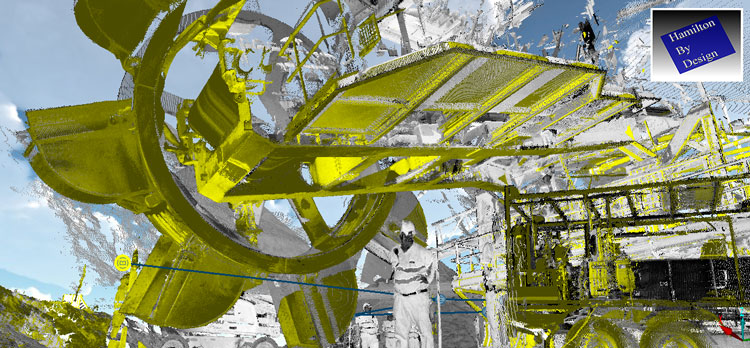
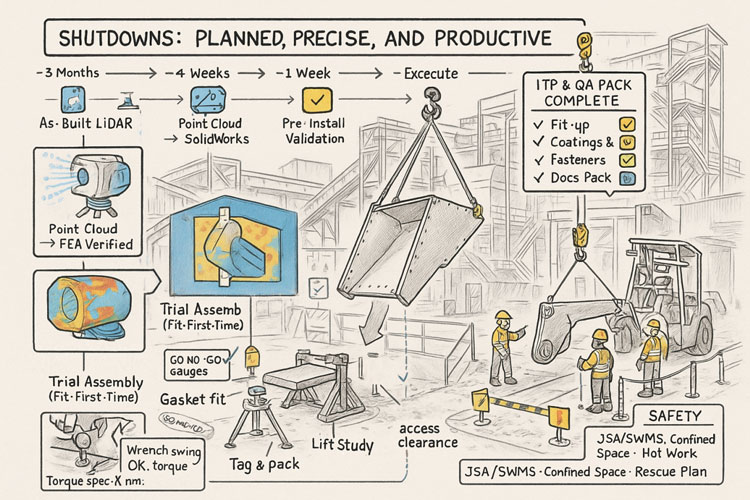
Laser scanning—also known as LiDAR (Light Detection and Ranging)—captures millions of precise data points across a site in seconds. These points create a “point cloud,” a detailed 3D representation of the scanned environment.
The Hamilton By Design workflow typically includes:
1. On-Site High-Accuracy Capture
We scan assets such as:
- Structural frames
- Conveyors, transfer towers and walkways
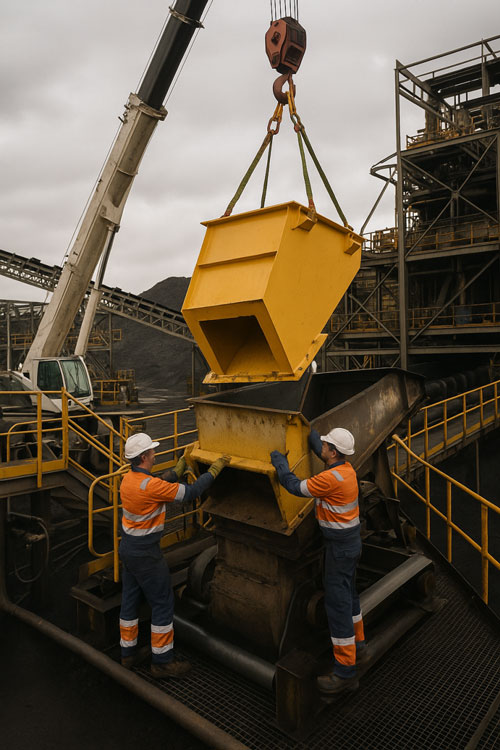
- Chutes, bins, hoppers and material-handling systems
- Tanks and pipe networks
- Mechanical equipment
- Buildings and platforms
- Processing areas and plant rooms
Scanning is performed safely, quickly and with minimal disruption to operations.
2. Point Cloud Processing
Individual scans are aligned and merged into a single, unified as-built dataset.
3. CAD Modelling
From the point cloud, we create:
- Accurate 3D models
- General arrangement drawings
- Fabrication details
- DXF files for workshop use
- Digital templates for pattern development
4. Engineering & Fabrication Support
We run digital checks for:
- Clearances
- Misalignments
- Bolt pattern accuracy
- Clash detection
- Fit-up assurance
This ensures all new components, structures and mechanical systems integrate correctly the first time.
Industries in the Hunter Valley Using Laser Scanning
1. Mining & Coal Handling Preparation Plants (CHPPs)
The Hunter Valley is one of Australia’s largest mining hubs, and laser scanning has become indispensable for:
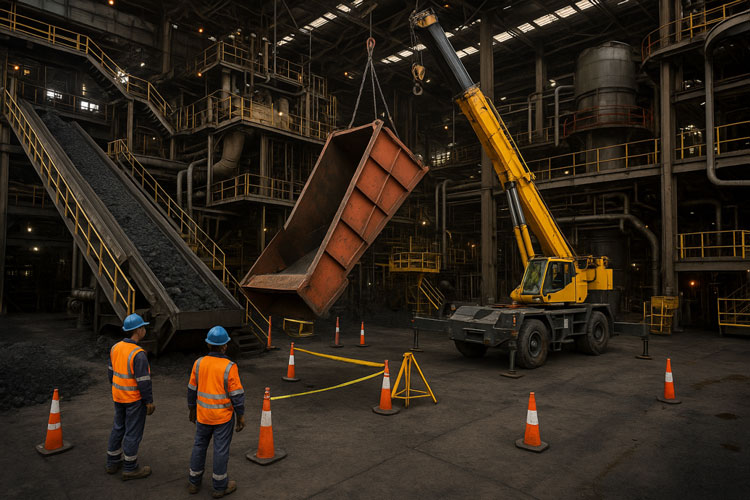
- Chute redesign and optimisation
- Conveyor alignment and pulley checks
- Structural replacements
- Screening and crushing system upgrades
- Transfer tower modifications
- Bin and hopper geometry capture
- Shutdown planning and scope definition
In CHPP environments—where dust, vibration, wear and deformation are constant—accurate as-built data is essential for safe and efficient upgrades.
2. Local Fabrication Workshops
Fabricators across Singleton, Muswellbrook, Rutherford and Thornton rely on precise digital information to ensure their products fit perfectly in the field. Laser scanning supports:
- Steel replacement projects
- Pipe spool fabrication
- Custom chutes and transfer systems
- Platform and walkway upgrades
- Reverse engineering worn components
By basing fabrication on exact site geometry, rework and installation delays are dramatically reduced.
3. Power Stations and Energy Infrastructure
The Hunter Valley contains major energy assets requiring constant maintenance and upgrades. These aging facilities benefit greatly from laser scanning for:
- Structural integrity assessments
- Boiler house modifications
- Pipe rerouting and replacements
- Access platform upgrades
- Plant room modelling
- Compliance documentation
Laser scanning supports safe access, better planning and accurate engineering.
4. Industrial, Manufacturing and Infrastructure Projects
The region’s industrial footprint is expanding, and many facilities require precise as-built data for:
- Renovations or expansions
- Facility mapping
- Mechanical upgrades
- Brownfield redevelopment
- BIM integration
Laser scanning provides the detail needed to plan these works correctly.
Benefits of Laser Scanning in the Hunter Valley
1. Millimetre Accuracy
Unlike manual measurements, laser scanning captures true geometry—not assumptions.
2. Reduced Rework
Digitally verified data ensures that fabrication is correct the first time.
3. Improved Safety
No need for workers to climb, stretch, or enter hazardous areas to measure.
4. Faster Shutdowns
Accurate pre-planning reduces onsite delays.
5. Digital Collaboration
Point clouds allow teams, contractors and engineers to review the site remotely.
6. Enhanced Engineering Confidence
Decisions are made on verified data, improving outcomes across the entire project lifecycle.
The Hamilton By Design Advantage
Hamilton By Design delivers more than just scanning—we combine decades of engineering, drafting and fabrication experience to interpret the data with real-world understanding.
What Sets Us Apart:
Engineering-Driven Approach
We understand the mechanical and structural context behind each scan.
Full Digital Workflow
From scan → point cloud → 3D model → fabrication drawings → installation, we support your entire project.
Local Knowledge of Hunter Valley Industry
We work routinely with mines, CHPPs, fabricators and industrial facilities across the region.
Fabrication-Ready Outputs
All models and drawings are created with workshop requirements and site constraints in mind.
Confidence Before Installation
We digitally confirm fitment before steel is cut—removing risk.
Applications Where Laser Scanning Delivers Immediate Value
- Chute replacements
- Conveyor system upgrades
- Access platforms and walkways
- Crusher and screen changes
- Transfer tower redesign
- Pipe spool fabrication
- Structural steel alignment checks
- Bin, tank and hopper measurement
- Reverse engineering
- Brownfield plant expansions
Anywhere accuracy matters, scanning is the superior choice.
Laser Scanning in the Hunter Valley: The New Standard
Across the region, laser scanning is now considered a must-have for safe, efficient and predictable project delivery. As plants age and the complexity of upgrades increases, organisations that invest in accurate data significantly outperform those relying on outdated drawings or manual measuring.
For engineering teams, maintenance planners, workshop fabricators and shutdown coordinators, laser scanning provides the certainty required to deliver work on time and on budget.
Partner with Hamilton By Design
When you choose Hamilton By Design for laser scanning in the Hunter Valley, you’re choosing:
- Accuracy
- Safety
- Engineering reliability
- Better planning
- Reduced risk
- Efficient installation
We’re ready to support your next shutdown, upgrade, redesign or fabrication project with the digital precision it deserves.
Contact Hamilton By Design today to discuss your site and discover how laser scanning can transform your project outcomes.