
Laser Scanning Hunter Valley: Delivering Engineering-Grade Accuracy for Mining, Manufacturing and Industrial Projects

The Hunter Valley remains one of Australia’s most important industrial regions. With world-class mining operations, CHPP facilities, fabrication workshops, power generation assets and major industrial precincts, the region depends on precision, reliability and efficient project planning. As plants age and infrastructure expands, the challenge of capturing accurate site information becomes increasingly critical.

This is why laser scanning in the Hunter Valley has rapidly become a foundational tool for maintenance, engineering, redesign, shutdown preparation and fabrication accuracy. Organisations across the region are turning to laser scanning because the demands of modern industrial work simply cannot be met with traditional tape measurements or outdated drawings.

Hamilton By Design is proud to deliver engineering-grade laser scanning throughout the Hunter Valley, supporting safer worksites, faster project execution and significantly improved installation outcomes. Below, we explore why laser scanning is essential, how the technology works and how it transforms operations across the region.


Why Laser Scanning Has Become Essential in the Hunter Valley

Across the Hunter, very few sites resemble their original drawings. Over decades, plants evolve—structures deform, temporary fixes become permanent, equipment shifts, and countless undocumented modifications occur.

These realities create a major problem:
Projects that rely on inaccurate measurements inevitably face delays, rework and installation challenges.

The consequences of bad data include:

  • Structural steel not fitting on site
  • Conveyor alignment issues
  • Misaligned chutes or transfer points
  • Inaccurate pipe spool lengths
  • Unexpected clashes in congested areas
  • Extended shutdown duration
  • Significant cost blowouts

By contrast, laser scanning in the Hunter Valley provides a millimetre-accurate digital representation of the real site, eliminating uncertainty and enabling confident engineering decisions.


How Laser Scanning Works

Laser scanning—also known as LiDAR (Light Detection and Ranging)—captures millions of precise data points across a site in seconds. These points create a “point cloud,” a detailed 3D representation of the scanned environment.

The Hamilton By Design workflow typically includes:

1. On-Site High-Accuracy Capture

We scan assets such as:

  • Structural frames
  • Conveyors, transfer towers and walkways
  • Chutes, bins, hoppers and material-handling systems
  • Tanks and pipe networks
  • Mechanical equipment
  • Buildings and platforms
  • Processing areas and plant rooms

Scanning is performed safely, quickly and with minimal disruption to operations.

2. Point Cloud Processing

Individual scans are aligned and merged into a single, unified as-built dataset.

3. CAD Modelling

From the point cloud, we create:

  • Accurate 3D models
  • General arrangement drawings
  • Fabrication details
  • DXF files for workshop use
  • Digital templates for pattern development

4. Engineering & Fabrication Support

We run digital checks for:

  • Clearances
  • Misalignments
  • Bolt pattern accuracy
  • Clash detection
  • Fit-up assurance

This ensures all new components, structures and mechanical systems integrate correctly the first time.


Industries in the Hunter Valley Using Laser Scanning

1. Mining & Coal Handling Preparation Plants (CHPPs)

The Hunter Valley is one of Australia’s largest mining hubs, and laser scanning has become indispensable for:

  • Chute redesign and optimisation
  • Conveyor alignment and pulley checks
  • Structural replacements
  • Screening and crushing system upgrades
  • Transfer tower modifications
  • Bin and hopper geometry capture
  • Shutdown planning and scope definition

In CHPP environments—where dust, vibration, wear and deformation are constant—accurate as-built data is essential for safe and efficient upgrades.


2. Local Fabrication Workshops

Fabricators across Singleton, Muswellbrook, Rutherford and Thornton rely on precise digital information to ensure their products fit perfectly in the field. Laser scanning supports:

  • Steel replacement projects
  • Pipe spool fabrication
  • Custom chutes and transfer systems
  • Platform and walkway upgrades
  • Reverse engineering worn components

By basing fabrication on exact site geometry, rework and installation delays are dramatically reduced.


3. Power Stations and Energy Infrastructure

The Hunter Valley contains major energy assets requiring constant maintenance and upgrades. These aging facilities benefit greatly from laser scanning for:

  • Structural integrity assessments
  • Boiler house modifications
  • Pipe rerouting and replacements
  • Access platform upgrades
  • Plant room modelling
  • Compliance documentation

Laser scanning supports safe access, better planning and accurate engineering.


4. Industrial, Manufacturing and Infrastructure Projects

The region’s industrial footprint is expanding, and many facilities require precise as-built data for:

  • Renovations or expansions
  • Facility mapping
  • Mechanical upgrades
  • Brownfield redevelopment
  • BIM integration

Laser scanning provides the detail needed to plan these works correctly.


Benefits of Laser Scanning in the Hunter Valley

1. Millimetre Accuracy

Unlike manual measurements, laser scanning captures true geometry—not assumptions.

2. Reduced Rework

Digitally verified data ensures that fabrication is correct the first time.

3. Improved Safety

No need for workers to climb, stretch, or enter hazardous areas to measure.

4. Faster Shutdowns

Accurate pre-planning reduces onsite delays.

5. Digital Collaboration

Point clouds allow teams, contractors and engineers to review the site remotely.

6. Enhanced Engineering Confidence

Decisions are made on verified data, improving outcomes across the entire project lifecycle.


The Hamilton By Design Advantage

Hamilton By Design delivers more than just scanning—we combine decades of engineering, drafting and fabrication experience to interpret the data with real-world understanding.

What Sets Us Apart:

Engineering-Driven Approach

We understand the mechanical and structural context behind each scan.

Full Digital Workflow

From scan → point cloud → 3D model → fabrication drawings → installation, we support your entire project.

Local Knowledge of Hunter Valley Industry

We work routinely with mines, CHPPs, fabricators and industrial facilities across the region.

Fabrication-Ready Outputs

All models and drawings are created with workshop requirements and site constraints in mind.

Confidence Before Installation

We digitally confirm fitment before steel is cut—removing risk.


Applications Where Laser Scanning Delivers Immediate Value

  • Chute replacements
  • Conveyor system upgrades
  • Access platforms and walkways
  • Crusher and screen changes
  • Transfer tower redesign
  • Pipe spool fabrication
  • Structural steel alignment checks
  • Bin, tank and hopper measurement
  • Reverse engineering
  • Brownfield plant expansions

Anywhere accuracy matters, scanning is the superior choice.


Laser Scanning in the Hunter Valley: The New Standard

Across the region, laser scanning is now considered a must-have for safe, efficient and predictable project delivery. As plants age and the complexity of upgrades increases, organisations that invest in accurate data significantly outperform those relying on outdated drawings or manual measuring.

For engineering teams, maintenance planners, workshop fabricators and shutdown coordinators, laser scanning provides the certainty required to deliver work on time and on budget.


Partner with Hamilton By Design

When you choose Hamilton By Design for laser scanning in the Hunter Valley, you’re choosing:

  • Accuracy
  • Safety
  • Engineering reliability
  • Better planning
  • Reduced risk
  • Efficient installation

We’re ready to support your next shutdown, upgrade, redesign or fabrication project with the digital precision it deserves.

Contact Hamilton By Design today to discuss your site and discover how laser scanning can transform your project outcomes.
Hamilton By Design logo displayed on a blue tilted rectangle with a grey gradient background

Hunter Valley Laser Scanning: Transforming Engineering Accuracy Across Mining, Manufacturing and Infrastructure

3D Laser Scanning in Singleton and the Hunter: Delivering Accuracy for Mining, Manufacturing and Industrial Projects

3D Laser Scanning

3D Scanning in The Hunter Valley

Name
You would like to:

The Real-World Accuracy of 3D LiDAR Scanning With FARO S150 & S350 Scanners

When people first explore 3D LiDAR scanning, one of the most eye-catching numbers in any product brochure is the advertised accuracy. FARO’s Focus S150 and S350 scanners are often promoted as delivering “±1 mm accuracy,” which sounds definitive and easy to rely on for engineering, mining and fabrication work. But anyone who has spent time working with 3D LiDAR scanning in real industrial environments understands that accuracy isn’t a single number — it is a system of interrelated factors.

This article explains what the ±1 mm specification from FARO really means, how accuracy shifts with distance, and what engineers, project managers and clients need to do to achieve dependable results when applying 3D LiDAR scanning on live sites.


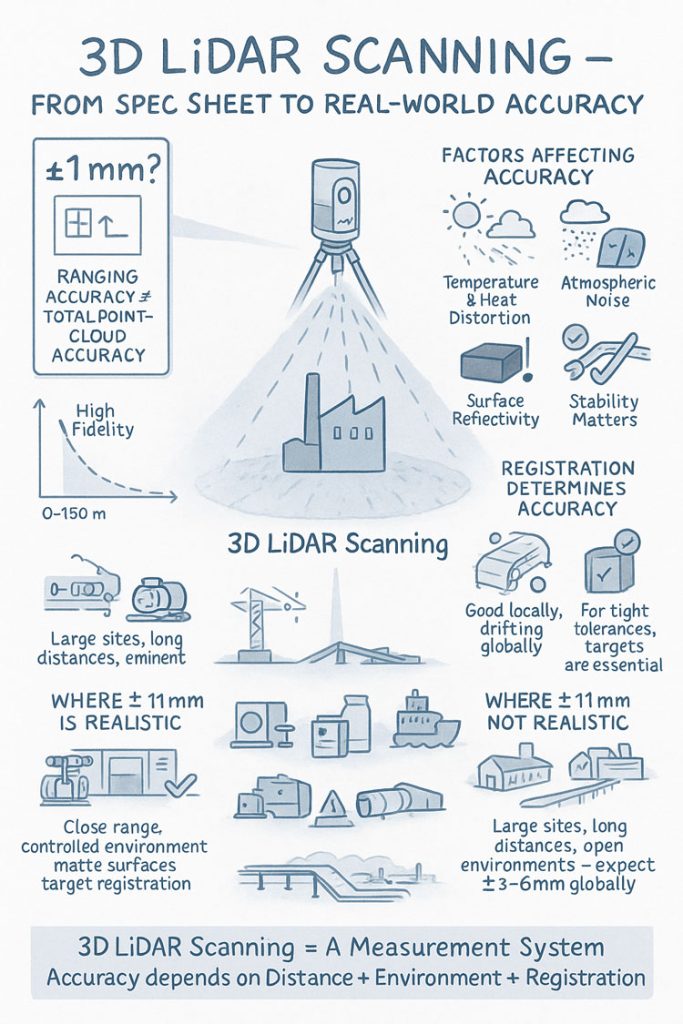
Infographic explaining 3D LiDAR scanning accuracy, showing a scanner capturing a building and highlighting factors that affect accuracy such as temperature, atmospheric noise, surface reflectivity and tripod stability. Includes diagrams comparing realistic versus unrealistic ±1 mm accuracy, the impact of distance, environment and registration quality, and notes that large open sites typically achieve ±3–6 mm global accuracy.

1. What FARO’s “±1 mm Accuracy” Really Means in 3D LiDAR Scanning

The ±1 mm number applies only to the internal distance measurement unit inside the scanner. It reflects how accurately the laser measures a single distance in controlled conditions.

It does not guarantee:

  • ±1 mm for every point in a full plant model
  • ±1 mm for every dimension extracted for engineering
  • ±1 mm global accuracy across large multi-scan datasets

In 3D LiDAR scanning, ranging accuracy is just one ingredient. Real-world accuracy is shaped by distance, reflectivity, scan geometry and how multiple scans are registered together.


2. How Accuracy Changes With Distance in Real Projects

Even though the S150 and S350 list the same ranging accuracy, their 3D LiDAR scanning performance changes as distance increases. This is due to beam divergence, angular error, environment and surface reflectivity.

Typical real-world behaviour:

  • 0–10 m: extremely precise, often sub-millimetre
  • 10–25 m: excellent for engineering work, only slight noise increase
  • 25–50 m: more noticeable noise and increasing angular error
  • 50–100 m: atmospheric distortion and reduced overlap become evident
  • Near maximum range: still useful for mapping conveyors, yards and structures, but not suitable for tight fabrication tolerances

This distance-based behaviour is one of the most important truths to understand about 3D LiDAR scanning in field conditions.


3. Ranging Accuracy vs Positional Accuracy vs Global Accuracy

Anyone planning a project involving 3D LiDAR scanning must distinguish between:

Ranging Accuracy

The ±1 mm value — only the distance measurement.

3D Positional Accuracy

The true X/Y/Z location of a point relative to the scanner.

Global Point Cloud Accuracy

How accurate the entire dataset is after registration.

Global accuracy is the number engineers depend on, and it is normally around ±3–6 mm for large industrial sites — completely normal for terrestrial 3D LiDAR scanning.


4. What Real Field Testing Reveals About FARO S-Series Accuracy

Independent practitioners across mining, infrastructure, CHPPs, plants and structural environments report similar results when validating 3D LiDAR scanning against survey control:

  • ±2–3 mm accuracy in compact plant rooms
  • ±5–10 mm across large facilities
  • Greater drift across long, open, feature-poor areas

These outcomes are not equipment faults — they are the natural result of how 3D LiDAR scanning behaves in open, uncontrolled outdoor environments.


5. Why Registration Matters More Than the Scanner Model

Most real-world error in 3D LiDAR scanning comes from registration, not the laser itself.

Cloud-to-Cloud Registration

Good for dense areas, less reliable for long straight conveyors, open yards or tanks.

Target-Based Registration

Essential for high-precision engineering work.
Allows tie-in to survey control and dramatically improves global accuracy.

If your project needs ±2–3 mm globally, target control is mandatory in all 3D LiDAR scanning workflows.


6. Surface Reflectivity and Environmental Effects

Reflectivity dramatically affects measurement quality during 3D LiDAR scanning:

  • Matte steel and concrete return excellent data
  • Rusted surfaces return good data
  • Dark rubber, black plastics and wet surfaces reduce accuracy
  • Stainless steel and glass behave unpredictably

Environmental factors — wind, heat shimmer, dust, rain — also reduce accuracy. Early morning or late afternoon typically produce better 3D LiDAR scanning results on mining and industrial sites.


7. When ±1 mm Is Actually Achievable

True ±1 mm accuracy in 3D LiDAR scanning is realistic when:

  • Working within 10–15 m
  • Surfaces are matte and reflective
  • Registration uses targets
  • Tripod stability is high
  • Conditions are controlled

This makes it suitable for:

  • Pump rooms
  • Valve skids
  • Structural baseplates
  • Reverse engineering
  • Small mechanical upgrades

But achieving ±1 mm across a full plant, CHPP, or yard is outside the capability of any terrestrial 3D LiDAR scanning workflow.


8. S150 vs S350: Which One for Your Accuracy Needs?

S150 – Engineering-Focused Precision

Ideal for industrial rooms, skids, structural steel and retrofit design work where short-to-mid-range accuracy is essential.

S350 – Large-Area Coverage

Perfect for conveyors, rail lines, yards, and outdoor infrastructure.
Global accuracy must be survey-controlled for tight tolerances.

Both scanners deliver excellent 3D LiDAR scanning performance, but the S150 is the engineering favourite while the S350 is the large-site specialist.


9. What to Specify in Contracts to Avoid Misunderstandings

Instead of stating:

“Scanner accuracy ±1 mm.”

Specify:

  • Local accuracy requirement (e.g., ±2 mm at 15 m)
  • Global accuracy requirement (e.g., ±5 mm total dataset)
  • Registration method (mandatory target control)
  • Environmental constraints
  • Verification method (e.g., independent survey checks)

This ensures everyone understands what 3D LiDAR scanning will realistically deliver.


10. When a Terrestrial Scanner Is Not Enough

Do not rely solely on 3D LiDAR scanning for:

  • Machine alignment <1 mm
  • Bearing or gearbox placement
  • Certified dimensional inspection
  • Metrology-level tolerances

In these cases, supplement scanning with:

  • Laser trackers
  • Total stations
  • Metrology arms
  • Hybrid workflows

Conclusion: The Real Truth About 3D LiDAR Scanning Accuracy

FARO’s S150 and S350 are outstanding tools for industrial 3D LiDAR scanning, but the ±1 mm spec does not tell the full story. Real-world accuracy is a combination of:

  • Distance
  • Registration method
  • Surface reflectivity
  • Site conditions
  • Workflow discipline

When used correctly, these scanners consistently deliver high-quality, engineering-grade point clouds suitable for clash detection, retrofit design, fabrication planning and as-built documentation.

3D LiDAR scanning is not just a laser — it is an entire measurement system.
And when the system is applied with care, it produces reliable, repeatable data that reduces rework, improves safety, and strengthens decision-making across mining, construction, fabrication and industrial operations.

Where Is your project

3D Scanning Sydney CBD3D Scanning Brisbane CBD
3D Scanning across Melbourne3D Scanning across Perth
3D Scanning across Adelaide3D Scanning in The Hunter Valley
3D Scanning Mount Isa3D Scanning Emerald
3D Laser Scanning Central Coast3D Scanning in The Pilbara
3d Scanning other Areas of Australia3D Scanning Outside Australia
Hamilton By Design logo displayed on a blue tilted rectangle with a grey gradient background
Name
You would like to:

3D CAD Modelling | 3D Scanning

3D Experience Platform Login

3D Scanning for Construction

Transforming Projects with 3D Scanning

3D LiDAR Scanning – Digital Quality Assurance