Laser Scanning Hunter Valley: Delivering Engineering-Grade Accuracy for Mining, Manufacturing and Industrial Projects

The Hunter Valley remains one of Australia’s most important industrial regions. With world-class mining operations, CHPP facilities, fabrication workshops, power generation assets and major industrial precincts, the region depends on precision, reliability and efficient project planning. As plants age and infrastructure expands, the challenge of capturing accurate site information becomes increasingly critical.

This is why laser scanning in the Hunter Valley has rapidly become a foundational tool for maintenance, engineering, redesign, shutdown preparation and fabrication accuracy. Organisations across the region are turning to laser scanning because the demands of modern industrial work simply cannot be met with traditional tape measurements or outdated drawings.

Hamilton By Design is proud to deliver engineering-grade laser scanning throughout the Hunter Valley, supporting safer worksites, faster project execution and significantly improved installation outcomes. Below, we explore why laser scanning is essential, how the technology works and how it transforms operations across the region.


Why Laser Scanning Has Become Essential in the Hunter Valley

Across the Hunter, very few sites resemble their original drawings. Over decades, plants evolve—structures deform, temporary fixes become permanent, equipment shifts, and countless undocumented modifications occur.

These realities create a major problem:
Projects that rely on inaccurate measurements inevitably face delays, rework and installation challenges.

The consequences of bad data include:

  • Structural steel not fitting on site
  • Conveyor alignment issues
  • Misaligned chutes or transfer points
  • Inaccurate pipe spool lengths
  • Unexpected clashes in congested areas
  • Extended shutdown duration
  • Significant cost blowouts

By contrast, laser scanning in the Hunter Valley provides a millimetre-accurate digital representation of the real site, eliminating uncertainty and enabling confident engineering decisions.


How Laser Scanning Works

Laser scanning—also known as LiDAR (Light Detection and Ranging)—captures millions of precise data points across a site in seconds. These points create a “point cloud,” a detailed 3D representation of the scanned environment.

The Hamilton By Design workflow typically includes:

1. On-Site High-Accuracy Capture

We scan assets such as:

  • Structural frames
  • Conveyors, transfer towers and walkways
  • Chutes, bins, hoppers and material-handling systems
  • Tanks and pipe networks
  • Mechanical equipment
  • Buildings and platforms
  • Processing areas and plant rooms

Scanning is performed safely, quickly and with minimal disruption to operations.

2. Point Cloud Processing

Individual scans are aligned and merged into a single, unified as-built dataset.

3. CAD Modelling

From the point cloud, we create:

  • Accurate 3D models
  • General arrangement drawings
  • Fabrication details
  • DXF files for workshop use
  • Digital templates for pattern development

4. Engineering & Fabrication Support

We run digital checks for:

  • Clearances
  • Misalignments
  • Bolt pattern accuracy
  • Clash detection
  • Fit-up assurance

This ensures all new components, structures and mechanical systems integrate correctly the first time.


Industries in the Hunter Valley Using Laser Scanning

1. Mining & Coal Handling Preparation Plants (CHPPs)

The Hunter Valley is one of Australia’s largest mining hubs, and laser scanning has become indispensable for:

  • Chute redesign and optimisation
  • Conveyor alignment and pulley checks
  • Structural replacements
  • Screening and crushing system upgrades
  • Transfer tower modifications
  • Bin and hopper geometry capture
  • Shutdown planning and scope definition

In CHPP environments—where dust, vibration, wear and deformation are constant—accurate as-built data is essential for safe and efficient upgrades.


2. Local Fabrication Workshops

Fabricators across Singleton, Muswellbrook, Rutherford and Thornton rely on precise digital information to ensure their products fit perfectly in the field. Laser scanning supports:

  • Steel replacement projects
  • Pipe spool fabrication
  • Custom chutes and transfer systems
  • Platform and walkway upgrades
  • Reverse engineering worn components

By basing fabrication on exact site geometry, rework and installation delays are dramatically reduced.


3. Power Stations and Energy Infrastructure

The Hunter Valley contains major energy assets requiring constant maintenance and upgrades. These aging facilities benefit greatly from laser scanning for:

  • Structural integrity assessments
  • Boiler house modifications
  • Pipe rerouting and replacements
  • Access platform upgrades
  • Plant room modelling
  • Compliance documentation

Laser scanning supports safe access, better planning and accurate engineering.


4. Industrial, Manufacturing and Infrastructure Projects

The region’s industrial footprint is expanding, and many facilities require precise as-built data for:

  • Renovations or expansions
  • Facility mapping
  • Mechanical upgrades
  • Brownfield redevelopment
  • BIM integration

Laser scanning provides the detail needed to plan these works correctly.


Benefits of Laser Scanning in the Hunter Valley

1. Millimetre Accuracy

Unlike manual measurements, laser scanning captures true geometry—not assumptions.

2. Reduced Rework

Digitally verified data ensures that fabrication is correct the first time.

3. Improved Safety

No need for workers to climb, stretch, or enter hazardous areas to measure.

4. Faster Shutdowns

Accurate pre-planning reduces onsite delays.

5. Digital Collaboration

Point clouds allow teams, contractors and engineers to review the site remotely.

6. Enhanced Engineering Confidence

Decisions are made on verified data, improving outcomes across the entire project lifecycle.


The Hamilton By Design Advantage

Hamilton By Design delivers more than just scanning—we combine decades of engineering, drafting and fabrication experience to interpret the data with real-world understanding.

What Sets Us Apart:

Engineering-Driven Approach

We understand the mechanical and structural context behind each scan.

Full Digital Workflow

From scan → point cloud → 3D model → fabrication drawings → installation, we support your entire project.

Local Knowledge of Hunter Valley Industry

We work routinely with mines, CHPPs, fabricators and industrial facilities across the region.

Fabrication-Ready Outputs

All models and drawings are created with workshop requirements and site constraints in mind.

Confidence Before Installation

We digitally confirm fitment before steel is cut—removing risk.


Applications Where Laser Scanning Delivers Immediate Value

  • Chute replacements
  • Conveyor system upgrades
  • Access platforms and walkways
  • Crusher and screen changes
  • Transfer tower redesign
  • Pipe spool fabrication
  • Structural steel alignment checks
  • Bin, tank and hopper measurement
  • Reverse engineering
  • Brownfield plant expansions

Anywhere accuracy matters, scanning is the superior choice.


Laser Scanning in the Hunter Valley: The New Standard

Across the region, laser scanning is now considered a must-have for safe, efficient and predictable project delivery. As plants age and the complexity of upgrades increases, organisations that invest in accurate data significantly outperform those relying on outdated drawings or manual measuring.

For engineering teams, maintenance planners, workshop fabricators and shutdown coordinators, laser scanning provides the certainty required to deliver work on time and on budget.


Partner with Hamilton By Design

When you choose Hamilton By Design for laser scanning in the Hunter Valley, you’re choosing:

  • Accuracy
  • Safety
  • Engineering reliability
  • Better planning
  • Reduced risk
  • Efficient installation

We’re ready to support your next shutdown, upgrade, redesign or fabrication project with the digital precision it deserves.

Contact Hamilton By Design today to discuss your site and discover how laser scanning can transform your project outcomes.
Hamilton By Design logo displayed on a blue tilted rectangle with a grey gradient background

Hunter Valley Laser Scanning: Transforming Engineering Accuracy Across Mining, Manufacturing and Infrastructure

3D Laser Scanning in Singleton and the Hunter: Delivering Accuracy for Mining, Manufacturing and Industrial Projects

3D Laser Scanning

3D Scanning in The Hunter Valley

Name
You would like to:

The Real-World Accuracy of 3D LiDAR Scanning With FARO S150 & S350 Scanners

When people first explore 3D LiDAR scanning, one of the most eye-catching numbers in any product brochure is the advertised accuracy. FARO’s Focus S150 and S350 scanners are often promoted as delivering “±1 mm accuracy,” which sounds definitive and easy to rely on for engineering, mining and fabrication work. But anyone who has spent time working with 3D LiDAR scanning in real industrial environments understands that accuracy isn’t a single number — it is a system of interrelated factors.

This article explains what the ±1 mm specification from FARO really means, how accuracy shifts with distance, and what engineers, project managers and clients need to do to achieve dependable results when applying 3D LiDAR scanning on live sites.


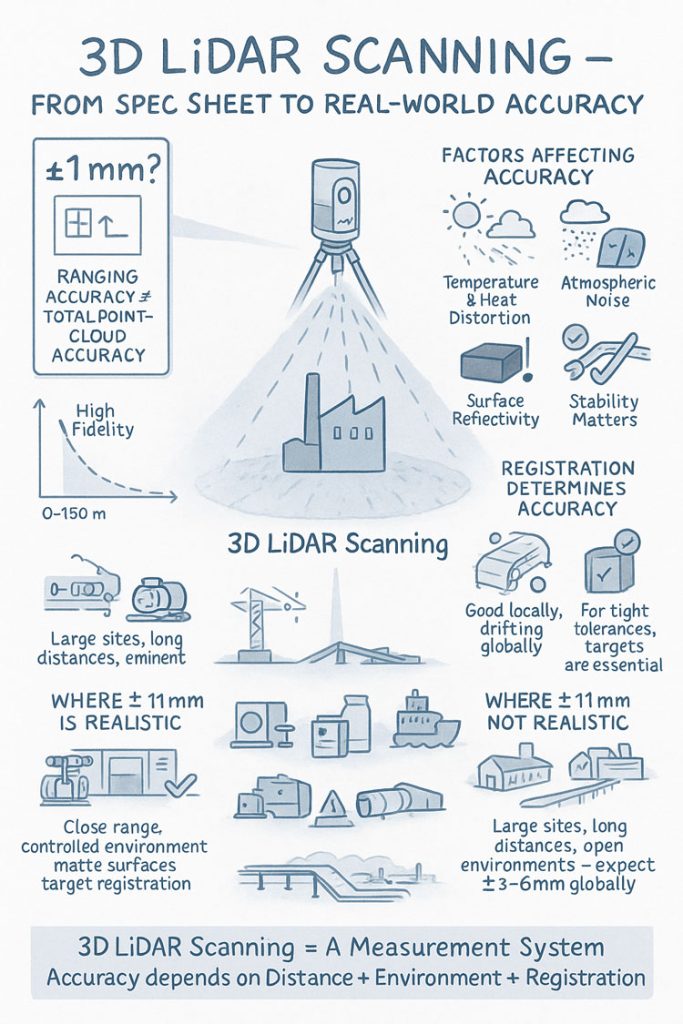
Infographic explaining 3D LiDAR scanning accuracy, showing a scanner capturing a building and highlighting factors that affect accuracy such as temperature, atmospheric noise, surface reflectivity and tripod stability. Includes diagrams comparing realistic versus unrealistic ±1 mm accuracy, the impact of distance, environment and registration quality, and notes that large open sites typically achieve ±3–6 mm global accuracy.

1. What FARO’s “±1 mm Accuracy” Really Means in 3D LiDAR Scanning

The ±1 mm number applies only to the internal distance measurement unit inside the scanner. It reflects how accurately the laser measures a single distance in controlled conditions.

It does not guarantee:

  • ±1 mm for every point in a full plant model
  • ±1 mm for every dimension extracted for engineering
  • ±1 mm global accuracy across large multi-scan datasets

In 3D LiDAR scanning, ranging accuracy is just one ingredient. Real-world accuracy is shaped by distance, reflectivity, scan geometry and how multiple scans are registered together.


2. How Accuracy Changes With Distance in Real Projects

Even though the S150 and S350 list the same ranging accuracy, their 3D LiDAR scanning performance changes as distance increases. This is due to beam divergence, angular error, environment and surface reflectivity.

Typical real-world behaviour:

  • 0–10 m: extremely precise, often sub-millimetre
  • 10–25 m: excellent for engineering work, only slight noise increase
  • 25–50 m: more noticeable noise and increasing angular error
  • 50–100 m: atmospheric distortion and reduced overlap become evident
  • Near maximum range: still useful for mapping conveyors, yards and structures, but not suitable for tight fabrication tolerances

This distance-based behaviour is one of the most important truths to understand about 3D LiDAR scanning in field conditions.


3. Ranging Accuracy vs Positional Accuracy vs Global Accuracy

Anyone planning a project involving 3D LiDAR scanning must distinguish between:

Ranging Accuracy

The ±1 mm value — only the distance measurement.

3D Positional Accuracy

The true X/Y/Z location of a point relative to the scanner.

Global Point Cloud Accuracy

How accurate the entire dataset is after registration.

Global accuracy is the number engineers depend on, and it is normally around ±3–6 mm for large industrial sites — completely normal for terrestrial 3D LiDAR scanning.


4. What Real Field Testing Reveals About FARO S-Series Accuracy

Independent practitioners across mining, infrastructure, CHPPs, plants and structural environments report similar results when validating 3D LiDAR scanning against survey control:

  • ±2–3 mm accuracy in compact plant rooms
  • ±5–10 mm across large facilities
  • Greater drift across long, open, feature-poor areas

These outcomes are not equipment faults — they are the natural result of how 3D LiDAR scanning behaves in open, uncontrolled outdoor environments.


5. Why Registration Matters More Than the Scanner Model

Most real-world error in 3D LiDAR scanning comes from registration, not the laser itself.

Cloud-to-Cloud Registration

Good for dense areas, less reliable for long straight conveyors, open yards or tanks.

Target-Based Registration

Essential for high-precision engineering work.
Allows tie-in to survey control and dramatically improves global accuracy.

If your project needs ±2–3 mm globally, target control is mandatory in all 3D LiDAR scanning workflows.


6. Surface Reflectivity and Environmental Effects

Reflectivity dramatically affects measurement quality during 3D LiDAR scanning:

  • Matte steel and concrete return excellent data
  • Rusted surfaces return good data
  • Dark rubber, black plastics and wet surfaces reduce accuracy
  • Stainless steel and glass behave unpredictably

Environmental factors — wind, heat shimmer, dust, rain — also reduce accuracy. Early morning or late afternoon typically produce better 3D LiDAR scanning results on mining and industrial sites.


7. When ±1 mm Is Actually Achievable

True ±1 mm accuracy in 3D LiDAR scanning is realistic when:

  • Working within 10–15 m
  • Surfaces are matte and reflective
  • Registration uses targets
  • Tripod stability is high
  • Conditions are controlled

This makes it suitable for:

  • Pump rooms
  • Valve skids
  • Structural baseplates
  • Reverse engineering
  • Small mechanical upgrades

But achieving ±1 mm across a full plant, CHPP, or yard is outside the capability of any terrestrial 3D LiDAR scanning workflow.


8. S150 vs S350: Which One for Your Accuracy Needs?

S150 – Engineering-Focused Precision

Ideal for industrial rooms, skids, structural steel and retrofit design work where short-to-mid-range accuracy is essential.

S350 – Large-Area Coverage

Perfect for conveyors, rail lines, yards, and outdoor infrastructure.
Global accuracy must be survey-controlled for tight tolerances.

Both scanners deliver excellent 3D LiDAR scanning performance, but the S150 is the engineering favourite while the S350 is the large-site specialist.


9. What to Specify in Contracts to Avoid Misunderstandings

Instead of stating:

“Scanner accuracy ±1 mm.”

Specify:

  • Local accuracy requirement (e.g., ±2 mm at 15 m)
  • Global accuracy requirement (e.g., ±5 mm total dataset)
  • Registration method (mandatory target control)
  • Environmental constraints
  • Verification method (e.g., independent survey checks)

This ensures everyone understands what 3D LiDAR scanning will realistically deliver.


10. When a Terrestrial Scanner Is Not Enough

Do not rely solely on 3D LiDAR scanning for:

  • Machine alignment <1 mm
  • Bearing or gearbox placement
  • Certified dimensional inspection
  • Metrology-level tolerances

In these cases, supplement scanning with:

  • Laser trackers
  • Total stations
  • Metrology arms
  • Hybrid workflows

Conclusion: The Real Truth About 3D LiDAR Scanning Accuracy

FARO’s S150 and S350 are outstanding tools for industrial 3D LiDAR scanning, but the ±1 mm spec does not tell the full story. Real-world accuracy is a combination of:

  • Distance
  • Registration method
  • Surface reflectivity
  • Site conditions
  • Workflow discipline

When used correctly, these scanners consistently deliver high-quality, engineering-grade point clouds suitable for clash detection, retrofit design, fabrication planning and as-built documentation.

3D LiDAR scanning is not just a laser — it is an entire measurement system.
And when the system is applied with care, it produces reliable, repeatable data that reduces rework, improves safety, and strengthens decision-making across mining, construction, fabrication and industrial operations.

Where Is your project

3D Scanning Sydney CBD3D Scanning Brisbane CBD
3D Scanning across Melbourne3D Scanning across Perth
3D Scanning across Adelaide3D Scanning in The Hunter Valley
3D Scanning Mount Isa3D Scanning Emerald
3D Laser Scanning Central Coast3D Scanning in The Pilbara
3d Scanning other Areas of Australia3D Scanning Outside Australia
Hamilton By Design logo displayed on a blue tilted rectangle with a grey gradient background
Name
You would like to:

3D CAD Modelling | 3D Scanning

3D Experience Platform Login

3D Scanning for Construction

Transforming Projects with 3D Scanning

3D LiDAR Scanning – Digital Quality Assurance

Stop Reacting — Start Engineering

How Smart Mechanical Strategies Extend CHPP Life

Every coal wash plant in Australia tells the same story: constant throughput pressure, harsh operating conditions, and the never-ending battle against wear, corrosion, and unplanned downtime. The reality is simple — if you don’t engineer for reliability, you’ll spend your time repairing failure.

At Hamilton By Design, we specialise in mechanical engineering, 3D scanning, and digital modelling for coal handling and preparation plants (CHPPs). Our goal is to help site teams transition from reactive maintenance to a precision, data-driven strategy that keeps production steady and predictable.

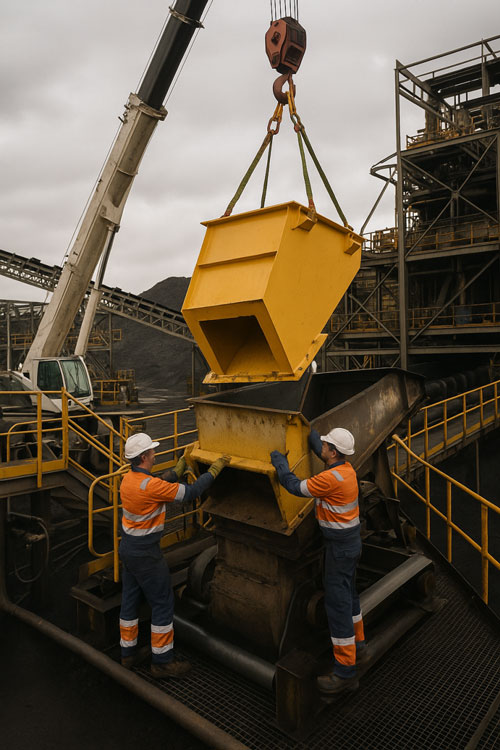
Workers guiding a crane-lifted yellow chute into position at a coal handling and preparation plant, with conveyor infrastructure and safety equipment visible on site

Design for Reliability — Not Reaction

Reliability begins with smart mechanical design. Poor geometry, limited access, and undersized components lead to fatigue and repeated downtime. Instead, modern CHPP maintenance programs start by engineering for fit, lift, and life:

  • Fit: Design components that align with the existing structure — every bolt, flange, and mating face verified digitally before fabrication.
  • Lift: Incorporate certified lifting points that comply with AS 4991 Lifting Devices, and ensure clear access paths for cranes or chain blocks.
  • Life: Select wear materials suited to the physics of the process — quenched and tempered steel for impact, rubber or ceramic for abrasion, and UHMWPE for slurry lines.

It’s not just about parts; it’s about engineering foresight. A well-designed plant component is safer to install, easier to inspect, and lasts longer between shutdowns.


Scan What You See — Not What You Think You Have

Over time, every wash plant drifts from its original drawings. Field welds, retrofits, and corrosion mean that “as-built” and “as-exists” are rarely the same thing.

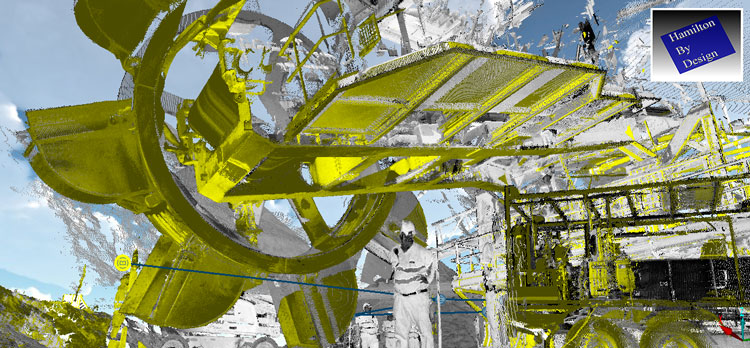
That’s where LiDAR scanning transforms maintenance. Using sub-millimetre accuracy, 3D laser scans capture your plant exactly as it stands — every pipe spool, every chute, every bolt hole.

With this data, our engineers can:

  • Overlay new models directly into your point cloud to confirm fit-up before fabrication.
  • Identify alignment errors, corrosion zones, and clearance conflicts before shutdowns.
  • Generate true digital twins that allow for predictive maintenance and simulation.

LiDAR scanning isn’t just a measurement tool; it’s an insurance policy against rework and lost production.

3D LiDAR point cloud of a CHPP plant showing detailed structural geometry, equipment, platforms, and personnel captured during an industrial site scan for engineering and upgrade planning.

Corrosion: The Hidden Killer in Every CHPP

Coal and water don’t just move material — they create acidic environments that eat through untreated or aging steel. In sumps, launders, and under conveyors, corrosion silently compromises strength until a structure is no longer safe to walk on.

Regular inspections are the first line of defence. At Hamilton By Design, we recommend combining:

  • Daily visual checks by operators for surface rust and coating damage.
  • Thickness testing during shutdowns to track wall loss on chutes and pipes.
  • 3D scan comparisons every 6–12 months to quantify deformation and corrosion in critical structures.

With modern tools, you can see corrosion coming long before it becomes a failure.


From Data to Decision: Predictive Maintenance in Action

A coal wash plant produces a river of data — motor loads, vibration levels, pump pressures, liner thickness, and flow rates. The key is turning that data into insight.

By integrating scanning results, maintenance records, and sensor data, plant teams can identify trends that point to future breakdowns. For example:

  • Vibration trending can reveal bearing fatigue weeks before failure.
  • Load monitoring can detect screen blinding or misalignment.
  • Scan data overlays can show sagging supports or displaced chutes.

When you understand what your plant is telling you, you move from reacting to problems to predicting and preventing them.


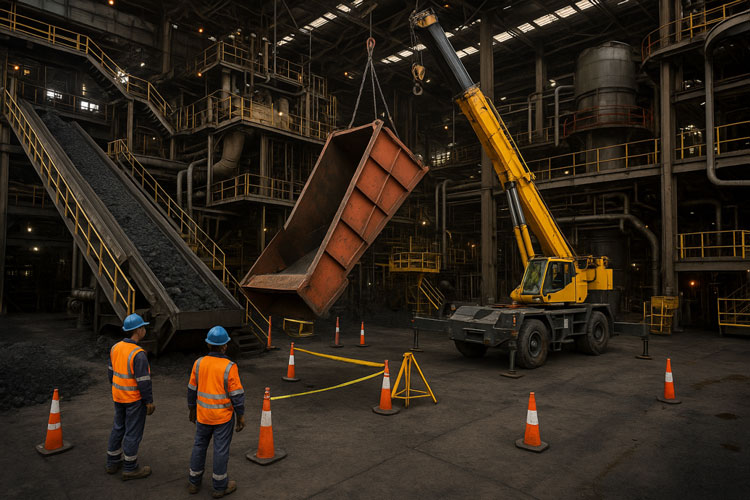
Industrial shutdown scene showing workers monitoring a mobile crane lifting a large steel chute inside a coal processing plant, with safety cones and exclusion zones in place

Shutdowns: Planned, Precise, and Productive

Every shutdown costs money — the real goal is to make every hour count. The best shutdowns start months ahead with validated design data and prefabrication QA.

Before you cut steel or mobilise cranes, every component should be digitally proven to fit. Trial assemblies, lifting studies, and bolt access checks prevent costly surprises once you’re on the clock.

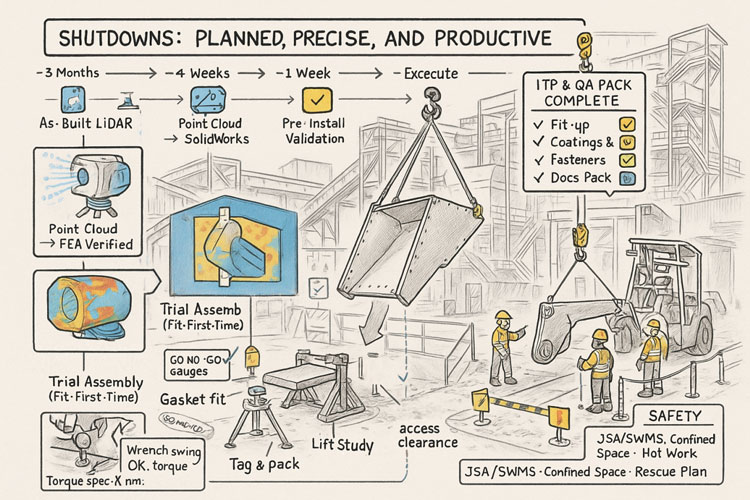
At Hamilton By Design, our process combines:

  • LiDAR scanning to confirm as-built geometry.
  • SolidWorks modelling and FEA for mechanical verification.
  • Pre-installation validation to ensure bolt holes, flanges, and lift paths align on day one.

That’s how you replace chutes, spools, and launders in a fraction of the usual time — safely, and with confidence.

Hand-drawn infographic showing the shutdown workflow from LiDAR scanning and FEA verification through SolidWorks modelling, pre-install validation, trial assembly, lift study, and execution, including ITP and QA checks, safety steps, and onsite installation activities

The Payoff: Reliability You Can Measure

The plants that invest in engineering-led maintenance see results that are tangible and repeatable:

Improvement AreaTypical Gain
Reduced unplanned downtime30–40%
Increased liner lifespan25–50%
Shorter shutdown duration10–20%
Fewer fit-up issues and rework60–80%
Improved safety performance20–30%

Reliability isn’t luck — it’s engineered.


Your Next Step: A Confidential Mechanical Assessment

Whether your plant is in the Bowen Basin, Hunter Valley, or Central West NSW, our team can deliver a confidential mechanical and scanning assessment of your wash plant.

We’ll benchmark your current maintenance strategy, identify high-risk areas, and provide a clear roadmap toward predictive, engineered reliability.

📩 For a confidential assessment of your current wash plant, contact:
info@hamiltonbydesign.com.au

Stop reacting. Start engineering. Build reliability that lasts.

Hamilton By Design Logo

Mechanical Engineering | Structural Engineering

Mechanical Drafting | Structural Drafting

3D CAD Modelling | 3D Scanning

Chute Design

Enhancing Plant Efficiency with Best Maintenance Practices: A White Paper by Hamilton By Design

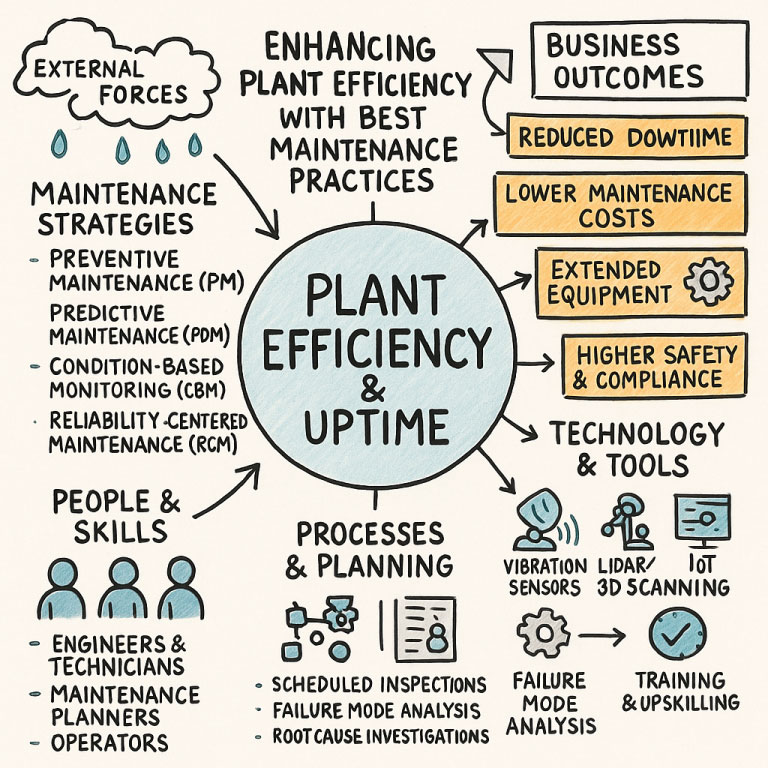
Hand-drawn infographic titled “Plant Efficiency & Uptime,” showing the key elements that enhance plant performance. Surrounding the central circle are categories including maintenance strategies (PM, PDM, CBM, RCM), people and skills (engineers, technicians, planners, operators), processes and planning (inspections, failure mode analysis, root-cause investigations), and technology and tools (vibration sensors, LiDAR/3D scanning, IoT, training). Benefits highlighted include reduced downtime, lower maintenance costs, extended equipment life, and higher safety and compliance.


In today’s competitive industrial landscape, maintaining high levels of Overall Equipment Effectiveness (OEE) is a cornerstone of operational success. Achieving this requires adopting advanced maintenance practices that minimize downtime, reduce operational costs, and extend the lifecycle of critical assets.

This white paper outlines best maintenance practices aligned with the ISO 18436.2 standard and highlights how Hamilton By Design’s team of mechanical engineers can partner with your organization to enhance your plant’s OEE. By leveraging our expertise in condition-based and predictive maintenance, we can optimize equipment performance and drive measurable improvements in productivity and reliability.

The Role of Maintenance in Maximizing OEE

OEE is a comprehensive measure of manufacturing productivity, defined by three critical components:

  1. Availability: Minimizing downtime to maximize operational hours.
  2. Performance: Ensuring equipment runs at optimal speeds.
  3. Quality: Reducing defects and waste during production.

Maintenance strategies are key to influencing these factors. Moving beyond reactive approaches to predictive and condition-based maintenance can significantly enhance equipment reliability and efficiency, ensuring better alignment with OEE goals.


Adopting Best Maintenance Practices

Condition-Based Maintenance (CBM)

CBM involves monitoring the real-time condition of equipment to predict and prevent failures. At Hamilton By Design, we integrate cutting-edge technologies like vibration analysis, thermography, and ultrasonic testing to enable proactive interventions before problems escalate.

How CBM Enhances OEE:
  • Reduces unplanned downtime (Availability).
  • Maintains consistent performance by addressing issues early (Performance).
  • Prevents production disruptions that cause defects (Quality).

Predictive Maintenance (PdM)

Predictive maintenance leverages data analytics to anticipate potential failures. By applying ISO 18436.2-certified practices, we implement advanced diagnostic tools and algorithms to forecast maintenance needs with precision.

Our Approach:
  • Deploy vibration analysis tools managed by certified Level II and III analysts.
  • Use infrared thermography to detect heat anomalies in electrical and mechanical systems.
  • Employ ultrasonic testing to identify leaks and structural weaknesses.
Benefits for OEE:
  • Prolonged equipment lifespan by addressing issues at their inception.
  • Higher productivity with fewer interruptions.
  • Reduced maintenance costs through targeted interventions.

Reliability-Centered Maintenance (RCM)

RCM focuses on optimizing maintenance strategies for each asset, emphasizing a deep understanding of failure modes and effects. Our engineers employ RCM to prioritize maintenance tasks that align with your plant’s specific OEE goals.

Steps We Implement:
  1. Asset Function Analysis: Understanding the purpose and criticality of each asset.
  2. Failure Mode and Effects Analysis (FMEA): Identifying risks and developing mitigation strategies.
  3. Data-Driven Decision Making: Using condition monitoring data to guide maintenance schedules.
Impact on OEE:
  • Ensures maintenance is aligned with production priorities.
  • Reduces waste and rework caused by unexpected equipment malfunctions.

Leveraging ISO 18436.2 Standards

ISO 18436.2 defines the competencies required for condition monitoring personnel, ensuring a standardized approach to predictive maintenance. Hamilton By Design’s mechanical engineers are certified under this standard, offering expertise in:

  • Vibration analysis for detecting unbalance, misalignment, and bearing faults.
  • Developing and managing comprehensive condition monitoring programs.
  • Interpreting and analyzing complex diagnostic data for actionable insights.

How Hamilton By Design Can Assist

Customized Maintenance Solutions

We recognize that every plant has unique operational challenges. Hamilton By Design tailors maintenance strategies to your specific needs, focusing on:

  • Asset Criticality Assessment: Identifying and prioritizing key equipment for monitoring and intervention.
  • Technology Integration: Implementing IoT-enabled sensors, data platforms, and diagnostic tools.
  • Program Development: Designing maintenance schedules aligned with production cycles and OEE targets.

Expert Training and Certification

Our team provides in-depth training for your personnel, ensuring they gain ISO 18436.2 certification and the skills to sustain advanced maintenance programs.

Ongoing Support and Continuous Improvement

Maintenance isn’t static. Hamilton By Design offers ongoing support to refine your maintenance practices, ensuring your plant stays ahead of evolving operational demands.


Case Study: Improving OEE with Hamilton By Design

Challenge: A manufacturing plant experienced frequent equipment failures, leading to a 15% drop in OEE.

Solution: Hamilton By Design implemented a tailored predictive maintenance program:

  • Installed vibration sensors on critical rotating machinery.
  • Trained plant engineers to monitor and analyze data using ISO 18436.2 standards.
  • Provided ongoing diagnostics and recommendations.

Outcome:

  • Downtime was reduced by 40%, significantly improving availability.
  • Equipment performance stabilized, enhancing productivity.
  • Defects decreased by 25%, improving product quality.

Maximizing OEE requires a strategic approach to maintenance that integrates advanced tools, skilled personnel, and data-driven insights. Hamilton By Design’s mechanical engineers, certified under ISO 18436.2, are uniquely equipped to help your plant achieve these goals.

By partnering with us, you can transform your maintenance practices, boost operational efficiency, and secure a competitive edge in your industry. Let Hamilton By Design help you take the first step toward a more reliable and productive future.

WorkTrek – 8 Ways to Improve Your Plant Maintenance
Practical tips for improving maintenance processes, reducing downtime, and boosting productivity.
https://worktrek.com/blog/how-to-improve-plant-maintenance/

Petrochem Expert – Best Practices for Plant Maintenance
Explores how proper maintenance planning ensures efficiency, reliability, and safety in plant operations.
https://petrochemexpert.com/best-practices-for-plant-maintenance-ensuring-operational-efficiency-and-safety/

MaintBoard – Maintenance Planning Strategies
Highlights how scheduling, IoT tools, and predictive approaches improve plant reliability and uptime.
https://maintboard.com/maintenance-planning-strategies

Hamilton By Design – Mechanical Engineering for Mining & Industry
Showcases engineering solutions designed to reduce downtime, improve reliability, and optimize plant performance.
https://www.hamiltonbydesign.com.au/mechanical-engineering-mining-industry-australia/

Hamilton By Design – Drafting & LiDAR / Scanning Services
Describes how accurate scanning and drafting streamline retrofits, reducing errors and saving time during plant upgrades.
https://www.hamiltonbydesign.com.au/services-drafting-lidar-scanning/

Hamilton By Design – Blog: Maximising Uptime at Transfer Points
Focuses on optimising chutes, hoppers, and conveyors to minimise stoppages and keep production flowing.
https://www.hamiltonbydesign.com.au/blog-engineering-insights/

Mechanical Designers

Mechanical Engineers Design

3D Mechanical Engineering

Mechanical Engineering Consultants

3D Laser Scanning