3D Scanning Engineering in Katherine

3D Scanning Engineering in Katherine

Delivering Precision Laser Scanning, Engineering, 3D Modelling & Drafting for the Northern Territory

Katherine is one of the Northern Territoryโ€™s most strategically important regional centres โ€” a crossroads between mining operations, defence activity, agricultural production, remote-area logistics and critical transport routes stretching across northern Australia. Its unique mix of rugged landscapes, flood-influenced terrain, ageing infrastructure and rapidly evolving industrial needs means projects here must be planned with accuracy, resilience and efficiency.

Hamilton By Design supports clients across Katherine and the broader NT by providing 3D LiDAR laser scanning, mechanical and structural engineering, 3D CAD modelling, and fabrication-ready drafting โ€” an end-to-end digital engineering workflow built for remote, high-demand and complex environments.

Whether you are upgrading plant equipment, expanding a depot, documenting as-built assets, or planning remote-area infrastructure works, our engineering-led scanning approach gives you clarity, certainty and confidence.


๐ŸŒพ Why Katherine Is a Unique Engineering Environment

Katherine stands apart due to several defining characteristics:

1. Gateway to Major Mining & Resource Regions

Operations in the Big Rivers region, remote NT mining projects, and transport corridors rely on accurate infrastructure planning and maintenance. Many sites require brownfield upgrades, alignment checks, structural assessments and digital documentation โ€” all supported by LiDAR and 3D modelling.

2. Defence Presence and Strategic Infrastructure

RAAF Base Tindal and associated facilities create continual demand for compliant, precise, and well-documented engineering works. Laser scanning is vital for site upgrades, retrofits, and high-security facility documentation.

3. Flood-Prone and Geographically Complex Terrain

Katherineโ€™s unique landscape โ€” including floodplains, waterways, and uneven terrain โ€” makes traditional surveying difficult and risky. 3D scanning captures real-world geometry safely and with millimetre accuracy.

4. Remote-Area Logistics, Agriculture & Transport Hubs

From agricultural processing to transport depots and maintenance facilities, Katherine relies on accurate digital design to minimise downtime and prevent costly construction errors.

These factors make digital engineering, LiDAR scanning, and precision drafting essential for successful project delivery.


๐Ÿ“ก 3D LiDAR Laser Scanning for Katherine Projects

Hamilton By Design uses engineering-grade 3D LiDAR scanners to capture complete as-built site data, delivering unmatched accuracy for planning, upgrades and fabrication.

Our scanning captures:

  • structural steel, platforms, walkways and frames
  • mechanical equipment layouts and tie-in points
  • pipework, tanks, conveyors, pumps and processing equipment
  • buildings, depots, workshops and remote facility layouts
  • terrain, drainage paths, access roads and outdoor assets

This level of detail dramatically reduces risk, improves communication between contractors, and enables precise design outcomes.

๐Ÿ”— Learn more:
3D Laser Scanning


๐Ÿ“ 3D CAD Modelling โ€” Turning Scans Into Smart Engineering Models

Once scanned, our team converts the point cloud into intelligent CAD models that allow clients in Katherine to design, plan and fabricate with total confidence.

Our modelling supports:

  • mechanical systems (pumps, conveyors, screens, chutes)
  • structural frameworks, footings, platforms and access ways
  • equipment replacement studies and upgrade layouts
  • GA drawings, detailed fabrication drawings and isometrics
  • clash detection and layout optimisation before fabrication

๐Ÿ”— See our modelling capability:
3D CAD Modelling

This digital foundation is especially valuable in remote NT locations where rework, delays and inaccurate measurements are costly.


๐Ÿ”ง Engineering & FEA Capability for Katherineโ€™s Industries

Our mechanical and structural engineering services cover everything from feasibility assessments to detailed verification.

We offer:

  • structural integrity assessments
  • mechanical design for processing and handling systems
  • vibration, fatigue and load assessments
  • pressure vessel, piping and equipment support analysis
  • multi-body assemblies and operational load modelling

For advanced validation, our Finite Element Analysis (FEA) capabilities allow us to simulate stresses, heat transfer, vibration, buckling and more โ€” ensuring the final design meets compliance, safety and performance standards.

๐Ÿ”— Explore FEA capabilities:
FEA Capabilities


โœ๏ธ Drafting Services โ€” Fabrication-Ready Documentation

Hamilton By Design produces clear, accurate engineering drawings that support fabrication, installation and QA requirements.

Our drafting services include:

  • fabrication drawings
  • structural detailing
  • mechanical layouts
  • piping isometrics
  • BOMs and material schedules
  • as-built drawing production from LiDAR scans

๐Ÿ”— View our drafting services:
Drafting

This ensures Katherine workshops, fabricators and contractors can build efficiently and confidently โ€” with no need for guesswork on site.


๐Ÿš€ Why Hamilton By Design Is the Right Fit for Katherine

  • Engineer-led scanning, ensuring accuracy suitable for real engineering and fabrication
  • Fast mobilisation across the NT, Queensland and remote locations
  • Experience with mining, defence, industrial and infrastructure projects
  • A single-source workflow โ€” scan โ†’ model โ†’ engineer โ†’ draft
  • Reduced rework, downtime and installation delays

Whether youโ€™re maintaining infrastructure, upgrading equipment, or planning new facilities in Katherine, Hamilton By Design delivers clarity, precision and reliability at every stage.

3D Scanning & Engineering in Wagga Wagga

3D Scanning Engineering in Wagga Wagga

Wagga Wagga is one of Australiaโ€™s most strategically important inland cities โ€” a major defence hub, agricultural powerhouse, logistics centre and educational region supporting industries across the entire Riverina. As the largest inland city in NSW, Wagga continues to grow in population, infrastructure, industrial capability and economic relevance.

With this growth comes a rising demand for accuracy, efficiency and confidence in engineering design and upgrades. Whether itโ€™s agricultural processing, defence infrastructure, civil works, industrial facilities, logistics depots or fabrication workshops, Waggaโ€™s mix of new developments and brownfield environments requires precise digital data and robust engineering methods.

Hamilton By Design is proud to support the region with 3D LiDAR laser scanning, mechanical and structural engineering, 3D modelling and drafting โ€” a unified, end-to-end digital engineering service designed to reduce risk, improve accuracy and streamline delivery for Wagga Wagga projects.

This article explores why Wagga is such a unique engineering landscape โ€” and how modern 3D scanning and digital modelling are transforming how regional projects are measured, designed and executed.


Why Wagga Wagga Needs Modern 3D Scanning & Engineering

Wagga Waggaโ€™s infrastructure and economy are shaped by its diverse activity across defence, agriculture, manufacturing, logistics and civil development. This diversity creates a constant demand for accurate documentation, brownfield upgrades and precise spatial understanding.

1. Dual Defence Bases โ€” RAAF + Army

Wagga is home to:

  • RAAF Base Wagga
  • Kapooka Army Recruit Training Centre

This dual-defence identity means:

  • continuous construction and refurbishment
  • compliance-heavy engineering
  • complex facility upgrades
  • strict access and safety requirements

High-accuracy digital scanning reduces the risk of mismeasurement, clash issues and design delays across defence projects.

2. The Agricultural Heart of NSW

The Riverina is the stateโ€™s:

  • wheat capital
  • canola belt
  • lamb and beef centre
  • cotton and irrigation district
  • food-processing and logistics hub

Agricultural processing facilities, machinery sheds, silos, workshops, pumps, tanks and conveyors all benefit from precise digital as-built records.

3. A Logistics & Freight Crossroads

Wagga sits at major inland transport intersections:

  • Sturt Highway
  • Olympic Highway
  • Northโ€“South freight corridors
  • Inland Rail connectivity

3D scanning helps map freight depots, warehouses, storage yards, transport facilities and industrial estates with clarity.

4. A Strong Regional Manufacturing & Industrial Base

Waggaโ€™s fabrication and engineering industries service:

  • agriculture
  • heavy vehicles
  • defence
  • civil works
  • utilities
  • regional contractors

Upgrades, fit-outs and brownfield modifications require accuracy โ€” something traditional surveying often cannot deliver.


3D LiDAR Laser Scanning โ€” The New Standard for Accurate Engineering in Wagga

In any environment where equipment, structures or terrain must be measured, documented or redesigned, accuracy is everything. This is especially true in brownfield environments โ€” common across Waggaโ€™s industrial sites, workshops, irrigation systems, defence facilities and civil infrastructure.

Hamilton By Design uses engineering-grade 3D LiDAR scanning to capture millions of measurement points per second, generating a verified, millimetre-accurate digital twin of your site.

Our scanning captures:

  • structural steel, platforms, walkways
  • pipes, tanks, pumps, conveyors
  • building interiors and exteriors
  • workshops and fabrication areas
  • terrain, drainage lines and civil structures
  • mechanical equipment layouts
  • heritage or older buildings requiring accurate as-built documentation

Learn more about our scanning capability here:
๐Ÿ‘‰ 3D Laser Scanning

Benefits of 3D Scanning for Wagga Wagga Clients

  • fewer site visits
  • reduced rework during fabrication and installation
  • faster, more accurate design and drafting
  • safer site capture (less manual measurement)
  • reliable as-built documentation for tenders and approvals
  • better coordination between contractors

For defence, agriculture, logistics, manufacturing or civil projects โ€” the precision advantage is enormous.


From Scan Data to 3D Models โ€” Smarter, Safer, More Reliable Design

Once scanning is complete, the point cloud is transformed into intelligent 3D models using our engineering-modelling workflow. This allows us to design, modify and upgrade with total spatial awareness.

We produce:

  • SolidWorks mechanical models
  • structural framing and platform models
  • building and facility layouts
  • conveyor and process-system geometry
  • pipework and tank layouts
  • access and maintenance design
  • clash detection and interference checks
  • fabrication-ready drawings and BOMs

This ensures every component fits the first time โ€” a major benefit for rural and regional projects, where returning to site several times is costly.


Engineering Services Tailored to Wagga Waggaโ€™s Industrial Landscape

Hamilton By Design provides mechanical and structural engineering services built around real, verified site conditions.

Mechanical Engineering

  • materials-handling systems
  • mechanical retrofits and upgrades
  • pump, tank and pipework design
  • equipment mounting and alignment
  • flow optimisation and plant layout analysis
  • fatigue and stress calculations

Structural Engineering

  • platforms, frames, beams and supports
  • structural integrity assessments
  • upgrades to older or load-limited structures
  • civil/terrain interface modelling
  • building refurbishment engineering
  • compliance documentation

All engineering is backed by digital scanning for accuracy and clarity.


Where We Add the Most Value in Wagga Wagga

1. Defence Infrastructure Upgrades

Perfect for high-precision modifications to facilities that require:

  • as-built modelling
  • structural assessments
  • digital documentation
  • layout redesign
  • fit-outs and replacements

2. Agricultural Processing & Irrigation Systems

Scanning and modelling support:

  • tank farms
  • grain-handling facilities
  • mechanical conveyors
  • irrigation pump stations
  • machinery sheds and workshops

3. Manufacturing & Fabrication Workshops

Local fabricators gain:

  • accurate steelwork dimensions
  • verified tie-in points
  • reduced fit-up errors
  • dependable drafting packages

4. Civil & Terrain Modelling

Useful for:

  • drainage
  • culverts
  • bridges
  • access roads
  • levees
  • earthworks planning

5. Commercial Building Upgrades

3D scanning helps deliver:

  • accurate internal layouts
  • HVAC and services routing
  • renovation-ready documentation
  • concept models for redevelopment

Our Complete Workflow โ€” One Team, One Source of Accountability

Wagga clients often face challenges with multiple contractors handling scanning, modelling and engineering separately. Hamilton By Design unifies this into one seamless process:

  1. 3D LiDAR scanning
  2. Point cloud registration and precision review
  3. 3D modelling (mechanical, structural, architectural)
  4. Engineering design & analysis
  5. Fabrication-ready drafting
  6. Digital QA and documentation

This eliminates handover risks and ensures your project progresses smoothly from measurement to installation.


Hamilton By Design logo displayed on a blue tilted rectangle with a grey gradient background

Wagga Wagga Is Growing โ€” And Digital Engineering Helps It Grow Smarter

With major defence activity, expanding industrial sectors, agricultural innovation, logistics infrastructure and civil development, Wagga Waggaโ€™s future will rely heavily on accuracy, digital documentation and modern engineering methods.

Hamilton By Design is excited to support the region with:

  • precision 3D LiDAR scanning
  • mechanical & structural engineering
  • 3D modelling and drafting
  • documentation for tenders, fabrication and compliance
  • digital QA and long-term asset records

Whether your project involves a defence facility upgrade, an agricultural processing line, a logistics depot redesign, a civil structure, or a manufacturing fit-out โ€” we provide the accuracy and engineering confidence you need.

Whether you’re planning a new coastal asset, redesigning a workshop, improving a facility or upgrading existing infrastructure, our team ensures accuracy, safety and efficiency every step of the way.

Our Clients


Name
Would you like us to arrange a phone consultation for you?

Lidar Scanning & Engineering in Cairns

Where Tropical Ecosystems, Marine Industry & Industrial Precision Converge

Cairns is not just a gateway to reefs and rainforests โ€” itโ€™s a strategic hub for marine engineering, coastal infrastructure, environmental projects and remote-region logistics. With its proximity to the Great Barrier Reef, the Wet Tropics rainforest, a busy regional port, defence facilities and frequent heavy industrial and marine maintenance requirements, Cairns demands precision, flexibility and deep engineering expertise.

At Hamilton By Design, we understand those needs. Our offerings โ€” 3D LiDAR laser scanning, mechanical and structural engineering, 3D modelling, and fabrication-ready drafting โ€” are designed to meet the unique challenges of Northern Queensland. Whether itโ€™s a marine-grade fabrication yard, a coastal infrastructure project, a remote-region logistยญics facility or an environmental structure upgrade โ€” we deliver accuracy, compliance and quality from start to finish.


Why Cairns Is a Special Case for Engineering & Digital Surveying

Cairns combines tropical climate, marine exposure, rainforest-adjacent terrain, heritage sensitivity and strategic infrastructure in ways few other regional Australian cities do. Key aspects include:

  • Coastal and marine infrastructure needing resistance to corrosion, saltwater, tidal influence and cyclone-proofing.
  • Environmental and ecological constraints thanks to proximity to reef and rainforest โ€” making accurate as-built documentation, impact assessments, and careful planning essential.
  • A busy port, marine services and vessel maintenance sector โ€” requiring complex structural, mechanical and fabrication-grade precision.
  • Remote-area supply chains and logistics hubs serving Cape York, Torres Strait, Gulf communities and mining / remote-site projects.
  • Mixed infrastructure: commercial, marine, industrial, tourism-facing โ€” often on tight schedules due to weather, seasonal demand or regulatory windows.

In short: for projects in Cairns, thereโ€™s no room for guesswork. Whatโ€™s needed is digital accuracy, detailed planning and structured engineering from scanning to delivery.


3D LiDAR Laser Scanning โ€” The Foundation for Reliable Project Delivery

Most coastal, marine or tropical-region facilities have complexities that challenge traditional surveying: uneven terrain, tide-influenced shorelines, dense vegetation, complex plant and structural geometry, and legacy infrastructure.

Our 3D LiDAR laser scanning solves these problems by capturing an exact โ€œdigital twinโ€ of the existing environment โ€” down to millimetre precision. That means:

  • accurate as-built geometry of buildings, wharfs, vessels, platforms, terrain, and utilities
  • precise mapping of structural steel, supports, pipework, stairs, and foundations
  • detailed spatial data for marine and coastal assets โ€” including elevation, overhangs, clearances, and water-line references
  • baseline data for planning upgrades, maintenance, or compliance audits

For any project where precision is critical โ€” from marine maintenance to coastal-infrastructure retrofits โ€” LiDAR scanning provides the data foundation you can trust.

Learn more about our scanning service: 3D Laser Scanning


3D Modelling & Drafting: Turning Point-Clouds into Work-Ready Designs

Once the scan is complete, Hamilton By Design converts raw point clouds into intelligent 3D CAD models and fabrication-ready drawings. This step is critical when building or refurbishing:

  • marine-grade structural supports and frameworks
  • coastal infrastructure (jetties, boat ramps, wharf extensions)
  • buildings, sheds, warehouses with corrosion-resistant materials
  • processing facilities for marine, aquaculture or remote-region supply
  • environmental or utility infrastructure sensitive to terrain and waterline

We provide:

  • accurate mechanical and structural models
  • general-arrangement (GA) drawings
  • detailed fabrication drawings, isometrics, BOMs
  • interference / clash detection before any welding or cutting begins
  • digital documentation for regulatory compliance, QA and future maintenance

With this workflow, you get clean, precise, build-ready plans โ€” essential for tropical marine environments where mistakes are expensive.


Engineering Services for Cairnsโ€™ Unique Industrial & Marine Needs

From marine maintenance to coastal infrastructure, Cairns projects often involve corrosion resistance, flooding, cyclone-proofing, load-bearing structures, and complex geometry. Hamilton By Design offers:

  • structural design for coastal & marine facilities (jetties, piers, decks, frames)
  • stress, vibration, fatigue and load capacity analysis (especially for salt-water, tidal and dynamic loads)
  • mechanical design for processing plants, workshops, offshore-support equipment
  • piping, ducting, and pressurised systems โ€” especially in marine, water treatment or aquaculture facilities
  • environmental compliance support โ€” ensuring designs accommodate tidal ranges, erosion, storm surges, vegetation and terrain

Whether for a harbour-side workshop, a marine-service shed, or remote-region logistics facility, we deliver structural integrity, regulatory compliance, and practical build plans.


Real-World Use Cases for Cairns โ€” Where Hamilton By Design Adds Value

Marine Infrastructure & Vessel Maintenance

For shipyards, vessel refits, port-side maintenance or marine-support infrastructure, accurate spatial data + structural modelling is critical. LiDAR scanning ensures all geometry is captured โ€” ideal for planning upgrades, retrofits or new builds with tight tolerances.

Coastal & Reef-Adjacent Infrastructure

Marine-environment facilities, boardwalks, eco-tourism builds, boat ramps, jetties or reef-support structures benefit from precise bathymetric / terrain-adjacent scans, corrosion-resistant design, and structural integrity.

Remote-Region Logistics & Utility Facilities

Supplying remote Northern Queensland or island communities often involves complex logistics, tight installation windows and harsh environmental conditions. Digital modelling + drafting supports efficient, low-risk builds and maintenance.

Industrial Workshops & Fabrication Yards

Whether for marine fabrication, equipment repair, small-scale processing, or heavy-duty maintenance โ€” these facilities benefit from accurate as-built documentation, clash detection, and fabrication-ready drawings before work begins.

Environmentally Sensitive / Compliance Projects

Projects near rainforest or reef zones often require strict regulatory compliance, environmental impact design, storm-water management, erosion control, and terrain-aware structural planning. Our engineering services integrate these factors from the start.


Hamilton By Design logo displayed on a blue tilted rectangle with a grey gradient background

Why Cairns & Hamilton By Design โ€” The Perfect Combination

Cairnsโ€™ unique blend of tropical climate, marine exposure, environmental sensitivity, remote-region logistics and industrial demand means projects here arenโ€™t simple. They require precision, compliance, resilience, and planning for extremes.

Hamilton By Design brings together:

  • 3D LiDAR laser scanning for accurate as-built documentation
  • 3D modelling & drafting to turn scan data into build-ready plans
  • Mechanical & structural engineering tailored to marine, coastal and tropical environments
  • End-to-end project documentation for compliance, QA and future maintenance

Whether youโ€™re building a marine maintenance facility, refurbishing coastal infrastructure, servicing remote-region supply chains, or building a fabrication workshop โ€” with Hamilton By Design, you get reliability, clarity and quality.

Our Clients

Name
Would you like us to arrange a phone consultation for you?

Townsvilleโ€™s Industrial Frontier

Townsvilleโ€™s Industrial Frontier โ€” How 3D LiDAR, Digital Engineering and Modern Drafting Are Powering North Queensland Projects

Townsville is much more than a tropical coastal city โ€” itโ€™s the beating industrial heart of Northern Australia. As the largest urban centre north of the Sunshine Coast, Townsville connects mining, maritime, defence, manufacturing and export logistics in a way few other regional centres can.

With rapid growth across the port, military infrastructure, mining-supply networks, marine services and export facilities, the region demands precision, reliability and future-ready engineering solutions. Thatโ€™s where Hamilton By Design steps in โ€” offering tailored 3D LiDAR laser scanning, comprehensive mechanical and structural engineering, advanced 3D modelling, and fabrication-ready drafting to meet Townsvilleโ€™s unique and complex needs.

If youโ€™re planning a warehouse expansion, a plant upgrade, port logistics facility, or maintenance overhaul โ€” we give you data-driven confidence from day one.


Why Townsville Needs Digital Engineering & 3D Scanning

Townsville stands out among Australian regional cities because of its diverse economy and heavy industrial footprint:

  • It hosts one of Australiaโ€™s busiest multi-cargo seaports โ€” Port of Townsville โ€” handling minerals, metals, bulk exports, container freight, and supporting exports from Western and North-West Queensland mining regions.
  • It supports major mining supply chains, metal-refining operations and logistics infrastructure across the region.
  • It hosts the largest defence garrison in northern Australia โ€” Lavarack Barracks โ€” plus associated military, infrastructure and support-facility requirements.
  • Townsvilleโ€™s urban and industrial centre sits beside a sensitive coastal environment, with proximity to the Great Barrier Reef and marine ecosystems โ€” meaning infrastructure must often balance heavy-duty utility with environmental and spatial constraints.

This mix of heavy industry, maritime logistics, defence requirements, and environmental sensitivity demands more than standard surveys โ€” it needs digital accuracy, thorough engineering, careful planning and future-ready documentation.


3D LiDAR Laser Scanning โ€” The Foundation of High-Integrity Projects

When dealing with port terminals, refinery installations, mining supply warehouses, defence facilities, or heavy-machinery workshops, inaccurate site measurements can be costly โ€” leading to misaligned equipment, interference, regulation compliance risks, fabrication errors or rework.

At Hamilton By Design, our 3D LiDAR laser scanning service captures full as-built environments with high precision, including:

  • structural steel, supports and framing
  • complex pipework, conveyors, fittings
  • terrain, civil features and existing utilities
  • machinery layout, clearances, and tie-in points

The result: a complete, millimetre-accurate digital record of your siteโ€™s geometry โ€” ideal for analysis, retrofits, expansions or maintenance.

Discover our full capabilities here: 3D Laser Scanning
https://www.hamiltonbydesign.com.au/home/3d-lidar-scanning-digital-quality-assurance/3d-laser-scanning/

For Townsville clients, this means fewer shutdowns, safer project planning, faster fabrication, and minimized risk of unexpected clashes or construction rework.


From Point Cloud to Precision โ€” 3D Modelling, Drafting & Engineering

Once the scan is complete and point-cloud data processed, we build intelligent 3D models and fabrication-ready documentation:

  • mechanical and structural CAD models (existing and proposed)
  • general arrangement (GA), detailed drawings, isometrics and BOMs
  • clash detection and interference checking before fabrication or retrofit
  • layout optimisation for workflow, maintenance access, and safety compliance
  • digital archives for future maintenance or expansion

For heavy-duty environments such as port facilities, refineries, warehouses, defence-related infrastructure or mining supply workshops โ€” having accurate 3D models eliminates costly guesswork and supports efficient execution.

In short: we give you digital twins, not just drawings.


Engineering Support for Townsvilleโ€™s Key Industries

Townsvilleโ€™s industrial profile spans mining, export logistics, maritime, defence, metals processing and large-scale fabrication โ€” each with its own engineering demands.

Hamilton By Design offers:

  • structural assessments (platforms, supports, frames, foundations) for retrofits or new installations
  • mechanical layout and alignment design (conveyors, cranes, heavy equipment, storage systems)
  • load, stress and fatigue analysis (FEA) for steelwork, pressure equipment, supports or chassis
  • piping, chute or conveyor design and re-routing for upgrading plants or refineries
  • compliance documentation and fabrication-ready drawings ready for procurement, tendering or regulatory approval

Whether youโ€™re upgrading a shipping-container terminal, expanding a warehouse, installing new refinery modules, building maintenance workshops for mining machinery, or constructing support facilities for defence or export operations โ€” our engineering-led workflow ensures you build right the first time.


Streamlined Workflow โ€” From Scan to Delivery, One Trusted Partner

One common problem for regional projects is coordinating between multiple service providers โ€” surveyors, draftspeople, engineers, fabricators โ€” which often leads to miscommunication, delays, or misaligned deliverables.

Hamilton By Design offers a single-source bundle:

  1. 3D LiDAR site scan
  2. Point-cloud data processing and registration
  3. 3D CAD modelling
  4. Engineering assessment and design
  5. Fabrication-ready drafting and documentation
  6. Digital QA and delivery

We handle everything โ€” you get consistent quality, clear responsibility, and projects that move smoothly from concept to construction.


Real-World Use Cases for Townsville Clients

Port Expansion & Upgrade Projects

As the Port of Townsville expands and modernises to handle larger cargo, new cranes, heavier loads and increased throughput, accurate 3D scans and structural/foundation assessments are critical. Our scanning + modelling + design services ensure new installations fit existing layouts perfectly, avoid clashes, and meet structural integrity and safety standards.

Mining Supply, Maintenance & Fabrication Workshops

Supporting the North-West mining region means heavy machinery maintenance, parts fabrication, and workshop upgrades. Accurate laser scans and CAD models allow fabricators to pre-validate alignments, clearances, and fit-outs before steel is cut.

Defence Infrastructure & Facility Upgrades

With the presence of large defence bases and logistics hubs, upgrades, extensions, or refurbishments often demand strict compliance and precise structural layouts. Our end-to-end digital engineering approach ensures regulations, load requirements, and integration requirements are met without surprises.

Industrial Refineries & Metals Processing Plants

Whether itโ€™s zinc, copper or other metals processing, heavy-duty installations often include pipework, structural supports, conveyors, and complex layout constraints โ€” perfect candidates for digital twin creation, clash detection, and fabrication-ready design.

Multi-use Warehouses, Logistics Hubs & Fabrication Yards

As Townsville grows, so does demand for supply-chain infrastructure. For logistics hubs and fabrication yards, accurate site scans and 3D planning streamline material flow, design logistics, safety compliance, and maintenance scheduling.


Hamilton By Design logo displayed on a blue tilted rectangle with a grey gradient background

Why Townsville โ€” and Hamilton By Design โ€” Is a Winning Combination

Townsville is uniquely placed as a northern Australia hub that supports mining, port exports, defence, fabrication, metallurgy and logistics โ€” all under a tropical but manageable climate. That diversity means clients across sectors demand precision, reliability and best-practice engineering.

Hamilton By Design is ready to deliver just that โ€” combining modern 3D laser scanning, smart CAD modelling, thorough engineering discipline and fabrication-ready design in one seamless package.

If youโ€™re operating in Townsville or servicing projects across North Queensland โ€” whether mining supply, port infrastructure, fabrication yards, defence facilities, metal processing, or logistics hubs โ€” weโ€™re equipped to support your next project, reduce risk, and deliver results on time and on spec.

Our Clients

Name
Would you like us to arrange a phone consultation for you?

3-D Lidar Scanning Hunter Valley: Transforming Industrial Projects with Accuracy, Safety and Engineering Confidence

The Hunter Valley is one of Australiaโ€™s most strategically important industrial regions. It supports large mining operations, CHPP facilities, fabrication workshops, energy infrastructure, civil projects and heavy manufacturing. These industries depend on precision, safety and efficient project delivery โ€” yet most operate in aging brownfield environments where original drawings are outdated, equipment has shifted over time, and modifications have occurred for decades without accurate documentation.

In environments like these, traditional measuring methods often fail to provide the precision required for confident engineering and fabrication. This is why 3-D Lidar scanning in the Hunter Valley has become a critical tool for engineers, supervisors, fabricators and project managers. It captures the real-world site conditions with millimetre accuracy, creating a digital foundation for smarter, safer and more efficient project execution.

This article explores the benefits, pros and cons of 3-D Lidar scanning, and explains why the Hunter Valley is uniquely positioned to gain massive value from this technology.


Understanding 3-D Lidar Scanning

3-D Lidar (Light Detection and Ranging) scanning is a non-contact measurement technology that uses lasers to capture millions of points in seconds. The scanner emits laser pulses and measures the return time to determine distances, building a dense โ€œpoint cloudโ€ of the environment.

This point cloud is a precise 3-D representation of:

  • Structural steel
  • Conveyors and transfer towers
  • Chutes, bins and hoppers
  • Tanks, pipework and mechanical equipment
  • Platforms, walkways and buildings
  • Industrial plant rooms and process areas

Once captured, this digital data becomes the foundation for engineering models, fabrication drawings, digital fit checks and project planning.


Why 3-D Lidar Scanning Matters in the Hunter Valley

The Hunter Valley contains some of the most complex and heavily used industrial assets in Australia. Many facilities have been in operation for decades, and almost all have undergone modifications, expansions and repairs. Over time, the real-world geometry diverges significantly from the old drawings stored on paper or outdated CAD files.

This creates major challenges:

  • Measurements taken by hand are inaccurate or unsafe
  • Shutdown windows are extremely tight
  • Fabricators rely on precise data to avoid costly rework
  • Engineers require true geometry for load calculations and interface design
  • Supervisors need reliable information to scope replacement work

3-D Lidar scanning provides a millimetre-accurate representation of what exists onsite, removing guesswork and supporting engineering best practice.


The Benefits of 3-D Lidar Scanning in the Hunter Valley

1. Millimetre Accuracy Improves Engineering Outcomes

In heavy industrial environments, small measurement errors can create large, expensive problems. Structural misalignment, worn steel, bent frames, sagging conveyors and distorted chutes are all common in brownfield plants.

3-D Lidar scanning captures:

  • True dimensions
  • Variations from design
  • Deformation and misalignment
  • Complex curved surfaces
  • Differences caused by wear and tear

Engineers design with confidence because the digital model reflects actual site conditions โ€” not assumptions.


2. Huge Reduction in Rework and Fabrication Errors

Fabricators in Singleton, Muswellbrook, Rutherford, Tomago and throughout the Hunter region rely on accurate measurements to ensure steel and mechanical components fit the first time.

Without accurate data, common fabrication issues include:

  • Bolt holes misaligned
  • Steel members too short or too long
  • Chutes or hoppers not matching openings
  • Pipe spools missing clearances
  • Platforms not sitting square

These problems lead to:

  • Onsite cutting and welding
  • Delayed installations
  • Extended shutdown time
  • Additional crane costs
  • Extra labour expenses

3-D Lidar scanning eliminates these risks, ensuring every component is manufactured to match the as-built site geometry.


3. Improved Shutdown Planning and Faster Execution

Mining and CHPP shutdowns in the Hunter Valley operate under strict time constraints. Any unexpected measurement issue can cause delays affecting production and safety.

With 3-D Lidar scanning:

  • Scope is defined accurately before shutdown
  • Fabrication is completed correctly the first time
  • Digital fit checks identify problems early
  • Installation is faster and safer

Shutdowns become more predictable and efficient.


4. Massive Safety Improvements

Manual measurement often requires workers to:

  • Enter confined spaces
  • Access heights
  • Work around operating equipment
  • Lean over conveyors
  • Navigate dirty, uneven or hazardous areas

3-D Lidar scanning minimises physical access requirements. Technicians can scan large areas from safe positions, reducing:

  • Fall risks
  • Pinch-point exposure
  • Hot-work hazards
  • Time on elevated structures

This is a major benefit for HSE and maintenance teams across the Hunter Valley.


5. Better Communication, Collaboration and Visualisation

Point clouds and 3-D models make it easier for teams to understand the project environment, especially when stakeholders are spread across:

  • Mine sites
  • Fabrication workshops
  • Design offices
  • Engineering consultancies
  • Projects teams and OEM vendors

Digital data allows remote review, reducing the need for repeated site visits and improving decision-making.


6. Ideal for Brownfield Upgrades and Congested Areas

Many Hunter Valley facilities are decades old, with layers of modifications. Clearances are tight, geometry is irregular, and equipment alignment has changed over the years.

3-D Lidar scanning is perfect for:

  • Transfer towers with layered steel
  • Congested plant rooms
  • Pipe networks
  • Stockpile conveyors
  • Old building footprints
  • Complex structural junctions

The scanner captures the complexity instantly and precisely.

Hamilton By Design logo displayed on a blue tilted rectangle with a grey gradient background

Pros and Cons of 3-D Lidar Scanning

While 3-D Lidar scanning is a game-changing tool, it is important to understand both the advantages and limitations.

3D Scanning in The Hunter Valley

3D Laser Scanning

Hunter Valley Laser Scanning: Transforming Engineering Accuracy Across Mining, Manufacturing and Infrastructure

3D Laser Scanning in Singleton and the Hunter: Delivering Accuracy for Mining, Manufacturing and Industrial Projects

Laser Scanning Hunter Valley: Delivering Engineering-Grade Accuracy for Mining, Manufacturing and Industrial Projects

Name
You would like to:

The Real-World Accuracy of 3D LiDAR Scanning With FARO S150 & S350 Scanners

When people first explore 3D LiDAR scanning, one of the most eye-catching numbers in any product brochure is the advertised accuracy. FAROโ€™s Focus S150 and S350 scanners are often promoted as delivering โ€œยฑ1 mm accuracy,โ€ which sounds definitive and easy to rely on for engineering, mining and fabrication work. But anyone who has spent time working with 3D LiDAR scanning in real industrial environments understands that accuracy isnโ€™t a single number โ€” it is a system of interrelated factors.

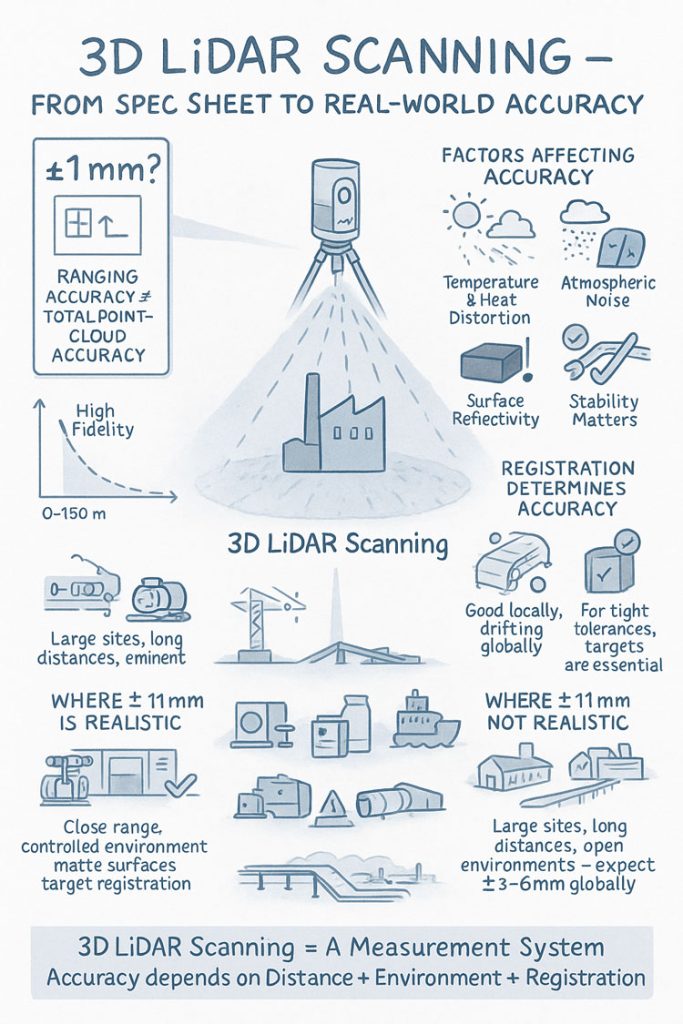
This article explains what the ยฑ1 mm specification from FARO really means, how accuracy shifts with distance, and what engineers, project managers and clients need to do to achieve dependable results when applying 3D LiDAR scanning on live sites.


Infographic explaining 3D LiDAR scanning accuracy, showing a scanner capturing a building and highlighting factors that affect accuracy such as temperature, atmospheric noise, surface reflectivity and tripod stability. Includes diagrams comparing realistic versus unrealistic ยฑ1 mm accuracy, the impact of distance, environment and registration quality, and notes that large open sites typically achieve ยฑ3โ€“6 mm global accuracy.

1. What FAROโ€™s โ€œยฑ1 mm Accuracyโ€ Really Means in 3D LiDAR Scanning

The ยฑ1 mm number applies only to the internal distance measurement unit inside the scanner. It reflects how accurately the laser measures a single distance in controlled conditions.

It does not guarantee:

  • ยฑ1 mm for every point in a full plant model
  • ยฑ1 mm for every dimension extracted for engineering
  • ยฑ1 mm global accuracy across large multi-scan datasets

In 3D LiDAR scanning, ranging accuracy is just one ingredient. Real-world accuracy is shaped by distance, reflectivity, scan geometry and how multiple scans are registered together.


2. How Accuracy Changes With Distance in Real Projects

Even though the S150 and S350 list the same ranging accuracy, their 3D LiDAR scanning performance changes as distance increases. This is due to beam divergence, angular error, environment and surface reflectivity.

Typical real-world behaviour:

  • 0โ€“10 m: extremely precise, often sub-millimetre
  • 10โ€“25 m: excellent for engineering work, only slight noise increase
  • 25โ€“50 m: more noticeable noise and increasing angular error
  • 50โ€“100 m: atmospheric distortion and reduced overlap become evident
  • Near maximum range: still useful for mapping conveyors, yards and structures, but not suitable for tight fabrication tolerances

This distance-based behaviour is one of the most important truths to understand about 3D LiDAR scanning in field conditions.


3. Ranging Accuracy vs Positional Accuracy vs Global Accuracy

Anyone planning a project involving 3D LiDAR scanning must distinguish between:

Ranging Accuracy

The ยฑ1 mm value โ€” only the distance measurement.

3D Positional Accuracy

The true X/Y/Z location of a point relative to the scanner.

Global Point Cloud Accuracy

How accurate the entire dataset is after registration.

Global accuracy is the number engineers depend on, and it is normally around ยฑ3โ€“6 mm for large industrial sites โ€” completely normal for terrestrial 3D LiDAR scanning.


4. What Real Field Testing Reveals About FARO S-Series Accuracy

Independent practitioners across mining, infrastructure, CHPPs, plants and structural environments report similar results when validating 3D LiDAR scanning against survey control:

  • ยฑ2โ€“3 mm accuracy in compact plant rooms
  • ยฑ5โ€“10 mm across large facilities
  • Greater drift across long, open, feature-poor areas

These outcomes are not equipment faults โ€” they are the natural result of how 3D LiDAR scanning behaves in open, uncontrolled outdoor environments.


5. Why Registration Matters More Than the Scanner Model

Most real-world error in 3D LiDAR scanning comes from registration, not the laser itself.

Cloud-to-Cloud Registration

Good for dense areas, less reliable for long straight conveyors, open yards or tanks.

Target-Based Registration

Essential for high-precision engineering work.
Allows tie-in to survey control and dramatically improves global accuracy.

If your project needs ยฑ2โ€“3 mm globally, target control is mandatory in all 3D LiDAR scanning workflows.


6. Surface Reflectivity and Environmental Effects

Reflectivity dramatically affects measurement quality during 3D LiDAR scanning:

  • Matte steel and concrete return excellent data
  • Rusted surfaces return good data
  • Dark rubber, black plastics and wet surfaces reduce accuracy
  • Stainless steel and glass behave unpredictably

Environmental factors โ€” wind, heat shimmer, dust, rain โ€” also reduce accuracy. Early morning or late afternoon typically produce better 3D LiDAR scanning results on mining and industrial sites.


7. When ยฑ1 mm Is Actually Achievable

True ยฑ1 mm accuracy in 3D LiDAR scanning is realistic when:

  • Working within 10โ€“15 m
  • Surfaces are matte and reflective
  • Registration uses targets
  • Tripod stability is high
  • Conditions are controlled

This makes it suitable for:

  • Pump rooms
  • Valve skids
  • Structural baseplates
  • Reverse engineering
  • Small mechanical upgrades

But achieving ยฑ1 mm across a full plant, CHPP, or yard is outside the capability of any terrestrial 3D LiDAR scanning workflow.


8. S150 vs S350: Which One for Your Accuracy Needs?

S150 โ€“ Engineering-Focused Precision

Ideal for industrial rooms, skids, structural steel and retrofit design work where short-to-mid-range accuracy is essential.

S350 โ€“ Large-Area Coverage

Perfect for conveyors, rail lines, yards, and outdoor infrastructure.
Global accuracy must be survey-controlled for tight tolerances.

Both scanners deliver excellent 3D LiDAR scanning performance, but the S150 is the engineering favourite while the S350 is the large-site specialist.


9. What to Specify in Contracts to Avoid Misunderstandings

Instead of stating:

โ€œScanner accuracy ยฑ1 mm.โ€

Specify:

  • Local accuracy requirement (e.g., ยฑ2 mm at 15 m)
  • Global accuracy requirement (e.g., ยฑ5 mm total dataset)
  • Registration method (mandatory target control)
  • Environmental constraints
  • Verification method (e.g., independent survey checks)

This ensures everyone understands what 3D LiDAR scanning will realistically deliver.


10. When a Terrestrial Scanner Is Not Enough

Do not rely solely on 3D LiDAR scanning for:

  • Machine alignment <1 mm
  • Bearing or gearbox placement
  • Certified dimensional inspection
  • Metrology-level tolerances

In these cases, supplement scanning with:

  • Laser trackers
  • Total stations
  • Metrology arms
  • Hybrid workflows

Conclusion: The Real Truth About 3D LiDAR Scanning Accuracy

FAROโ€™s S150 and S350 are outstanding tools for industrial 3D LiDAR scanning, but the ยฑ1 mm spec does not tell the full story. Real-world accuracy is a combination of:

  • Distance
  • Registration method
  • Surface reflectivity
  • Site conditions
  • Workflow discipline

When used correctly, these scanners consistently deliver high-quality, engineering-grade point clouds suitable for clash detection, retrofit design, fabrication planning and as-built documentation.

3D LiDAR scanning is not just a laser โ€” it is an entire measurement system.
And when the system is applied with care, it produces reliable, repeatable data that reduces rework, improves safety, and strengthens decision-making across mining, construction, fabrication and industrial operations.

Where Is your project

3D Scanning Sydney CBD3D Scanning Brisbane CBD
3D Scanning across Melbourne3D Scanning across Perth
3D Scanning across Adelaide3D Scanning in The Hunter Valley
3D Scanning Mount Isa3D Scanning Emerald
3D Laser Scanning Central Coast3D Scanning in The Pilbara
3d Scanning other Areas of Australia3D Scanning Outside Australia
Hamilton By Design logo displayed on a blue tilted rectangle with a grey gradient background
Name
You would like to:

3D CAD Modelling | 3D Scanning

3D Experience Platform Login

3D Scanning for Construction

Transforming Projects with 3D Scanning

3D LiDAR Scanning โ€“ Digital Quality Assurance