3D LiDAR Scanning Hunter Valley Power Stations: Unlocking Accuracy, Safety and Efficiency for Critical Infrastructure

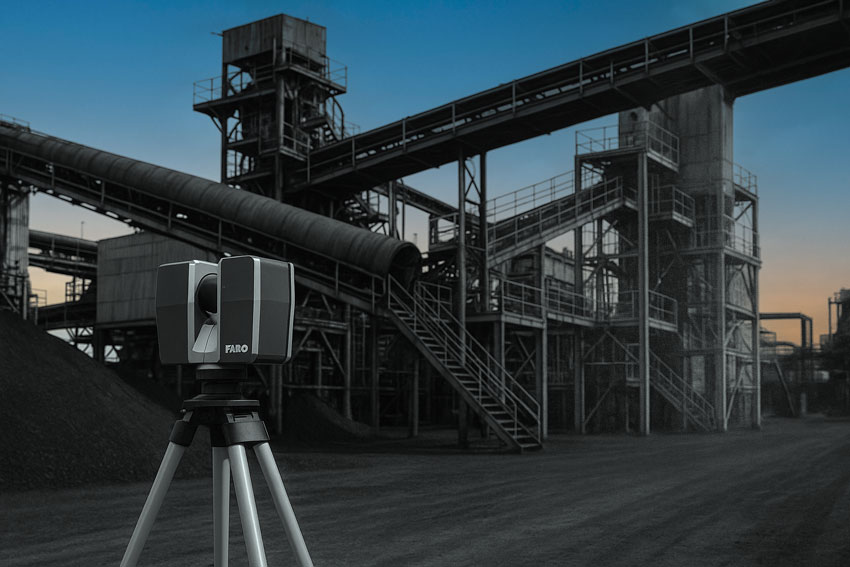
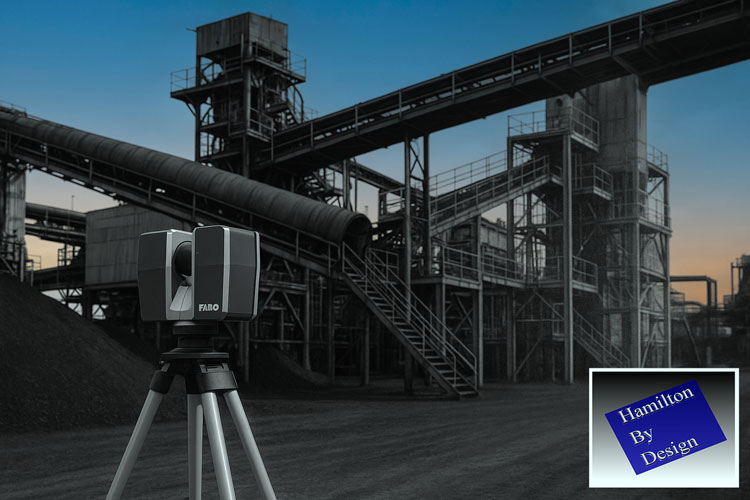
FARO 3D laser scanner set up on a tripod capturing an industrial plant for LiDAR scanning and digital modelling, with Hamilton By Design branding in the corner.

The Hunter Valley is home to some of Australia’s most significant power generation assets. These power stations — many of which have operated for decades — supply energy to mining operations, manufacturing facilities, regional communities and industries throughout New South Wales. As these plants age and undergo continual maintenance, upgrades and redevelopment, the importance of accurate, reliable and safe measurement methods becomes increasingly critical.

Traditionally, engineers and maintenance teams have relied on manual measurements, outdated drawings or partial documentation to plan upgrades or execute shutdown work. But in complex, congested and ageing plant environments, this introduces risks, delays and expensive rework.

This is why 3D LiDAR scanning in Hunter Valley power stations has emerged as one of the most valuable tools for modern asset management, engineering and maintenance planning. LiDAR provides a millimetre-accurate digital snapshot of real-world conditions, enabling smarter, safer and more predictable project outcomes.

This article explores the benefits, applications, and pros and cons of 3D LiDAR scanning and explains why Hunter Valley power stations stand to gain significantly from adopting this technology.


Why Power Stations Need Accurate As-Built Data

Power stations are among the most complex industrial facilities in Australia. Over decades of operation, they experience:

  • Structural deformation
  • Settlement and movement
  • Corrosion and wear
  • Numerous undocumented modifications
  • Equipment realignments
  • Tight access restrictions
  • Ageing steelwork and infrastructure

In these environments, original construction drawings rarely match reality. As a result, engineers planning upgrades, shutdowns or replacements often face:

  • Inaccurate interface points
  • Misaligned structures
  • Unpredictable installation conditions
  • High rework costs
  • Safety delays
  • Poor shutdown timing

3D LiDAR scanning offers a precise, digital representation of the site, giving engineers the confidence they need to design upgrades accurately and eliminate guesswork.


The Benefits of 3D LiDAR Scanning for Hunter Valley Power Stations

1. Unmatched Measurement Accuracy for Complex Assets

A power station contains thousands of interconnected components:

  • Boilers
  • Turbines
  • Structural platforms
  • Pipe networks
  • Pressure vessels
  • Ducting systems
  • Conveyor bridges
  • Cooling towers
  • Electrical cabinets
  • Steel supports

Capturing these geometries manually is nearly impossible.

3D LiDAR scanning provides millimetre-level accuracy across enormous plant areas, allowing engineers to:

  • Create precise as-built models
  • Validate structural alignment
  • Check pipe routes and clearances
  • Identify interferences
  • Understand deformation over time
  • Design new works based on real geometry

This level of data is invaluable for maintaining safe and compliant power-generation operations.


2. Major Safety Improvements

Power stations present significant safety risks:

  • High-voltage environments
  • Confined spaces
  • Elevated platforms
  • Hot surfaces
  • Restricted access
  • Operational machinery

Manual measurement often requires workers to climb structures, enter hazardous zones or physically reach difficult areas.

3D LiDAR scanning dramatically reduces risk by:

  • Capturing data from safe distances
  • Eliminating the need for repeated access
  • Reducing time in hazardous zones
  • Minimising interaction with live equipment

For Hunter Valley power stations with strict safety requirements, this is a major benefit.


3. Reduced Shutdown Duration and Cost

Shutdowns are among the most expensive events for power-generation facilities. Every hour counts.

With 3D LiDAR scanning:

  • Engineers define accurate scopes before shutdown
  • Fabricators receive precise data and cut steel correctly
  • Digital fit checks identify issues early
  • Installation is faster and smoother
  • Delays due to bad measurements are eliminated

This leads to shorter outages, safer work and fewer unexpected problems.


4. Supports Engineering, Design and Structural Integrity Works

Power stations frequently require:

  • Boiler upgrades
  • Turbine area modifications
  • Ducting and flue replacements
  • Pipework rerouting
  • Cooling-system upgrades
  • Structural strengthening
  • Platform and walkway replacements
  • Electrical equipment relocations

All of these tasks depend on accurate geometry.

3D LiDAR scanning supports engineering teams by providing:

  • Reference geometry for load calculations
  • Verified connection points
  • True alignment data
  • Accurate slope and deflection measurements
  • High-resolution drawings and 3D models

This ensures engineering decisions are made using verified, real-world information.


5. Perfect for Brownfield and Congested Environments

Power stations are some of the most complex brownfield assets in the industrial landscape. They contain layers of modifications, years of retrofits and areas where access is extremely limited.

3D LiDAR scanning excels at capturing:

  • Tight clearances
  • Overlapping structures
  • Equipment clusters
  • Interconnected pipes
  • Hard-to-reach surfaces

This makes it ideal for planning:

  • New platforms
  • Replacement ducting
  • Pipe realignments
  • Structural upgrades
  • Asset lifecycle extensions

The result: fewer surprises during installation.


6. Better Collaboration Between Teams

Power stations typically involve:

  • Maintenance teams
  • OEMs
  • Engineering consultants
  • Fabricators
  • Shutdown managers
  • Safety personnel
  • Project delivery teams

3D LiDAR scanning enables everyone to work from the same digital truth.

Point clouds and 3D models allow:

  • Remote site understanding
  • Clear communication
  • Digital reviews instead of repeated site visits
  • Improved planning alignment

For Hunter Valley projects involving multiple contractors, this significantly boosts performance.


Pros and Cons of 3D LiDAR Scanning

Like any technology, LiDAR has strengths and limitations. Understanding both helps power station operators make informed decisions.


Pros

Extremely high accuracy

Millimetre precision for large and complex areas.

Fast data capture

Reduces time spent in hazardous areas.

Clear visibility of congested spaces

Captures geometry that traditional methods miss.

Enhances engineering confidence

Designers base work on verified conditions.

Reduces installation rework

Fabrication matches the real site exactly.

Supports digital engineering workflows

Perfect input for CAD, BIM, simulation and modelling.

Safer measurement practices

Less climbing, reaching and confined-space entry.


Cons

Requires skilled interpretation

Point cloud data must be processed by trained technicians or engineers.

Large file sizes

High-resolution scans require strong computing resources.

Reflective or transparent surfaces can create challenges

Requires technique or matte marking in some areas.

Upfront cost may seem higher

But it eliminates far greater downstream costs in rework and shutdown delays.

Despite these considerations, LiDAR scanning remains the most cost-effective measurement tool for power station environments.


Why Hunter Valley Power Stations Benefit More Than Most

The Hunter Valley industrial landscape presents unique challenges:

  • Ageing energy infrastructure
  • Multiple retrofits and undocumented modifications
  • Extremely tight maintenance windows
  • Harsh environmental conditions
  • Congested structures with difficult access
  • High safety standards
  • Heavy reliance on local fabrication accuracy

3D LiDAR scanning Hunter Valley power stations provides the one thing these facilities need most: confidence.

Confidence in measurements.
Confidence in fabrication.
Confidence during shutdowns.
Confidence in engineering decisions.
Confidence in safety performance.

Few regions stand to gain more from LiDAR than the Hunter.


Hamilton By Design: Supporting Hunter Valley Power Stations with Advanced LiDAR Solutions

Hamilton By Design brings together:

  • Engineering expertise
  • On-site scanning capability
  • CAD modelling and drafting
  • Fabrication-ready documentation
  • Digital fit-checking and clash detection
  • Mechanical and structural design experience

We understand the complex realities of power-station environments, and we deliver precise, reliable and engineering-ready digital data for:

  • Boiler upgrades
  • Turbine hall modifications
  • Structural replacements
  • Pipe rerouting
  • Platform and access upgrades
  • Ducting and flue modifications
  • Cooling tower projects
  • Balance-of-plant improvements

Every model, point cloud and drawing is produced with installation success and fabrication accuracy in mind.


Conclusion: 3D LiDAR Scanning is the New Standard for Hunter Valley Power Stations

As the Hunter Valley transitions into a future of renewable generation, asset extension and industrial redevelopment, 3D LiDAR scanning stands out as a technology that delivers real, immediate value.

It improves safety.
It increases accuracy.
It reduces rework.
It enables better engineering.
It shortens shutdowns.
It lowers project risk.

Power stations across the Hunter Valley rely on critical, ageing and highly complex infrastructure — infrastructure that demands accurate, reliable digital measurement.

Hamilton By Design is proud to support the region with advanced laser scanning technologies that empower engineers, fabricators, supervisors and project managers to work smarter, safer and more efficiently.
Hamilton By Design logo displayed on a blue tilted rectangle with a grey gradient background

3D Laser Scanning

Hunter Valley Laser Scanning: Transforming Engineering Accuracy Across Mining, Manufacturing and Infrastructure

3D Laser Scanning in Singleton and the Hunter: Delivering Accuracy for Mining, Manufacturing and Industrial Projects

Laser Scanning Hunter Valley: Delivering Engineering-Grade Accuracy for Mining, Manufacturing and Industrial Projects

Name
You would like to:

3-D Lidar Scanning Hunter Valley: Transforming Industrial Projects with Accuracy, Safety and Engineering Confidence

The Hunter Valley is one of Australia’s most strategically important industrial regions. It supports large mining operations, CHPP facilities, fabrication workshops, energy infrastructure, civil projects and heavy manufacturing. These industries depend on precision, safety and efficient project delivery — yet most operate in aging brownfield environments where original drawings are outdated, equipment has shifted over time, and modifications have occurred for decades without accurate documentation.

In environments like these, traditional measuring methods often fail to provide the precision required for confident engineering and fabrication. This is why 3-D Lidar scanning in the Hunter Valley has become a critical tool for engineers, supervisors, fabricators and project managers. It captures the real-world site conditions with millimetre accuracy, creating a digital foundation for smarter, safer and more efficient project execution.

This article explores the benefits, pros and cons of 3-D Lidar scanning, and explains why the Hunter Valley is uniquely positioned to gain massive value from this technology.


Understanding 3-D Lidar Scanning

3-D Lidar (Light Detection and Ranging) scanning is a non-contact measurement technology that uses lasers to capture millions of points in seconds. The scanner emits laser pulses and measures the return time to determine distances, building a dense “point cloud” of the environment.

This point cloud is a precise 3-D representation of:

  • Structural steel
  • Conveyors and transfer towers
  • Chutes, bins and hoppers
  • Tanks, pipework and mechanical equipment
  • Platforms, walkways and buildings
  • Industrial plant rooms and process areas

Once captured, this digital data becomes the foundation for engineering models, fabrication drawings, digital fit checks and project planning.


Why 3-D Lidar Scanning Matters in the Hunter Valley

The Hunter Valley contains some of the most complex and heavily used industrial assets in Australia. Many facilities have been in operation for decades, and almost all have undergone modifications, expansions and repairs. Over time, the real-world geometry diverges significantly from the old drawings stored on paper or outdated CAD files.

This creates major challenges:

  • Measurements taken by hand are inaccurate or unsafe
  • Shutdown windows are extremely tight
  • Fabricators rely on precise data to avoid costly rework
  • Engineers require true geometry for load calculations and interface design
  • Supervisors need reliable information to scope replacement work

3-D Lidar scanning provides a millimetre-accurate representation of what exists onsite, removing guesswork and supporting engineering best practice.


The Benefits of 3-D Lidar Scanning in the Hunter Valley

1. Millimetre Accuracy Improves Engineering Outcomes

In heavy industrial environments, small measurement errors can create large, expensive problems. Structural misalignment, worn steel, bent frames, sagging conveyors and distorted chutes are all common in brownfield plants.

3-D Lidar scanning captures:

  • True dimensions
  • Variations from design
  • Deformation and misalignment
  • Complex curved surfaces
  • Differences caused by wear and tear

Engineers design with confidence because the digital model reflects actual site conditions — not assumptions.


2. Huge Reduction in Rework and Fabrication Errors

Fabricators in Singleton, Muswellbrook, Rutherford, Tomago and throughout the Hunter region rely on accurate measurements to ensure steel and mechanical components fit the first time.

Without accurate data, common fabrication issues include:

  • Bolt holes misaligned
  • Steel members too short or too long
  • Chutes or hoppers not matching openings
  • Pipe spools missing clearances
  • Platforms not sitting square

These problems lead to:

  • Onsite cutting and welding
  • Delayed installations
  • Extended shutdown time
  • Additional crane costs
  • Extra labour expenses

3-D Lidar scanning eliminates these risks, ensuring every component is manufactured to match the as-built site geometry.


3. Improved Shutdown Planning and Faster Execution

Mining and CHPP shutdowns in the Hunter Valley operate under strict time constraints. Any unexpected measurement issue can cause delays affecting production and safety.

With 3-D Lidar scanning:

  • Scope is defined accurately before shutdown
  • Fabrication is completed correctly the first time
  • Digital fit checks identify problems early
  • Installation is faster and safer

Shutdowns become more predictable and efficient.


4. Massive Safety Improvements

Manual measurement often requires workers to:

  • Enter confined spaces
  • Access heights
  • Work around operating equipment
  • Lean over conveyors
  • Navigate dirty, uneven or hazardous areas

3-D Lidar scanning minimises physical access requirements. Technicians can scan large areas from safe positions, reducing:

  • Fall risks
  • Pinch-point exposure
  • Hot-work hazards
  • Time on elevated structures

This is a major benefit for HSE and maintenance teams across the Hunter Valley.


5. Better Communication, Collaboration and Visualisation

Point clouds and 3-D models make it easier for teams to understand the project environment, especially when stakeholders are spread across:

  • Mine sites
  • Fabrication workshops
  • Design offices
  • Engineering consultancies
  • Projects teams and OEM vendors

Digital data allows remote review, reducing the need for repeated site visits and improving decision-making.


6. Ideal for Brownfield Upgrades and Congested Areas

Many Hunter Valley facilities are decades old, with layers of modifications. Clearances are tight, geometry is irregular, and equipment alignment has changed over the years.

3-D Lidar scanning is perfect for:

  • Transfer towers with layered steel
  • Congested plant rooms
  • Pipe networks
  • Stockpile conveyors
  • Old building footprints
  • Complex structural junctions

The scanner captures the complexity instantly and precisely.

Hamilton By Design logo displayed on a blue tilted rectangle with a grey gradient background

Pros and Cons of 3-D Lidar Scanning

While 3-D Lidar scanning is a game-changing tool, it is important to understand both the advantages and limitations.

3D Scanning in The Hunter Valley

3D Laser Scanning

Hunter Valley Laser Scanning: Transforming Engineering Accuracy Across Mining, Manufacturing and Infrastructure

3D Laser Scanning in Singleton and the Hunter: Delivering Accuracy for Mining, Manufacturing and Industrial Projects

Laser Scanning Hunter Valley: Delivering Engineering-Grade Accuracy for Mining, Manufacturing and Industrial Projects

Name
You would like to:

Hunter Valley Laser Scanning: Transforming Engineering Accuracy Across Mining, Manufacturing and Infrastructure

The Hunter Valley stands as one of Australia’s most important industrial regions, supporting mining, energy, heavy fabrication, processing, manufacturing and major commercial development. Across this diverse landscape, one challenge consistently affects project performance: the need for accurate, reliable and up-to-date site information.

For engineers, maintenance planners, fabricators and construction managers, relying on outdated drawings or manual tape measurements introduces unnecessary risk. Plants evolve over decades. Structures deform. Equipment shifts alignment. Site conditions rarely match legacy documentation.

This is why Hunter Valley laser scanning has become essential. The ability to capture millimetre-accurate as-built data is transforming how projects are planned, designed and executed—reducing cost, increasing safety and ensuring that every component fits the first time.

Hamilton By Design is proud to support the region with advanced, engineering-grade laser scanning services designed specifically for heavy industry and complex brownfield environments. This article explores how laser scanning works, why the Hunter Valley relies on it, and how it strengthens everything from shutdown planning to fabrication accuracy.


Why the Hunter Valley Depends on Laser Scanning

The Hunter’s operating assets are large, complex and often decades old. Across mines, processing facilities, power stations, port handling infrastructure and manufacturing plants, very few sites match their original drawings.

Typical challenges include:

  • Numerous undocumented modifications
  • Wear, deformation and structural movement
  • Limited or unreliable legacy drawings
  • Tight shutdown windows
  • Hazardous access for manual measuring
  • Brownfield constraints that complicate upgrades

These conditions make traditional measurement methods slow, risky and error-prone. A wrong measurement in a transfer tower, a misaligned conveyor frame, or an incorrect chute dimension can create thousands of dollars in rework and delay.

Hunter Valley laser scanning eliminates these risks completely by capturing the site exactly as it exists today—not as it was decades ago.


How Hunter Valley Laser Scanning Works

Laser scanning uses high-precision LiDAR technology to record millions of data points across structures, equipment and plant areas. These points combine to create a three-dimensional “point cloud”—a highly accurate digital representation of real-world conditions.

The Hamilton By Design workflow typically includes:

1. On-Site Reality Capture

Our laser scanner is deployed across key vantage points to capture the full environment, including:

  • Structural steel
  • Conveyors and walkways
  • Chutes, bins, hoppers and material-handling equipment
  • Pipework networks
  • Equipment footprints
  • Building geometry
  • Confined or elevated spaces

The capture process is fast, safe and non-intrusive—ideal for operational sites.

2. Registration & Point Cloud Processing

Data from each scan position is aligned into a complete, unified point cloud representing the entire area with millimetre accuracy.

3. Modelling & Analysis

From the point cloud we can create:

  • True as-built CAD models
  • Structural layouts
  • Mechanical assemblies
  • Pipework geometry
  • Digital templates for fabrication
  • Probe measurements for checking clearances and alignment

4. Engineering & Fabrication Support

Once converted into a usable engineering environment, the data supports:

  • Shutdown planning
  • Structural redesign
  • Chute and conveyor optimisation
  • Digital fit checks
  • Fabrication drawings
  • Reverse engineering of worn components

The result is a reliable, verified understanding of your site—available digitally to your entire project team.


Where Hunter Valley Laser Scanning Delivers the Most Value

The unique industrial profile of the Hunter Valley means laser scanning is useful across a broad range of applications. Here are the areas where it delivers the highest impact.


Mining & CHPP Operations

Mining infrastructure in the region is constantly under pressure to operate safely and efficiently. For CHPP upgrades, conveyor realignments, chute replacements and structural modifications, laser scanning provides:

  • True as-built dimensions
  • Clearances and offset measurements
  • Verified alignment data
  • Digital templates for safe, accurate fabrication
  • Reduced shutdown duration
  • Fewer fitment issues onsite

Upgrades become predictable instead of stressful, and fabricators can manufacture with confidence.


Processing Plants & Material-Handling Systems

Transfer towers, bin replacements, screening arrangements and crusher areas often contain congested layouts with poor access. Manual measurement is difficult and unsafe.

Laser scanning solves this by allowing the entire environment to be measured remotely. This supports:

  • Clash prevention
  • Redesign of worn systems
  • Smoother installation
  • Accurate interface points
  • Digital verification before fabrication

Heavy Fabrication & Workshop Integration

Fabricators across the Hunter Valley consistently face the same problem: components not fitting onsite due to bad measurements.

Hunter Valley laser scanning ensures:

  • Perfectly matched bolt hole patterns
  • Correct flange alignment
  • True geometry of mating parts
  • Accurate templates for bending, rolling and welding
  • Reduced rework and scrap

It is a direct cost saver for both workshops and clients.


Energy, Power Stations & Utilities

Power stations and energy sites require sophisticated maintenance planning. Laser scanning helps engineers:

  • Document aging structures
  • Compare deformation over time
  • Plan retrofits and upgrades
  • Replace platforms, pipework and supports with confidence
  • Identify clashes before installation

This improves compliance and reduces risk.


Commercial, Industrial and Infrastructure Projects

Beyond heavy industry, the Hunter region features growing precincts of commercial and industrial developments. Laser scanning supports:

  • Renovations and extensions
  • As-built documentation
  • BIM workflows
  • Accurate drafting and facility mapping

It ensures architects, builders and property owners are working with verified building conditions instead of assumptions.


Why Choose Hamilton By Design for Hunter Valley Laser Scanning?

Hamilton By Design is not simply a scanning service—we are engineers first. This is what sets our work apart.

Our Engineering Mindset

We understand plant design, structural requirements, chute behaviour, mechanical layouts and fabrication constraints. This allows us to interpret the point cloud with engineering intent, not just technical detail.

Millimetre Accuracy

Our laser scanning systems deliver the precision required for heavy industry, ensuring designs and fabrication match the real-world geometry exactly.

Complete Digital Workflow

We provide:

  • Point clouds
  • 3D models
  • General arrangement drawings
  • Fabrication drawings
  • DXFs and model exports

Our deliverables integrate seamlessly with fabrication shops and engineering teams across the Hunter.

Local Expertise

We understand the region’s industries, shutdown pressures, safety expectations and operational challenges.

Confidence Before Steel Is Cut

Every design can be checked digitally for clash, alignment and fitment—reducing uncertainty and rework.


The Future of Engineering in the Hunter Valley

As sites age and operational demands increase, precise as-built information is becoming essential. Hunter Valley laser scanning is now the standard for safe, efficient and accurate engineering work across the region.

Whether you are replacing structural steel, redesigning a chute, installing new conveyors, upgrading a plant room or fabricating new components, laser scanning gives your project the foundation it needs for success.


Work With Hamilton By Design

Hamilton By Design is ready to support your next project with high-accuracy Hunter Valley laser scanning, modelling and drafting services.

Contact our team to discuss:

  • Your scanning requirements
  • Project constraints
  • Fabrication goals
  • Engineering support needs

We will help you build a digital foundation that improves safety, reduces downtime and ensures every component fits the first time.

Hamilton By Design logo displayed on a blue tilted rectangle with a grey gradient background

3D Scanning in The Hunter Valley

Enhancing Plant Efficiency with Best Maintenance Practices

3D Point Clouds Are a Game-Changer for Your Projects

Lessons from a Landmark Case

Why Shutdown Parts Don’t Fit — And How 2 mm LiDAR Scanning Stops the Rework

When Parts Don’t Fit, Shutdowns Fail

Every shutdown fitter, maintenance crew member, and supervisor has lived the same nightmare:

A critical part arrives during shutdown.
The old part is removed.
Everyone gathers, ready to install the new one.
Production is waiting.
The pressure is on.

And then—
the part doesn’t fit.

Not 2 mm out.
Not 10 mm out.
Sometimes 30–50 mm out, wrong angle, wrong bolt pattern, wrong centreline, or wrong geometry altogether.

The job stops.
People get frustrated.
Supervisors argue.
Fitters cop the blame.
The plant misses production.
And someone eventually says the words everyone hates:

“Put the old worn-out chute back on.”

This blog is about why shutdowns fall apart like this… and how 2 mm LiDAR scanning finally gives fitters a system that gets it right the first time.


The Real Reason Parts Don’t Fit

Most shutdown failures have nothing to do with the fitter, nothing to do with the workshop, and nothing to do with the installation crew.

Parts don’t fit because:

  • Wrong measurements
  • Bad drawings
  • Outdated as-builts
  • Guesswork
  • Fabricators “eyeballing” dimensions
  • Cheap non-OEM parts purchased without geometry verification
  • Designers who have never seen the site
  • High staff turnover with no engineering history
  • Wear profiles not checked
  • Intersection points impossible to measure manually

Fitters are then expected to make magic happen with a tape measure and a grinder.

It’s not fair. It’s not professional. And it’s completely avoidable.


Shutdown Pressures Make It Even Worse

When a part doesn’t fit during a shutdown:

  • The entire job stalls
  • Crews stand around waiting
  • The supervisor gets hammered
  • The fitter gets the blame
  • Other shutdown tasks cannot start
  • The clock ticks
  • Production loses thousands per hour
  • Everyone becomes stressed and angry

And the worst part?

You were only replacing the part because the existing one was worn out.
Now you’re bolting the worn-out one back on.

This isn’t good enough.
Not in 2025.
Not in heavy industry.
Not when there is technology that eliminates this problem completely.


Why Manual Measurement Fails Every Time

Fitters often get asked to measure:

  • Inside chutes
  • Wear sections
  • Pipe spools with intersection points
  • Tanks too large to measure from one position
  • Walkways too long for tape accuracy
  • Geometry with no records
  • Components 10+ metres above ground
  • Hard-to-reach bolt patterns
  • Angles and centrelines distorted by wear

But some measurements simply cannot be taken safely or accurately by hand.

You can’t hang off an EWP 20 metres up measuring a worn flange angle.
You can’t crawl deep inside a chute trying to measure intersecting surfaces.
You can’t take a 20-metre walkway measurement with a tape measure and hope for precision.

This is not a measurement problem.
This is a method problem.

Manual measurement has hit its limit.
Shutdowns have outgrown tape measures.


This Is Where 2 mm LiDAR Scanning Changes Everything

Hamilton By Design uses 2 mm precision LiDAR scanning to capture the exact geometry of a site — even in areas that are:

  • Too high
  • Too big
  • Too unsafe
  • Too worn
  • Too complex
  • Too tight
  • Too distorted to measure manually

From the ground, up to 30 metres away, we can capture:

  • Wear profiles
  • Flange positions
  • Bolt patterns
  • Pipe centrelines
  • Chute geometry
  • Conveyor interfaces
  • Complex intersections
  • Ductwork transitions
  • Mill inlet/outlet shapes
  • Tank dimensions
  • Walkway alignment
  • Structural deflection
  • Existing inaccuracies

No tape measure. No guesswork. No EWP. No risk.

The result is a perfect 3D point cloud accurate within 2 mm — a digital version of real life.


2 mm Scanning + Fitter-informed Design = Parts That Fit First Time

This is where Hamilton By Design is different.

We don’t just scan and hand the files to a drafter who’s never set foot on-site.

We scan and your parts are modelled by someone who:

  • Has been a fitter
  • Understands how parts are installed
  • Knows what goes wrong
  • Knows how to design parts that actually fit
  • Knows where shutdowns fail
  • Knows what to check
  • Knows what NOT to trust
  • And most importantly — knows where the real-world problems are hidden

This fitter-informed engineering approach is why our parts fit the first time.

And why shutdown crews trust us.


Digital QA Ensures Fabrication Is Correct Before It Leaves the Workshop

Once the new chute, spool, or component is modelled, we run digital QA:

  • Fit-up simulation
  • Clash detection
  • Tolerance analysis
  • Wear profile compensation
  • Reverse engineering comparison
  • Bolt alignment verification
  • Centreline matching
  • Flange rotation accuracy
  • Structural interface checks

If something is out by even 2–3 mm, we know.

We fix it digitally — before the workshop cuts steel.

This stops rework.
This stops shutdown delays.
This stops blame.
This stops stress.

This is the future of shutdown preparation.


Accuracy of 3D LiDAR Scanning With FARO


When the Part Fits, Everything Runs Smooth

Here’s what actually happens when a chute or spool fits perfectly the first time:

  • The plant is back online faster
  • No rework
  • No reinstalling old worn-out parts
  • No arguing between fitters and supervisors
  • No unexpected surprises
  • No extra access equipment
  • No late-night stress
  • No grinding or “making it fit”
  • Other shutdown tasks stay on schedule
  • Everyone looks good
  • Production trusts the maintenance team again

Shutdowns become predictable.
Fitters become heroes, not last-minute problem-solvers.


Shutdown Example (Anonymous but Real)

A major processing plant needed a large chute replaced during a short shutdown window.
Access was limited.
The geometry was distorted.
Measurements were impossible to take safely.
The workshop needed exact dimensions, fast.

Hamilton By Design scanned the entire area from the ground — no EWP, no risk.

We produced:

  • Full 2 mm point cloud
  • As-built 3D model
  • New chute design
  • Digital fit-up validation
  • Workshop-ready drawings

The new chute arrived on site.
The old chute came out.
The new chute went straight in.
Zero rework.
Zero stress.
Plant online early.

The supervisor called it the smoothest shutdown they’d had in 10 years.


Why Fitters Should Reach Out Directly

Sometimes fitters know more about what’s really happening on-site than anyone in the office.

Fitters see the problems.
Fitters carry the blame.
Fitters deal with the rework.
Fitters just want parts that fit.

So we’re making this simple:

If you’re tired of fitting parts that don’t fit —
If you’re tired of fixing other people’s mistakes —
If you’re tired of shutdown stress —

Call Hamilton By Design.

We scan it.
We model it.
We get it right.
Every time.


Services Featured

Hamilton By Design offers:

  • 3D LiDAR laser scanning (2 mm precision)
  • 3D modelling by a fitter-engineer who understands real-world installation
  • Digital QA before fabrication
  • Reverse engineering of worn components
  • Shutdown planning support
  • Fabrication-ready drawings
  • Fit-up simulation
  • Clash detection between old and new parts

This is how shutdowns run smooth.

Hamilton By Design logo displayed on a blue tilted rectangle with a grey gradient background

Call to Action

Are you a Fitter: tired of parts that don’t fit?

Email or Call Hamilton By Design.

Email – info@hamiltonbydesign.com.au

Phone – 0477002249


Would you Like to Know more?

Name
Would you like us to arrange a phone consultation for you?

Accuracy of 3D LiDAR Scanning With FARO

Why Shutdown Parts Don’t Fit

Engineering Services

Coal Chute Design

Chute Design

3D CAD Modelling | 3D Scanning

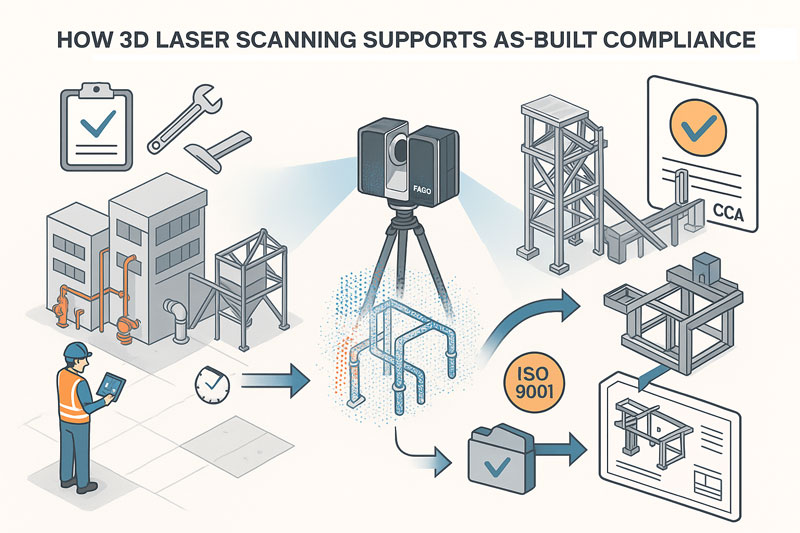
How 3D Laser Scanning Supports As-Built Documentation Under Australian Building Codes & Legal Requirements

illustration of 3d scanning and building code of australia

1. What the Building Code of Australia (BCA) and Australian Standards Require

While the BCA (part of the National Construction Code – NCC) does not mandate 3D laser scanning, it does mandate that:

You must provide accurate, verifiable as-built documentation, including:

  • As-built drawings reflecting what was actually constructed
  • Evidence that construction aligns with design intent and approvals
  • Documentation for certification, compliance, commissioning and future maintenance

These requirements flow through:

  • NCC Volume 1 – Construction documentation, fire systems, mechanical services
  • AS 1100 – Technical drawing standards
  • AS 5488 – Subsurface utility information
  • AS 9001/ISO 9001 – Quality management documentation
  • State-based WHS / Plant Safety legislation
  • Engineering registration Acts (NSW, QLD, VIC)
  • Client-specific QA frameworks (e.g., TfNSW Digital Engineering, mining compliance standards, government project handover requirements)

These frameworks all emphasise accuracy, traceability, verification and record-keeping.


2. Common Problems with Traditional As-Built Documentation

Most non-compliance issues in handover packages arise because traditional methods rely on:

  • Manual tape measurements
  • Incomplete mark-ups on outdated drawings
  • Limited site access
  • Errors stacking up across multiple trades
  • No accurate record of clashes and deviations
  • No evidence trail for certifiers

This often results in:

  • Disputes between builders, certifiers and subcontractors
  • Rework costs during commissioning
  • Safety risks due to undocumented services or variations
  • Delays in obtaining Occupation Certificates (OC)

3. How 3D Laser Scanning Directly Supports Legal & BCA/NCC Compliance

✔ 3D Scanning Provides “Verified As-Constructed Evidence”

Point clouds record geometry with millimetre–level accuracy, giving:

  • Audit-proof evidence of what exists
  • Time-stamped scanning sessions
  • A defensible digital record for certifiers, engineers and auditors

This is extremely helpful for:

  • Compliance sign-off
  • Dispute resolution
  • Safety compliance
  • Future upgrades or modifications

✔ Produces Accurate As-Built Drawings That Meet AS 1100 Requirements

Laser scanning allows you to generate:

  • Certified 2D as-built drawings
  • 3D models
  • Fabrication-ready details
  • Clash-free spatial coordination drawings

This ensures:

  • Dimensions are correct
  • Penetrations, fall directions, service locations and structural offsets are true to field conditions
  • All documentation aligns with NCC-required accuracy

✔ Eliminates Measurement Errors That Could Breach Compliance

Regulators and certifiers need as-built documents to match constructed work.

Laser scanning:

  • Removes subjective tape measurements
  • Captures difficult/unsafe areas safely
  • Ensures penetrations, ductwork, pipe routes and tolerances match required clearances
  • Supports inspections under NCC (fire, structural, mechanical, accessibility, plant rooms, etc.)

✔ Simplifies BCA Documentation for Fire, Mechanical & Structural Systems

Scanning assists with validating:

Fire Safety Systems

  • Hydrants, hose reels, fire pump rooms
  • Fire damper locations
  • Egress paths and spatial compliance
  • Service penetrations

Mechanical Systems

  • Duct routes
  • Plant room layouts
  • Fan coil units / AHU placement
  • Shaft centre-lines
  • Compliant access paths

Structural Elements

  • Columns
  • Beams
  • Brackets
  • Plant mounts
  • Retrofitted steelwork
  • Tolerance checks

The point cloud provides certifiers with confidence that what was installed does not deviate from approved plans beyond allowable tolerances.


✔ Strengthens ISO 9001 & Government QA Requirements

Most government tenders (TfNSW, Defence, Health Infrastructure, QBuild, etc.) require:

  • Traceable QA
  • As-constructed verification
  • Digital documentation

A 3D scan becomes proof of measurement, improving your QA process by providing:

  • Verifiable dimensional control
  • Pre-fabrication QA
  • Handover packages that exceed minimum compliance

4. How Hamilton By Design Can Position This Service

3D Laser Scanning Enables:

  • NCC-compliant as-built documentation
  • Faster certifier approval
  • Fewer construction disputes
  • Reduced rework during commissioning
  • Better safety compliance
  • Accurate digital twins for maintenance and lifecycle management

You can state (truthfully):

“Our 3D scans provide defensible, audit-ready as-built records that satisfy NCC, engineering, and certification requirements. Certifiers appreciate the precision because it removes ambiguity and reduces approval delays.”


Hamilton By Design logo displayed on a blue tilted rectangle with a grey gradient background

Why Shutdown Parts Don’t Fit

Accuracy of 3D LiDAR Scanning With FARO

Mechanical Engineering | Structural Engineering

Mechanical Drafting | Structural Drafting

3D CAD Modelling | 3D Scanning

Chute Design

Mechanical Engineering Sydney: Why Local Expertise Beats Offshore Design

When Local Knowledge Makes All the Difference

Across Sydney, the Central Coast, and Newcastle, more contractors and plant managers are discovering a simple truth — offshore engineering might look cost-effective, but local expertise delivers better outcomes every time.

When drawings don’t meet Australian Standards, materials can’t be sourced locally, or site measurements are off by just a few millimetres, “cheap” design quickly becomes expensive rework.

That’s why businesses across NSW are turning to Hamilton By Design — a Sydney-based mechanical engineering practice that understands how to bridge design and construction through real-world experience, compliance, and precision.

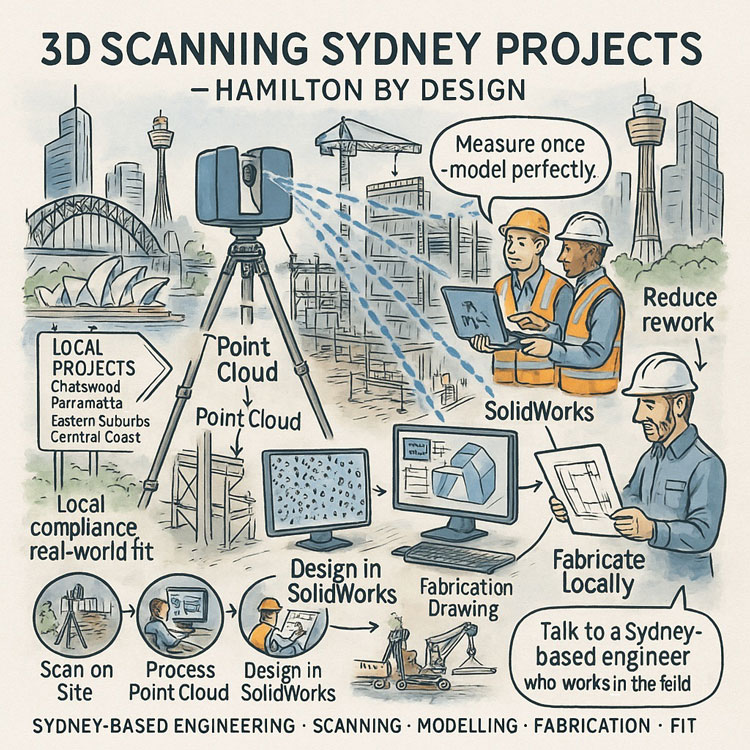
Illustrated infographic showing Hamilton By Design’s 3D scanning workflow in Sydney, including onsite LiDAR scanning, point-cloud processing, SolidWorks modelling, and local fabrication, with Sydney landmarks in the background

Built for Australia, Not Adapted for It

Engineering design isn’t universal.
Sydney’s environment, industry, and regulatory framework are unique — from local council approval requirements to the coastal conditions that affect corrosion and material selection.

At Hamilton By Design, our drawings and models are created with Australian Standards front and centre. We design for:

  • AS 4100 (Steel Structures)
  • AS 3990 (Mechanical Equipment Design)
  • AS 1657 (Walkways, Platforms & Stairs)
  • AS 4991 (Lifting Devices)
  • AS 4024 (Machine Safety)

Designing to these standards means your project moves faster through approvals, fabrication, and certification — with no surprises down the track.

Offshore designers often mean well, but they don’t work within these standards every day.
A single misinterpreted load case or welding symbol can mean days of rework on site.
A local engineer gets it right the first time.


Drawings That Fabricators Love

A good drawing doesn’t just look professional — it saves hours in the workshop.
Hamilton By Design creates fabrication drawings that make sense to the people who use them.

We think like tradespeople because we’ve been tradespeople.
Our background in fitting, machining, and CNC fabrication ensures every detail — from weld prep to bolt clearances — reflects how the job will actually be built.

That means fewer questions from the shop floor, cleaner fit-ups, and faster turnaround from fabrication to installation.

FARO 3D laser scanner set up on a tripod capturing an industrial plant for LiDAR scanning and digital modelling, with Hamilton By Design branding in the corner

Local Materials. Local Supply Chains. Fewer Delays.

Sydney’s fabrication and construction industry runs on locally available materials — from Bluescope steel to Bisalloy plate.
When offshore drawings specify unavailable materials or imperial sizes, fabrication stalls.

Our team specifies components, sections, and finishes that Sydney and Central Coast suppliers actually stock.
That reduces lead times, avoids substitutions, and keeps projects moving.

We also design with Sydney’s coastal environment in mind — using corrosion-resistant coatings, sealants, and fasteners suitable for marine-influenced locations like Parramatta, Botany, and Gosford.


Designed to Fit the Site — The First Time

It’s one thing to design in CAD; it’s another to make it fit in the field.
Sydney worksites can be complex — restricted access, uneven terrain, or legacy structures that don’t match the old drawings.

That’s why Hamilton By Design uses 3D scanning and LiDAR technology to capture accurate site data before design begins.
We integrate those scans directly into SolidWorks, building models that align with real-world geometry.

Every bracket, pipe run, and platform is verified in 3D before fabrication starts — ensuring a smooth installation with no rework.


Sydney Expertise with Regional Reach

We proudly serve clients across Sydney, Newcastle, and the Central Coast, working with builders, maintenance contractors, and fabrication workshops who value local knowledge.

Our typical projects include:

  • Plant upgrades and retrofits in brownfield sites.
  • Fabrication drawing packages for chutes, platforms, and pipework.
  • Reverse engineering from worn or obsolete components.
  • 3D scanning for as-built documentation.
  • Finite Element Analysis (FEA) for structural verification.

Every project benefits from our combined trade and engineering background — practical solutions grounded in decades of hands-on experience.


Smooth Communication. Real Accountability.

When you work with a local engineer, you’re not waiting overnight for an email response from another time zone.
You can pick up the phone, meet on site, or review models in person.

That direct collaboration saves time, reduces misunderstandings, and builds confidence between all stakeholders — engineers, fabricators, and project managers alike.

At Hamilton By Design, we value clear communication. You’ll know exactly what stage your project is at, what we’re designing, and how it aligns with your goals.


The Real Cost of Offshore Design

Offshore pricing often looks appealing — until you factor in delays, non-compliance, or fabrication mismatches.
Here’s what typically happens when projects cut corners:

ChallengeOffshore DesignLocal Expertise (Hamilton By Design)
Standards & CodesOften missed or misappliedFully compliant with AS/NZS standards
Material AvailabilitySpecified incorrectlyDesigned for Australian supply chains
CommunicationDelayed and unclearDirect, same-day response
Site UnderstandingBased on photosBased on 3D scans and site visits
Rework RiskHighMinimal – verified before fabrication

When you calculate the true cost — lost time, rework, freight, and approval delays — offshore design rarely saves money.

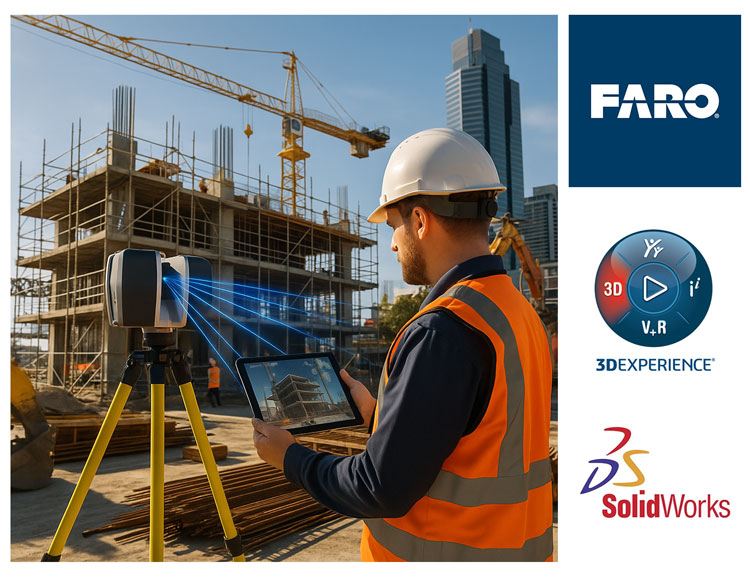
Technician using a FARO 3D laser scanner and tablet to capture a construction site for digital modelling, with 3DEXPERIENCE and SolidWorks logos shown on the side

Real Example: Central Coast Fabrication Success

A local contractor recently engaged Hamilton By Design to assist with a pump platform upgrade on the Central Coast.
Previous offshore drawings had mismatched hole patterns and unsupported loads.

We performed a quick 3D scan, remodelled the assembly in SolidWorks, and issued fabrication drawings ready for workshop production.
The new structure was installed without modification, saving the client several days of rework and earning rapid certifier approval.

That’s what local insight delivers — certainty and speed.


Why Choose a Sydney-Based Engineer

Sydney projects move quickly.
They need partners who can respond fast, understand the regulations, and coordinate seamlessly with site teams.

Hamilton By Design offers:
Over 25 years of trade and design experience
SolidWorks and FEA capability since 2011
3D scanning and as-built modelling for existing plants
Fabrication drawings built for local workshops
Practical designs created by people who’ve worked in the field

We’re based in Sydney and proud to support regional clients in Newcastle, the Central Coast, and Western Sydney.


Talk to a Sydney-Based Engineer Who’s Worked in the Field

Every project is a partnership — and great results come from working with people who understand your environment.
Hamilton By Design isn’t just another design service; we’re your local mechanical engineering partner — practical, responsive, and invested in your success.

If you’re planning a plant upgrade, mechanical installation, or fabrication project, let’s make sure your drawings are done right the first time.

Banner displaying Hamilton By Design alongside partner and technology logos including SolidWorks, UTS, Dassault Systèmes 3DEXPERIENCE, and FARO, with the text ‘3D Scanning 3D Modelling’ and website www.hamiltonbydesign.com.au

👉 Talk to a Sydney-based engineer who’s worked in the field.
Visit www.hamiltonbydesign.com.au or contact us today to discuss your next project.